
A claim file comes in with a second claim running alongside it: a common law action against a third party, or a parallel entitlement under a state scheme. The SRC Act is built so the same injury is not paid for twice, and the moment an overlap appears, a number has to be worked out and a recovery decision made. AI can spot that an overlap may be there and lay out the parallel claim. It cannot work out the number, and it does not make the recovery decision.
Context for general readers: The Safety, Rehabilitation and Compensation Act 1988 (SRC Act) is the Commonwealth workers compensation scheme run by Comcare. Sometimes an injured worker is compensated for the same injury from more than one source: they sue a third party who caused the injury, they also have a claim under a state workers compensation scheme, or they receive money under another state compensation scheme such as a motor accident scheme. The Act contains provisions that prevent double payment, and Comcare's scheme guidance on those provisions (SRC344, updated March 2026) sets out how they work.
This is a piece about those anti-double-dipping rules and the narrow, useful job AI can do around them. When an overlap surfaces, the case manager has to identify which provision applies, work out what can be recovered or offset, and decide what to do. AI can take the first slice of that off the desk, noticing the overlap and assembling the parallel claim, but it must be kept away from the calculation and the decision. Every example here uses placeholders, because in production the file must be de-identified before it goes near an AI tool.
Three overlaps the SRC Act guards against
SRC344 addresses the provisions that prevent an employee, or a dependant of a deceased employee, from being compensated twice for the same injury. The guidance groups them by where the second payment comes from. The three overlaps are:
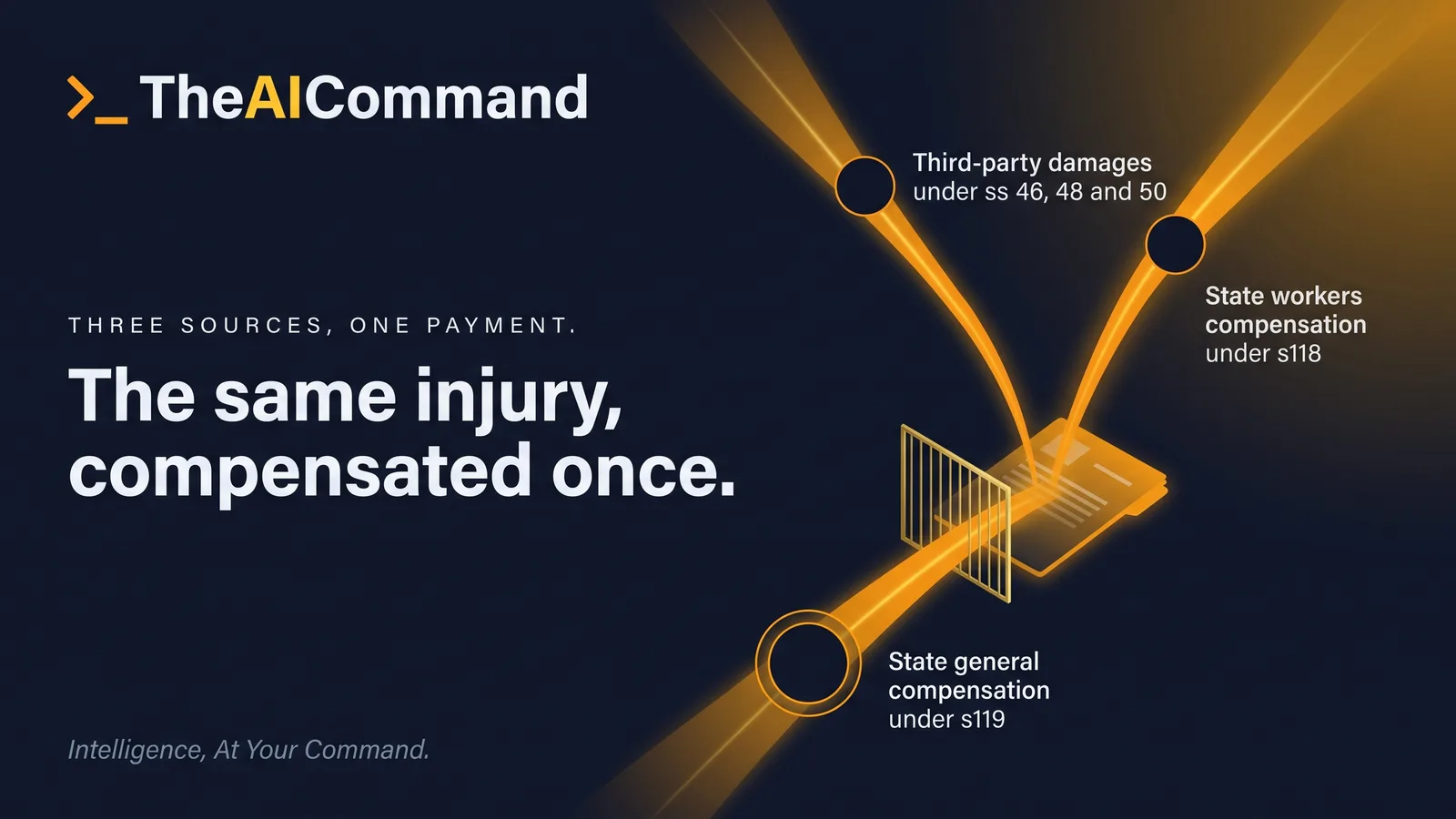
- Third-party common law damages, dealt with under sections 46, 48 and 50, where the worker or dependant recovers damages from someone other than the employer who is liable for the injury.
- State or territory workers compensation, dealt with under section 118, where the same injury attracts an entitlement under a state or territory workers compensation scheme as well as the SRC Act.
- State or territory general compensation, dealt with under section 119, where the worker receives compensation under a state or territory law that is not workers compensation, such as a motor accident or victims compensation scheme.
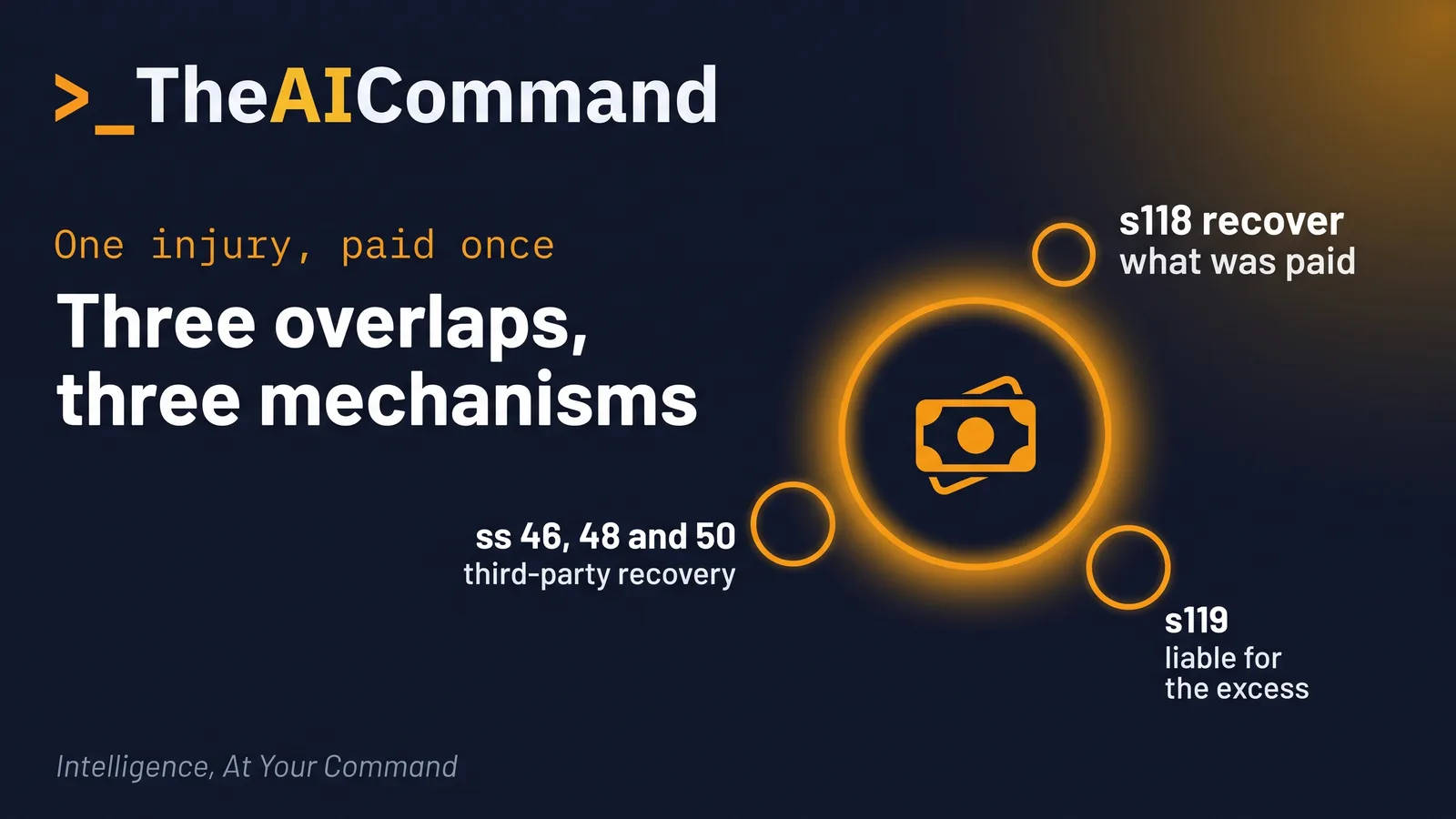
The recovery mechanism is different in each case, and getting the right one is the first thing the case manager settles. It is also the first thing AI can help surface, because the tell that an overlap exists is usually sitting in the correspondence.
Third-party damages: sections 46, 48 and 50
Where a worker or dependant recovers damages from a third party for the injury, the SRC Act treats those damages and SRC Act compensation as covering the same loss, so both are not payable in full. Comcare's guidance sets out the framework across sections 46, 48 and 50.
There are notification duties on the claimant. The guidance states that a person who decides to pursue a common law claim for damages against a third party must tell the relevant authority in writing as soon as practicable and within 7 days of becoming aware of the claim, and once damages are recovered must notify the authority in writing of the amount within 28 days. Those duties are what let the scheme act before, rather than after, a settlement is spent.
The effect of recovering damages is significant. Broadly, once a person recovers damages from a third party for the injury, the right to further SRC Act compensation for that injury is affected, and the relevant authority can recover the compensation it has already paid, with a limited exception for damages recovered for non-economic loss under a section 45 election. The guidance also notes that the relevant authority can itself start or take over a common law claim against the third party under section 50, so recovery does not depend solely on chasing the claimant after the money has arrived. Because "damages" is defined broadly to include amounts paid under a compromise or settlement, a negotiated settlement engages these provisions just as a court award does.
None of that is a mechanical read from the file. Which heads of damage were recovered, whether any part was for non-economic loss, and how the offset resumes are all matters the case manager determines on the specific facts.
State workers compensation: section 118
Section 118 deals with the overlap the guidance describes as double benefits: the same injury, or the death of the same employee, attracting both SRC Act compensation and compensation under a state or territory workers compensation scheme. A person is not to receive both for the same injury.
Where SRC Act compensation has already been paid and the worker or dependant then receives state workers compensation for the same injury, the relevant authority can recover the amount it paid. The guidance is clear that this is not a discretion to recover a lesser, negotiated figure: the amount recoverable is the amount that was paid. There are carve-outs. The guidance states that payments made under Part III of the Act, the rehabilitation provisions, are not recoverable, so a rehabilitation program's costs are not clawed back through this route. The definition of state workers compensation for these purposes reaches a law of a state, a territory or a foreign country relating to workers compensation.
The trigger is often invisible until someone looks: a worker whose history spans Commonwealth and state employment, or an injury with a state claim opened in parallel. That is exactly the pattern an early triage step can notice.
State general compensation: section 119
Section 119 deals with a different overlap: compensation the worker receives under a state or territory scheme that is not workers compensation. The guidance describes this as compensation recoverable under a specified law, a state or territory law that provides for the payment of compensation other than workers compensation. A motor accident compensation scheme is the common example, where the same injury is compensable both because it happened at work and because it happened in a vehicle.
Here the mechanism is generally one of excess rather than full recovery. Where the two overlap, the relevant authority's liability is directed to the amount in excess of what the other scheme provides, and where SRC Act compensation has already been paid the authority can recover the lesser of the specified amounts rather than simply the whole of what it paid. There are protections built in, including for weekly amounts paid for the benefit of a prescribed child, which the guidance treats as not recoverable. The result is a more calibrated calculation than section 118, and a correspondingly greater chance of getting the arithmetic wrong.
Why the calculation is where the risk sits
The reason AI has to stop at the flag is that the calculation is not a summary, it is a determination with money attached in both directions. Recover too much and the scheme has taken back an amount the worker was entitled to keep, with the fairness and review consequences that follow. Recover too little and public money is not recovered as the Act requires. The offset depends on which section is engaged, which heads of damage or compensation overlap, whether an exception like non-economic loss or a prescribed-child payment applies, and the exact figures involved.
This is precisely the kind of task where a general model produces a confident, well-formatted answer that is wrong in a way that is hard to catch. The number looks authoritative, but it is not verified against the sections, the settlement documents or the other scheme's payment record unless a person does that work. An AI-suggested offset is a prompt to check, never a figure to adopt.
Where AI fits, and where it stops
The work splits into two parts. There is the screening and assembly: noticing that an overlap may exist, identifying which of the three provisions is likely engaged, and building a chronology of the parallel claim and the payments already made. Then there is the calculation and the decision. AI is genuinely useful for the first and must be kept out of the second.
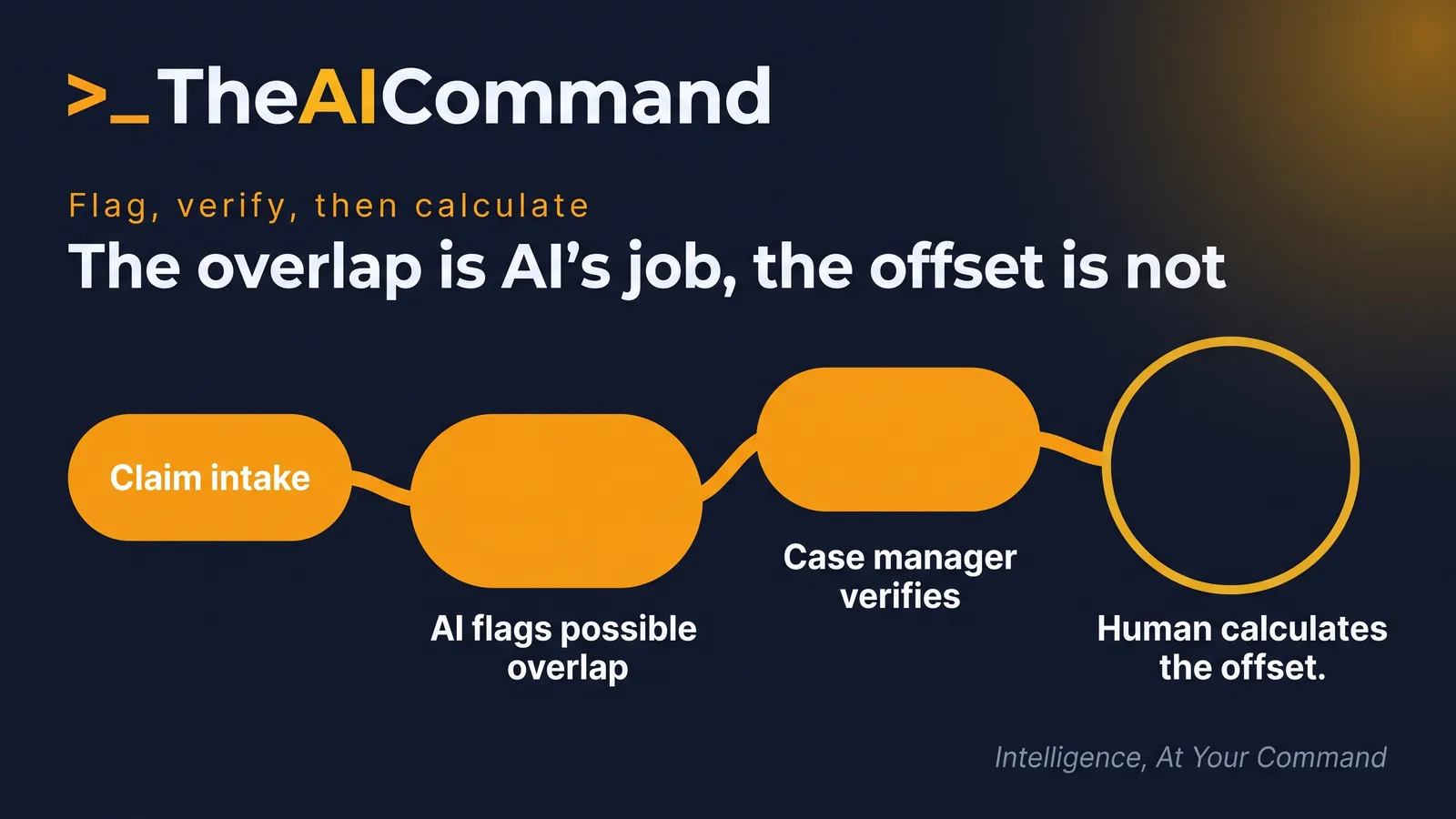
Working from a de-identified file, AI can scan the correspondence for the signals of an overlap: a reference to a solicitor and a common law claim, a state claim number, a motor accident or public liability incident, an insurer that is not the employer. It can classify which provision the signal points to, build a timeline of the parallel claim beside the SRC Act payments, and list the documents needed to confirm and quantify it, such as a settlement deed, a schedule of damages, or the other scheme's statement of payments. That is early screening that surfaces the file before a settlement is finalised, when intervention is easiest.
What AI cannot do is quantify the offset or make the recovery decision. It cannot decide which provision applies, calculate the amount recoverable, or issue a notice requiring payment, and it should not be asked to estimate a settlement's compensable component or predict what a court or tribunal would allow. The case manager confirms the overlap against the source documents, works out the amount under the relevant section, makes the determination in their own reasons, and records the AI's role in the file note at the time of decision.
De-identification callout. Files that involve a third-party action or a parallel scheme claim are dense with identifiers: claimant and solicitor names, claim and matter numbers, insurer details, dates and settlement figures. Before any of it goes near an AI tool that sits outside the scheme's perimeter, remove full names, claim numbers, dates of birth, addresses, employer and insurer identifiers, and any diagnosis tied to an identifier, and replace them with stable placeholders the case manager can re-attach afterwards. Use [CLAIMANT_NAME], [CLAIM_NUMBER], [CONDITION] and [DATE_OF_INJURY] as the standard tokens. The de-identified analysis is a draft the case manager applies back to the real file.
Two prompts you can adapt
The first prompt is a triage step. It asks the model to flag a possible overlap and classify it, without quantifying anything.
The second prompt builds a verification skeleton for the case manager to complete, and deliberately leaves every figure blank.
Do this Monday
- Add an overlap-screening step to intake and to any material file review, so a possible third-party or parallel-scheme claim is noticed early rather than after a settlement.
- De-identify the file before any AI tool touches it. Strip names, claim and matter numbers, dates of birth, addresses, employer and insurer identifiers and identified diagnoses, and swap in placeholders you can re-attach.
- Use AI to flag a possible overlap, classify which of the three provisions it points to, and build a timeline of the parallel claim beside the SRC Act payments.
- Confirm the overlap yourself against the source documents. The AI flag is a prompt to check, not a finding.
- Identify the section engaged and read it, and SRC344, directly before setting any figure, because the mechanism differs across sections 46, 48 and 50, section 118 and section 119.
- Make the calculation and the recovery decision as the case manager, in your own reasons, and never adopt an AI-suggested amount as the number.
- Record the AI's role in the file note at the time of decision: which tool, what de-identified data it saw, and how you used its output.
The double-payment checklist
- The file has been screened for a possible overlap, and the source of any second payment is identified.
- The overlap is classified against the right provision: third-party damages, section 118, or section 119.
- The file was de-identified before any AI tool touched it, with placeholders recorded for re-attachment.
- The overlap is confirmed against source documents, not accepted on the AI flag alone.
- The section engaged has been read directly, along with SRC344, before any figure is set.
- Any exception has been checked: non-economic loss under a section 45 election, Part III rehabilitation payments, prescribed-child amounts.
- The calculation and the recovery decision are the case manager's, made on these facts and recorded in the case manager's own reasons.
- The AI's role is captured in the file note at the time of decision.
A worked example
[CLAIMANT_NAME] has an accepted claim for [CONDITION], date of injury [DATE_OF_INJURY], claim number [CLAIM_NUMBER], and has been receiving incapacity and medical payments under the SRC Act. A letter from a law firm arrives on the file referring to proceedings against the driver of another vehicle involved in the incident, and separately mentions a claim lodged with a state motor accident scheme.
De-identified, the file goes to AI, which flags two possible overlaps: a third-party common law claim pointing to sections 46, 48 and 50, and a state scheme that is not workers compensation pointing to section 119. It builds a timeline of the motor accident claim and the correspondence beside the SRC Act payments made to date, and lists the documents needed to confirm and quantify each. It states no amount.
The case manager now does the part that is theirs. They obtain the documents, confirm the third-party action is on foot and the motor accident scheme has begun paying, and read the sections and SRC344 before touching a figure. They work out, on the actual heads of compensation and amounts involved, the scheme's liability and recovery position under each provision, and record the calculation and decision in their own reasons. The AI surfaced the overlap and assembled the parallel claim early, when it mattered. The case manager made the determination. That division is the whole point.
Bottom line
The SRC Act is designed so the same injury is compensated once, and it does that through three different mechanisms: third-party damages under sections 46, 48 and 50, state workers compensation under section 118, and state general compensation under section 119. Each has its own recovery arithmetic, and the arithmetic is a determination with money at stake in both directions. AI can take the screening and assembly off the case manager's desk, flagging a possible overlap on a de-identified file and building the parallel claim so nothing is missed. The calculation of the offset, and the decision to recover, stay with the person the Act empowers to make them.
Content disclaimer: This article is for general educational and informational purposes only. It does not constitute legal, compliance, or professional advice. The SRC Act 1988 should always be consulted directly. Practitioners should refer to current Comcare scheme guidance and seek legal advice where required. Nothing in this article constitutes a formal determination or interpretation of law.
TheAICommand. Intelligence, At Your Command.