
A claimant misses a medical examination, and the file lands on a delegate's desk with one question attached: was there a reasonable excuse. AI can lay out every fact that bears on that question, sorted against the test the SRC Act applies. It cannot answer it. The reasonable-excuse finding, and any suspension or refusal that follows, is the delegate's to make.
Context for general readers: Under the Safety, Rehabilitation and Compensation Act 1988 (SRC Act), a claimant has obligations during a claim: to attend examinations, take part in rehabilitation, and provide information the decision maker reasonably requires. When a claimant does not comply, the delegate can sometimes suspend compensation or refuse to deal with the claim, but usually only if the claimant had no reasonable excuse. Comcare's scheme guidance on reasonable excuse (SRC345, updated March 2026) sets out how that assessment is made, and the same concept runs through five sections of the Act.
This is a piece about one test that appears in five places, and the narrow job AI can do around it. The assessment is a judgement on specific facts, made by a person the Act empowers. AI can remove the sorting in front of that judgement, so the delegate's time goes to the finding rather than assembling the file. Every example here uses placeholders, because in production the file must be de-identified before it goes near an AI tool.
One test, five sections
SRC345 addresses the term "reasonable excuse" as it appears across the Act. The concept is the same in each place, even though the consequence and the review pathway are not. It is the gateway between a claimant's failure to comply and whatever consequence can follow. The five sections the guidance covers are:
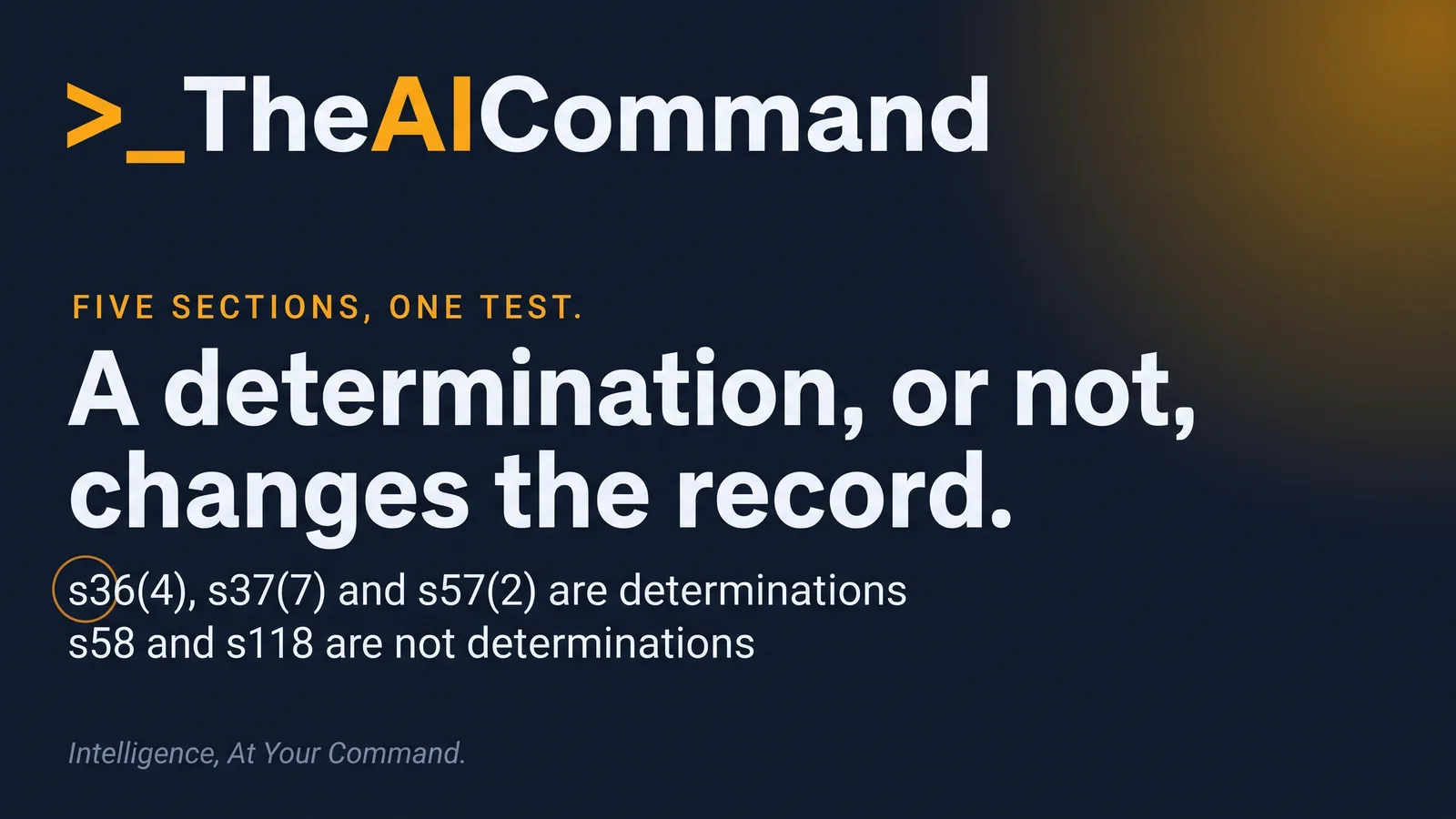
- Section 36(4), suspension where a claimant refuses or fails, without reasonable excuse, to undergo a rehabilitation assessment examination, or obstructs it.
- Section 37(7), suspension where a claimant refuses or fails, without reasonable excuse, to undertake a rehabilitation program provided under that section.
- Section 57(2), suspension where a claimant refuses or fails, without reasonable excuse, to undergo a medical examination the delegate has required, or obstructs it.
- Section 58, refusal to deal with a claim where a claimant refuses or fails, without reasonable excuse, to comply with a written notice requesting information or documents.
- Section 118(4), suspension where a claimant refuses or fails, without reasonable excuse, to give a statutory declaration stating whether any State workers' compensation has been paid in respect of the injury, loss or damage to which the claim relates.
The test does not change between sections. What changes is what the decision is, and that shapes the record the delegate must build.
The subjective and objective test
The core of SRC345 is that reasonable excuse is assessed on a combined basis. The delegate must consider both the subjective grounds the claimant advances and the grounds that are objectively reasonable. It requires more than a rational explanation. It is directed to physical or practical difficulties in complying, or to the capacity of the person concerned, and it must relate to the claimant being unable, rather than unwilling, to comply.
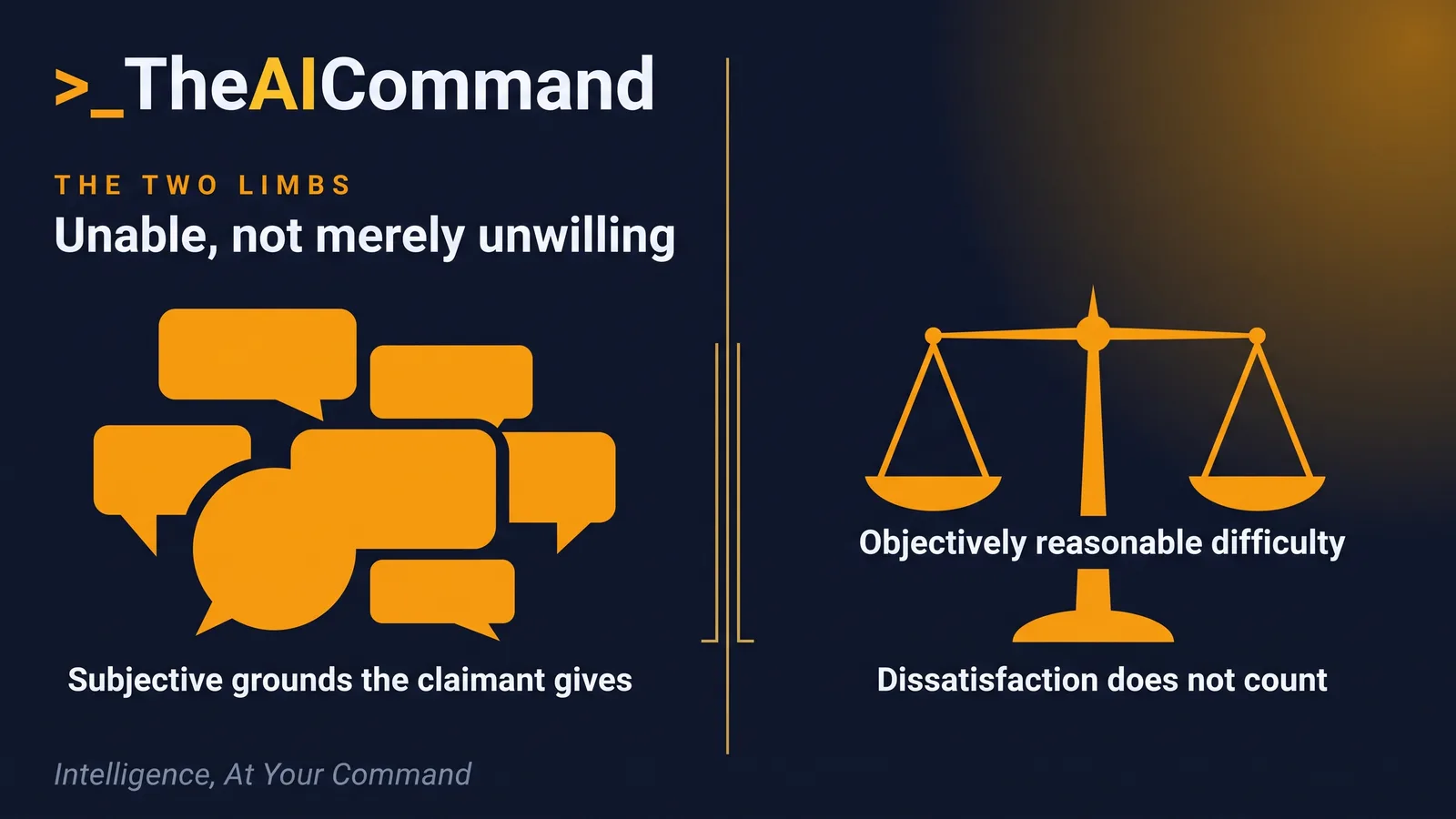
That "unable, not unwilling" line does most of the work. A claimant who does not want to attend an examination, or who disagrees with the decision to require one, has not established a reasonable excuse on that basis alone. The guidance is explicit that practical difficulties do not extend to a claimant simply being dissatisfied with the terms of a request, nor to a difficulty that exists only because of personal preference. Comcare's example is a claimant with practical difficulty taking part in a rehabilitation program because they chose to relocate overseas: the difficulty is real, but it arose because they removed themselves from where the requirement could be met, so it is unlikely to be a reasonable excuse.
Where a claimant faces a practical difficulty that is objectively reasonable, it is likely to qualify. The guidance points to a remote location that makes compliance difficult, difficulty sourcing documents from a third party, a claimant not being aware they had received a request, and accessibility needs that prevent them meeting a requirement. The guidance's own worked examples run the same way: a program activity that could worsen the injury, confirmed by the treating practitioner, the sudden death of a close family member shortly before an examination, or a postal disruption that meant a notice was never received. The common thread is that the claimant was unable, and that a person looking at the circumstances objectively would accept it.
SRC345 cites the authorities the scheme relies on, including Comcare v Singh [2012] FCA 136 on the objective character of the assessment and Nunez and Australian Postal Corporation [2014] AATA 125. A delegate should read those authorities in the guidance itself rather than any summary, because the finding turns on how the test applies to particular facts.
Why the determination distinction matters
Here is the part that changes how careful the record has to be. Not every reasonable-excuse decision is a determination under the SRC Act, and whether it is one governs how it can be challenged.
Where a delegate assesses that a claimant had no reasonable excuse for failing to undergo a section 36 rehabilitation examination or a section 57 medical examination, or to undertake a section 37 rehabilitation program, the suspension that follows under section 36(4), section 37(7) or section 57(2) is a determination. It can be reconsidered under section 62 (or section 38 for a licensee), and the reconsideration decision can then be reviewed by the Administrative Review Tribunal. The delegate's reasons have to withstand that scrutiny.
A reasonable-excuse assessment tied to a refusal to deal with a claim under section 58, or to a suspension under section 118, is different. Comcare's guidance treats these as decisions that are not determinations under the SRC Act, so they are not subject to reconsideration or Tribunal review. They can still be challenged, by judicial review under the Administrative Decisions (Judicial Review) Act 1977 or the Judiciary Act 1903 in the Federal Court, which examines the legality and fairness of how the decision was made rather than remaking it on the merits. Even for these non-determinations, the guidance says the decision maker should communicate the outcome verbally and in writing, with a letter setting out the terms and reasons, and make clear that the suspension or refusal lifts as soon as the claimant complies.
The practical effect is the same in both directions: whether the decision is reviewable on the merits or only for legality, the delegate needs a clean record of what the claimant was asked to do, what they did or did not do, what excuse they advanced, and how it was weighed. That record is exactly where AI can save time without touching the judgement.
Where AI fits, and where it stops
The assessment breaks into two parts. There is the assembly: reading the correspondence, building the timeline, identifying what the claimant actually said, and noticing what evidence is missing. Then there is the finding: weighing the assembled facts against the test and deciding whether the excuse holds. AI is genuinely useful for the first part and must be kept out of the second.
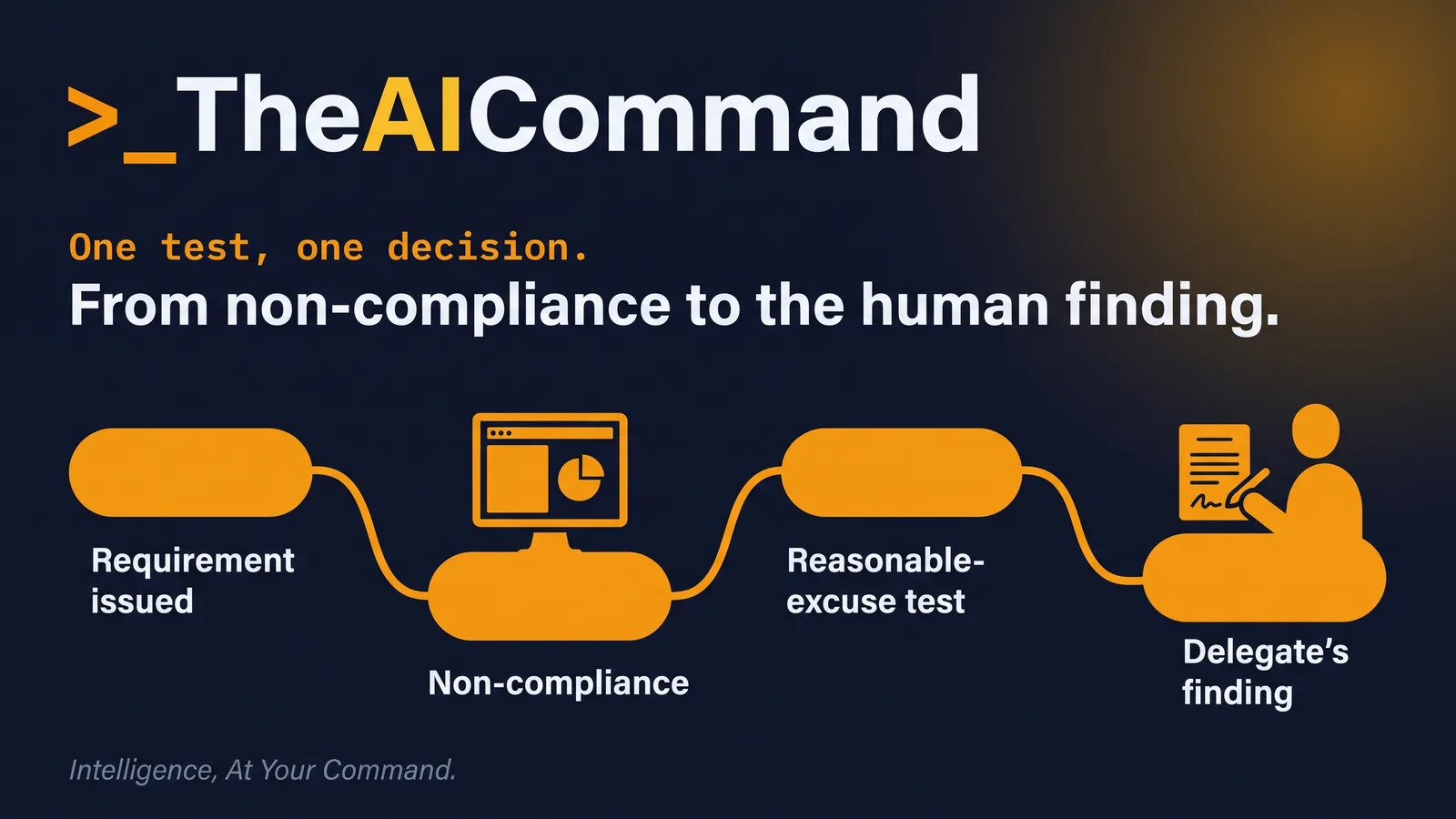
Working from a de-identified file, AI can build a chronology of the requirement, the correspondence and the non-compliance, and sort the claimant's stated reasons against the two limbs of the test. It can produce an explicit unable-versus-unwilling read of each reason and label the ones that look like dissatisfaction or personal preference rather than inability. It can flag gaps, such as a medical certificate referred to but not on file, or a request whose delivery cannot be confirmed. That structured comparison is a working aid: it surfaces the real questions the delegate has to answer.
What AI cannot do is answer them. It cannot find that a reasonable excuse existed or did not, because that is an exercise of delegated judgement on the specific facts, and the Act gives it to a person. It cannot decide to suspend compensation, refuse a claim, or reinstate entitlements once the claimant complies, and it should never be asked to predict what the Tribunal would do. The delegate reads the source documents alongside the AI-built chronology, makes the finding in their own reasons, and records the AI's role in the file note at the time of decision.
De-identification callout. Reasonable-excuse files are dense with identifiers and with sensitive medical and personal information. Before any of it goes near an AI tool that sits outside the scheme's perimeter, remove full names, claim numbers, dates of birth, addresses, employer identifiers and any diagnosis tied to an identifier, and replace them with stable placeholders the delegate can re-attach afterwards. Use [CLAIMANT_NAME], [CLAIM_NUMBER], [CONDITION] and [DATE_OF_INJURY] as the standard tokens. The de-identified analysis is a draft the delegate applies back to the real file.
Two prompts you can adapt
The first prompt structures the analysis. It asks the model to sort a de-identified file against the test, without reaching a conclusion.
The second prompt drafts a reasoning skeleton for the delegate to complete in their own words, and confirms which review pathway applies so the record is built to the right standard.
Do this Monday
- Confirm which section is engaged before anything else, because it decides whether the eventual decision is a determination and how it can be challenged.
- De-identify the file. Strip names, claim numbers, dates of birth, addresses, employer identifiers and identified diagnoses, and swap in placeholders you can re-attach.
- Use AI to build the chronology and to sort the claimant's stated reasons against the subjective and objective limbs, and to flag missing evidence.
- Read the source correspondence yourself. The AI chronology is a map, not a substitute for the documents.
- Make the reasonable-excuse finding in your own reasons, applying the "unable, not unwilling" test to these facts, not to a general rule.
- Build the record to the standard the pathway demands: reasons that withstand reconsideration and Tribunal review for a section 36(4), 37(7) or 57(2) suspension, and a fair, well-documented process for a section 58 or 118 decision.
- Communicate the outcome to the claimant in writing, with the terms and reasons, and state that the suspension or refusal lifts as soon as they comply.
- Record the AI's role in the file note at the time of decision: which tool, what de-identified data it saw, and how you used its output.
The reasonable-excuse checklist
- The section engaged is identified, and you know whether the decision will be a determination.
- The file was de-identified before any AI tool touched it, with placeholders recorded for re-attachment.
- The chronology captures the requirement, how it was communicated, the due date and the non-compliance.
- Each stated reason is tested against both the subjective grounds and objective reasonableness.
- Each reason has an explicit unable-versus-unwilling assessment, with dissatisfaction and personal preference identified.
- Missing evidence has been listed and either obtained or accounted for.
- The finding is the delegate's, made on these facts and recorded in the delegate's own reasons.
- The outcome is communicated in writing, including that it lifts on compliance.
- The AI's role is captured in the file note at the time of decision.
A worked example
[CLAIMANT_NAME] has an accepted claim for [CONDITION], date of injury [DATE_OF_INJURY], claim number [CLAIM_NUMBER]. The delegate required a section 57 medical examination. [CLAIMANT_NAME] did not attend, and later wrote that they had a hospital appointment for an unrelated acute issue that morning, and separately that they did not see why a further examination was needed given their specialist's recent report.
De-identified, the file goes to AI, which builds the timeline and sorts the two reasons. The clashing appointment it places under objective reasonableness as a possible inability, while flagging that no document confirming it is on file. The claimant's view that the examination was unnecessary it labels as dissatisfaction with the request rather than an inability, noting it does not go to unable-versus-unwilling. It marks the missing confirmation as the key evidence gap.
The delegate now does the part that is theirs. They read the correspondence, request the appointment confirmation, and on receiving it find that [CLAIMANT_NAME] had a reasonable excuse for the non-compliance, so no suspension under section 57(2) is warranted and a fresh date is arranged. Had the confirmation not existed, the delegate would have weighed the reasons on the available evidence and made the finding accordingly. The AI structured the analysis. The delegate made the decision and recorded the reasons. That division is the whole point.
Bottom line
Reasonable excuse is a single test the SRC Act runs through five sections, and it turns on whether the claimant was unable rather than unwilling to comply, judged on both the reasons they give and whether those reasons are objectively reasonable. Whether the resulting decision is a determination changes how it can be challenged, but not who makes it. AI can take the assembly work off the delegate's desk so their time goes to the finding. The finding, the suspension or refusal, and the reasons stay with the person the Act empowers to make them.
Content disclaimer: This article is for general educational and informational purposes only. It does not constitute legal, compliance, or professional advice. The SRC Act 1988 should always be consulted directly. Practitioners should refer to current Comcare scheme guidance and seek legal advice where required. Nothing in this article constitutes a formal determination or interpretation of law.
TheAICommand. Intelligence, At Your Command.