
An invoice exception can tell you that two controlled records do not align. It cannot tell you why, prove misconduct or decide what section 16 requires. The safe workflow builds a source-anchored query packet and leaves every payment and conduct decision with an authorised human.
Anomalies are useful because they interrupt routine payment. They are dangerous when a field mismatch is dressed up as a conclusion about a provider, claimant or treatment.
After a human has approved treatment, AI can compare an invoice with the approval, service history, provider record, applicable rate source and prior payments. It can expose a duplicate invoice number, an unmatched service date, a frequency difference or a rate-version conflict. It cannot decide that the treatment was not obtained, that its cost is inappropriate, that the invoice is fraudulent or that payment should be denied.
Build the control around a simple rule: the model identifies the difference, preserves both source records and drafts the question. A human verifies the data, considers the individual circumstances and decides the next step.
What can AI compare without making a finding?
The current in-force Safety, Rehabilitation and Compensation Act 1988 is Compilation No. 82, with a compilation date of 1 July 2026. Section 16(1) makes Comcare liable to pay, in respect of the cost of medical treatment obtained in relation to an injury, being treatment that it was reasonable for the employee to obtain in the circumstances, compensation of such amount as Comcare determines is appropriate to that medical treatment. For employees of licensees, subsections 4(10) and 4(10A) apply the relevant statutory substitution to references to Comcare in section 16.
An approval record establishes only what the human determination actually says. AI cannot expand or reinterpret it because an invoice differs. Note the difference from a section 39 request, where the question is which statutory route an item belongs to before any checklist runs. Here the route is already settled and the question is whether the invoice matches what was approved under it.
Comcare's current invoicing and payment page provides a useful transactional schema. It says an invoice should be submitted after services are provided and must be itemised. Required details include a unique invoice number, employee and claim details, payee information, applicable practitioner registration, invoice date, service date, description, cost, hours and hourly rate where relevant, and GST information.
For a governed workflow, place those fields into five separate ledgers:
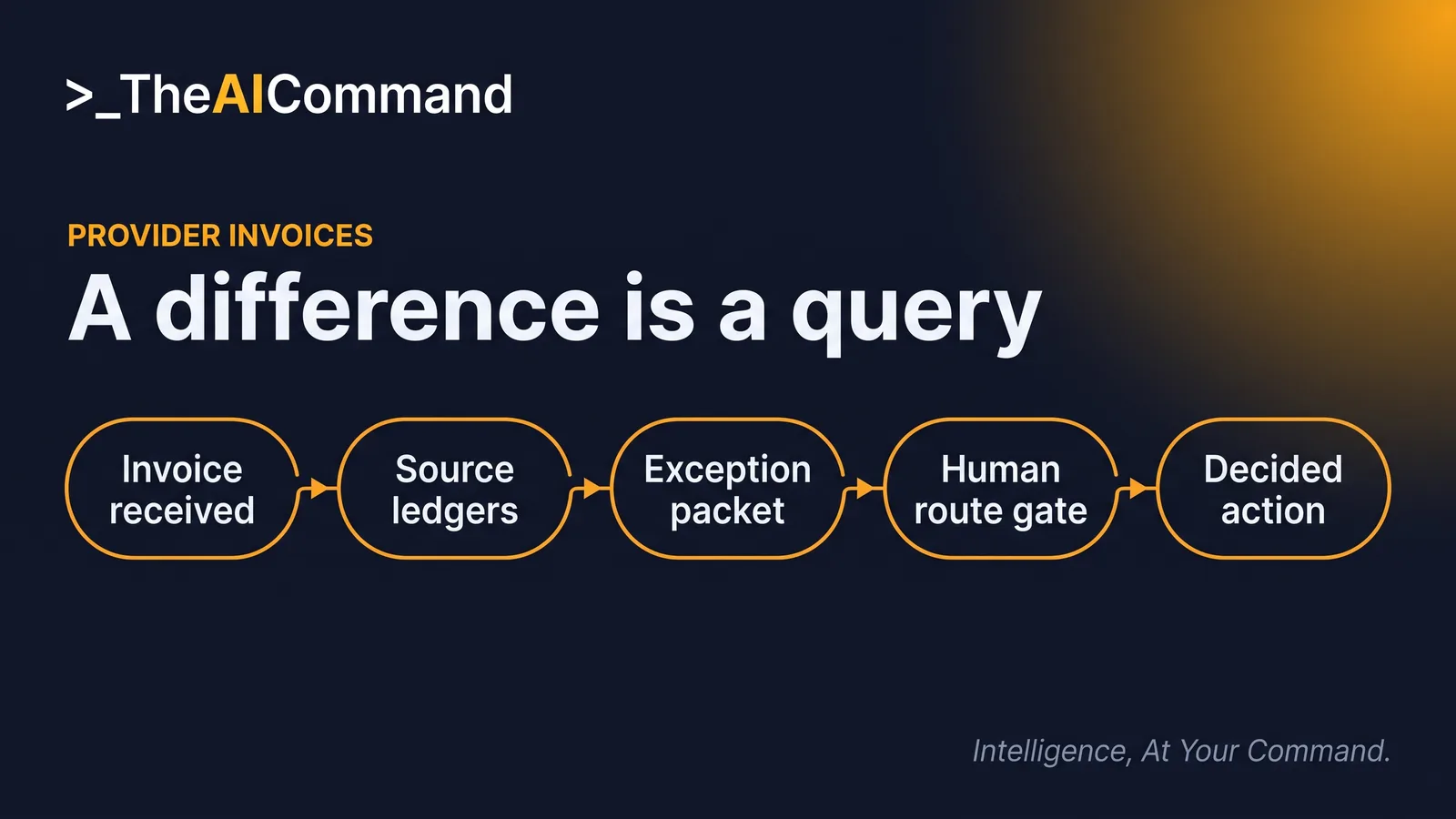
The model compares fields across ledgers. It never compresses them into a risk score. NO MATCH LOCATED means the nominated search scope did not produce a match. DIFFERENCE DETECTED means two recorded values differ. Neither label explains the difference.
This prompt builds the comparison packet. A human must verify every extracted value against the controlled source and decide whether any query should be issued.
Why is a rate mismatch not enough?
The rate column is a reference point, not an automatic verdict. Comcare's appropriate-cost scheme guidance says the amount considered appropriate is determined case by case by the relevant authority. It describes the guidance as non-binding and says relevant authorities and their claims managers retain their discretion to determine amounts they consider appropriate for compensable medical treatments.
The same guidance says published national, state or territory rates are a better-practice reference. It also recognises that a lower or higher amount may be appropriate in the circumstances, and that a higher fee could be paid where, for example, the isolated location at which the treatment is provided means the provider incurs additional costs. A difference from a published rate therefore opens an evidence question. It does not answer it.
Comcare's treatment-rates page adds an operational complication. It says the referenced fees guide upper limits, claims managers are not bound by them, and allied health rates are reviewed three times a year with updates taking effect from 1 February, 1 July and 1 November. Your comparison must therefore capture the rate version and its effective date, then match it to the service date. Comparing every invoice with today's displayed rate can manufacture false exceptions for earlier services.
Rate testing needs a precedence ladder:
- the amount or basis stated in the human-approved treatment record
- the controlled rate source and version applicable to the service date
- the invoiced item, units, duration, jurisdiction, modality and GST treatment
- any documented individual circumstance that requires human consideration
HUMAN AMOUNT DETERMINATION REQUIREDwhere the records do not resolve the issue
Do not let the model choose which source governs when the approval and rate table conflict. The conflict itself is the output. Nor should it silently convert a description to an item code. It can propose candidate matches, but the original invoice wording and confidence must remain visible.
Comcare's medical-treatment page says claims managers can decide how appropriate treatment fees are on a case-by-case basis or by referencing the payment limits Comcare recommends. A licensee's payment rule, delegation or contract may add controls, but it must be labelled as local rather than presented as law or Comcare guidance.
Which controls stop a query becoming an allegation?
Start with language. Ban labels such as suspicious provider, fraud risk, invalid service and excessive treatment from the anomaly engine. Use neutral labels tied to observable records: POSSIBLE DUPLICATE IDENTIFIER, APPROVAL MATCH NOT LOCATED, SERVICE DATE OUTSIDE RECORDED RANGE, RATE VERSION REVIEW and PROVIDER FIELD DIFFERENCE.
Then separate the route. A clerical question about a mistyped invoice number should not enter the same queue as a possible section 16 amount determination or a conduct concern. Use three destinations:
- administrative correction: a verified transcription, formatting or matching issue
- claim decision review: a difference that may affect the amount or scope of a determination
- conduct escalation: a concern supported by verified evidence under an approved human-led procedure
Section 60 of the SRC Act includes a section 16 decision within the definition of a determination. Section 61 generally requires written notice of the terms, reasons and reconsideration route, although subsection 61(2) disapplies that section for a determination under subsection 16(1) that compensation equal to the full amount of the cost of the medical treatment is payable, where that amount is payable to a person other than the employee. Section 62 provides the reconsideration pathway. If invoice review produces a new or changed section 16 determination, an authorised human must make and communicate it in accordance with the applicable law and procedure. The AI exception is not that determination.
Comcare's service-provider standards expect providers to comply with relevant legislative requirements such as record keeping and privacy, to comply with the responsibilities of their profession or service, and to follow Comcare's guidance on invoicing, receipts and GST. Those standards support clear questions and controlled follow-up. They do not authorise an AI system to make findings about compliance or professional conduct.
This prompt red-teams the queue before a human acts. A claims or compliance professional must choose the route, approve the communication and make any substantive decision.
Fictional worked example
This scenario is fictional and de-identified. Invoice [INVOICE_NUMBER] records six sessions for [CLAIMANT_NAME], delivered by [PROVIDER_ROLE] across [SERVICE_DATE_RANGE]. The controlled approval record shows five sessions within the same range. The payment ledger also contains an earlier invoice with a similar total but a different invoice number.
The safe output has two exceptions. The frequency differs by one session, and a possible earlier-payment match needs human verification. It copies both sources, records that similarity is not identity, and drafts two questions: whether an additional session was separately approved, and whether the two invoices concern the same services.
The unsafe output calls the sixth session unauthorised and the later invoice a duplicate. The records have not yet established either proposition. A revised approval may sit outside the searched folder. The earlier invoice may cover different dates or may have been reversed.
The human reviewer locates [REVISED_APPROVAL_ID], covering the sixth session, and confirms that the earlier payment was reversed. Both exceptions close with evidence anchors. There is no allegation or automatic denial.
Do this Monday
- Create the five ledgers. Separate approval, service, provider, rate and payment facts so one field cannot silently stand for another.
- Version every rate. Store source, jurisdiction, profession, item, effective date and retrieval date, then compare against service date rather than invoice date.
- Install neutral labels. Replace suspicious or invalid with language that describes the observed field difference only.
- Split the routes. Keep administrative correction, claim decision review and conduct escalation review in separate human-owned queues.
- Block automatic consequences. Test that no anomaly can deny payment, change section 16 liability, alter approval or send correspondence.
- Run fictional failure tests. Include reversals, credits, corrected invoice numbers, rate updates, changed providers, overlapping approvals and incomplete search scopes.
Bottom line
Invoice anomaly review is a reconciliation task before it is anything else. AI can make that reconciliation faster and more traceable when it preserves sources, rate versions and uncertainty. It cannot supply intent, decide that treatment was unreasonable or determine the appropriate compensation amount. Treat every anomaly as a query until an authorised human establishes otherwise.
This article is general information and education only. It is not legal advice, and it is not advice about any individual claim. Decisions under the Safety, Rehabilitation and Compensation Act 1988 are made by human decision-makers on the individual merits of each claim, and claimants have reconsideration and review rights in respect of determinations. Seek advice specific to your scheme and circumstances.
References
- Federal Register of Legislation, Safety, Rehabilitation and Compensation Act 1988, Compilation No. 82, compilation date 1 July 2026. https://www.legislation.gov.au/C2004A03668/latest/text
- Comcare, Invoicing and Payment. https://www.comcare.gov.au/service-providers/invoicing-and-payment
- Comcare, Medical treatment. https://www.comcare.gov.au/claims/supports-benefits/medical-treatment
- Comcare, Scheme guidance - Appropriate cost of medical treatment, document SRC301, updated October 2024. https://www.comcare.gov.au/scheme-legislation/src-act/guidance/appropriate-cost-medical-treatment
- Comcare, Rates for medical and allied health treatment. https://www.comcare.gov.au/service-providers/medical-allied-health/treatment-rates
- Comcare, Standards for Comcare service providers. https://www.comcare.gov.au/service-providers/general-requirements
TheAICommand. Intelligence, At Your Command.