
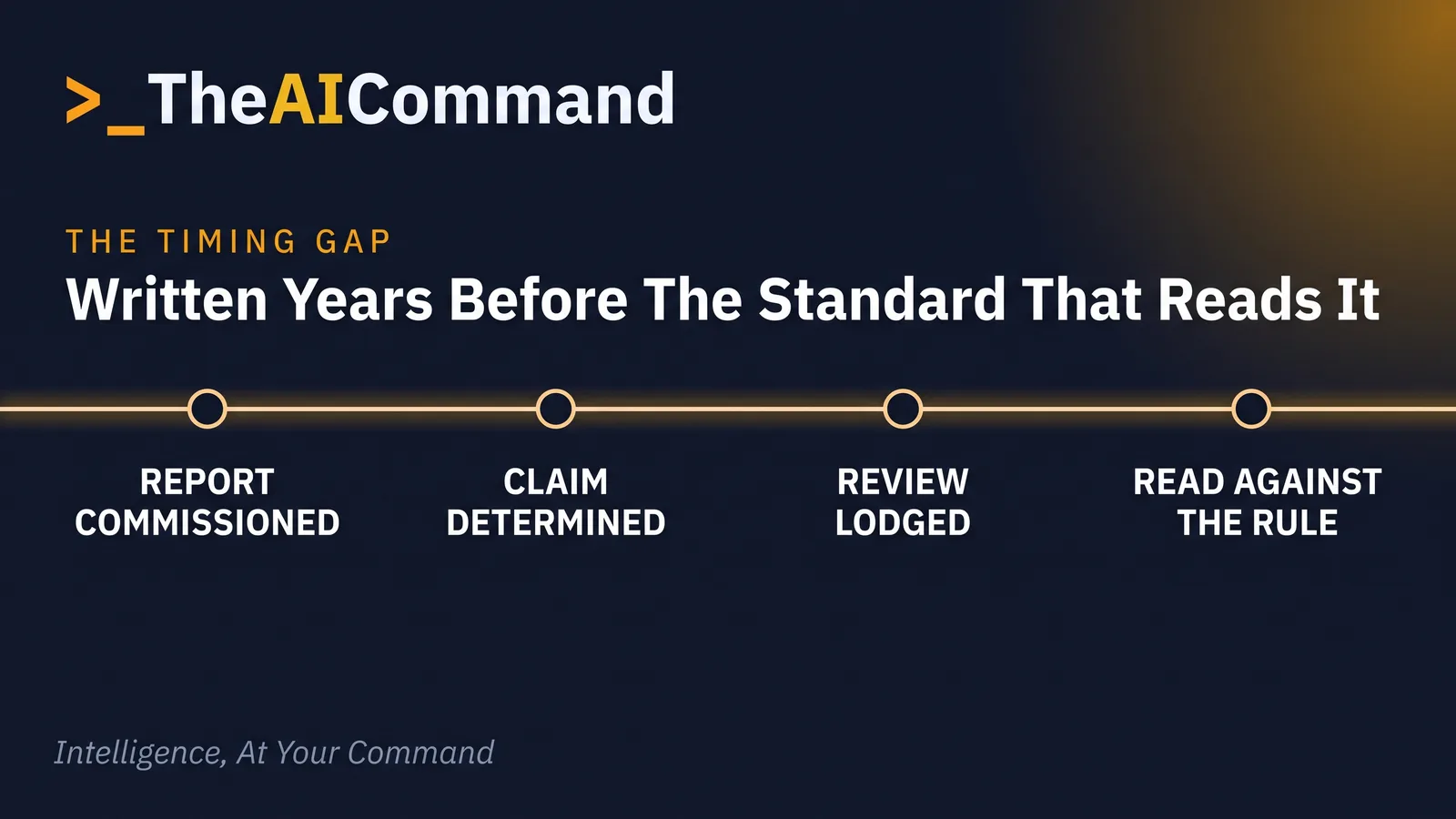
The report was written before the rule existed.
On 2 March 2026 the Administrative Review Tribunal (Expert Evidence) Practice Direction 2026Practice_Direction_2026.pdf) took effect, replacing the 2024 instrument. It carries something the earlier version did not. An expert's written report prepared for a Tribunal proceeding must state whether it includes content generated using Generative AI. Where it does, the expert must clearly identify that content and the applications used to generate it, and certify that they have personally checked all of it and are satisfied it is accurate and reliable.
Read as a Tribunal rule, that is a matter for the lawyers if a claim ever gets that far. It is not, and the reason sits in clause 3.7. Medical evidence commissioned in the ordinary course of a claim, long before anyone contemplates review, can end up in the documents a decision-maker gives the Tribunal, where it is read against a standard nobody had in mind when it was written.
What the Practice Direction actually requires
The instrument was made under section 36 of the Administrative Review Tribunal Act 2024, headed "President may make practice directions", and is dated 27 January 2026 over the signature of the President, the Hon Justice Emilios Kyrou AO. The Tribunal published it on 2 February 2026 as one of six revised practice directions. Clause 1.3 commences it on 2 March 2026 and applies it to all proceedings where expert evidence is required or intended to be given, whether lodged before, on or after that date.
Clause 3.1 sets the information a report must include, in the body or as an annexure: the expert's subject area of knowledge and their qualifications or experience; the letter of instruction, or the questions or issues the expert was asked to address, and a reference to any documents or materials they were given to consider; the facts and assumptions that inform the report and their sources; and the reasons for any opinion expressed. Clause 3.2 adds, where relevant, details of any examinations, tests or investigations relied on, including the identity, qualifications and experience of the person who conducted them, and any literature or secondary sources relied on.
Clause 3.5 then requires a declaration in these terms:
I understand that I have an overriding duty to provide impartial assistance to the Tribunal. This report contains my independent opinion on the matters set out in it and I am satisfied that the report is accurate and reliable. No matters of significance have been withheld from the Tribunal.
The Generative AI clauses follow. Clause 3.5A defines Generative AI as a system of artificial intelligence capable of generating content such as text, images or sound in response to prompts, covering both open-source and closed-source applications, and names ChatGPT, Gemini, Microsoft Copilot, Perplexity, Claude, Grok and DeepSeek AI as examples. Clause 3.5B requires the expert to state whether the report includes AI content. Clause 3.5C requires, where it does, that the expert clearly identify the AI content and the applications used, and certify they have personally checked all of it, including research and other material cited in support.
Clause 3.5D requires the expert to complete, sign and date the cover sheet in the Schedule. That cover sheet is the sharp end. Its checklist offers two mutually exclusive statements: the report does not include content generated by using Generative AI, or it does and the expert certifies they have personally checked all the AI content and are satisfied it is all accurate and reliable. There is no third box and no silent option. Clause 3.6 adds a continuing duty: a material error or omission in the report or the cover sheet, or a change of opinion on a material matter, must be notified in writing to the engaging party, and where the report has been lodged, to the Tribunal and the other parties without delay.
What happens to a report that carries none of this
Not exclusion. Clause 1.11 says a failure to comply may have consequences for the weight given by the Tribunal to the expert's evidence. The note under it records that the Tribunal is not bound by the rules of evidence relating to opinion evidence, citing section 52 of the ART Act 2024, headed "Tribunal is not bound by rules of evidence", and may have regard to material that would not be admissible in a court applying those rules. The Tribunal determines the weight to give any evidence before it.
That is a softer consequence than inadmissibility and a harder one to manage. Nothing is struck out. A report simply carries less than it might have, and nobody tells you.
The clause claims practitioners have missed
Clause 3.7 is two sentences and it is the whole article. The documents which are required to be given to the Tribunal by a decision-maker on commencement of a review may include reports that fall within the scope of the Practice Direction. If a party wishes to place particular reliance on such a report but it does not include information of the kind referred to in clauses 3.1 to 3.5C, the party should consider whether any additional information should be sought from the expert and given to the Tribunal.
Follow that through to a Comcare scheme file. Section 23 of the ART Act 2024 carries the general rule that a decision-maker must give the Tribunal reasons and documents, and when an SRC Act matter reaches the Tribunal under section 64, headed "Applications to the Administrative Review Tribunal", that bundle is where the claim file goes, medical evidence included. Comcare's guidance on engaging a legally qualified medical practitioner records that independent examinations are initiated by a rehabilitation delegate under section 36 or a claims delegate under section 57, subject to the section 57A Guide. Those reports were commissioned to answer a clinical question on a live claim. They were not drafted for a Tribunal.
The obligation is not retrospective, and clause 3.7 does not say an older report is defective. What it says is that when someone later wants to lean on that report, the gap becomes their problem to fix, under a review timetable, through an expert who may have moved practice, retired, or have no record of how the report was produced. The cheapest moment to close it is at commissioning.
Build the disclosure in at commissioning
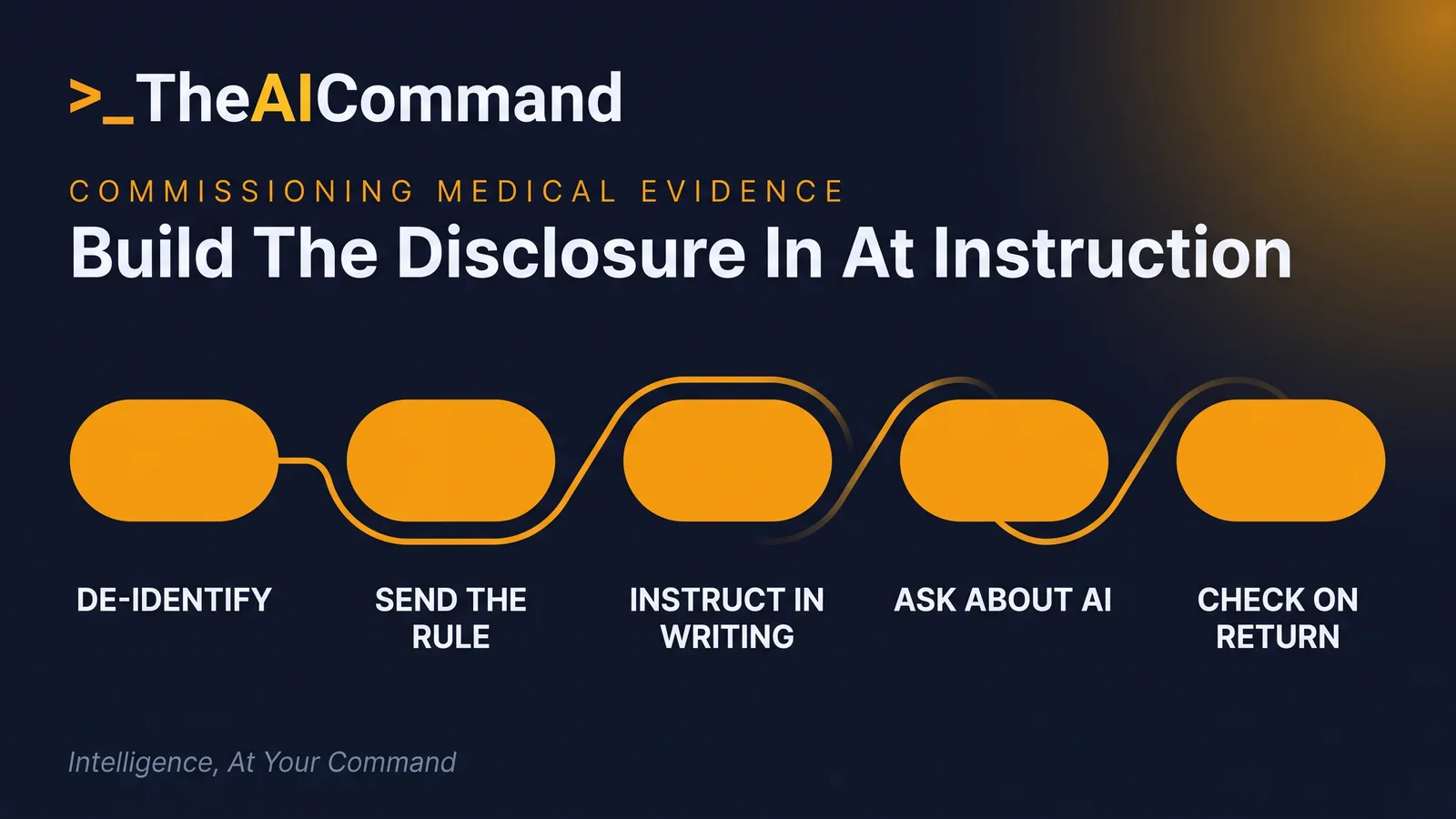
- De-identify before any AI touches the material. If your team uses AI anywhere in preparing the brief, the file is de-identified first. Replace names, claim numbers and dates of birth with placeholders such as [CLAIMANT_NAME], [CLAIM_NUMBER] and [DATE_OF_INJURY], following a disciplined de-identification routine. This is a condition on everything downstream, not a preference.
- Send the Practice Direction with the engagement. Clause 2.1 requires a party engaging an expert for a proceeding to ensure the expert has a copy at the time of engagement. Making that the default at commissioning costs one attachment and puts the standard in the examiner's hands before they write a word.
- Write the instruction so the report can satisfy clause 3.1 on its face. State the questions plainly, and list the documents provided as a numbered schedule rather than describing them loosely. Comcare's guidance already makes the point for a different reason, that proper instructions including the appropriate scope of the examination reduce the risk of the examiner inquiring into areas irrelevant to the claim.
- Ask the examiner to address Generative AI use expressly. One paragraph. Ask them to state whether the report includes content generated using Generative AI, and if it does, to identify that content and the applications used and certify they have personally checked all of it. You are not accusing anyone of anything, only asking for the statement the Tribunal will look for.
- Record what you gave and what you asked, at the time. The instruction letter, the document schedule and the date they went. Reconstructing that two years later from a mailbox is the exact failure clause 3.7 describes.
- Check the report on return, against the required set, while the examiner is still engaged and the matter is live.
Working example. A claim for [CONDITION] with a date of injury of [DATE_OF_INJURY], claim number [CLAIM_NUMBER], has reached the point where an independent examination is being arranged for [CLAIMANT_NAME]. The instruction pack goes out with the Practice Direction attached, four numbered questions, a schedule listing the eleven documents, and a short paragraph on Generative AI. The report returns with a qualifications section, facts and assumptions, reasons, and a signed statement that no Generative AI content was used. Nothing about the claim changes. What changes is that if the determination is later reviewed, nobody has to hunt down an examiner to ask how the report was written.
Reading a report you already hold
For reports already on file, three checks. Does the report identify the questions asked and the documents considered, or does it open straight into history and opinion? Does it state facts and assumptions and give reasons, or assert a conclusion? Does it say anything about Generative AI, and is the declaration there?
Where the answer is no and the report matters, clause 3.7 points to the step: consider seeking additional information from the expert. That is a request for missing information, not a request to change the opinion, and the difference is worth stating in the correspondence itself. Record what you asked and what came back. Where the report is peripheral, note the gap and move on.
Your own AI use, on the other side of the file
The mirror of all this is the determining authority's own tooling. AI genuinely helps in preparing to commission medical evidence. On a de-identified file it can assemble the material, build a chronology, separate medical opinion from assertion, and draft a first cut of the questions.
What it does not do is form the medical opinion, and it does not make the determination. The examiner's opinion is the examiner's. The determination under section 14, or any other determination on the file, is made by a properly delegated officer who can explain their reasons. Every AI output here is a draft a person checks: if AI drafted the questions, the case manager reads every one and strikes any that lead the examiner or reach for liability rather than a clinical matter. And when reports disagree, AI can map where they diverge without deciding which to prefer.
What never to do
- Never put claimant names, claim numbers, dates of birth or medical detail into a general-purpose AI tool. De-identify first, every time, including the second document when you are rushed.
- Never ask an examiner to remove, soften or restate an opinion. Clause 3.7 supports seeking additional information, a different thing, and clause 2.1 requires a party not to do anything that compromises the independence of the expert's report.
- Never let AI draft the reasons for a determination. Organising evidence is preparation. Reasons are the delegate's.
- Never treat a signed cover sheet as verification of content. It confirms the required information is present. It does not make the opinion right.
- Never assume silence about AI means none was used. The Practice Direction exists because that assumption stopped being safe.
SRC Act sections referenced
- Section 14, "Compensation for injuries", and section 36, "Assessment of capability of undertaking rehabilitation program".
- Section 57, "Power to require medical examination", and section 57A, "Guide for Arranging Rehabilitation Assessments and Requiring Examinations".
- Section 64, "Applications to the Administrative Review Tribunal".
Bottom line
The Expert Evidence Practice Direction 2026 is not a litigation rule that activates at review. Through clause 3.7 it reaches back into medical evidence commissioned on live claims now, because those reports travel into the Tribunal's documents with the file. The disclosure, the information set and the signed cover sheet cost almost nothing at commissioning and are expensive to retrofit later. The consequence is weight rather than exclusion, which is exactly why the control sits upstream. Nothing will tell you it happened.
Do this Monday:
- Attach the Practice Direction to your standard engagement pack for medical examinations, and record that you sent it.
- Rewrite the instruction template so the questions and a numbered schedule of documents are both in the letter, ready to answer clause 3.1.
- Add one paragraph asking the examiner to state whether the report includes Generative AI content and, if so, to identify it and certify they checked it.
- Check the reports most likely to matter on a live contested matter against clauses 3.1 to 3.5C, while the examiners are still engaged.
- Confirm every AI step your team runs on medical material starts from a de-identified file and ends with a named person who checked the output.
Content disclaimer: This article is for general educational purposes only and does not constitute legal advice, liability determination guidance, or a substitute for professional judgement. Workers compensation decisions must be made by appropriately qualified and authorised persons under the Safety, Rehabilitation and Compensation Act 1988. All AI outputs described in this article require human review before use in any claims management context.
TheAICommand. Intelligence, At Your Command.