A procedure says that a lone worker checks in with the office. It identifies a contact number and a supervisor. It says nothing about an unanswered call, an absent supervisor or a message that arrives after the response has begun. The obligation to check in is clear. The work that follows a missed contact is not.
The practical drafting task is to make that response explicit before anyone relies on the procedure. A check-in is only one event in a wider arrangement. People need to know who receives it, what counts as acknowledgement and which approved response applies when expected contact does not occur. A list of telephone numbers cannot supply those instructions.
This article uses a fictional NSW workplace. No approved example policy or escalation timings have been supplied. Every timing field therefore remains a placeholder for the human policy owner. The example is not an approved procedure and cannot be used operationally. It teaches how to find and resolve gaps before competent approval and testing.
Start with the existing risk assessment
SafeWork NSW's remote-work guidance describes risks arising when assistance is limited by the location, time or nature of work. It addresses effective communication and emergency planning. Section 48 of the WHS Regulation 2025 (NSW) requires a PCBU to provide a system of work that includes effective communication with a remote or isolated worker. [4] A worker can be isolated in an urban workplace as well as a distant location. Begin with the actual work and access to assistance, rather than a rural postcode. [1]
The responsible people first decide whether the work can proceed alone and what controls it requires. A check-in arrangement cannot answer that question by itself. The NSW facilities code includes buddy systems among possible controls and states that some jobs carry such a high level of risk that workers should not work alone. The model is not authorised to select the arrangement for an individual task. [2]
Give the drafting assistant the approved risk-assessment extract and the procedure the owner has actually authorised. The extract needs to identify the work covered and relevant dependencies. If the documents are missing, the model can prepare questions and a structure. It cannot transform a generic policy example into an approved local control.
Safe Work Australia's guidance also recognises that remote or isolated work can interact with poor support and other hazards. A check-in procedure belongs within that wider risk-management process. It is not a complete assessment of physical and psychosocial risks, and a communication log does not demonstrate that every relevant risk is controlled. [3]
Define the handover between people
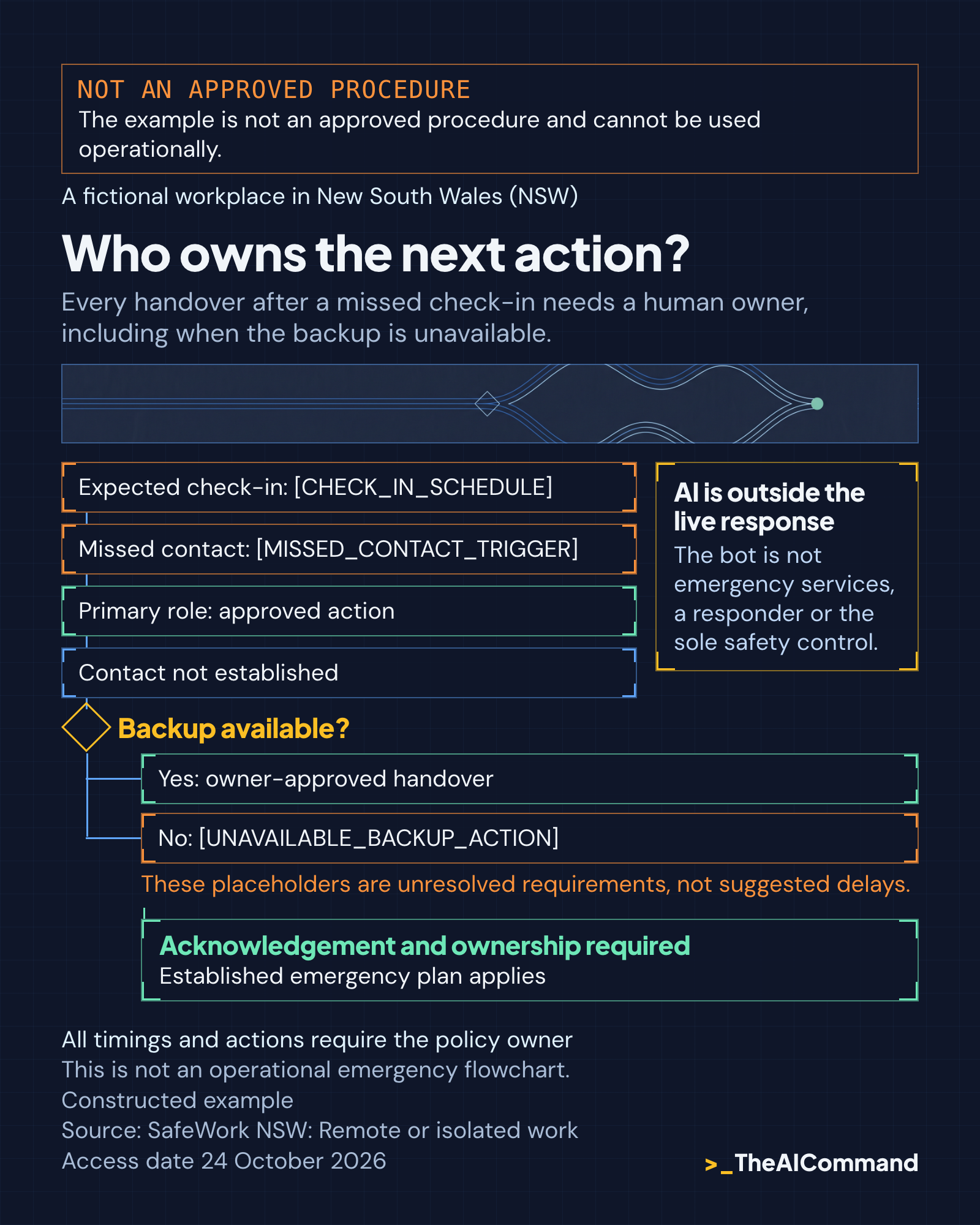
Start with the expected event. The owner specifies when contact is due using [CHECK_IN_SCHEDULE], the permitted channel and what information confirms the check-in. The draft records those requirements from the policy. A model must not infer them from a calendar entry or decide that any incoming message is enough.
Next identify the receiving role and its coverage. A generic label such as office can conceal uncertainty about who is watching during a handover or break. The procedure needs a controlled way to establish the person covering the role for the relevant period. Real names and contact details remain in the organisation's authorised operational system.
Distinguish receiving a message from acknowledging responsibility. The draft can ask how the receiving role knows that an action has been accepted by the next responder. Sending a message into a group chat does not, by itself, establish that a particular person has taken ownership. The policy owner determines the acknowledgement requirements.
Every time setting comes from that owner and the approved risk process. Use [MISSED_CONTACT_TRIGGER], [CONTACT_ATTEMPT_TIMING] and [ESCALATION_TIMING] until the values and sources are supplied. These placeholders are unresolved requirements, not suggested delays. They must never be interpreted as permission to wait during an emergency or override an immediate emergency response.
A constructed inspection task
The fictional business has a worker checking non-operational equipment at a separate storage location. This description is deliberately limited: it is not an assertion that this task is safe to perform alone. The risk assessment, work authorisation and appropriate controls would need competent approval before the example could become a real arrangement.
The draft source pack identifies a primary contact role, a backup role and an emergency-response coordinator role. It includes a placeholder for the approved check-in schedule and a reference to the established emergency plan. It does not include personal telephone numbers, detailed access credentials, health information or a live worker's location history.
The planning assistant is asked to map the handovers and missing instructions. It can organise the supplied roles into a draft sequence, but it cannot decide which role has authority from a job title alone. The policy owner needs to confirm each responsibility and the relationship with the emergency plan before the sequence is approved.
The resulting draft begins with a pre-work coverage question. Who has confirmed that the receiving and backup roles are staffed for the whole period? A name on a document is not current availability. The next question asks what approved action applies if that coverage is absent before work starts. The model leaves that action unresolved.
For the expected contact, the draft records the approved channel, required acknowledgement and source reference. For a missed contact, it points to the supplied response rule and its owner. Where those instructions are absent, it writes missing policy input. It does not fill the gap with a plausible number of minutes or a generic instruction to keep trying.
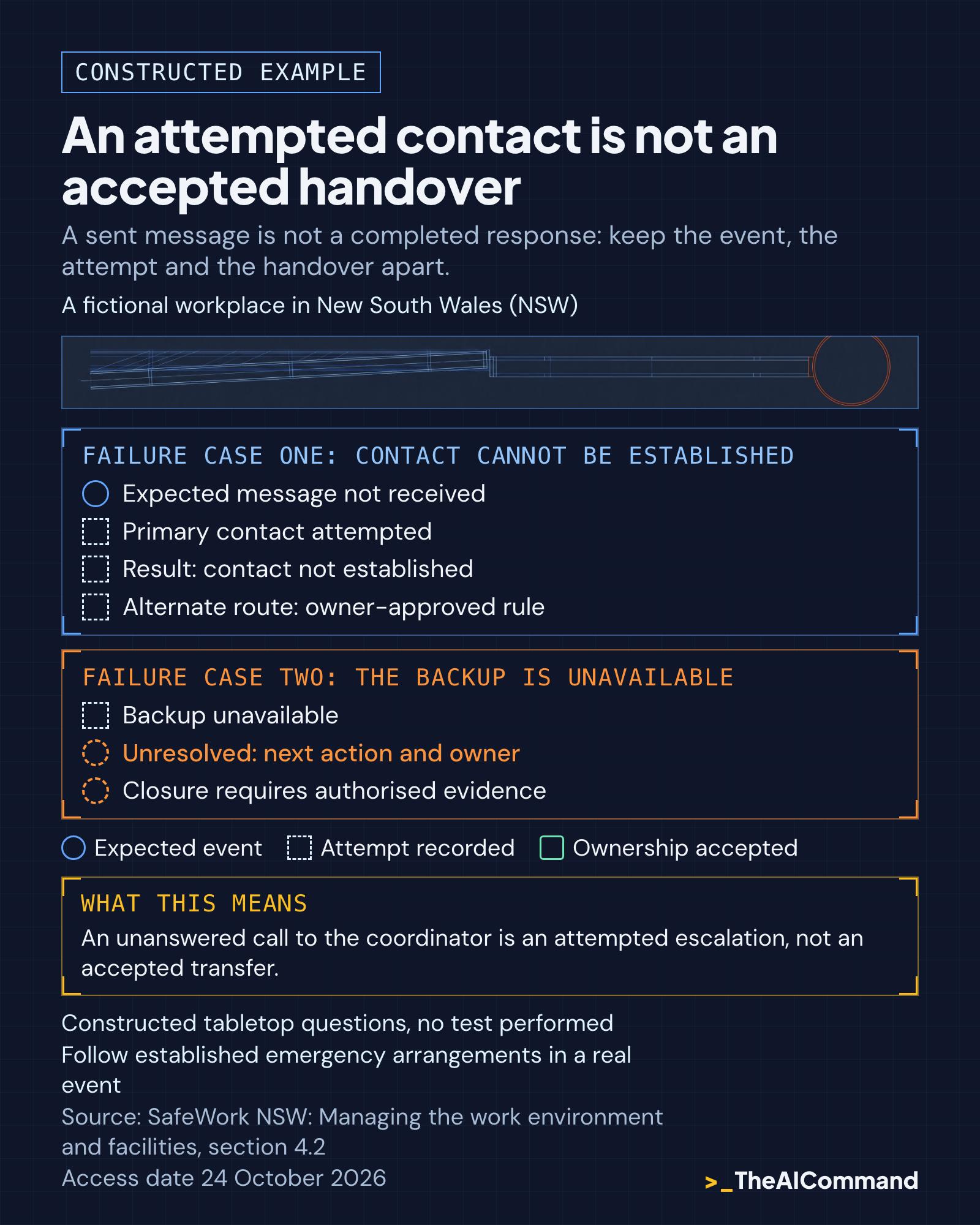
Failure case one: contact cannot be established
In the first constructed scenario, the expected check-in is not received and the primary channel cannot establish contact. This is a tabletop premise, not an observed event. The question is which approved action applies, who owns it and what information they need. The article cannot supply that action without the workplace policy.
The draft records the missed event separately from the attempted contact. One is an expected check-in that was not received. The other is a response attempt with a recorded result. Keeping them separate helps a reviewer reconstruct what happened without assuming that an attempted call reached the worker or that silence has a particular explanation.
The next branch asks whether the approved alternate communication method is available and applicable. A second application on the same unavailable network may not provide independent coverage. The competent reviewer examines the real dependencies. The model can identify shared dependencies from supplied information, but it cannot verify network coverage or equipment performance.
The NSW code discusses communication selection in relation to location and environment, and checking mobile coverage before work. Since 1 July 2026, section 26A of the WHS Act 2011 (NSW) requires a PCBU to comply with an approved code or manage the risk to an equivalent or higher standard. [5] The code supports testing the actual arrangement. It does not establish that a particular handset, application or channel will work at this fictional site. Any reliability claim requires evidence from the relevant operating conditions. [2]
If contact remains unresolved, the procedure needs the owner-approved escalation route and emergency interface. The draft points to [APPROVED_ESCALATION_ACTION] and [EMERGENCY_PLAN_REFERENCE], with [ESCALATION_TIMING] still unresolved. In a real event, people follow the established emergency arrangements. They do not wait for a model to interpret the missing check-in.
Failure case two: the backup is unavailable
The second constructed scenario starts with the same missed contact but adds an unavailable backup. This tests a different weakness. A procedure that says call the backup can look complete until the backup is absent, unreachable or already handling another incident. The next accountable role and approved response need to be explicit.
The model can expose a circular handover. For example, a primary role refers the problem to a backup while the backup's instruction refers it to the primary. The draft labels that loop and cites both source passages. It cannot solve the loop by creating a new authority or nominating an unapproved person.
The policy owner supplies [UNAVAILABLE_BACKUP_ACTION] and identifies the authorised role responsible for it. If neither exists, the procedure remains incomplete. The reviewer must resolve the work and coverage arrangements before relying on it. A chain of increasingly senior job titles is not a substitute for a workable, resourced response.
The scenario also asks how the receiving role knows that a handover has succeeded. An unanswered call to the coordinator is an attempted escalation, not an accepted transfer. The operational procedure needs clear ownership while contact is being sought. The draft can highlight the question; the responsible people set and resource the answer.
Keep the record open when responsibility has not been accepted. A system that closes an event after sending its final notification can conceal an unresolved situation. This is a proposed design check for the procedure owner, not a specification for an autonomous safety bot. The human response remains the operational process.
A late message is another decision point
Suppose a check-in arrives after the response has started. The procedure needs to explain who validates it and how ongoing actions are reconciled. The model cannot declare the worker safe from the message alone, particularly when the message's timing, origin or context is uncertain. That judgement belongs within the approved human process.
The same principle applies at the end of work. A task completion entry and a confirmed end-of-work check-in may be different events under the policy. The draft preserves that distinction until the owner defines it. Otherwise, an administrative change to a job record could accidentally close a monitoring requirement that remains active.
These questions keep the procedure grounded in observable events. What was expected? What was received? What action was attempted? Who accepted responsibility? What evidence permitted closure? The purpose is to support the people running the process, not to create a surveillance record of unrelated worker activity.
Exercise the procedure before relying on it
A written review can find missing branches, inconsistent roles and unsupported timings. It cannot establish that a device works, a person understands the instruction or a handover succeeds under operating conditions. The competent owner determines the safe exercise arrangements, participants and evidence needed to evaluate the procedure.
Start with a controlled tabletop exercise that identifies each unresolved instruction. Then plan any practical checks through the organisation's approved process. Do not create a real missed-contact event, misuse emergency channels or expose a worker to risk for demonstration purposes. The article proposes testing questions; it reports no completed exercise or successful outcome.
Observers can record the action expected under the approved procedure and the action actually observed. Keep evidence factual, such as which role acknowledged a message and which document they used. A conclusion that communication worked needs a clear basis. The AI assistant may organise de-identified notes after the exercise, while people assess their significance.
An exercise finding remains open until the accountable owner resolves it and checks the change. If the backup role could not be reached, updating the contact list alone may not answer the coverage problem. The reviewer determines whether staffing, communication or the work arrangement requires revision. A model cannot close the action from a rewritten paragraph.
Keep the procedure controlled and the AI outside the response
Store the approved procedure and current coverage information where authorised people can access them during an outage or other relevant failure. The specific arrangements depend on the workplace. The drafting assistant can flag an access dependency, but it cannot certify that an offline copy or alternate channel will be available when needed.
Revisit the procedure when its assumptions change through the organisation's review process. Different locations, schedules, roles or equipment can alter how the response works. Record the version that people have been trained to use and reconcile superseded copies. A current heading on an old document does not establish current instructions.
Use AI before the exercise to challenge the written logic and after it to organise approved notes. Keep it outside the live emergency response. The bot is not emergency services, a responder or the sole safety control. Its availability must never become a condition for people taking action under the established plan.
The immediate task for a WHS practitioner or manager is to take one existing check-in instruction and trace a missed contact through to an accepted human handover. Then repeat the trace with the backup unavailable. Where the instruction ends, record the gap and assign it to the policy owner. Resolve it before approving the procedure.
Copyable procedure-review prompt
Use the procedure template and scenario-test checklist that accompany this article to collect the missing owner inputs.
Reusable materials: missed check-in procedure review
NOT AN APPROVED PROCEDURE. Educational NSW design template only. No owner-approved example policy or timings were supplied. All timings, response actions and coverage decisions require the human policy owner. Placeholders are not permitted waiting periods and must not override established emergency action.
Procedure template
No operational values have been filled. The model may expose a missing branch; it may not create a rescue instruction, timing, approval or coverage assurance.
Scenario-test checklist for competent exercise planning
These are proposed checks, not completed tests. The competent owner sets safe exercise conditions. Do not misuse emergency channels or stage a real unattended incident. Record facts, retain unresolved findings and verify corrective action through people.
Bounded prompt
Review requirement
Check the output against every supplied source. Reject invented values, implied approvals and unsupported conclusions. Preserve the earlier version and record the accountable human decision. The main article and its references set the jurisdiction and role boundaries.
Related reading
- Editorial Standards
- An AI Safety Control Is Still Just a Control. The Duty to Verify It Stays With You.
- AI Can Stress-Test an Emergency Plan. It Cannot Run the Drill.
- A Practical Planning Brief for Work in the Heat, the companion article for 19 November
References
- SafeWork NSW: Remote or isolated work
- SafeWork NSW: Managing the work environment and facilities, section 4.2, August 2019, pages 27 to 29
- Safe Work Australia: Remote or isolated work
- NSW Legislation: Work Health and Safety Regulation 2025 (NSW), current version for 3 July 2026 to date, section 48
- NSW Legislation: Work Health and Safety Act 2011 (NSW), current version for 1 July 2026 to date, section 26A
TheAICommand. Intelligence, At Your Command.