The weather forecast is on the supervisor's screen. The outdoor work schedule is in another document. A reminder to drink water has gone to the team, but nobody has checked whether the shaded break area remains accessible while deliveries arrive. The information exists in pieces without a useful account of the work.
A heat-planning brief brings those pieces together before the responsible people decide how work will proceed. Its value is practical: it connects each task to the conditions expected, the controls available and the questions still open. A polished page with unverified controls can create more confusion than a short page with clearly owned gaps.
This article uses a fictional private workplace in New South Wales. It draws on SafeWork NSW guidance and the approved NSW code of practice on the work environment and facilities. Since 1 July 2026, section 26A of the WHS Act 2011 (NSW) requires a PCBU to comply with an approved code or manage the risks to an equivalent or higher standard. [4] Safe Work Australia material is identified as national guidance. The example is a drafting exercise for competent review and worker consultation. It is not a heat-risk assessment, an approved work schedule or evidence of an actual site inspection.
Begin with the work, not the forecast headline
Write down what people will do and where they will do it. Loading materials in an exposed yard differs from checking labels inside a shed. A single description such as outdoor duties hides differences in physical effort, duration and access to controls. The brief needs enough detail for people familiar with the work to recognise it.
The NSW work-environment code identifies both personal and environmental factors in heat assessment. These include physical activity, clothing, exposure duration, humidity, air movement and radiant heat. A forecast temperature therefore cannot stand in for the whole assessment. Keep the relevant information distinct rather than converting it into a model-generated risk score. [1]
Record where each fact came from. A forecast is a prediction for a place and period. A site observation describes conditions at a particular location and time. A worker's account describes their experience of the task. Each can contribute, but they are not interchangeable. A model must preserve those differences when it condenses the material.
Avoid entering personal medical information into a general drafting tool. The planning extract can state that individual requirements need confidential review through the employer's established process. It does not need to identify a person's condition, medication or treatment. The competent reviewer determines how those requirements inform the work arrangements outside the model's role.
No universal stop-work number
SafeWork NSW states that the WHS Regulation does not specify a precise temperature at which workers stop work because heat-related illness depends on several factors. That is a source-qualified NSW statement, not permission to treat any temperature as acceptable. Nor does it cancel an applicable workplace rule or other requirement. [2]
The drafting instruction is consequently straightforward: reproduce a threshold only when the human owner supplies its authoritative source, scope and current version. If the organisation has no supplied trigger, leave a question for the competent person. Do not ask the model to choose a round number from general knowledge or adapt a threshold from another industry.
This boundary applies to work-rest intervals, hydration quantities and acclimatisation schedules as well. A general article cannot choose these settings for an unknown workforce and task. The brief can identify that an arrangement is needed and link to the relevant approved material. It cannot create an operating instruction by completing an empty field.
A workplace also needs to know what changes trigger a fresh review. Those triggers come from its risk-management process and responsible people. The model can organise supplied triggers beside the tasks they affect. It cannot guarantee that the resulting list captures every relevant change or decide that conditions remain acceptable after one occurs.
A fictional outdoor schedule
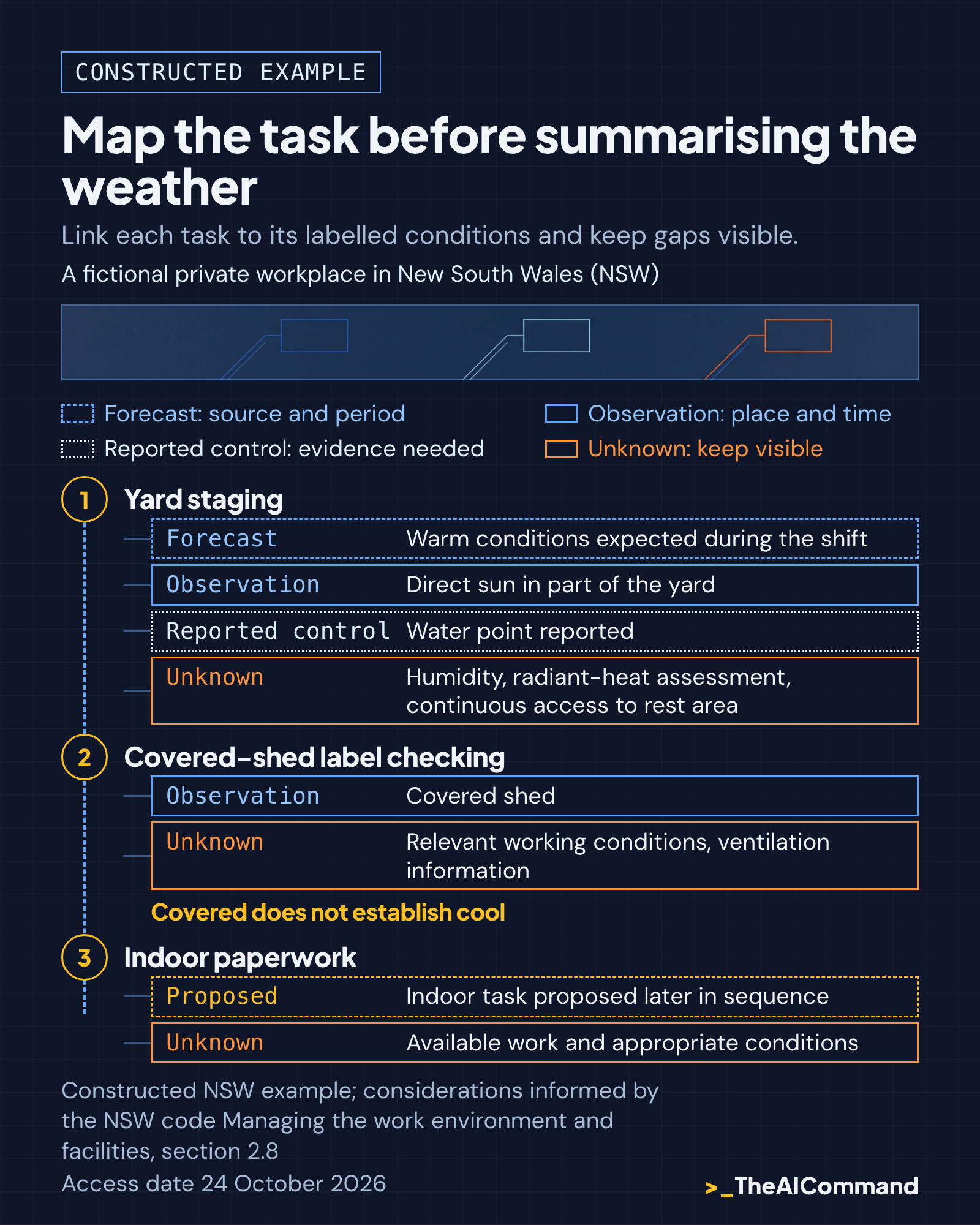
Consider a NSW business preparing equipment for dispatch. The constructed schedule contains three tasks: staging materials in an exposed yard, checking labels in a covered shed and completing dispatch paperwork indoors. The proposed order places yard work first, then label checking, then paperwork. This sequence is an input to review, not an approved heat-control instruction.
The invented planning extract describes warm conditions expected during the shift and direct sun in part of the yard. It records an existing water point and a nominated shaded rest area. It contains no humidity observation, no assessment of radiant heat around stored materials and no confirmation that the rest area will remain accessible during dispatch.
The shed entry says covered, which the model must not silently rewrite as cool. The yard entry says water point present, which is not proof that it is accessible throughout the task. The paperwork entry says indoors, which does not establish a satisfactory indoor environment. These are factual distinctions the reviewer needs to retain.
A supervisor has supplied a draft task description and the organisation's approved heat-management guidance. For this constructed demonstration, that guidance is represented only by a placeholder and source fields. No organisation's actual procedure has been supplied or approved. The example can show the structure of a useful brief without inventing its operational settings.
The model receives the task schedule, the labelled conditions, the regulator excerpts and the missing-information list. Its assignment is to organise a draft with source references. It must separate existing controls from proposed changes and leave authorisation fields empty. Asking whether the schedule is safe would exceed the information and the model's authority.
What a useful draft says
For the yard task, the draft records the supplied exposure description and connects it to the need for competent review. It marks humidity and radiant-heat information as not supplied. It records the water point as a reported existing facility and the rest-area access as unconfirmed. It does not give the task a green status.
For the shed task, the draft retains the description covered shed and asks for relevant information about its working conditions. It does not infer ventilation performance from the building label. For the paperwork task, it records the indoor location and asks the reviewer to confirm that the proposed alternative work is genuinely available and appropriate.
The brief also separates decisions from dependencies. Moving a task to another part of the day is a proposal until the responsible people assess and approve it. That proposal may depend on equipment, staffing or deliveries. Listing those dependencies helps the reviewer see whether a proposed control can actually be implemented.
Safe Work Australia's heat guidance presents a hierarchy that begins with eliminating exposure where possible, then considers stronger controls before administrative measures and personal protective equipment. The brief can organise options in that order for review. It must not reduce the discussion to reminders while leaving task redesign or physical controls unexplored. [3]
Suppose the draft proposes moving the material-staging task into a covered area. The reviewer needs to examine the new location and any other hazards the move creates. The AI output has identified an option, not proved it workable. Keep the proposal open until the appropriate people have resolved its dependencies and assessed the resulting arrangement.
In the constructed example, a human inspection later confirms that deliveries will obstruct the nominated rest-area route. This is an invented event for teaching, not a reported test. The brief is revised to show the failed assumption and the need for another arrangement. The earlier version remains available so the reason for the change is clear.
The reviewer then seeks a workable arrangement through the established process. The model can update the wording when an authorised decision is supplied. It cannot label the problem resolved because someone has suggested a different place. A candidate location and a confirmed arrangement belong in different fields until the evidence supports the change.
Consultation supplies information the documents miss
SafeWork NSW recommends developing and implementing a workplace heat-management plan in consultation with workers, their health and safety representatives, or both. Use the draft to support that conversation. It can show what the documents currently say and where practical knowledge is needed, rather than presenting a completed answer for workers to accept. [2]
Ask about the actual task sequence, access to the facilities and whether proposed changes create other difficulties. Workers may describe a queue, locked door or delivery practice that the schedule does not record. Capture their account accurately, including disagreement, then have the responsible people determine the appropriate response and explain the resulting decision.
Do not let the model convert consultation notes into consensus. If one group reports that the rest area is accessible and another reports repeated obstruction, preserve both accounts. Record the context and the question to resolve. A smooth summary can conceal the information that matters most to the planning decision.
The same care applies when other businesses share the location. The brief needs clear ownership of arrangements that depend on another party. A statement that facilities are available requires confirmation from whoever controls access. The author of a planning document cannot establish that fact simply by placing it in a table.
Keep the briefing usable when conditions change
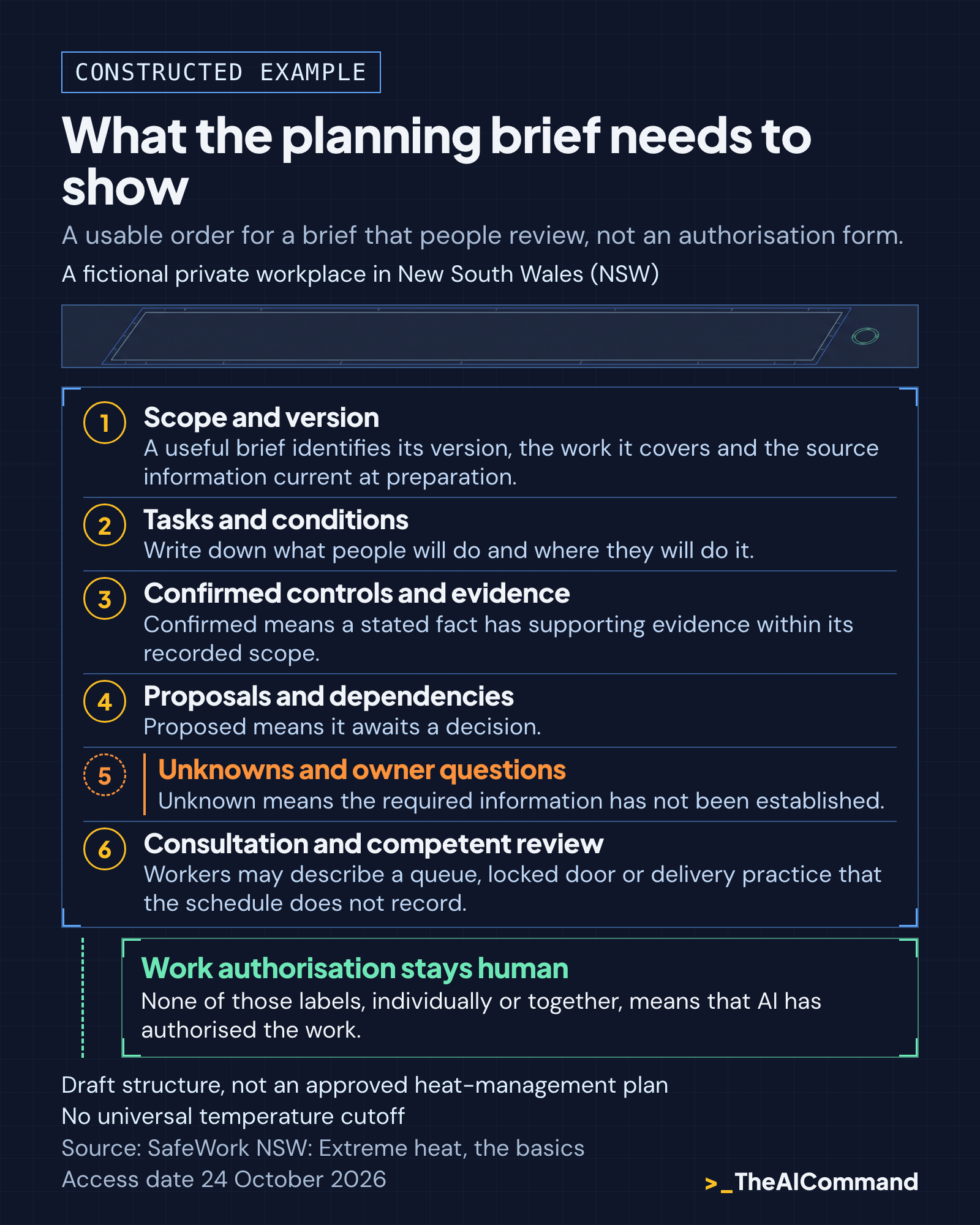
A useful brief identifies its version, the work it covers and the source information current at preparation. It also identifies the person responsible for checking changes before use. If the shift moves, the task changes or a planned control becomes unavailable, the responsible person needs a clear route back to the assessment process.
Keep the summary short enough to use while preserving the supporting record. The front page can describe the work, confirmed arrangements and outstanding decisions. Detailed source extracts and consultation notes can sit behind it. This is an editorial design choice, not a substitute for the organisation's document-control or safety-management requirements.
Make the meaning of every status visible. Confirmed means a stated fact has supporting evidence within its recorded scope. Proposed means it awaits a decision. Unknown means the required information has not been established. None of those labels, individually or together, means that AI has authorised the work.
An AI tool is also unsuitable as the live route for reporting illness or requesting emergency assistance. Workers use the employer's established reporting, first-aid and emergency arrangements. The brief can point to those approved arrangements. It must not encourage someone to wait for a chatbot response or seek a diagnosis from the drafting system.
Check the result before anyone relies on it
The reviewer compares the generated brief with the source pack. Every task needs to remain present, every number needs its original meaning and every control needs its true status. Look for apparently helpful additions. An invented break interval or a rewritten permission can be more consequential than an obvious spelling error.
Check the relation between the summary and its attachments too. If the summary says access confirmed while the supporting note says awaiting facilities review, correct the discrepancy before circulation. A reader may act on the summary without opening the source pack. The brief must not make a stronger claim than its evidence supports.
Finally, inspect whether the draft has hidden an unresolved decision inside reassuring language. Phrases such as adequate shade or suitable breaks need an accountable basis in the workplace process. Replace unsupported conclusions with the precise arrangement and its status. The responsible people can then judge whether it is adequate for the work.
Prepare the next shift's questions
Take one upcoming outdoor task and assemble its schedule, current guidance and known conditions. Identify which controls have implementation evidence and which remain proposals. Use the bounded prompt to organise the material, then take the unresolved questions to the competent reviewer and affected workers before the brief becomes operational.
For a WHS adviser, the useful output is a clearer basis for review and consultation. For a manager, it is a visible account of what still needs to be confirmed. The article's method succeeds when missing information stays visible and decisions reach the right people. It does not succeed merely because a model produces a complete page.
Copyable briefing prompt
Use the heat-planning checklist that accompanies this article to assemble the input before drafting.
Reusable materials: heat-planning brief
Educational NSW planning template. No approved local procedure, heat threshold or operating instruction is supplied.
Heat-planning information checklist
- [ ] Work/task descriptions, locations and proposed sequence are specific.
- [ ] Forecast is labelled with source, issued time, location and forecast period.
- [ ] Site observations are labelled with observer role, location, time and method.
- [ ] Relevant effort, duration, clothing/PPE and environmental information is available for competent review.
- [ ] Personal health matters remain in the authorised confidential process, not the model input.
- [ ] Each existing control has an evidence reference and scope.
- [ ] Proposed changes are separate from confirmed controls.
- [ ] Access to water/rest facilities and dependencies are checked by responsible people.
- [ ] Missing information has a question and accountable role.
- [ ] Approved workplace triggers/settings are copied exactly with source/version, or remain unresolved.
- [ ] Worker/HSR consultation and relevant other-party coordination are documented.
- [ ] Established reporting, first-aid and emergency procedures are referenced without routing an emergency to AI.
- [ ] Competent review and authorisation fields remain blank until completed by people.
Constructed briefing table
All statements are synthetic. There is no actual forecast, observation or inspection result.
Blank brief structure
Do not use a thermal-comfort figure as a universal outdoor work threshold. No hydration, work-rest or acclimatisation prescription is provided here.
Bounded prompt
Review requirement
Check the output against every supplied source. Reject invented values, implied approvals and unsupported conclusions. Preserve the earlier version and record the accountable human decision. The main article and its references set the jurisdiction and role boundaries.
Related reading
- Editorial Standards
- AI Can Stress-Test an Emergency Plan. It Cannot Run the Drill.
- What Happens When a Lone Worker Misses a Check-In?, the companion article for 19 November
References
- SafeWork NSW: Managing the work environment and facilities, section 2.8, August 2019, pages 17 to 19
- SafeWork NSW: Extreme heat, the basics
- Safe Work Australia: Working in heat, managing risks
- NSW Legislation: Work Health and Safety Act 2011 (NSW), current version for 1 July 2026 to date, section 26A
TheAICommand. Intelligence, At Your Command.