
A roster can start the discussion
A work health and safety adviser receives a spreadsheet showing several early starts, extended finishing times and a recurring late task. Management wants a fatigue briefing before the next roster is issued. The spreadsheet offers something useful, but it does not contain sleep, actual recovery, task intensity or the experience of the people doing the work.
The first drafting decision is therefore about the question. Ask what the available work records suggest should be explored through consultation. Do not ask which workers are fatigued. The latter invites a model to turn administrative data into an individual assessment without the information or authority needed to make it.
A useful brief can say that a shift span increased, that a particular task is scheduled near the end of several shifts or that actual break information is missing. Those observations give people something concrete to discuss. Their usefulness depends on keeping the missing context beside them, so a reader does not mistake a descriptive pattern for a completed risk assessment.
This article uses a fictional private warehousing employer operating under New South Wales work health and safety arrangements. It does not concern heavy vehicle driving, aviation, mining or another specialist working-hours regime. The example is deliberately small enough to check manually. Every input and sample response is constructed, with no real worker records and no claim of a product trial.
Identify the applicable guidance before analysing hours
Safe Work Australia published its model fatigue code on 19 September 2025. A national model document and an approved jurisdictional code are different things. For this NSW example, the SafeWork NSW fatigue code records commencement on 20 February 2026. Use the applicable NSW material when reviewing the workplace process.
The NSW code addresses work hours and shift design alongside task demands and other contributing factors. It also describes using multiple information sources to identify fatigue-related hazards. That supports a consultation brief which combines work records with questions about how work happens. It does not support a formula that declares every shift below a selected number of hours safe.
SafeWork NSW's current codes guidance also explains the code-compliance duty in section 26A of the NSW WHS Act, which commenced on 1 July 2026. It describes a PCBU duty to comply with an approved code or to manage hazards and risks in a different way that provides an equivalent or higher standard of health and safety. Have the responsible adviser check the current requirements and organisational arrangements. A template downloaded years ago may describe a different regulatory position.
Keep the article's workflow separate from those legal judgements. The proposed brief is a preparation aid for consultation and risk management. It does not certify compliance with the code or establish the adequacy of existing controls. Where an immediate safety concern is identified, use the workplace's response process rather than waiting for an AI analysis or the next scheduled meeting.
Use the smallest dataset that can answer the question
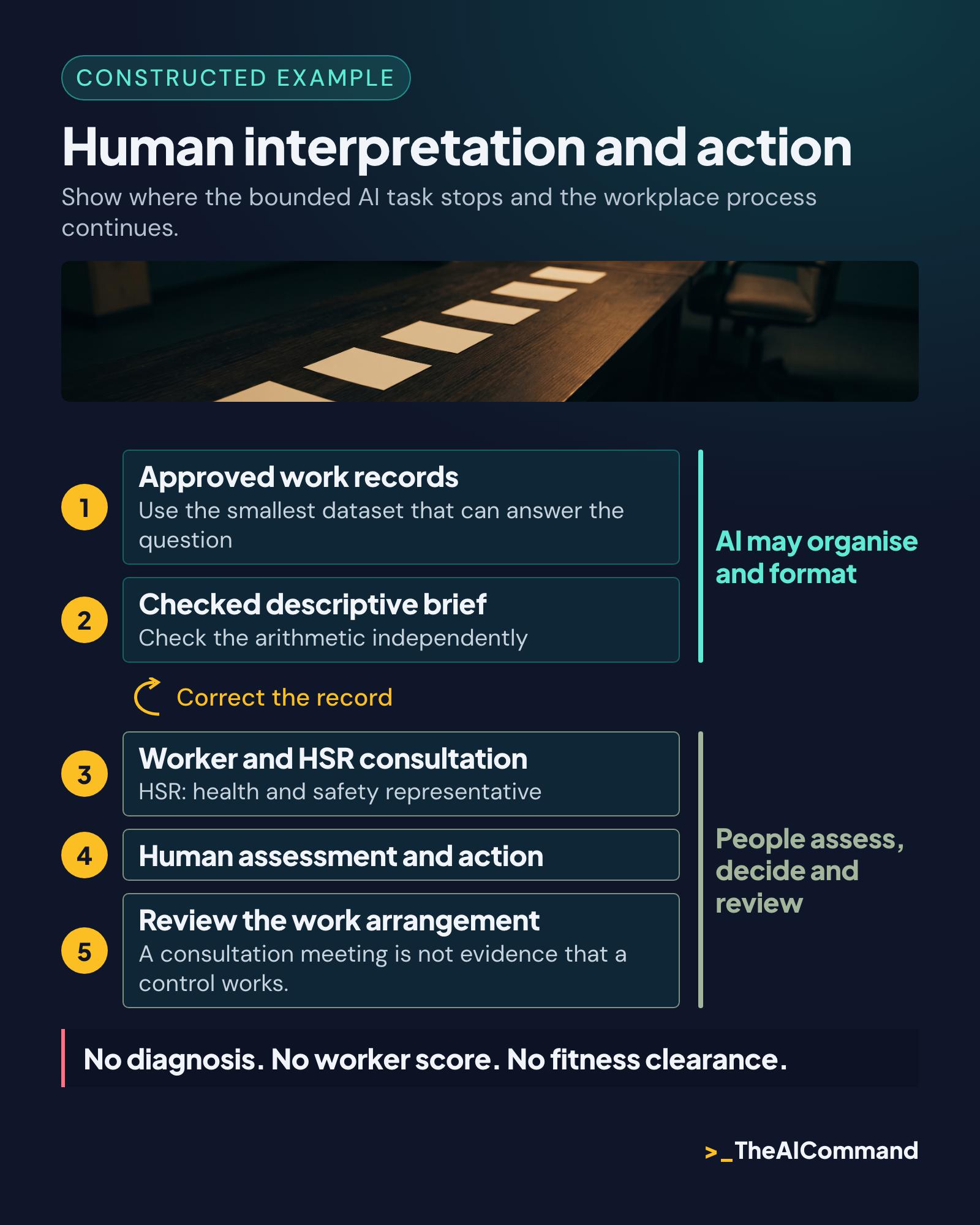
Choose a defined work group, period and operational question. Start with role-level scheduled starts and finishes, the status of those records and factual task-demand notes. Distinguish a roster from time records, and distinguish both from an employee's report. Without those labels, the model may treat planned breaks as taken breaks or a scheduled finish as proof that work stopped.
Give every row a stable identifier. Record the time zone and include dates where a shift crosses midnight. Document any excluded rows and the reason. A missing finish time should remain missing rather than being filled from the most common shift. Keep the original supplied version so a reviewer can reproduce the calculation after the draft has been edited.
Use operational details only where they help explain the question. A note that a batch-checking task occurs late in a shift can be useful. An individual's medical history, family situation or personal messages do not belong in this general preparation pack. Where personal circumstances need discussion, provide an appropriate confidential route handled by the responsible people.
The OAIC's commercial AI guidance explains privacy risks in both inputs and inferred outputs. Applicability depends on the entity and information involved. Do not assume that a private employer, an employee-record label or removal of names automatically makes an upload acceptable. Obtain the organisation's privacy and security assessment for the proposed use.
For rehearsal, construct a small dataset independently of actual records. Calling a transformed employee roster "synthetic" does not establish that it is anonymous. In operational reporting, small groups, distinctive shifts and exact dates may allow identification. Choose aggregation and access controls for the context, and check that the output does not recreate details removed from the inputs.
Define the arithmetic before the writing
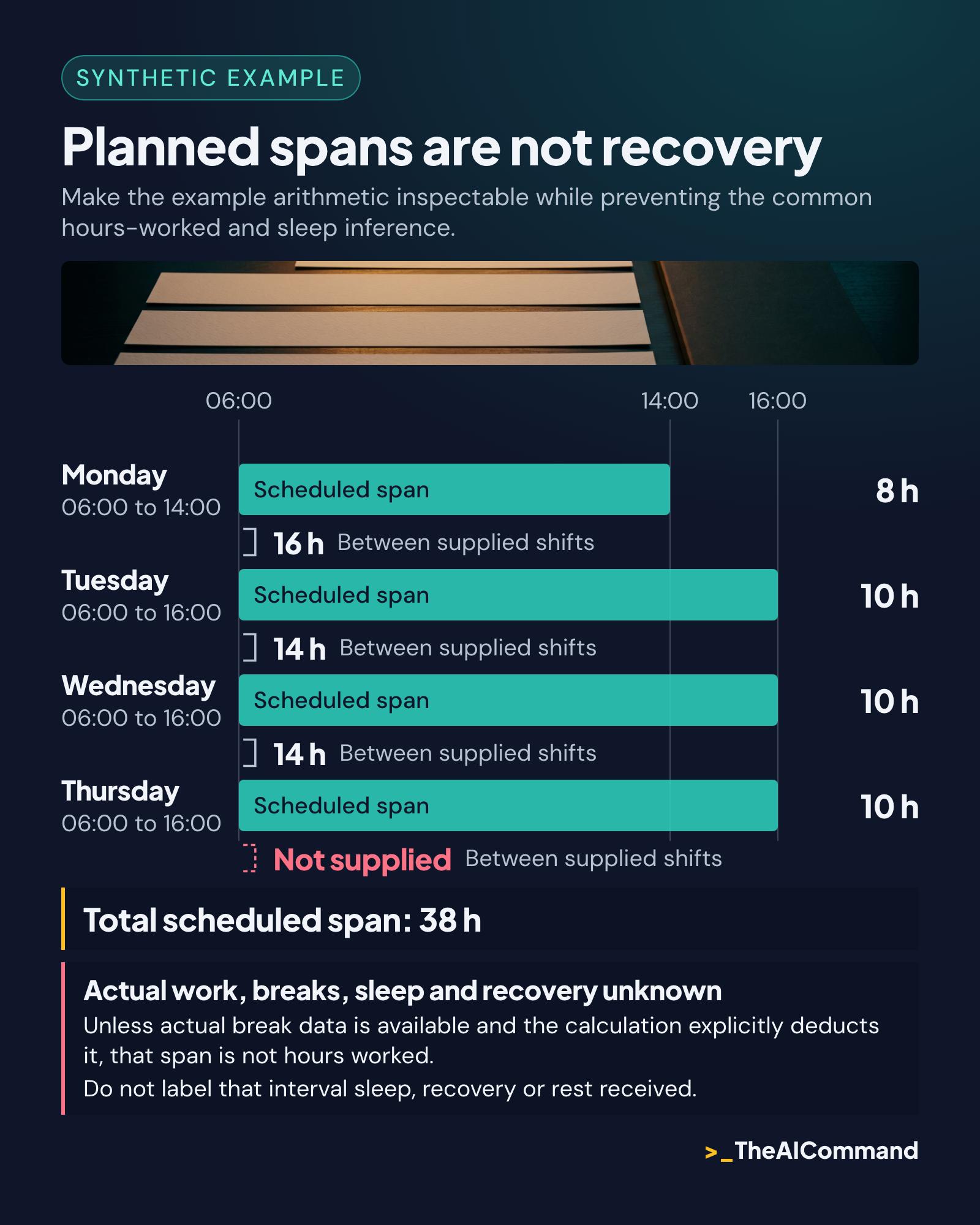
Calculate simple quantities in a spreadsheet or another checked tool, then ask AI to describe them. Define shift span as the elapsed time from the supplied start to finish. Unless actual break data is available and the calculation explicitly deducts it, that span is not hours worked. It is also not a measure of physical or mental demand.
Define the interval between shifts as the elapsed time between one supplied finish and the next supplied start for the same work sequence. Do not label that interval sleep, recovery or rest received. Travel, domestic activity, interrupted time and unrecorded work are not established by the roster. The wording of the column matters because readers often carry it directly into a meeting paper.
Do not combine unrelated workers' shifts to create a fictional individual sequence. In the example, a single synthetic role sequence is intentionally used for arithmetic. In an actual grouped dataset, totals and distributions need a clear unit of analysis. A team average can conceal a very different experience for people on a particular shift or handling a particular task.
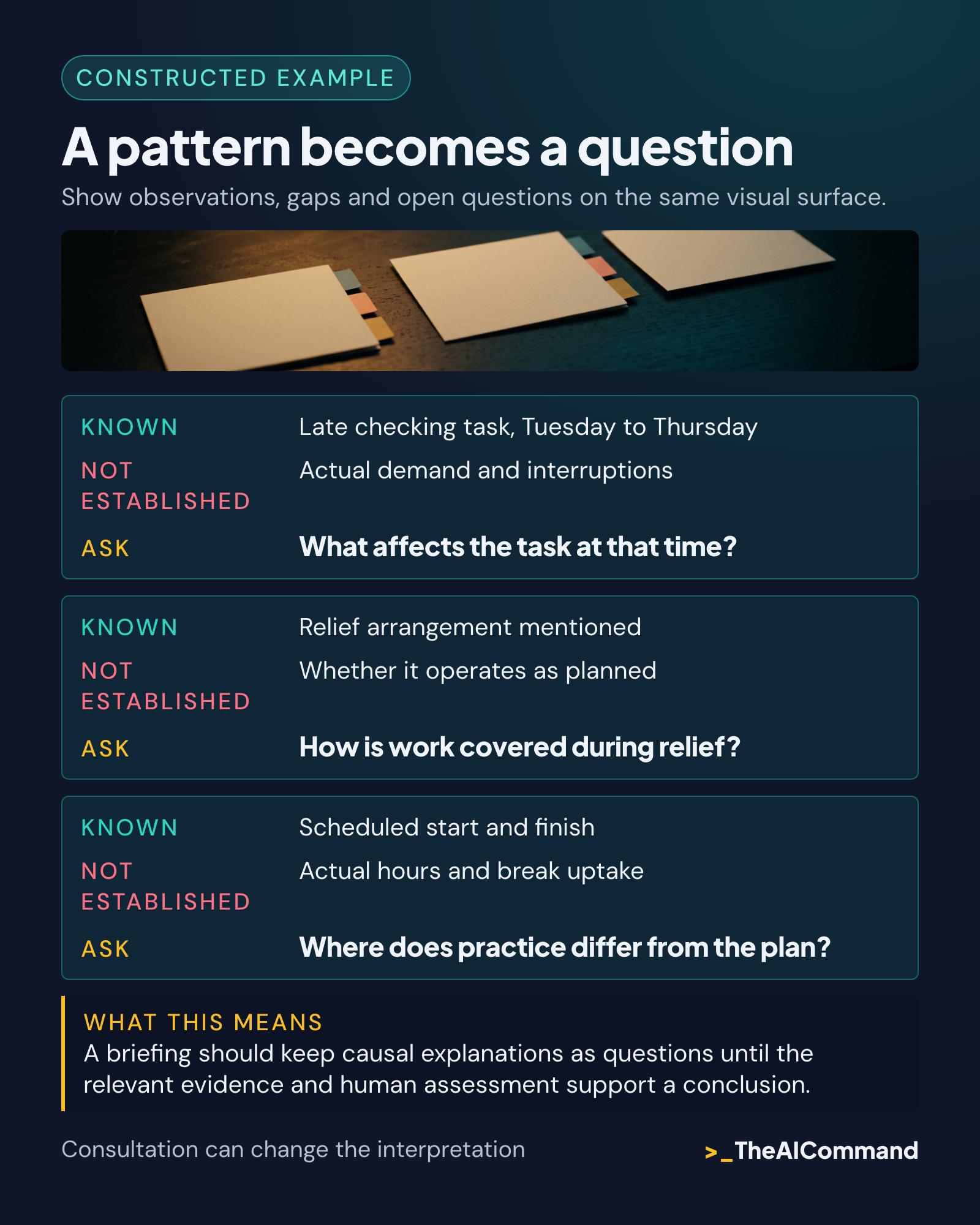
Ask the model for an observation only when the source supports it. "Three supplied shifts each span ten hours" is checkable. "The team is exhausted" is an unsupported inference. "Long shifts caused the errors" requires evidence beyond the pattern. A briefing should keep causal explanations as questions until the relevant evidence and human assessment support a conclusion.
Worked example: the late checking task
The constructed input contains four consecutive shifts in one fictional role sequence, from Monday to Thursday. Monday runs from 06:00 to 14:00. Tuesday, Wednesday and Thursday each run from 06:00 to 16:00. These are planned times. No actual attendance, overtime or break records are supplied. All times use the same local time zone and no daylight-saving transition occurs within the example.
The spans are eight, ten, ten and ten hours, totalling thirty-eight hours of scheduled span. The intervals from the first three finishes to the following starts are sixteen, fourteen and fourteen hours. These numbers describe the constructed rows. They are not legal thresholds, actual work totals or proof of sufficient recovery. The same figures appear in the reusable table so a reader can check them.
A fictional task note says that detailed batch checking is planned between 14:30 and 15:30 on Tuesday, Wednesday and Thursday. A second note says a relief arrangement exists but provides no evidence of when it operates. The briefing therefore has two useful areas to explore: the placement of a concentration-demanding task and whether the planned relief is available in practice.
The sample output says that the late checking task occurs on each of the three extended scheduled shifts. It asks workers whether the time allocated matches the actual demand, what interruptions occur and whether other duties compete for attention. It asks the supervisor to clarify the relief arrangement. It does not infer that an error occurred or that anyone was fatigued.
The adviser verifies the durations independently and labels the table "scheduled span, not actual hours worked". The adviser also checks that the sample question does not assume that moving the task earlier would solve the problem. Earlier work may have its own demands, and a change could transfer pressure to another group. Consultation is needed to understand those dependencies.
A useful next step could be to examine whether the task can be rescheduled, resourced differently or redesigned, alongside other relevant controls. Those are options for competent human consideration, not recommendations selected by the model. No person is cleared to work and no roster is approved by producing the brief. The output is a transparent starting point for the workplace process.
Make consultation capable of changing the proposal
SafeWork NSW's duty-to-consult guidance identifies consultation when hazards are assessed and decisions about controls or relevant changes are made. The fatigue code also includes health and safety representatives who represent affected workers. Use the agreed consultation arrangements and provide information early enough for people to influence the proposal.
For the synthetic example, share the source table, definitions and known limitations before asking for views. Explain that the exercise concerns work design and that the draft does not make findings about individuals. Give workers a way to correct the description of the job. A person may identify an unscheduled handover or a task dependency that changes the interpretation of the table.
Ask about situations that the records cannot answer. Does the late task finish at the planned time? Can someone take the planned break without leaving work uncovered? Which demands increase when the shift is extended? Keep the questions open enough to hear a different explanation. A briefing that asks people merely to endorse the preferred roster has already narrowed the answer.
Provide a confidential route for concerns that should not appear in a group discussion. Do not invite disclosure of health conditions into an AI prompt or put identifiable accounts into a shared summary. The general brief can record that additional confidential consideration is required without exposing the underlying personal information to everyone attending the meeting.
Record what workers and representatives said, how the proposal changed and which issues remain unresolved. Identify the person responsible for the next assessment or control decision. Where a suggestion is not adopted, record the reason and communicate the outcome through the agreed process. The AI can format approved notes, but it must not infer agreement or remove an inconvenient minority view.
Review the work after an action is taken
Before reusing the prompt, test how it responds to a missing finish time and an ambiguous task note. The expected output should refuse to calculate an unsupported total and retain the ambiguity. Keep that check separate from assessing the workplace. A successful formatting test shows only that the template handled those supplied examples; it does not validate fatigue predictions or demonstrate safer work.
A consultation meeting is not evidence that a control works. Decide what information will be reviewed after any authorised change, by whom and when. For the constructed checking task, this might include whether the task actually moved, whether relief was available and what workers report about the resulting demands. Each measure should answer the reason the change was considered.
Avoid turning the review into an individual surveillance score. Track the operation of the work arrangement and any relevant safety information through approved processes. A lower count of reports can reflect a change in reporting behaviour, so it does not by itself establish lower risk. Discuss what would count as contrary evidence before celebrating a favourable-looking result.
Retain the input version, checked calculations, consultation record and authorised outcome. If actual-hours information later differs from the roster, update the affected observations visibly. Do not silently substitute new numbers in an earlier brief. A reviewer should be able to see why the interpretation changed and which follow-up actions need reconsideration.
For WHS advisers, start with one defined work-pattern question and a small table that can be independently checked. For operational managers, make time for workers to explain the work the roster cannot show. Use the AI draft to focus that conversation, then record the human assessment and action. The successful brief is useful because its evidence and limits remain visible together.
Synthetic input and checked calculations
These fictional values are training material, not limits or a risk score. Time zone: Australia/Sydney, a week with no daylight-saving transition.
Total scheduled span: 38 h. Actual hours worked, breaks, sleep and recovery are unknown. T1: detailed batch checking planned 14:30 to 15:30 Tuesday to Thursday. T2: relief arrangement exists; operation is not described.
Copyable consultation prompt
Fatigue consultation brief: reusable materials
Draft preparation templates for a fictional private NSW warehouse. This is work-design consultation, not diagnosis, fitness assessment, compliance certification or a replacement for risk management. No real worker data used.
Synthetic inputs
One role sequence, consecutive days, Australia/Sydney local time, no daylight-saving transition. No actual attendance, breaks, overtime, commute, sleep or recovery information. T1: detailed batch checking is planned 14:30 to 15:30 Tuesday to Thursday. T2: a relief arrangement exists; operation not described. All values are fictional, not real records renamed or perturbed.
Calculation rules
- Span = scheduled finish minus scheduled start; no breaks deducted.
- Intershift interval = next supplied start minus preceding supplied finish, following the same sequence across days.
- Total span = 8 + 10 + 10 + 10 = 38 h. These are not actual hours worked.
- Intervals = 16, 14, 14 h. Thursday next start unknown. These are not hours slept or recovery received.
- No threshold or safe/unsafe classification is assigned to any number.
- For operational data, define dates, time zones, midnight/DST handling and missing data rules before calculation. Never join separate workers into one sequence.
Limitations-aware analysis prompt
Example expected output
Illustrative output authored for this guide, not an observed product test. No worker condition or risk clearance follows from these rows.
Consultation brief template
Reviewer checklist
- [ ] Scope and applicable NSW requirements confirmed by the responsible adviser.
- [ ] Data selection and tool pathway authorised; no claim that name removal proves privacy.
- [ ] Arithmetic checked outside the model and record types retained.
- [ ] No roster interval described as sleep or actual recovery.
- [ ] Missing values remain missing; population inference and causation avoided.
- [ ] No diagnosis, vulnerability score, fitness clearance or universal hours threshold.
- [ ] Affected workers and representing HSRs can influence the proposal.
- [ ] Confidential concerns have a suitable human route.
- [ ] Consultation changes, reasons and unresolved issues recorded without inferred consensus.
- [ ] Operational action and effectiveness review owned by people.
Reuse test
Use the synthetic pack first. Remove R3's finish time, and change T2 to say relief availability is disputed. Expected behaviour: no invented span or total for the incomplete period, and a question preserving the disputed relief status. This is a proposed acceptance exercise, not a completed model test. Later operational use needs the organisation's data, tool, privacy and consultation approvals.
Related reading
- An AI Safety Control Is Still Just a Control. The Duty to Verify It Stays With You., on verifying AI-based safety controls, a different question from consultation preparation
- Maintain a Working Project With Codex, the companion article for 14 November
References
- Safe Work Australia: Model Code of Practice: Managing the risk of fatigue at work (published 19 September 2025)
- SafeWork NSW: Code of Practice: Managing the risk of fatigue at work (February 2026, commenced 20 February 2026)
- SafeWork NSW: Codes of practice
- Office of the Australian Information Commissioner: Guidance on privacy and the use of commercially available AI products
- SafeWork NSW: Duty to consult
- NSW Legislation: Work Health and Safety Act 2011 (NSW), current version for 1 July 2026 to date, section 26A
TheAICommand. Intelligence, At Your Command.