The inspection notes say the passage was obstructed again. Another line says the loading area was slippery. A third says the machine was making an unusual sound. By the time those observations reach the action register, they have become three instructions to improve housekeeping.
That translation has lost the useful information. The repeated obstruction may need more than another tidy-up. The slippery surface has no confirmed cause. The unusual sound has no identified machine. An action table becomes less useful when its writer resolves those uncertainties without asking anyone.
A practical AI task is to organise the notes while preserving the questions that require a person. This article uses a fictional private distribution workplace in New South Wales. Its inspection notes, draft rows and review decisions are constructed. They are not records from a real inspection or results from a tested AI workflow.
Respond to the workplace before processing the notes
An inspection record is a record of work, not permission to delay the response. SafeWork NSW's workplace inspections guidance says serious hazards or unsafe work practices must be fixed immediately, which it describes as a legal obligation, with less serious hazards prioritised, assigned to someone and followed up. The people at the workplace must assess the situation and act through the relevant arrangements. Do not wait for a model to format a register.
The same guidance encourages observation, worker discussion and recording what was seen. That matters because an inspection note is often compressed. A short phrase can be adequate for the person who wrote it and inadequate for the next person receiving it. The drafting process should expose that difference rather than guess at the missing context.
Keep urgent response and administrative follow-up connected but distinct. If the responsible person arranged an immediate response during the walk, capture that fact and its source. If the note does not say what happened, leave it unknown. Never turn a phrase such as reported to supervisor into a statement that a hazard was controlled.
For this NSW example, the local risk-management code is the starting reference for the wider process. Since 1 July 2026, section 26A of the NSW Work Health and Safety Act 2011 has required a PCBU to comply with an approved code of practice or manage the risk to an equivalent or higher standard. Any approved code covering a hazard found on the walk-through, such as the codes on the work environment and on plant, therefore also needs checking. The risk-management code's review and record sections support preserving decisions, implementation and consultation information. The table below is an editorial working aid, not a statutory form or a replacement for the applicable hazard-specific assessment.
Keep the original observation intact
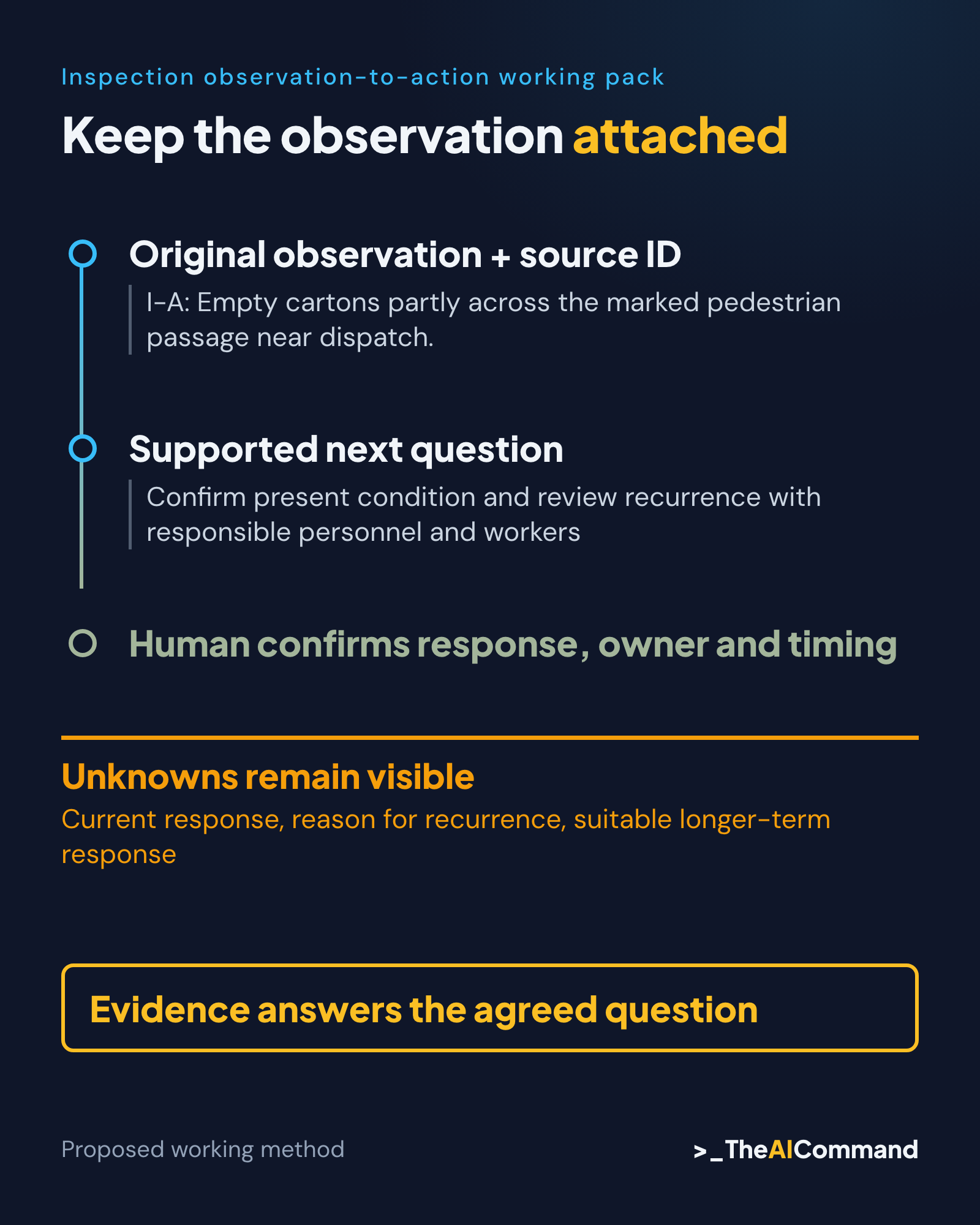
Copy the source observation into a protected field and give it an identifier. Retain the date, location and inspector role where those details are supplied. Store permitted photos or related records in their controlled location. The draft action field can then change without quietly changing the historical observation.
Distinguish what someone saw from what someone inferred. A note about a wet surface describes an observation. A statement that a leaking pipe caused it needs evidence. If the note records a worker's explanation, attribute it as that person's account for review. Do not silently upgrade it into an established cause.
Also distinguish a past event from a current condition. An old note about an obstructed passage does not prove the passage is obstructed now. A fresh note describing the same location can justify investigating recurrence, but the reviewer still needs the relevant timing and circumstances. Preserve both records so the pattern can be examined.
A usable source packet contains the inspection notes, relevant prior observations and approved response records. It need not include every safety document in the organisation. Limit the packet to material authorised for the task and remove unnecessary personal information. Workers' health details and unrelated complaints do not belong in a generic extraction exercise.
Work through the constructed notes
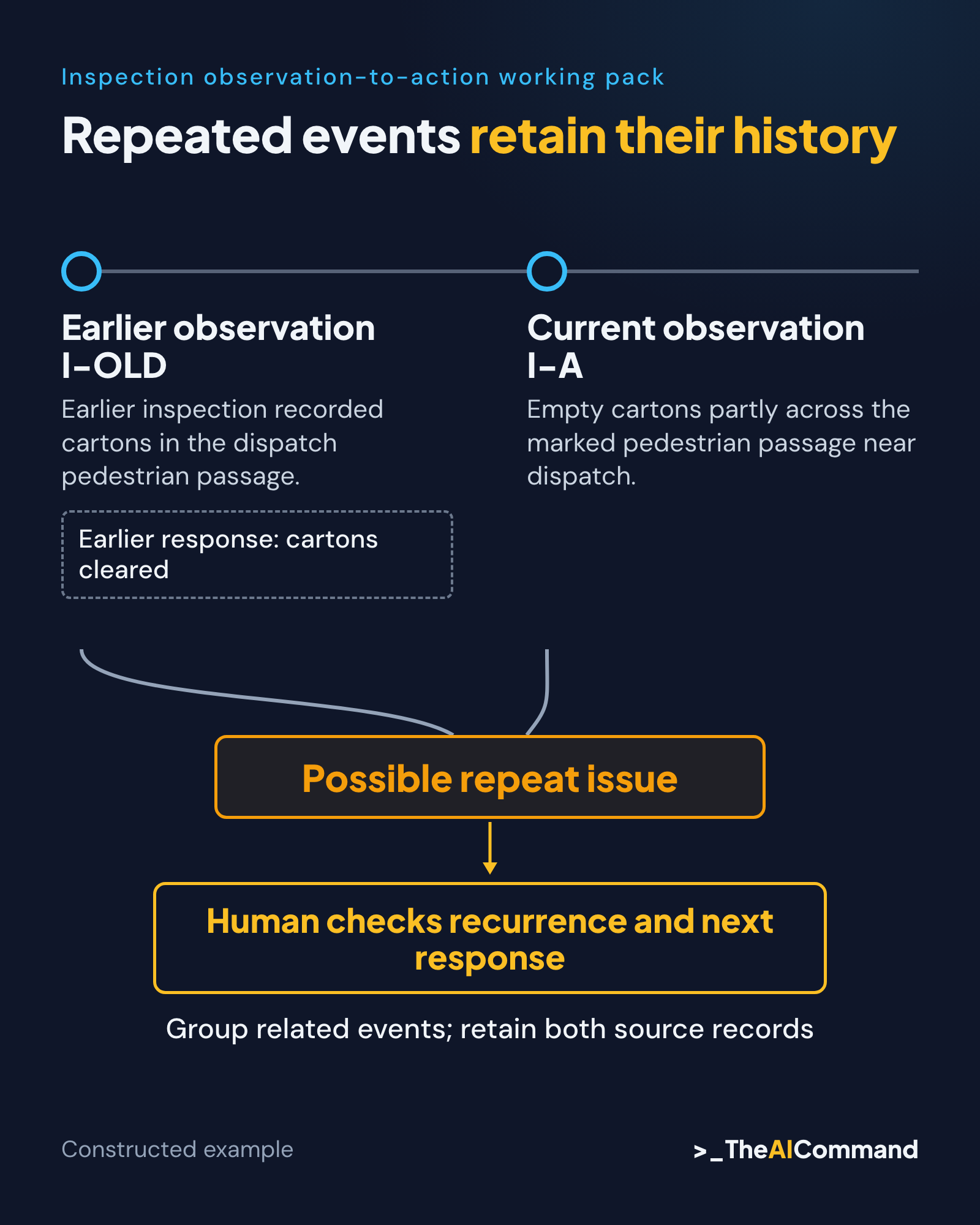
The fictional inspector records that empty cartons were partly across the marked pedestrian passage near dispatch. A previous inspection note describes cartons in the same passage. A separate response record says the earlier obstruction was cleared, but gives no information about why the cartons were placed there or whether the arrangement changed.
The draft groups these records as a possible repeat issue while retaining each source identifier. It proposes confirming the present condition and examining the circumstances behind recurrence. It does not combine them into a single undated event or infer that workers ignored instructions. The human reviewer needs the earlier response to remain visible.
The next note describes a slippery patch near the loading doorway and adds that the source is unclear. A worker's note says the condition appears during wet weather. This is useful information for a follow-up conversation, but it does not establish the cause. The proposed row requests competent inspection and clarification of the conditions.
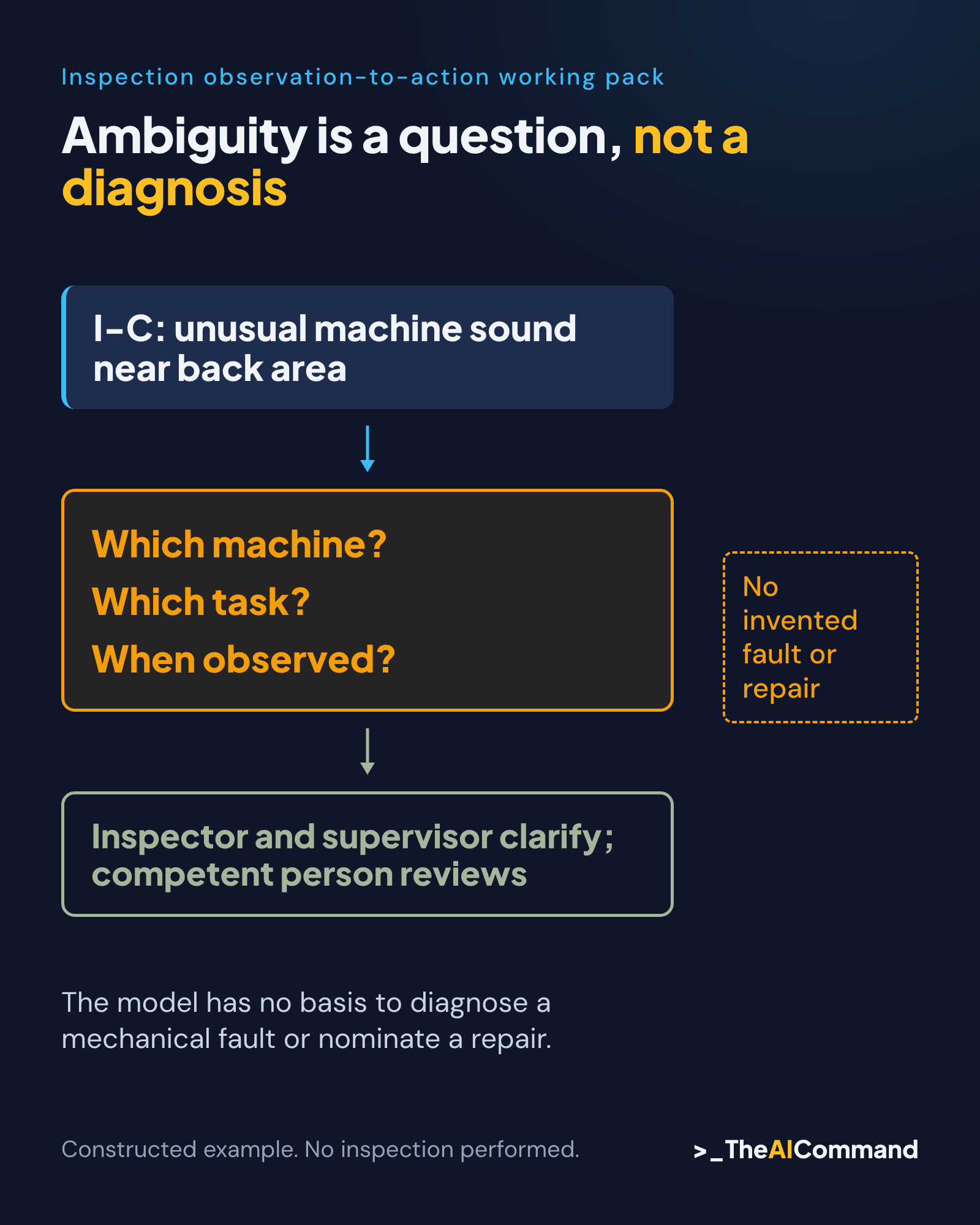
The final note says a machine sounded unusual near the back area. It names neither the machine nor the task underway. The model has no basis to diagnose a mechanical fault or nominate a repair. The supported next step is to identify the equipment and circumstances promptly through the inspector and responsible supervisor.
These rows need different routes. The repeated obstruction needs a review of the work arrangement and earlier response. The slippery patch needs clarification of the condition and appropriate assessment. The unidentified machine needs enough information to locate the issue. A universal instruction to remind staff would obscure all three.
Constructed observation-to-action draft
The constructed reviewer accepts the first row for a recurrence discussion but rejects an added suggestion that training is the cause. The second row stays open for assessment because the worker account is not a diagnosis. The third is sent back for location details. These are fictional review outcomes, not evidence that a particular prompt reliably produces them.
Notice that asking for clarification is itself an action. It needs someone responsible for obtaining the missing fact and returning it to the record. A row labelled unclear with no route back to the inspector can remain unresolved indefinitely. Give uncertainty a practical destination without pretending its answer is known.
Group repeat observations without deleting their history
Repeated notes can be difficult to recognise when people use different names for the same place. AI may help propose a grouping, but the reviewer must confirm that the records refer to the same location or activity. Retain the original location text until that mapping is checked.
Use a parent issue with linked observations if the existing register supports it. If it does not, a shared reference in each row is enough. The purpose is to preserve the recurrence history, not to build a new reporting system. Avoid deleting duplicate-looking rows until a person confirms they describe the same event rather than repeated events.
A repeated observation deserves attention to the previous response. Was the item removed once, was the storage arrangement changed, or was a wider action left incomplete? Those are different histories. Ask the tool to retrieve the documented response and identify what is absent, then let the responsible people decide what the pattern means.
Keep frequency claims out unless the source set supports them. Several supplied notes do not establish how often a condition occurred across the workplace. A statement that it recurred in the supplied records is narrower and usually more defensible. If frequency matters to the assessment, obtain an appropriate source rather than extrapolating from the draft.
Allocate the next decision, not just a task name
An action such as investigate has little value without a defined question. For the dispatch passage, the question is why the condition returned and what response is appropriate. For the loading doorway, it is what the condition is and under what circumstances it arises. Write the question clearly enough that the assigned person can return a useful answer.
The proposed coordination role is not a confirmed owner. The responsible manager must identify someone with authority, access and the necessary competence or support. A WHS adviser may help coordinate without being responsible for maintenance work or operational decisions. Confirm those boundaries instead of letting a role label substitute for agreement.
Have the responsible person set timing against the actual risk and the organisation's requirements. The model must not supply standard deadlines simply to fill a blank column. A proposed administrative follow-up date can be useful, but mark it as proposed until confirmed. Record escalation arrangements for missing decisions or overdue work.
Consult the people who perform the affected tasks and involve the relevant health and safety representative where applicable. Ask whether the note describes ordinary conditions and whether a proposed response would create difficulties elsewhere. Keep unresolved views in the record. A register distributed after a decision is not evidence that consultation shaped that decision.
Decide what evidence will answer the follow-up question
Choose evidence that fits the action. A record of a cleared passage can support completion of a particular housekeeping response. It cannot, by itself, establish that the storage arrangement prevents recurrence. If the agreed action concerns recurrence, the reviewer needs evidence appropriate to that broader question.
A photograph is useful only within its limits. It may show a condition at a particular time and viewpoint while excluding the task or area that matters. Keep the original context and permitted metadata. Do not ask AI to turn an ambiguous image into a definitive safety finding, and never use generated imagery as an inspection record.
For the slippery patch, the evidence might include the competent person's observations and the agreed response record. The exact assessment and control decision depend on what is found. The draft should request the relevant evidence without supplying a cause, technical specification or assurance that the selected response will work.
For the machine note, successful clarification may identify the equipment and lead to an entirely separate action. Close the clarification only when its question is answered and the remaining work is linked. Otherwise a resolved location query can make an unresolved equipment concern disappear from the dashboard.
Check the draft for five common distortions
Read each row against its original note before using it. Look for an observation transformed into a cause, an account transformed into a fact, a proposed role transformed into an owner, a past response transformed into current protection, or a question transformed into a completion statement. Each distortion changes what the next person thinks is established.
Check omissions as well as additions. If the note says the issue occurs during a particular task, that condition belongs in the follow-up. If the source records uncertainty, the draft must preserve it. A shorter action can remain faithful, but the qualifying information needs to be visible at the point where decisions are made.
Review any suggested priorities separately. This workflow does not give AI authority to rate risks or determine legal notification requirements. An unfamiliar observation needs competent review. The correct administrative output can be a clear referral containing the known facts and unknowns, without a speculative hazard label attached.
Keep a record of accepted and rejected changes during the first approved trial. That helps establish whether the tool reduces clerical work without increasing review effort or losing source meaning. No efficiency claim is made here because the example has not been run. An actual trial needs its own evidence and authorised handling arrangements.
Return the outcome to the people doing the work
Once an action is confirmed, make its status understandable to the affected people. Distinguish an allocated task from a completed response and a completed response from an effectiveness review. The record should explain what changed, what still needs attention and how a new concern can be raised.
SafeWork NSW's inspection guidance includes communicating findings to workers and making inspection reports available to the relevant representative or committee. Use the appropriate workplace channels and permissions. AI can prepare a proposed summary from approved decisions, but sending it and confirming its accuracy remain human responsibilities in this workflow.
The existing article on risk-register currency considers how changing conditions reach control reviews. This piece begins earlier, with the inspection observation. A confirmed action or review need may feed that wider process, but an inspection extract should not silently rewrite the whole risk register.
Start with one inspection sheet
Take one permitted, de-identified inspection sheet and its relevant earlier observations. Preserve the original wording, use the extraction prompt and compare every proposed row with the source. Bring missing decisions to the responsible people before transferring accepted actions into the official system.
The test is whether someone receiving the register can tell what was observed, what is still unknown and who will resolve it. Keep repeated issues connected to their history. Keep completion tied to the agreed evidence. The notes become useful when they direct accountable follow-up without inventing the facts that follow-up must establish.
Copyable extraction prompt
Acceptance checklist
- Original observations and dates remain available.
- Repeated events are linked without being erased.
- Causes and uncertain accounts remain qualified.
- The responsible person confirms response, owner and timing.
- Closure evidence answers the actual follow-up question.
Inspection observation-to-action working pack
Status: constructed, untested teaching material for a fictional NSW private distribution workplace. Immediate workplace responses occur through established arrangements without waiting for AI processing.
Constructed notes
Observation-to-action register
Copyable prompt
Constructed review exercise
Human review and return record
Use only authorised, de-identified inputs in an approved environment. Remove unrelated health details, complaints and personal identifiers. Do not treat an AI image interpretation or generated scene as an inspection. Test this packet only in an approved trial and record actual errors; this pack reports no run.
Related reading
- A Risk Register Is Not Current Because AI Reworded It
- What Counts as Evidence That an Audit Action Is Closed?, the companion article for 8 November
References
- SafeWork NSW: Workplace inspections
- SafeWork NSW: How to manage work health and safety risks, sections 5 and 6
- SafeWork NSW: Codes of practice, for current NSW status and obligations
- NSW Legislation: Work Health and Safety Act 2011 (NSW), current version for 1 July 2026 to date, sections 26A and 47 to 49
TheAICommand. Intelligence, At Your Command.