
The occupational noise report has arrived. Maintenance has received the enclosure recommendation, operations has seen the hearing-protection section, and the report is filed. At the next safety meeting, nobody can explain who is checking the work the assessor did not observe.
That gap starts when a report becomes a task list without its qualifications. A recommendation to investigate an option becomes an instruction to buy it. A finding about one operating condition becomes a statement about the whole workshop. The register looks useful because uncertainty has disappeared.
A better follow-up process preserves what the specialist actually said, then adds the decisions needed to act. This article uses a fictional private manufacturing workshop in New South Wales. Every report excerpt, proposed output and review decision below is constructed for teaching. No measurement, AI workflow test or site inspection was performed.
Decide what the report can support
Start with the complete authorised report, including its appendices and any later clarification. Record its version and the work it assessed. A recommendation extracted from an executive summary may depend on information in a task description or limitations section. Keep those parts together before asking a model to organise anything.
The NSW noise code places assessment with a competent person. Its sections on assessment reports and reviewing controls connect findings with control selection, communication and follow-up. Those requirements do not turn a language model into a noise assessor. The workflow here is an editorial method for administering follow-up.
Check the jurisdiction before relying on a national model document. SafeWork NSW currently lists the noise code as a December 2022 code. Its codes page also explains section 26A of the Work Health and Safety Act 2011 (NSW), which commenced on 1 July 2026: a person conducting a business or undertaking must comply with an approved code or manage the risks in a different way that provides an equivalent or higher standard. Use the current NSW position when checking obligations. The code's December 2022 foreword predates section 26A and describes "should" as a recommended course of action, whereas SafeWork NSW now explains that "should" identifies the standard a code requires.
The first practical question is scope. Did the assessment cover ordinary production, changeovers, maintenance work or only a particular operating sequence? If an activity was excluded, carry that exclusion into every action whose interpretation depends on it. A clean spreadsheet must not expand the report's coverage.
Keep measurement information attached to its context if the real report includes it. Preserve the original metric, units, duration and qualifications, and ask the assessor to resolve any uncertainty. This example deliberately contains no measurements or exposure limits. There is no useful reason to invent a number to demonstrate clerical extraction.
Build a small source packet
Prepare a permitted working copy under the organisation's information-handling rules. Remove personal information and commercially sensitive details that the task does not need. Employee hearing results do not belong in a general-purpose drafting exercise. De-identification also does not make an otherwise prohibited upload acceptable; use only an approved environment for the material.
Give every source passage a stable reference. A page and section are often enough for a short report, with an excerpt identifier for the working copy. Avoid relying on the document's visual position after text extraction. Check that tables, symbols and footnotes remain associated with the right findings.
Include a short description of the output you need. The model is to extract recommendations, preserve dependencies and identify missing decisions. It is not to supply fresh technical advice. If an owner or deadline is absent, the correct output is a visible gap for a human to resolve.
Separate three kinds of source statement before drafting actions. A finding describes what the assessment established. A recommendation proposes a response. A limitation restricts the conclusions available. A single passage can contain all three, so the working record needs room to retain their relationship rather than choosing only one label.
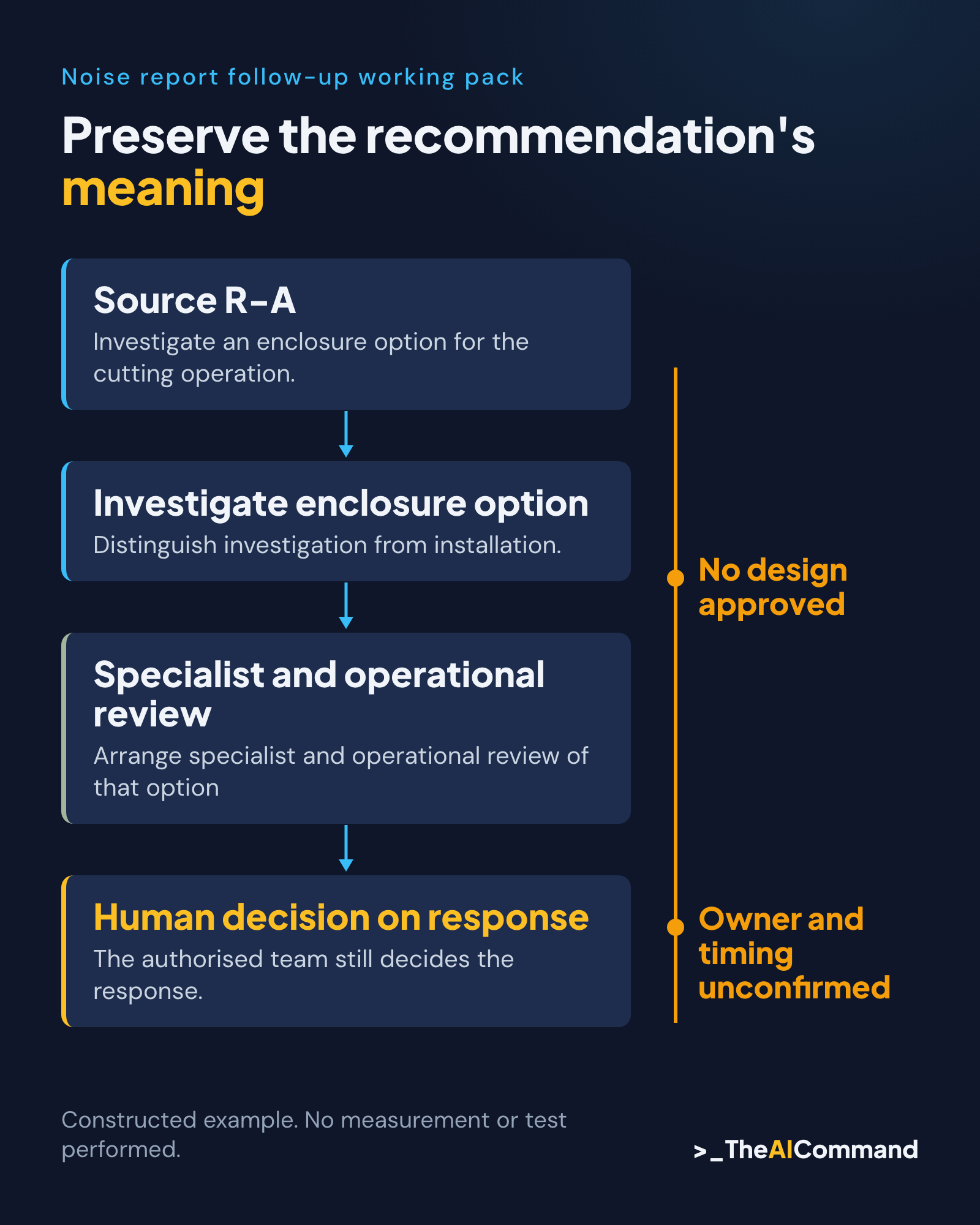
A constructed report becomes a reviewable register
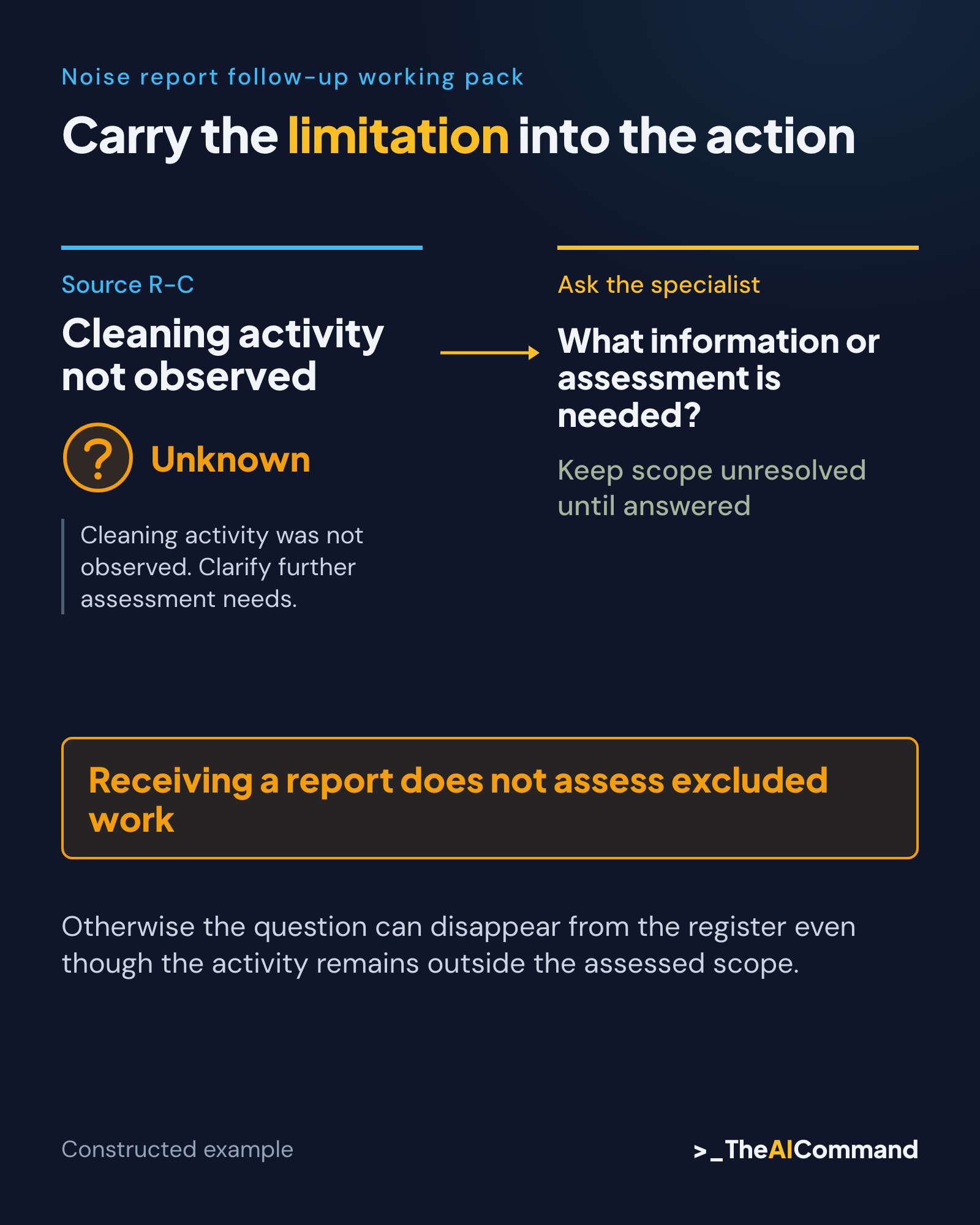
The fictional report covers the workshop's normal cutting operation. Its recommendation passage proposes specialist investigation of an enclosure option. A separate passage asks maintenance to examine a loose panel that may be contributing to noise. The limitations passage says the cleaning activity was not observed and requires clarification before its exposure can be characterised.
The operations supervisor wants three tasks ready for allocation. A poor extraction would say to install an enclosure, fix the machine and confirm the workshop is compliant. Each phrase goes further than the constructed evidence. The first skips investigation, the second erases uncertainty about the panel, and the third invents a conclusion.
The useful draft instead records an investigation task linked to the enclosure passage. It retains the need to examine access, operation and maintenance implications with the specialist and affected workers. It does not name an enclosure design or treat a supplier quote as approval. The authorised team still decides the response.
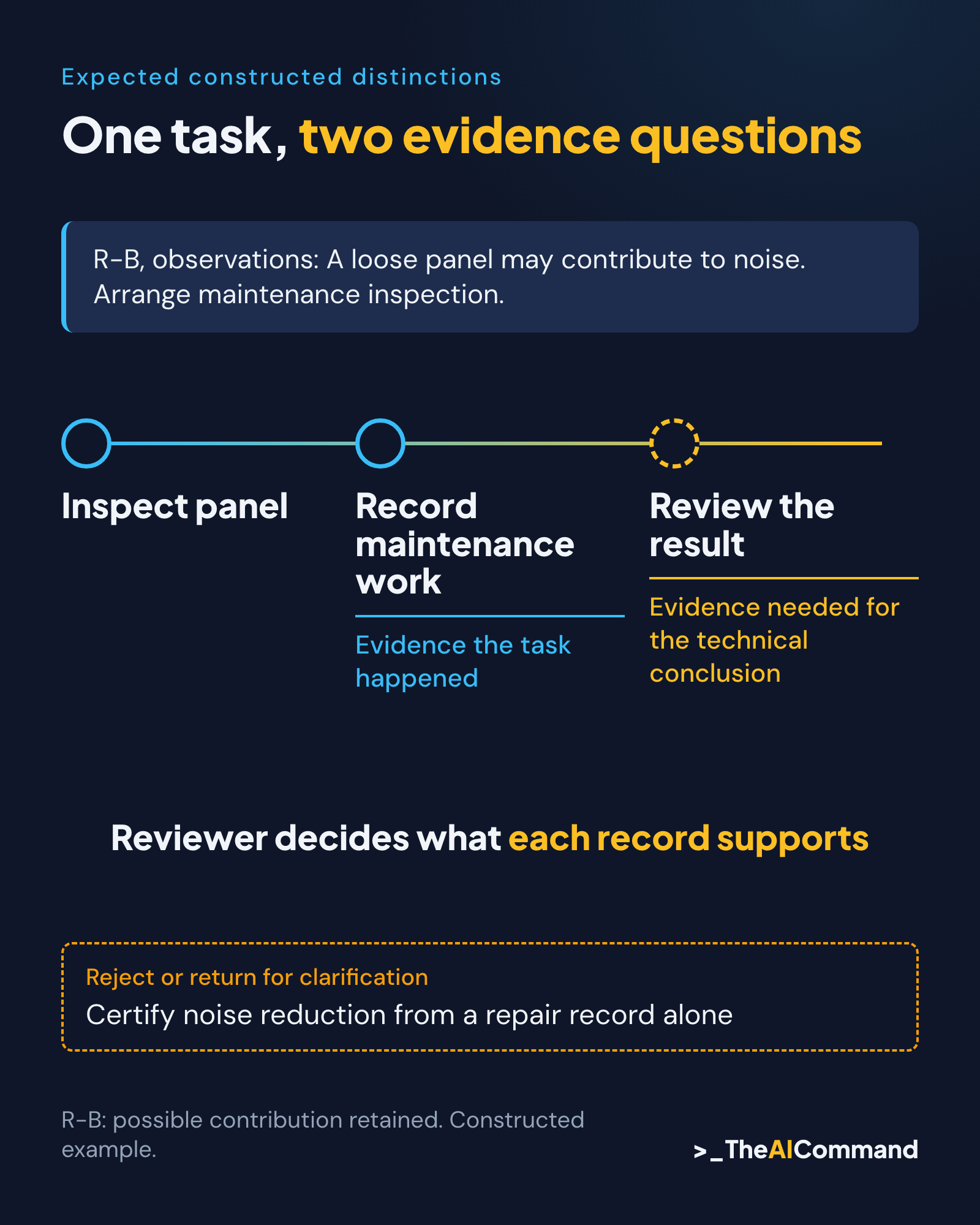
For the panel, the draft asks the responsible maintenance lead to inspect the identified component and document the finding. The phrase about a possible contribution stays visible. A maintenance record may establish that a repair occurred, but the person reviewing the noise controls must decide what evidence is needed to establish the result.
The cleaning activity becomes a clarification request. The proposed question asks what further information or assessment the specialist requires about that activity. It is neither a completed assessment nor a finding of acceptable exposure. The register gives the question an owner so that uncertainty remains active work rather than becoming a footnote everyone overlooks.
Constructed source packet and draft extraction
The constructed reviewer accepts these rows as a basis for discussion, with owners and dates still unconfirmed. That acceptance means the extraction represents the fictional source. It does not approve a control, close a risk or assert that anyone has already completed the work.
This distinction matters when an action-management system requires every row to have a due date. A default date can acquire apparent authority as soon as it appears in a dashboard. Keep proposed administrative dates visibly separate until the responsible person confirms them against the circumstances and any applicable requirements.
Confirm ownership without moving the duty into a spreadsheet
An action owner needs enough authority to obtain the next decision or deliver the assigned work. The WHS adviser may coordinate the register while a maintenance lead arranges inspection and operations provides task information. The person holding a row is not automatically the person authorised to approve a technical solution.
Discuss the draft with affected workers and the relevant health and safety representative, where applicable. Ask whether the reported operating conditions match the work, whether a proposed change affects access or communication, and what the assessor needs to know. Record the substance of unresolved questions rather than replacing consultation with a circulation email.
Use the meeting to identify dependencies. An enclosure investigation may need maintenance requirements before a workable option can be assessed. A follow-up assessment may need the changed operation to be available. Show those dependencies explicitly, because a deadline attached to a blocked task can conceal the decision actually holding up progress.
Nothing about preparing the register permits delay where a safety response is needed. The responsible workplace personnel must deal with immediate concerns through established arrangements. AI processing sits alongside that work. It is not a gate that workers must wait behind before raising an issue or obtaining competent assistance.
Keep interim arrangements visible
A report can recommend work that takes time to investigate, approve and complete. During that period, the register needs a separate place for the arrangements the authorised people have decided will apply. Do not ask the model to infer those arrangements from generic hearing-protection advice or from a previous site's plan.
Record who made the interim decision, its scope and when it will be reviewed. If the source packet contains no such decision, flag its absence. That is a useful result: it tells the coordinator precisely what needs a conversation. A plausible instruction drafted by AI would conceal the missing authority.
Keep procurement milestones distinct from control milestones. A quote requested, purchase approved and component delivered describe progress toward implementation. They do not show that the installed arrangement works in the actual task. Give the reviewer a clear view of both progress and the evidence still needed.
Similarly, avoid turning attendance at a briefing into proof that every worker understands the revised arrangements. If communication is part of an agreed action, record what was communicated and how questions were addressed. The responsible person decides what further confirmation is proportionate to the work and the change.
Review the extraction before using it
Read the proposed register against the report passage by passage. The useful check asks whether a condition disappeared, an excluded task became included, or a recommendation became a confirmed requirement. Check empty fields as carefully as populated ones. A missing limitation can change the meaning of an otherwise accurate row.
Then inspect the draft for technical additions. Unsupported equipment specifications, hearing-protection selections, legal deadlines and compliance verdicts are not harmless extras. Remove them from the action text and put a source-bounded question to the relevant person. Record the correction so a later drafting run does not restore the unsupported wording.
Do not assume a model will flag every gap because the prompt requests it. The prompt is a proposed work aid whose output needs checking. Test it first on the constructed packet, then compare each generated row with the expected distinctions above. Any real workflow adoption needs its own approved trial and review record.
Keep the original report available through an access-controlled link. A forwarded spreadsheet should still tell the recipient where the authoritative source sits and which version was used. If the assessor issues an amendment, preserve the previous extraction and compare the affected rows before replacing operational instructions.
Close the action the evidence actually supports
Define completion evidence when the action is confirmed. An investigation task might end with an authorised decision and its reasons. An implementation task might need a work record and acceptance checks. A control-review task needs the competent review agreed for that purpose. These are different questions with different evidence.
For the fictional panel issue, a repair record alone supports a narrower statement than a noise-control conclusion. The reviewer can acknowledge that maintenance work occurred while leaving the assessment question open. Avoid a single green status that makes these separate statements look interchangeable.
For the unobserved cleaning activity, receiving a specialist response may close the clarification request but create further work. Link that follow-up to the original limitation. Otherwise the question can disappear from the register even though the activity remains outside the assessed scope. Completion should leave a readable trail of what remains unresolved.
The Verified Draft Method provides a broader handling pattern for this kind of assisted work. Apply its source and human-decision discipline to the report, while retaining the specialist's technical role. The value here is a smaller administrative gap between receiving advice and making accountable decisions about it.
Start with the recommendations that are hardest to track
For the next report, choose a small set of passages covering a recommendation, a conditional observation and a limitation. Build the draft register from those passages and ask the responsible people to resolve its missing decisions. This exposes the difficult parts before a large extraction makes them harder to see.
The deliverable is a record that lets another person follow a recommendation into a decision, implementation evidence and the required review. Keep unresolved scope visible. Keep technical conclusions with competent people. A report has begun to change the work only when its findings have an accountable route into what happens next.
Copyable extraction prompt
Before accepting a row
- Match the recommendation and limitation to the source passage.
- Confirm the owner, authority and timing with the responsible person.
- Identify any interim decision and its review point.
- Specify what proves the task happened and what establishes its result.
- Keep unanswered specialist questions visible.
Noise report follow-up working pack
Status: copyable working pack. Constructed demonstration only; no tested workflow or approved operational register. Use an approved tool and authorised information. The competent specialist and responsible workplace personnel retain technical decisions.
Constructed inputs for a practice exercise
Copyable recommendation-to-action register
Prompt
Expected constructed distinctions
Reviewer record
Before real use, remove unnecessary personal, health and commercial details; confirm the environment is approved for what remains. Do not feed audiometry records into this exercise. Test using constructed inputs first. Record the actual tool, version and observed errors only after a run your organisation has authorised. Check the output against the source before anyone relies on it.
Related reading
- The Verified Draft Method
- Your First Testable Project in Codex Desktop, the companion article for 6 November
References
- SafeWork NSW: Managing noise and preventing hearing loss at work, especially sections 4.2, 4.4 and 5.2
- SafeWork NSW: Codes of practice, jurisdiction and current code status
- NSW Legislation: Work Health and Safety Act 2011 (NSW), current version for 1 July 2026 to date, section 26A
- NSW Legislation: Work Health and Safety Regulation 2025 (NSW)
TheAICommand. Intelligence, At Your Command.