Keep the task visible
A supervisor returns from a packing area with three pages of notes. There is a description of reaching into a container, a worker's account of discomfort and a question about the delivery schedule. A quick AI summary turns them into advice to use correct lifting technique. The details needed for a useful review have disappeared. The problem begins before anybody considers a particular control: the summary no longer describes the work that was observed.
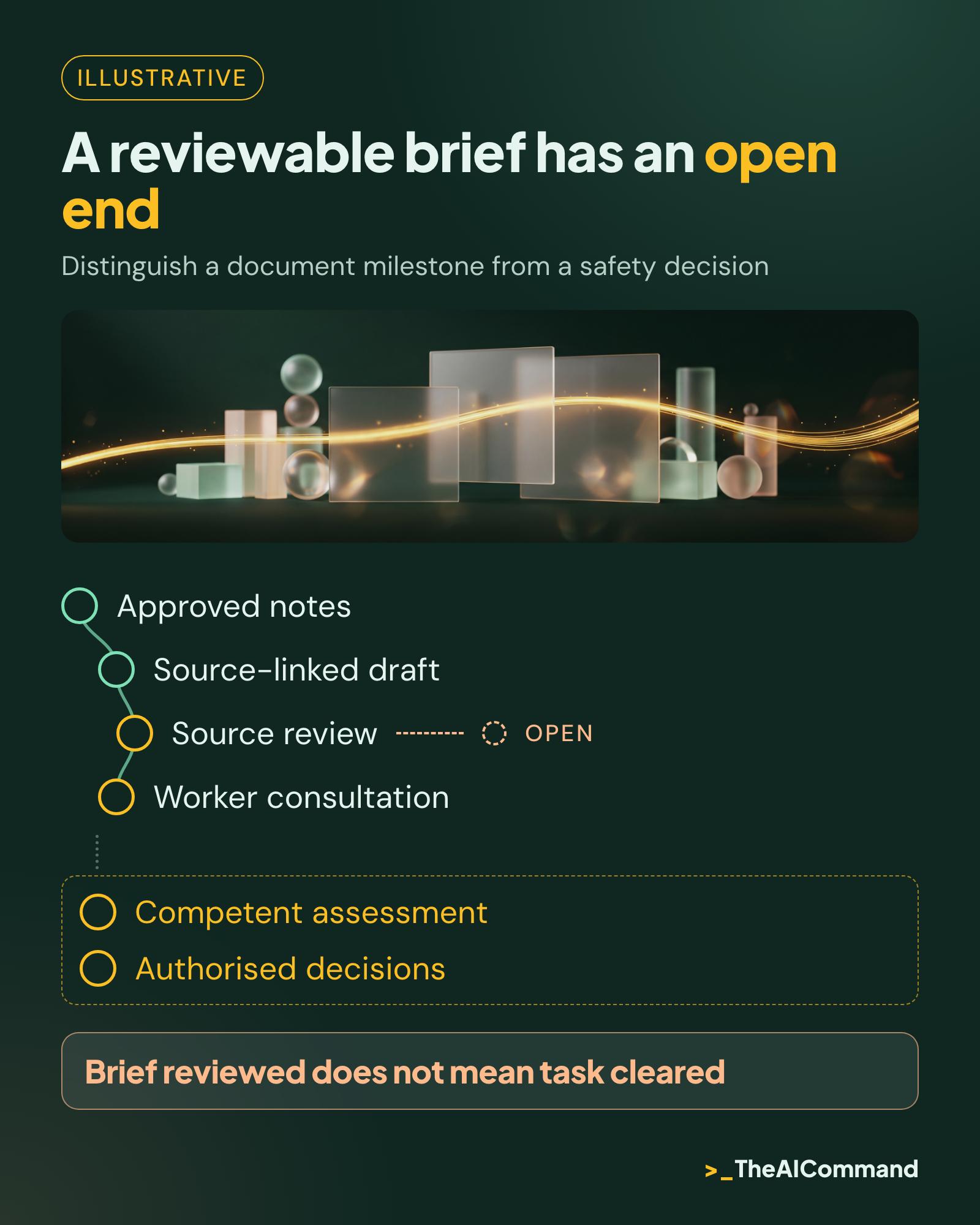
A better assignment is to prepare an observation brief that another person can challenge. It identifies the task, the circumstances recorded, the source of each statement and the information still needed. It helps a work health and safety practitioner organise a discussion with workers and the people responsible for assessing the task. It does not make that discussion unnecessary. Nor does a polished brief establish that an activity can continue safely while questions remain unresolved.
This example concerns a fictional private distribution business in New South Wales. Its observations, times and records are constructed for teaching. No workplace was inspected and no tool was tested on real worker information. The proposed document workflow is an editorial method, not a regulator-approved assessment instrument. Use the applicable workplace process for immediate concerns; preparing a summary must never become a reason to postpone an existing escalation or response.
Give each kind of evidence its own place
SafeWork NSW identifies force, repetitive movement, posture and vibration among the characteristics relevant to hazardous manual tasks. Its guidance combines observation with worker consultation and review of available information. Those categories help organise questions, but they do not supply findings about an unobserved task. A model given a note about a container cannot establish its weight, the force required or the exposure across a whole shift. SafeWork NSW guidance.
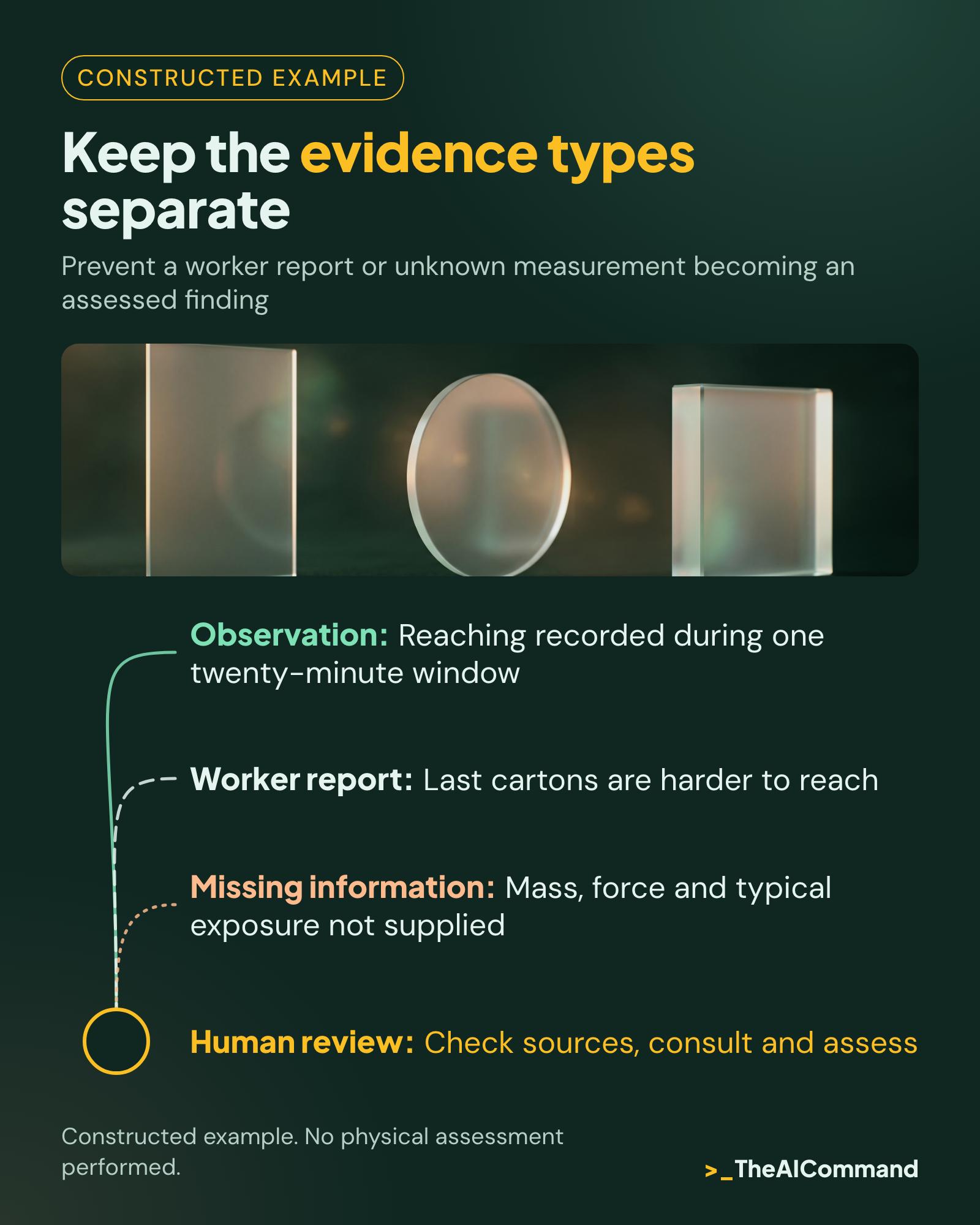
Separate what the observer recorded from what a worker reported. A note that somebody reached across the bench is different from a report that the task feels harder near the end of a shift. Both can matter. Neither authorises a diagnosis. Keep the original wording available when a shorter description could change its meaning. A reviewer needs to see whether a statement is a direct observation, a person's account or an interpretation added during preparation.
Missing information deserves an explicit field. An empty cell is easy to overlook, particularly when the rest of the brief looks finished. Write that container mass was not recorded, rather than inserting an assumed value. Write that the observation period covered one delivery, rather than implying it represented normal operations. These distinctions give the reviewer a practical next step. They also make it possible to correct the brief without silently rewriting the original notes.
Define a small, permitted input set
Start with a copy of the task record that the organisation has approved for this use. Replace identifying details with role labels and remove unrelated health or employment information. Keep the original records in their authorised location. A role label alone does not guarantee anonymity: a unique incident, shift pattern or detailed description can still identify somebody. The person preparing the inputs must decide what can be shared under the organisation's rules before a model sees it.
Give every note a stable reference, such as O1 for an observation and W1 for a worker report. Include the observation window and the version of the source pack. Do not let the model search the wider file system, retrieve medical records or browse for a likely explanation. The task is to organise supplied material. General guidance can appear in a separate reference section, clearly distinguished from evidence about the particular workplace.
Use a modest output structure. Ask for a task description, an evidence table, missing information and questions for review. Require source references for every factual statement about the example. Instruct the model to retain disagreement and to identify any conclusion it cannot support. Do not ask it to choose equipment, calculate a risk rating or draft a fitness judgement. Those requests would change the nature of the task and introduce evidence the pack does not contain.
A constructed packing-area example
The example pack contains four observations and two worker reports. O1 records a twenty-minute observation of transferring sealed cartons from a delivery container to a fixed bench. O2 records repeated reaching across the container edge, without measuring reach distance or counting movements. O3 records a trolley nearby, with no observation of whether it was available or suitable for this task. O4 records that the delivery arrived during another packing activity. These are deliberately incomplete observations, not a completed assessment.
W1 records that a worker finds the last cartons harder to reach. W2 records that the task feels more hurried when deliveries overlap. Neither report identifies a medical condition or proves a cause of injury. The pack contains no measured mass, force, full-shift frequency or assessment of the trolley. A local instruction, D1 (version 0.4, dated 1 September 2026), says deliveries are usually separated. Its date is retained because the observed overlap may reflect an exception, a changed process or an outdated instruction.
A useful draft opening would explain that the observed activity involved moving sealed cartons during one twenty-minute window, with reaching and an overlapping activity recorded. It would state that workers described difficulty reaching the last cartons and pressure during overlaps. It would also state that the pack does not establish typical exposure or equipment suitability. Every sentence can point back to O1, O2, O3, O4, W1 or W2. Nothing requires the model to invent a diagnosis or a solution.
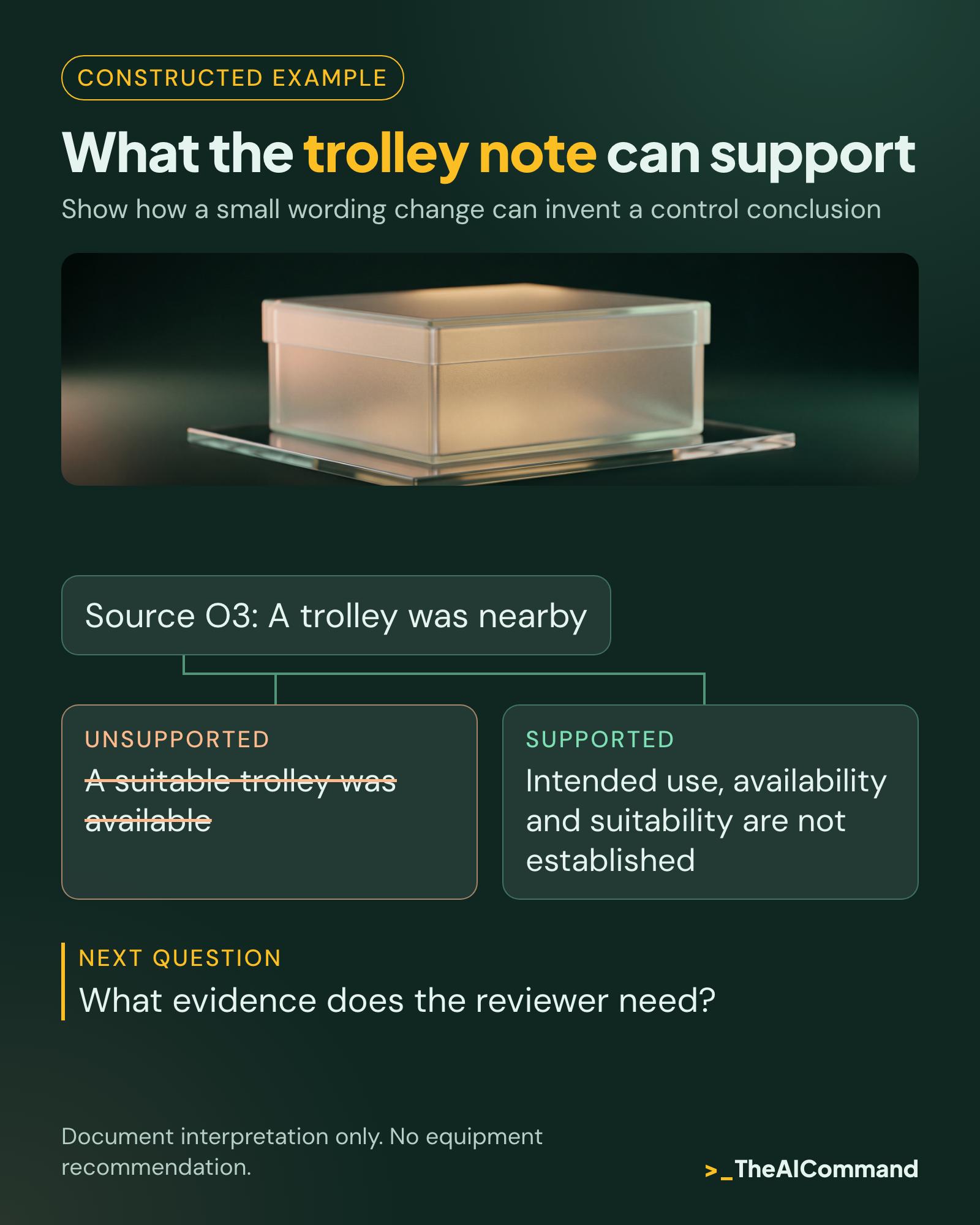
The trolley is a particularly useful test. A weak summary might recommend using it and mark the issue addressed. The evidence supports only that a trolley was nearby. A better entry asks the reviewer to establish its intended use, availability and suitability through the workplace's assessment process. The brief must not convert the presence of an object into proof of a workable control. That would hide the very question the observation needs to bring forward.
The delivery instruction creates another test. The model must not decide that the worker's report is wrong because D1 describes a different arrangement. Keep both records and ask whether the instruction reflects current practice. A source disagreement can be valuable information. It may reveal a gap between the documented process and the activity being performed, but the available notes do not explain why the difference occurred. That explanation needs inquiry, not fluent guesswork.
Review the output against the notes
Read the generated brief with the source pack beside it. Check every example-specific statement, including the small connecting words. Changing "during this observation" to "usually" turns a limited observation into a general claim. Changing "reported difficulty" to "unsafe technique" introduces a judgement and shifts attention towards the individual. Changing "nearby" to "available" removes an unresolved operational question. These edits can be more consequential than an obvious wrong number because they sound reasonable.
Look separately for omissions. Did the model retain the overlapping delivery? Did it preserve the worker report about the last cartons? Did it identify the missing information instead of producing a tidy but incomplete story? A source reference does not guarantee completeness. Use the input list to account for each record, including a short reason where something has been excluded. This is a practical quality check for the brief, not an assurance that every workplace hazard has been identified.
Then review the questions. A neutral question asks what differs when deliveries overlap and who needs to contribute to the review. A leading question asks whether the worker agrees that refresher lifting training will solve the problem. The second version has chosen an explanation and a response before assessment. Remove that assumption. If the preparation team already has a proposed option, label it as a proposal with its source and leave its assessment to the appropriate people.
Consultation changes the brief
The brief should make it easier for workers to correct the account of the task. Provide it in a form they can understand and use the workplace's consultation arrangements, including health and safety representatives where applicable. The NSW hazardous manual tasks code discusses consultation throughout the risk-management process, rather than treating it as a final signature. The specific worksheet proposed here is a drafting aid, not a replacement for that process. NSW code, consultation and hazard identification.
In the constructed example, a later discussion could reveal that the observed delivery was unusual. It could instead establish that overlaps occur regularly. Neither outcome is presumed. Add the actual response as a new dated record and show which statement it changes. Retain the earlier version so a reviewer can follow the development of the account. Do not rewrite the first observation as though the observer knew the later information at the time.
Where a competent assessor supplies findings, record the assessor's role, scope and evidence separately from the AI-prepared summary. A finding about one arrangement should not become clearance for every similar task. If a proposed change is considered, the responsible people need to assess its implications and consult through the applicable process. The document can track that work and its evidence. It cannot do the physical assessment or settle whether a control is adequate.
Use the right jurisdiction and current documents
For this NSW example, the relevant starting points are the NSW regulator's current guidance and its list of applicable codes. The list includes the Hazardous manual tasks code (August 2019) and explains section 26A of the Work Health and Safety Act 2011 (NSW), which commenced on 1 July 2026: a person conducting a business or undertaking must comply with an approved code or manage the risks in a different way that provides an equivalent or higher standard. Do not reuse an old national summary as a statement of current NSW law. The code's August 2019 foreword predates section 26A and describes "should" as a recommended course of action, whereas SafeWork NSW now explains that "should" identifies the standard a code requires. Confirm the current legislation and the applicable code before relying on legal wording. SafeWork NSW codes of practice.
This article does not prescribe a legal risk score, a safe lifting limit or an approved equipment solution. It provides a way to preserve evidence for review. That limited purpose matters when a template travels between teams. A Queensland operation, a Commonwealth workplace and a NSW distribution business may use similar columns, but the governing requirements need their own check. Copying the table does not carry jurisdictional approval with it.
Make the next action specific
The useful end product is a short, reviewable brief with named responsibilities for resolving its gaps. In the example, one person may organise the discussion about delivery timing while another arranges the appropriate task assessment. Those are responsibilities to confirm within the business, not assignments invented by the model. Each open question needs an owner and a review point. Avoid assigning an arbitrary deadline that conflicts with the workplace's response to an immediate concern.
Keep the administrative state distinct from the safety state. "Brief reviewed" means somebody checked the document. "Further observation arranged" means an activity is planned. Neither means that the task is safe or that a risk has been controlled. Use ordinary words for these states so a manager cannot mistake progress on paperwork for a completed assessment. If the records do not contain a competent finding, say so plainly.
Start with one permitted, synthetic practice pack before using the method in an approved workplace setting. Check whether another practitioner can reconstruct the task, identify every source and explain what remains unknown. If the answer depends on information held only by the author, improve the pack. The value of AI here is a clearer route from notes to review, with the limits intact and the people who understand the work still responsible for the decisions.
Reusable material
The task-observation record and source-bounded prompt below include the complete synthetic pack, an example output and a review checklist.
Task-observation record and source-bounded prompt
Constructed teaching material only. NSW private distribution-business example. No workplace observation or physical assessment was performed.
Synthetic input pack
Pack SYN-MT-01 v1.0. All values below are invented for this exercise.
No mass, force measurement, full-shift frequency, clinical information or completed risk assessment is supplied. Role labels are used; real inputs require separate permission and privacy review.
Blank observation record
Copyable prompt
Constructed expected output
This is an authored output example, not an observed model test result.
Human review checklist
- Account for every input record and preserve its evidence type.
- Compare every statement with its cited source and the stated observation window.
- Remove invented measurements, diagnoses, ratings, control recommendations and implied clearance.
- Keep worker reports separate from assessor findings.
- Confirm authorised inputs, consultation arrangements and current NSW requirements.
- Assign actual owners and review points through the workplace process.
- Keep immediate safety responses independent of document preparation.
Related reading
For a related discussion of document preparation and site-specific review, read AI Can Draft a SWMS in Seconds. The Site Walk and the Consultation Cannot Be Automated.. Its construction-work scope differs from this example.
Also see Connect Plant Maintenance Records With Open Safety Actions, the companion article for 24 November.
References
- SafeWork NSW: Hazardous manual tasks
- SafeWork NSW: Code of practice, Hazardous manual tasks (August 2019)
- SafeWork NSW: Codes of practice
- NSW Legislation: Work Health and Safety Act 2011 (NSW), current version for 1 July 2026 to date, sections 26A and 47 to 49
- NSW Legislation: Work Health and Safety Regulation 2025 (NSW), section 60
TheAICommand. Intelligence, At Your Command.