The work order says complete
A safety coordinator opens an action marked overdue. Maintenance says the relevant job was finished last week. Both statements may be accurate. The job could concern a different component, the completion record might omit required evidence, or the safety action might include a further review. Joining the records can clarify the position. Simply copying the maintenance status into the safety register can conceal it.
AI can help prepare a proposed linkage table when information is spread across a maintenance export, an asset register and safety observations. The useful output shows why two records might belong together and what remains unresolved. It does not verify the condition of plant. It also does not acquire authority to close an action because it has found a plausible work order. The distinction needs to be visible in both the prompt and the resulting table.
The example here is a fictional private manufacturing workplace in New South Wales. All asset identifiers, dates, observations and work orders are constructed. No machine was inspected, no control was tested and no maintenance system was connected. The example teaches evidence reconciliation. It is not an isolation procedure, inspection programme or decision about operating plant. Existing workplace responses to hazards continue independently of the document exercise.
Begin with the records the question requires
Define the question before exporting data. For example, the coordinator needs to know which open actions concerning three assets have related maintenance records. That question does not require the full maintenance history, personal details of workers or unrelated production information. Obtain only the approved records and retain them in the organisation's authorised environment. Removing names does not make commercially sensitive layouts, asset vulnerabilities or access details suitable for a public AI service.
The minimum source pack has an asset list, the relevant safety actions and maintenance entries for a stated period. Include stable record identifiers and the date of each export. If the records come from different times, state that difference. A work order created after the safety export may explain an apparent gap. The model must not treat a snapshot as the live register or imply it has checked changes made after the export.
Keep asset identity separate from descriptive similarity. An asset register might identify conveyor CV-014 while a note says packing conveyor. That description may refer to several machines. A nickname, location or similar component can support an inquiry, but it should not silently replace an identifier. Where an alias is genuinely authorised, include the alias mapping and its source. Otherwise the link remains a candidate for human review.
Maintenance evidence has a specific scope
The NSW plant code discusses inspection, maintenance, repair and communication before restarting plant. Its inspection section addresses competent people and records concerning planned inspection and maintenance. These are reasons to preserve the scope and evidence of a work order, not reasons to assume that any entry labelled complete resolves every associated concern. This article's linkage method is an editorial records workflow, not a procedure endorsed by the regulator. NSW plant code, sections 3.5 and 3.6.
A maintenance record may show that a component was replaced. An inspection record may address whether the relevant condition was checked. A safety action may require a further consultation, a documented review or evidence specified by the responsible person. Treat those as separate propositions. The same person may perform more than one role in a particular workplace, but the evidence must still identify what was done and what decision was made.
Avoid using a single confidence percentage to conceal these differences. A model might be very confident that two records concern the same asset while having no evidence that they concern the same issue. Use plain categories instead: exact asset match, issue relationship supported, relationship uncertain or no supporting record found in the supplied pack. These are labels for document review, not calculated measures of physical safety or a guarantee that a match is correct.
Work through a false match
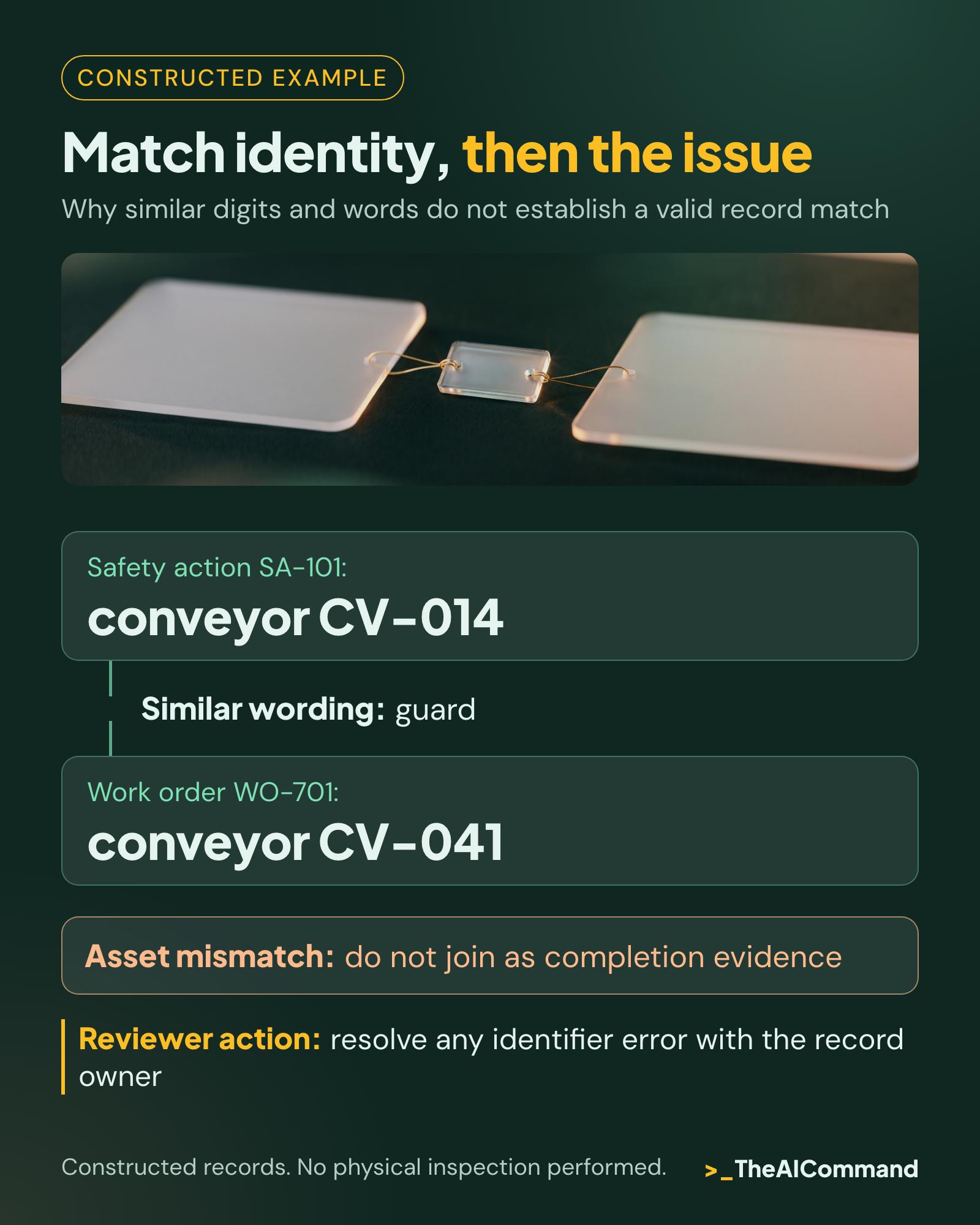
The synthetic pack lists conveyor CV-014 in the packing area and conveyor CV-041 in dispatch. Safety action SA-101 concerns a report about the guarding arrangement on CV-014. Work order WO-701 records work on CV-041 and includes the word guard. The digits are similar and the terminology overlaps. A model asked to find completed maintenance for guarding actions could attach WO-701 to SA-101 unless the prompt requires exact identifiers and explicit mismatch handling.
The correct proposed entry preserves the conflict. SA-101 names CV-014, while WO-701 names CV-041. They must not be joined as supporting completion evidence. The table can flag WO-701 as a rejected candidate and explain why. If the source contains a typing error, the authorised record owner needs to correct it with a traceable change. The model cannot decide which identifier is wrong merely because one correction would make the records fit.
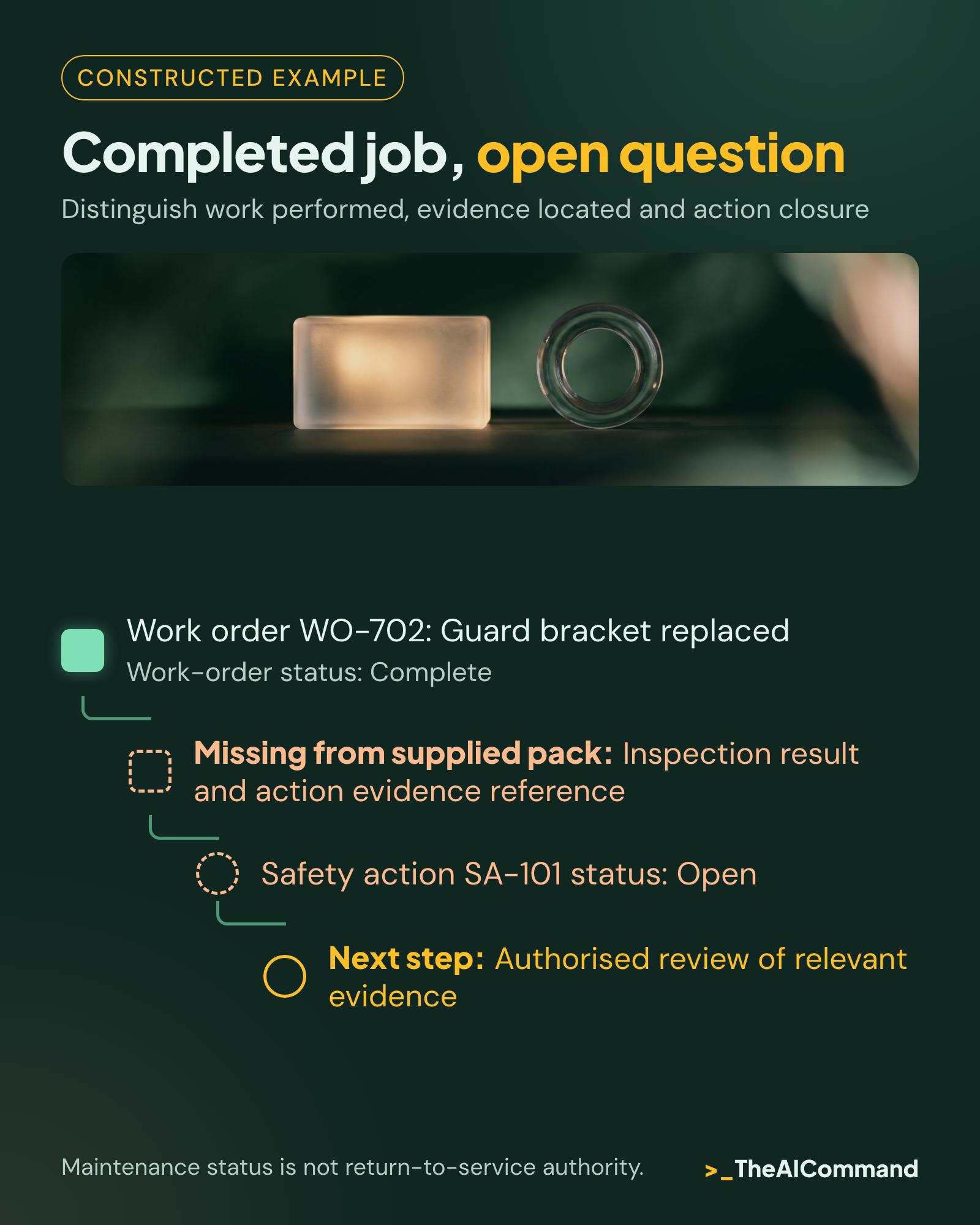
A second work order, WO-702, names CV-014 and records that a guard bracket was replaced. Its completion field is marked complete. The supplied extract contains no inspection result or reference to the evidence specified for SA-101. This supports a link between the action and maintenance activity. It does not establish that the action can close. The proposed table therefore retains the action as open for review and identifies the missing completion evidence.
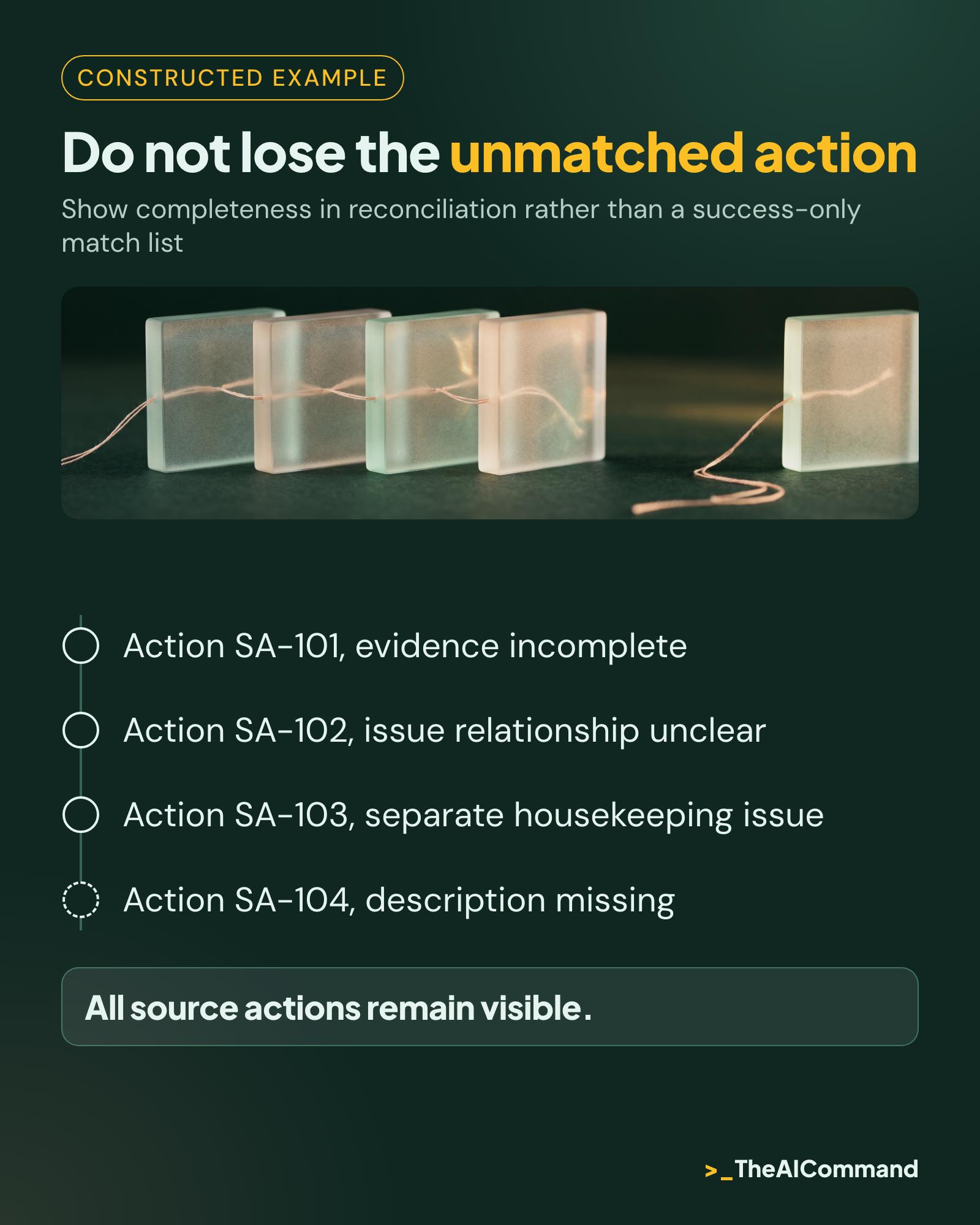
A third action, SA-102, concerns an intermittent problem reported on mixer MX-006. WO-703 records a service on MX-006, but its description covers lubrication and does not mention that problem. The asset matches; the issue relationship is unclear. The useful output sends the question to the record owner rather than describing the service as a repair of the reported problem. An exact asset number is necessary evidence for this match, but it is not sufficient evidence of resolution.
The example also includes SA-103 for CV-014, concerning a separate housekeeping observation. It must not be absorbed into SA-101 simply because both name the same conveyor. One asset can have several open issues and one maintenance activity can address only part of an issue. Preserve that structure. Where a job is relevant to several actions, create distinct proposed links with a reason for each, rather than copying an undifferentiated completion status across them.
A fourth action, SA-104, identifies MX-006 but omits the issue description. Leave it visible as an incomplete source record. The model must not borrow the description from SA-102 or assume both actions concern the same problem. The next step is to ask the responsible record owner to clarify the original entry through the authorised process. Until that happens, there is no supported issue to match, even though the asset itself is known.
Ask for a proposed view, not register changes
Give the model a fixed set of source records and request a table of proposed links. Each row needs the safety action identifier, asset identifier, candidate work order, supporting source references, mismatch or gap, and the next human review. Retain the original action status in a separate column. Do not ask the model to write back to the register, close jobs or produce a list of equipment that is ready to use.
The prompt should expressly prohibit invented inspection findings and inferred return-to-service approval. It should also require a record for every supplied action, including those with no maintenance candidate. Otherwise the output may look successful because only easy matches are shown. Preserve rejected candidates where they explain a material ambiguity. The reviewer can then see both what was linked and what was deliberately kept apart.
Use a small initial set that somebody can review fully. In the constructed pack, the reviewer can trace four actions and three work orders without relying on a sample. A larger export may justify different quality controls, but those controls need a deliberate design. Do not scale from one neat example to automatic reconciliation across the business. The example demonstrates the intended output, not measured accuracy or a validated error rate.
Review identity, issue and completion independently
First check the identity. Compare the proposed asset identifier with the source action, work order and asset register. Preserve the spelling and punctuation used in the authoritative record. A model may normalise identifiers as if they were ordinary text. That is not acceptable when a small difference distinguishes two machines. If normalisation is necessary for a search, retain the original value and the transformation so it can be checked.
Then check the issue relationship. Does the work-order description address the reported condition, or only something nearby in time and location? Read the underlying record rather than trusting the model's paraphrase. In WO-703, a lubrication service marked complete cannot supply a missing reference to the intermittent problem. Ask the record owner whether further evidence exists. The absence of evidence from the pack means it was not available to this review, not that the activity never occurred.
Finally check what the completion evidence actually establishes. The reviewer may find a referenced attachment that was excluded from the export, a required inspection still awaiting completion or a status that was updated incorrectly. Record that finding in the authorised process. Do not allow the model to fill the gap with a plausible sentence. A status label is a pointer to the work and its evidence, not a substitute for either.
Keep operations separate from the document queue
SafeWork NSW's plant guidance discusses guarding and isolation arrangements. Where guarding is removed for maintenance or cleaning, the person with management or control of the plant must ensure, so far as is reasonably practicable, that the plant cannot be restarted unless the guarding is replaced (Work Health and Safety Regulation 2025 (NSW), section 208(5)). A reconciliation table cannot establish whether those arrangements are in place. It must not be used as an operating instruction or a substitute for the workplace's authorised isolation and return-to-service processes. Those decisions require the relevant people and evidence. SafeWork NSW plant guidance.
Make the table's limitations visible where a manager will read it. Label it as a proposed document linkage based on named exports, with no physical verification performed. Avoid green ticks beside assets, language such as cleared, or a dashboard that makes all linked records look resolved. A manager scanning a status report should be able to distinguish evidence located from action reviewed and action closed. Formatting is part of preserving that distinction.
If the document review reveals an apparent urgent concern, follow the existing workplace escalation process. Do not wait for the whole batch to be reconciled or ask the model to set the response priority. The records may be incomplete, but that uncertainty does not justify ignoring the concern. The person responsible for the review can record the escalation and keep document correction separate from the operational response.
Leave a trace that survives the next export
Record the date, source versions and reviewer for each accepted linkage. Keep the rejected false match so a later reviewer does not repeat the same mistake. When source records change, reassess the affected links rather than treating the old table as current indefinitely. An updated work order can supply new evidence, but it may also alter the basis on which an earlier link was accepted. Retaining the previous version makes that change visible.
For the NSW example, start from the regulator's current list of codes and check the legislation applicable to the workplace. The list includes the plant code (December 2022) and explains section 26A of the Work Health and Safety Act 2011 (NSW), which commenced on 1 July 2026: a person conducting a business or undertaking must comply with an approved code or manage the risks in a different way that provides an equivalent or higher standard. The publication date printed on an older code is not, by itself, proof of the complete current legal position. The plant code's December 2022 foreword predates section 26A and describes "should" as a recommended course of action, whereas SafeWork NSW now explains that "should" identifies the standard a code requires. Have the responsible adviser reconcile the current requirements before relying on statutory wording. SafeWork NSW codes of practice.
Keep this method proportionate. A spreadsheet with a clear record trail may be enough for a small, approved review. Building a new integration is unnecessary until the team understands its identifiers, evidence gaps and review responsibilities. The first useful improvement is usually a common way of referring to the asset and issue across the existing records. Automation cannot compensate for a decision process that nobody has defined.
Begin with a handful of open actions and their approved source records. Test whether the proposed links preserve the false match, distinguish work performed from evidence still needed and leave every action visible. Then let authorised people make and record the next decisions. A successful reconciliation makes the outstanding work easier to see. It does not make an unresolved safety question disappear behind a completed maintenance job.
Reusable material
Use the asset-action linkage table, synthetic records and match-review prompt below. This material is for document review only.
Asset-action linkage pack and match-review prompt
Entirely constructed NSW private manufacturing example. No physical inspection, test, operational system connection or restart authorisation occurred.
Synthetic asset register
Synthetic action extract
Snapshot date: 20 October 2026. Dates and identifiers are invented.
Synthetic maintenance extract
Snapshot date: 21 October 2026.
Proposed linkage view, authored example
The table is constructed, not an observed model output. No row is a safety judgement.
Copyable prompt
Acceptance checklist
- WO-701 must not become completion evidence for SA-101.
- WO-702 must not automatically close SA-101 or SA-103.
- WO-703 must not be described as resolving SA-102.
- SA-104 remains visible with its missing description.
- All four source actions remain open in the proposed view.
- Output names no asset as safe, cleared or approved for restart.
- A person checks all source references and records actual decisions separately.
Related reading
For the separate engineering-control and reaction-window discussion, read The Ride Had No Way to Stop Itself. This records-linkage workflow does not repeat that case analysis.
Also see Turn Manual-Task Observations Into a Reviewable Brief, the companion article for 24 November.
References
- SafeWork NSW: Code of practice, Managing the risks of plant in the workplace (December 2022), sections 3.5 and 3.6
- SafeWork NSW: Machinery and equipment
- SafeWork NSW: Codes of practice
- NSW Legislation: Work Health and Safety Act 2011 (NSW), current version for 1 July 2026 to date, section 26A
- NSW Legislation: Work Health and Safety Regulation 2025 (NSW), sections 208 and 213
TheAICommand. Intelligence, At Your Command.