
Same tool. Same person. Who writes the first draft changes everything.
That is the uncomfortable finding sitting inside a study published in Scientific Reports in March 2026, and it lands on a decision most leaders have not realised they are making. Most organisations have said very little about AI at all. As at May 2026, Gallup found 25 percent of US employees saying their organisation had communicated a clear plan for integrating AI, and 47 percent saying their organisation had integrated AI tools. Almost none of them has said anything about when in a piece of work people should use it. That unspoken detail may be doing more to shape how people feel about their jobs than the tool choice everybody spent months debating.
What did the study actually find?
Elena Hayoung Lee, Yidan Yin, Nan Jia and Cheryl Wakslak ran a pre-registered experiment in which people completed occupation-specific writing tasks under one of three conditions: no AI at all, copy and paste the AI output without modification, or draft as a human first and then use AI to refine. The analysed sample is 269, the participants out of 408 completers who confirmed they had followed the condition they were assigned.
What the authors say they manipulated is "the degree of human involvement", not the clock. The copy-and-paste group wrote nothing of their own at any point.
Three results came out of it, and they point the same way.
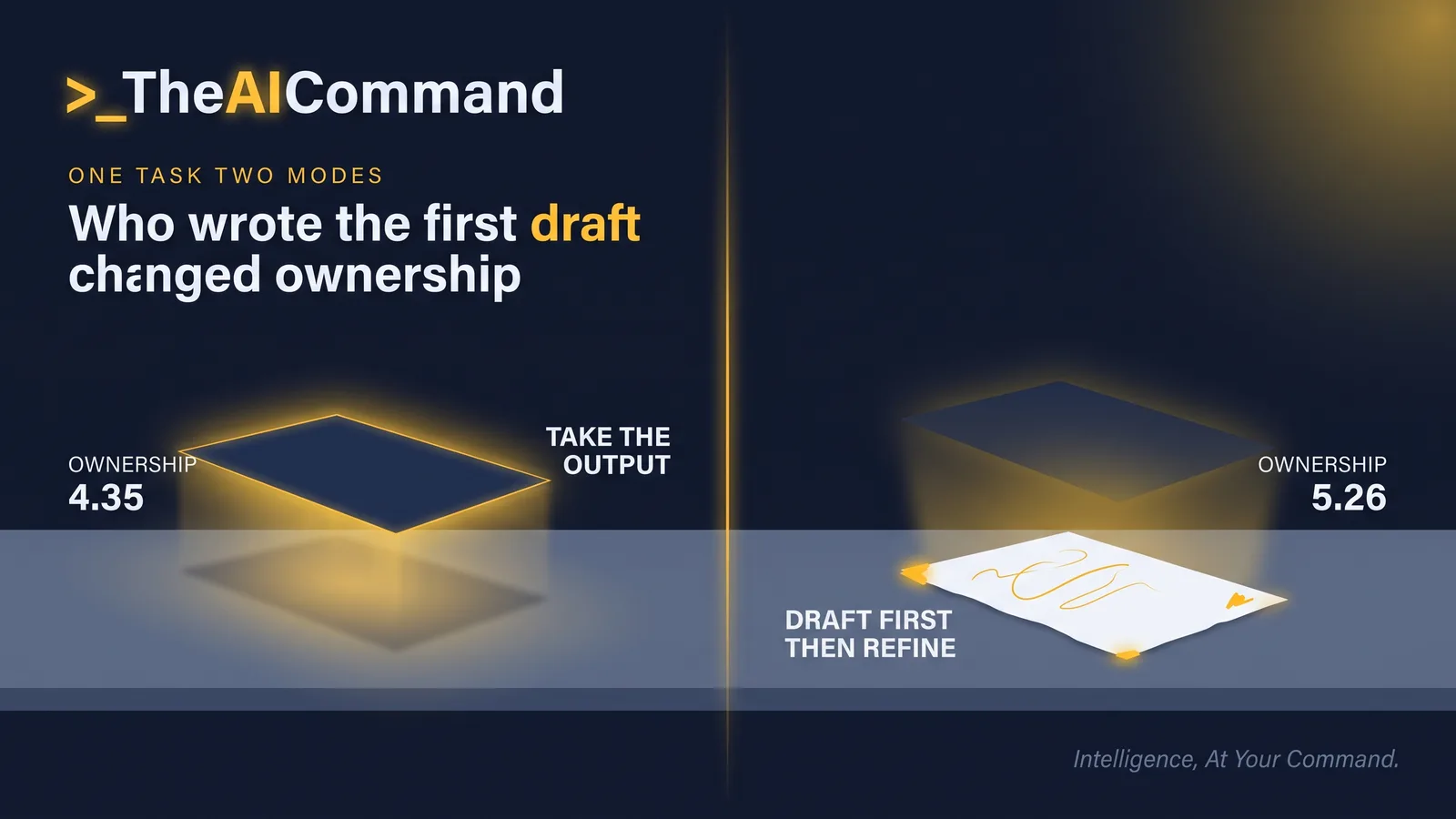
On psychological ownership, the copy-and-paste group reported "significantly lower psychological ownership than both the First Human Then AI...and No AI Use groups", with means of 4.35 against 5.26 and 5.34.
On confidence, the copy-and-paste group reported "significantly lower AI-independent self-efficacy than those in the No AI Use group", 5.16 against 5.63. That is confidence in being able to do the work without the tool, measured immediately after a single task.
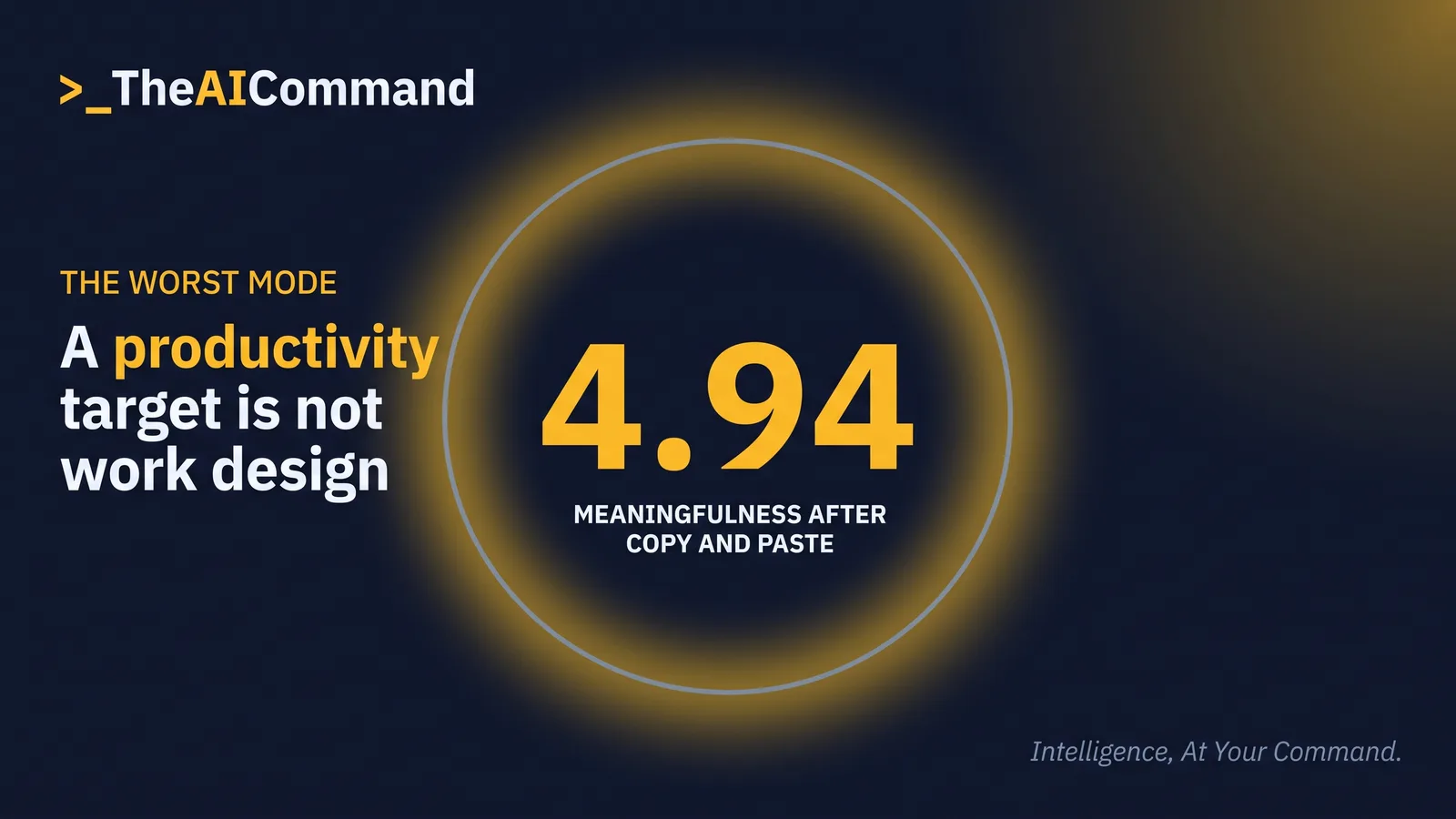
On meaning, the copy-and-paste group "rated their work as significantly less meaningful than those in both the No AI Use group and the First Human Then AI group", 4.94 against 5.54 and 5.46.
The part that makes this actionable is what happened in the third condition. On ownership and meaning, drafting first and then applying AI was not merely less damaging than copy and paste. On these measures the authors report it came out "statistically similar to those who had not used AI at all". Confidence is the exception worth stating plainly: the draft-first group sat between the other two and could not be separated from either, p = 0.355 against no AI and p = 0.239 against copy and paste, so the comparison that carries on that measure is copy and paste against no AI. The cost was not attached to using AI. It was attached to letting the model produce the work instead of the person.
Every participant then completed a second writing task with no AI at all, and the three effects did not age the same way. The ownership gap closed, the authors reporting that when individuals produce work themselves "their sense of ownership is restored". The other two did not close: AI-independent self-efficacy still differed, F(2, 266) = 6.25, p = 0.002, and so did meaningfulness, F(2, 266) = 3.40, p = 0.035. Ownership is the same-day effect. Confidence and meaning are the ones that lingered.
Three caveats belong in the same breath, because they change how hard you should push this. The study measured how people felt, not how good the work was. It did not compare output quality between the two AI conditions, so nothing here says draft-first produces better documents. These were short tasks with recruited participants, not teams observed over months. And there is no condition anywhere in the design in which the model drafts and the person then substantially rewrites, so what the experiment separates is whether a human first attempt existed at all, not sequence on its own. What the researchers established is that mode matters. Everything about how a leader responds to that is extension, including everything below.
Why is this different from the deskilling problem?
Because the timescales and the mechanisms are different, and conflating them produces the wrong intervention.
Deskilling is a capability story that plays out over years. People stop doing the reps, the expertise quietly decays, and nobody notices until the expertise is needed. The response is to decide which work stays human on purpose.
This is a same-day story about how a person relates to work they just finished. Ownership, confidence and meaning are not skills. They are the reasons people bring discretionary attention to a task, and the study shows they can be reduced by a single interaction with a tool everyone agrees is useful. Ownership at least comes back as soon as the person does a task themselves. Confidence and meaning, on this evidence, do not.
A related 2025 study by Suqing Wu and colleagues, four experiments across 3,562 participants, points at the handback problem from the other direction. Working with generative AI improved immediate performance, but that improvement "did not persist in subsequent tasks performed independently by humans", and moving from AI-assisted work back to solo work brought "significant decreases in intrinsic motivation and increases in feelings of boredom", though the paper's own summary table records the boredom effect as significant in two of the four studies and the motivation effect in three. Worth noting precisely: the same abstract reports an increase in sense of control on that transition, which is counterintuitive and should not be misread, and the carryover finding was not uniform, with one of the four studies showing higher creativity in the following solo task. The honest summary is no consistent carryover benefit, not none at all.
A 2026 preprint from Grace Liu and colleagues, still awaiting peer review, adds a timing observation from three randomised trials: effects on persistence and unassisted performance "emerge after only brief interactions with AI (approximately 10 minutes)". Treat that as a signal to watch rather than a settled number, but it does suggest this is not a slow-burn phenomenon.
These are three different mechanisms, not one finding replicated. Lee looks inside a single task. Wu looks at what happens when the tool is taken away. Liu looks at persistence. Reading them together is a synthesis, and it is ours.
What is the operating move?
Set the sequence explicitly, for defined categories of work, and say why.
This is the part the research does not test. Lee and colleagues measured the modes; they did not evaluate a management intervention, a policy, or whether such a rule survives a deadline. So treat the following as a design proposal grounded in the finding rather than as a validated method.
- Sort your team's recurring work into two lists. Throughput work, where the output is the point and nobody's professional identity is attached to it: meeting notes, status summaries, formatting, first-pass research collation. And formative work, where the thinking is the point: the analysis a recommendation rests on, the client argument, the design rationale, the paper somebody's reputation travels with.
- On throughput work, leave the sequence alone. AI first is fine. Arguing otherwise wastes the credibility you will need for the second list.
- On formative work, set the first attempt as human. Not a polished draft. A rough structure, the shape of the argument, the position the person actually holds, produced before the model is opened. Ten to fifteen minutes is usually the whole intervention.
- Then bring AI in properly. Refine, challenge, restructure, check. The productivity case is intact. What has changed is that the person has a position of their own to defend, which is also what makes the model's suggestions assessable rather than authoritative.
- Name the reason out loud. A rule that reads as suspicion of AI will be ignored and will cost you standing. A rule explained as protecting the part of the work that makes it theirs is a different conversation entirely.
One of the study's authors makes the point that the default instruction is itself the problem. Yidan Yin, commenting on the research, said companies "need to do more than just ask employees to use AI to maximize their productivity, which may inadvertently encourage passive reliance on AI". If the only guidance a team has received is a productivity target, the guidance has quietly selected the mode that performed worst.
Where does the leader stay in the loop?
Three places, and none of them can be delegated to a policy document.
The sort is yours. Nobody else in the organisation can decide which categories of work are formative for a given team, because that judgement depends on what you are trying to develop in specific people over the next two years. Get it wrong in the cautious direction and you have added friction to work that never needed it.
The modelling is yours. If you forward model output into a channel with no framing of your own, you have set the norm regardless of the rule. People calibrate to what leaders visibly do.
The measurement problem is yours too, and it is genuinely hard. Ownership and meaning do not show up in a delivery metric, and by the time they show up in an engagement survey the cause is six months cold. The only instrument most leaders have is the question asked directly in a one-to-one: whose work is this, and did you enjoy doing it. That is a weaker signal than anyone would like, and it is still better than inferring satisfaction from throughput.
And the exceptions are yours. There will be weeks where the deadline wins and the sequence is a luxury. Say so explicitly rather than letting the rule quietly lapse, because a rule that dies without being killed teaches the team that none of the rules are real.
A worked example
[TEAM_LEAD] runs a team of six analysts. The recurring work splits cleanly: weekly reporting packs, which nobody has ever felt ownership of, and the quarterly recommendation papers that go to a steering group with an analyst's name on them.
The rule set is one line. Reporting packs, use AI however you like. Recommendation papers, fifteen minutes of your own structure and position before you open anything, then use AI as hard as you want.
[ANALYST_NAME] tries it on the next paper. The fifteen minutes produces four bullet points and a claim they are not sure they can defend. The model then does what it is good at, filling gaps, finding counter-arguments, tightening the prose. The difference shows up in the steering group, where [ANALYST_NAME] is defending a position rather than explaining a document. Whether that is a better paper is not something the research can tell us. Whether it is their paper is not really in question.
Bottom line
The debate about AI at work has been about how much and which tool. The evidence points at a smaller and more controllable variable: whether the first attempt is the person's or the model's. Taking the output as the model produced it reduced ownership, confidence and meaning against a no-AI baseline in a controlled test. Drafting first and then using the same tool did not. That is a work design decision, it costs about fifteen minutes on the work where it matters, and no policy will make it for you.
Do this Monday
- Write two lists for your team, throughput work and formative work, and be honest that most of it is throughput
- Pick one item from the formative list and set a human-first-attempt rule on it, with a stated time box rather than a quality bar
- Say why in the next team meeting, framed as protecting ownership rather than limiting AI
- Check your own last three AI-assisted outputs and note which mode you used, because your team already knows
- Book a review in six weeks to ask the team whether the rule held under pressure, and treat a no as information rather than failure
References
- Elena Hayoung Lee, Yidan Yin, Nan Jia and Cheryl J. Wakslak, Relying on AI at work reduces self-efficacy, ownership, and meaning while active collaboration mitigates the effects, Scientific Reports 16(1), article 13583, 15 March 2026. https://www.nature.com/articles/s41598-026-42312-6
- Yidan Yin, author commentary reported in Passive AI use at work increases feelings of work meaninglessness, study finds, Phys.org, 5 June 2026. https://phys.org/news/2026-06-passive-ai-meaninglessness.html
- Suqing Wu, Yukun Liu, Mengqi Ruan, Siyu Chen and Xiao-Yun Xie, Human-generative AI collaboration enhances task performance but undermines human's intrinsic motivation, Scientific Reports 15(1), article 15105, 29 April 2025. https://www.nature.com/articles/s41598-025-98385-2
- Grace Liu, Brian Christian, Tsvetomira Dumbalska, Michiel A. Bakker and Rachit Dubey, AI Assistance Reduces Persistence and Hurts Independent Performance, arXiv preprint 2604.04721, submitted 6 April 2026, version 4 last revised 5 August 2026, still not peer reviewed. https://arxiv.org/abs/2604.04721
- Gallup, Gallup Indicators: Artificial Intelligence, figures as at May 2026, accessed 21 September 2026. https://www.gallup.com/699797/indicator-artificial-intelligence.aspx
TheAICommand. Intelligence, At Your Command.