
Your output is up. Your bench is thinning.
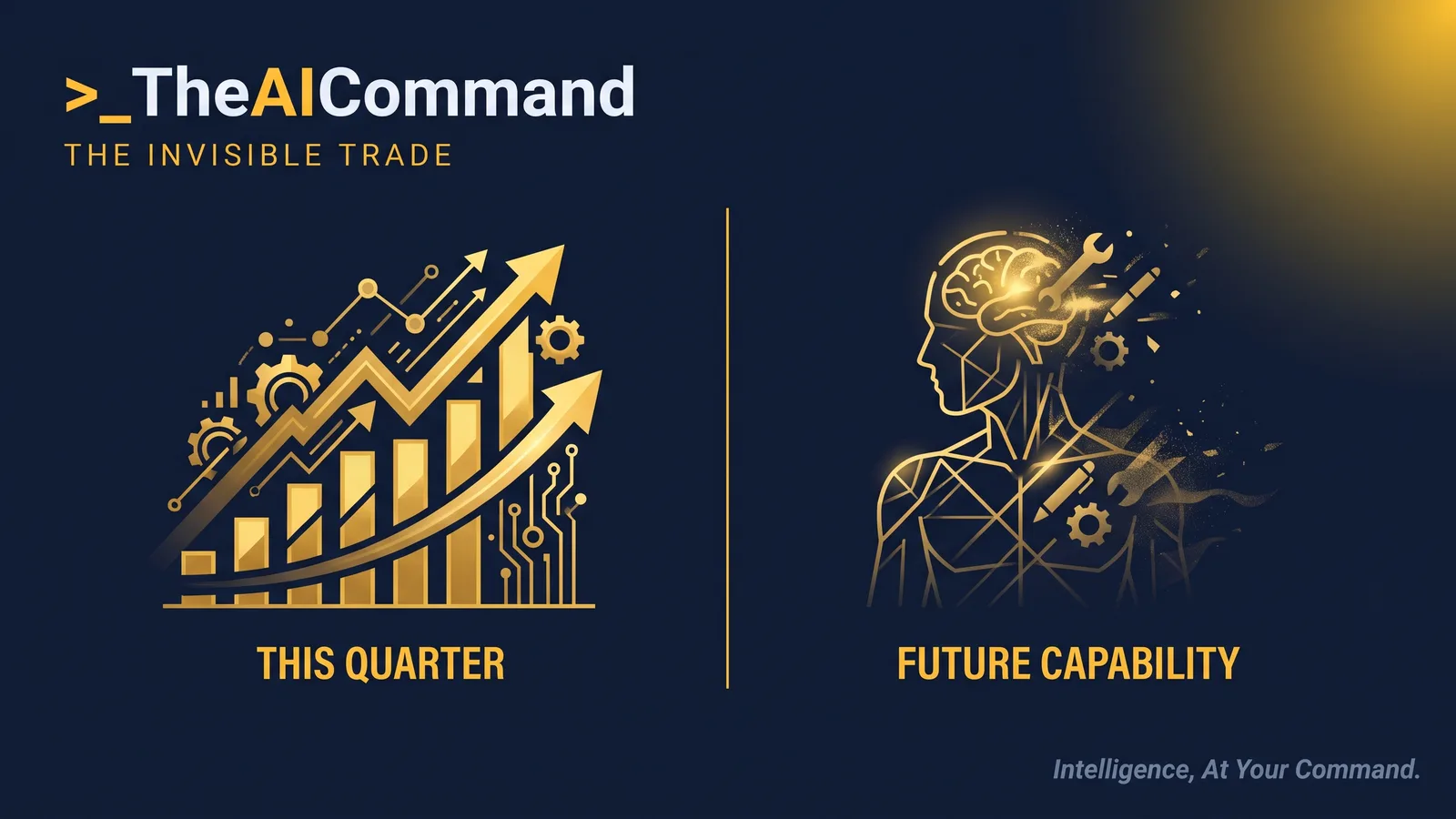
There is a trade every leader is now making, usually without deciding to. The AI that lets a team ship more this quarter is also doing the work through which that team used to get better. The junior who once wrote the first draft, wrestled with the analysis and learned from being wrong now prompts a model and edits the result. The output looks the same, often better. The learning that used to come attached to it does not happen.
Call them the reps. The drafting, the analysis, the first-pass problem solving, the checking of an answer against reality. They are how a junior becomes a senior and how a senior stays sharp. They are also exactly the tasks AI is best at taking away. And because the loss is invisible in the moment, nobody notices until the organisation reaches for expertise it quietly stopped building.
Protecting those reps is not nostalgia, and it is not resistance to a good tool. It is a leadership decision about the future capability of the team, and right now it is the one most leaders are not making.
The shift is real, and it is measurable
This is not a hunch about kids these days. The evidence is starting to land.
In a 2025 study by Microsoft Research and Carnegie Mellon, The Impact of Generative AI on Critical Thinking, a survey of knowledge workers found that higher confidence in generative AI is associated with less critical thinking, while higher confidence in one's own ability is associated with more. The same work found AI shifts the nature of the thinking that remains, away from doing the task and toward verifying, integrating and stewarding what the machine produced. In other words, the reps do not just get faster. They change into a different, thinner activity.
There is a trap hidden in that shift. If the remaining human skill is verifying the model's output, verifying well depends on the very expertise the reps used to build. You cannot reliably catch a wrong assumption in an analysis you never learned to do, or spot a flawed argument in a field you only ever prompted your way through. So the one skill AI leaves us with, judgement over the output, is the skill it also quietly stops us from building. That is the loop leaders have to break.
An MIT Media Lab study, Your Brain on ChatGPT, went further. Over four months, participants who relied on an AI assistant to write consistently underperformed at neural, linguistic and behavioural levels, showed reduced brain connectivity that the researchers read as under-engagement, and struggled to accurately quote work they had just produced with the tool. The output existed. The engagement that builds and retains skill did not.
Put those together and the pattern is clear. When AI does the rep, the person is present for the result but absent from the practice. Do that across a team, for years, and you are running a slow, invisible experiment in deskilling, with this quarter's numbers as the cover.
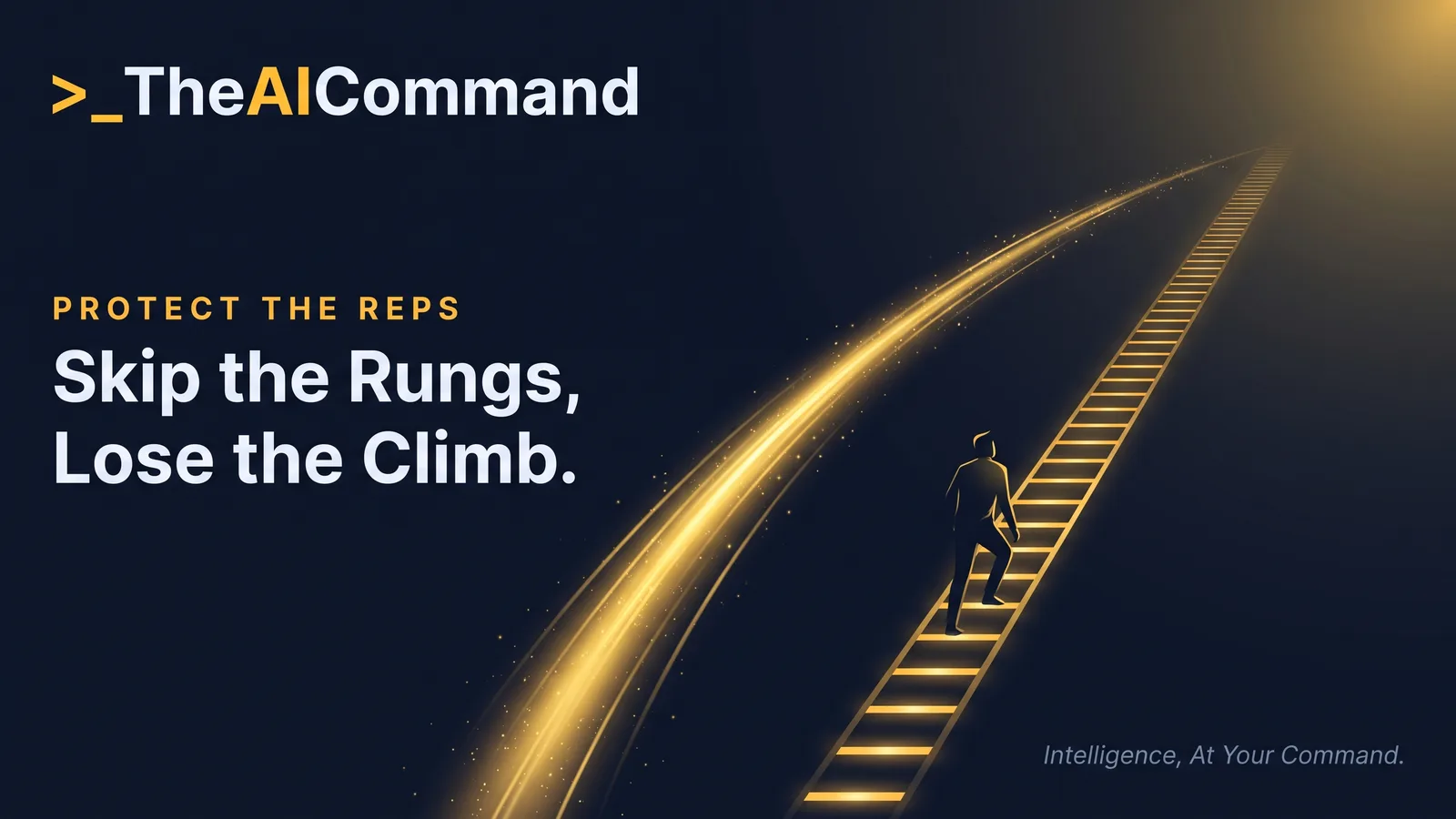
There is a second-order version of the same problem that operates at the level of the whole organisation. The reps AI takes first are the entry-level and junior ones, the drafting and the first-pass analysis, and those are precisely the tasks through which people used to climb toward senior expertise. Harvard Business Review named this in June 2026 as a looming capability crisis: automate the bottom rungs and you can sever the pipeline that produces the seniors you will need. A team can look highly productive today while quietly ceasing to manufacture its own experts. The individual atrophy and the pipeline erosion compound, and neither shows up in a quarterly output number.
Why this is a leadership problem, not an IT one
The reason this lands on leaders, and cannot be handed to the technology function, is that it is a capability decision dressed as an efficiency one.
Harvard Business Review put the organisational stakes plainly in April 2026, warning that leaning on AI to the generic standard can kill the individual DNA of an organisation, leaving it more efficient yet less legitimate in the eyes of employees and customers. California Management Review made the same point from the asset side in March 2026, arguing that the real differentiator is not the data or the models but the tacit knowledge embedded in the judgement of your people, and that leaders can no longer merely delegate AI strategy to the technology team or treat knowledge retention as a back-office function.
McKinsey's research on AI in the workplace lands in the same place from a different angle: the main brake on getting value from AI is not employees but leaders, who are not steering fast enough. Deskilling is that failure to steer, seen over a longer horizon. If nobody decides which work stays human, efficiency decides, and efficiency has no view on your future capability.
For Australian leaders the stakes are close to home. The same dynamic is already visible in the conversation about graduate and apprenticeship pathways, where the early-career work that builds a professional is the work most exposed to automation. An organisation that lets AI absorb all of its junior reps is not just running a productivity play, it is opting out of growing the next layer of its own experts, at a time when experienced judgement is exactly what is scarce.
The operating move: name the reps and protect them
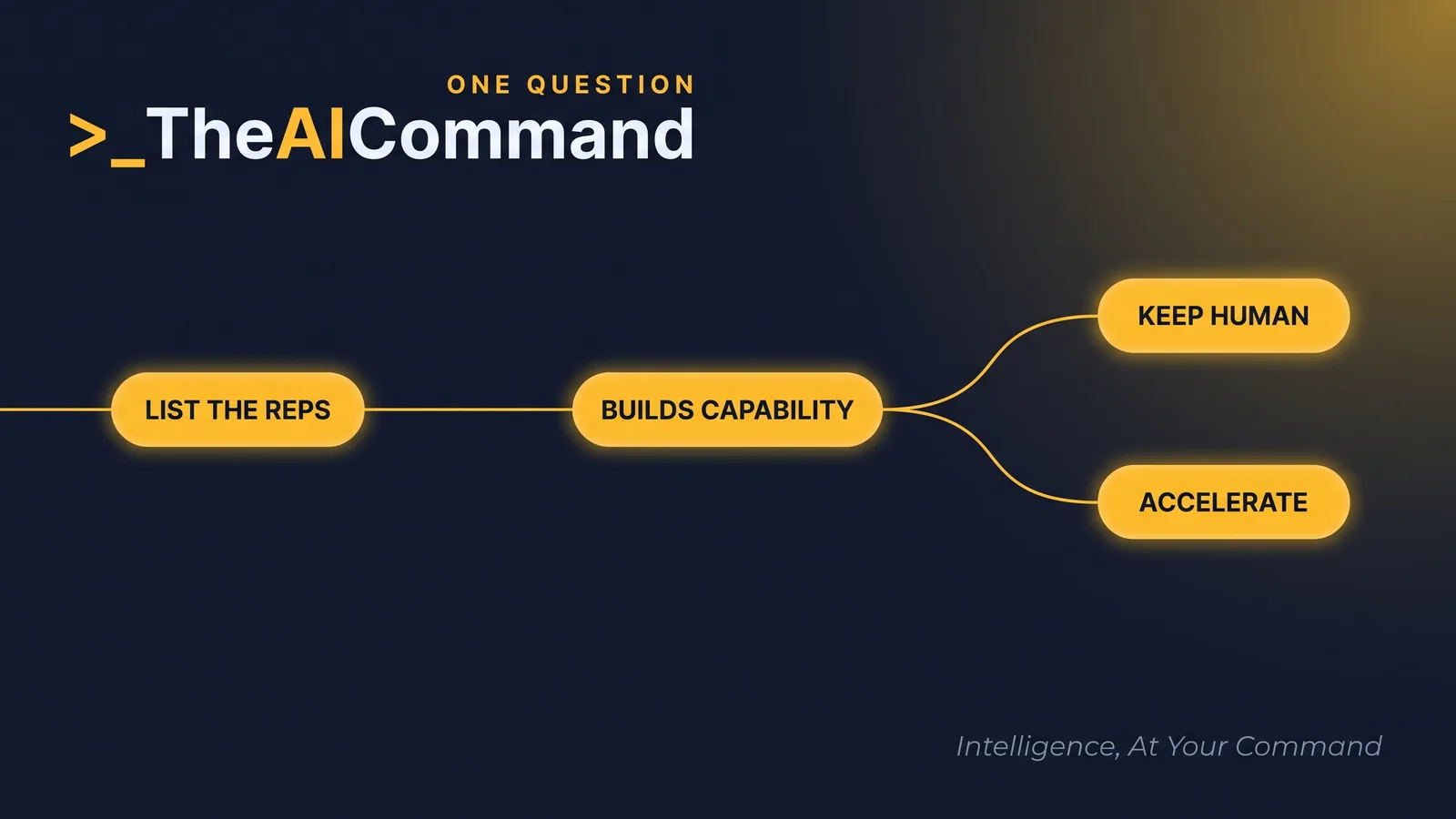
You do not fix this by banning AI or by slowing the team down. Most work should be accelerated. You fix it by making one decision, deliberately, that you are currently making by default. Here is a way to run it this week.
- List your team's recurring cognitive work. Not projects, the repeated thinking tasks: the analyses, the drafts, the reviews, the problem-solving a role does again and again. This is the raw material of both productivity and skill.
- Ask one question of each: does doing this build a capability we need to protect? For most tasks the answer is no, and those you accelerate with AI without guilt. For a few the answer is yes. These are the reps through which a junior reasons their way to seniority, or a senior keeps a perishable skill alive. Mark them.
- Decide the mode for the protected reps. For each one, choose. Keep it fully human for now because the struggle is the point. Or restructure it so the person does the reasoning and AI does the support, the person forms the analysis and AI checks it, not the reverse. The rule of thumb: on a protected rep, the human's mind must be the thing doing the work, with AI as a tool, not the author.
- Make the trade-off explicit. Tell the team which tasks are development reps and why they are staying human, so it reads as an investment in them, not a productivity tax. Unspoken, it looks like inefficiency. Named, it looks like leadership.
- Review it as a capability, not a policy. Revisit the list as roles and tools change. The protected set is small and deliberate, and it should shift over time, but it should never be empty.
The judgement boundary
The line here is the leader's to hold, and it runs against the grain of every incentive pointing at short-term output.
AI can and should carry most of the load. What it cannot do is decide which of your team's capabilities are worth protecting, because that is a judgement about the organisation's future that depends on strategy, on where expertise is scarce, and on which people you are trying to grow. It cannot feel the difference between a rep that builds someone and a task that just needs doing. And it cannot be accountable for a team that, three years from now, is fast at producing and thin on the judgement to know when the output is wrong.
That accountability is the leader's, and it is not shared with the model. The uncomfortable part is that protecting the reps will sometimes cost you speed you could have had, and the benefit shows up later, in people who can do the hard thing without the tool. Bearing a visible cost now for an invisible capability later is exactly the kind of call leaders exist to make. It is also the kind of call that does not get made unless someone owns it, because every day-to-day incentive, the deadline, the dashboard, the next deliverable, pushes the other way.
A worked example
Take a de-identified team. [TEAM] runs financial analysis, and a capable junior, [EMPLOYEE_NAME], has started producing polished models fast by leaning on an AI assistant for the build and the commentary.
The output is good, and the temptation is to celebrate the productivity and move on. The leader instead asks the question. Building and interrogating a financial model from scratch is precisely how an analyst learns to smell a wrong assumption, the capability the team most needs from its seniors and most struggles to hire. It is a protected rep.
So the leader does not ban the tool. They restructure the rep. On a defined set of analyses, [EMPLOYEE_NAME] builds and reasons through the model themselves, forms a view, and only then uses AI to stress-test it and catch errors, with the person's judgement leading and the model checking. On everything else, they use AI freely. The team keeps most of its speed, and it keeps building the one skill it cannot afford to lose. The leader made a call the efficiency numbers would never have made for them.
Bottom line
AI takes the reps, the drafting, the first-pass analysis and the checking of an answer, through which a junior becomes a senior and a senior stays sharp. The evidence points the same way, with higher confidence in the tool associated with less critical thinking, and sustained reliance leaving people under-engaged and unable to accurately quote work they had just produced. The trap is that the skill AI leaves behind, judgement over the output, depends on the expertise it quietly stopped building, and the same erosion runs through the entry-level work that used to produce your seniors. None of that appears in a quarterly output number, which is why it goes unmanaged by default. Deciding which small set of reps stays human, and holding that line against short-term output pressure, is the leader's call and cannot be handed to the technology function.
Do this Monday
- Write down three protected reps. Pick the three recurring tasks on your team that most build the judgement you will need in two years. If you cannot name three, that is the first problem.
- Check where AI already does one. For each, ask whether a person or a model currently does the thinking. If the model does, you have a deskilling risk in progress.
- Restructure one this week. Take a single protected rep and flip it so the person reasons first and AI checks second, then tell them why.
- Say it out loud. Name, to the team, which work you are deliberately keeping human and that it is an investment in them. Silence reads as inefficiency. The sentence is the leadership.
The productivity is real, and you should take it almost everywhere. But a leader who accelerates every rep is trading a capability they will need for a number they will forget. Decide which work stays human, protect it on purpose, and you keep both the speed and the people who can tell when the machine is wrong.
TheAICommand. Intelligence, At Your Command.