Everyone's ideas got better. You have fewer of them.
That is the trade on offer the moment you give every person on your team a capable AI. Something genuinely good happens. Drafts sharpen. Analysis gets tighter. The people who were weakest on a topic close the gap on the strongest. Every one of them reports, honestly, that the work improved.
Then the pre-reads land on your desk and they are all pointing the same way.
Nobody did anything wrong here. There was no lazy shortcut, no careless prompt, no model flattering someone into a worse answer. Several people each used a good tool well, each got a better answer than they would have reached alone, and the set of answers narrowed anyway. This is not the problem of an AI that agrees too readily, which is a fault you can correct inside a single conversation and which we have covered in make AI disagree before you decide. This is the opposite situation. The model behaved. The individuals improved. The damage exists only at the level of the group.
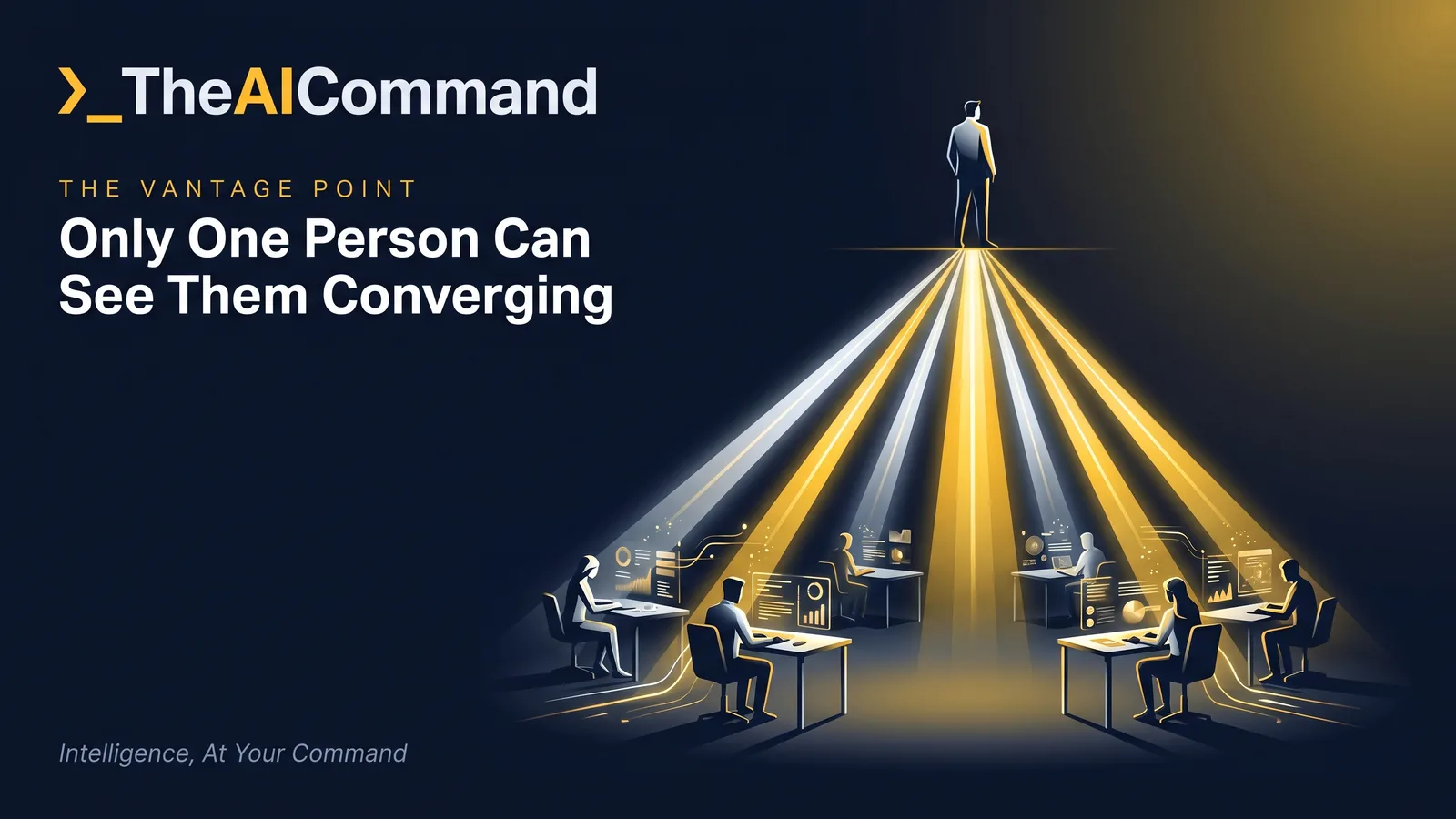
Which is exactly why it lands on you. Everyone on the team is optimising the thing they can see, their own output, and every one of them is succeeding at it. You are the only person holding the full set. The narrowing is visible from where you sit and nowhere else, and by the time it reaches you it arrives wearing the costume of consensus, which is the one thing a leader is least likely to interrogate.
<!-- style: cinematic -->
The shift: individual creativity up, collective variety down
The measurement here is unusually clean.
In Generative AI enhances individual creativity but reduces the collective diversity of novel content, published in Science Advances in July 2024, Anil Doshi and Oliver Hauser gave 293 writers a simple job: write an eight-sentence story. Some worked alone. Some were offered one GPT-4 story idea. Some were offered five. Then 600 evaluators scored the output, producing 3,519 evaluations. When AI ideas were on the table, 88.4% of writers took one.
The individual gains were real. Novelty rose 5.4% with one AI idea and 8.1% with five. Usefulness rose 3.7% and 9.0%. The gains were largest for the writers who scored lowest on creativity going in: in the five-idea condition their novelty scores rose 10.7% and their writing quality by up to 26.6%, to the point where the authors report the condition effectively levelled the creativity scores between the less and more creative writers. If you lead a team, that is the outcome you would have hoped for. Your weakest contributor on a given problem now arrives with something solid.
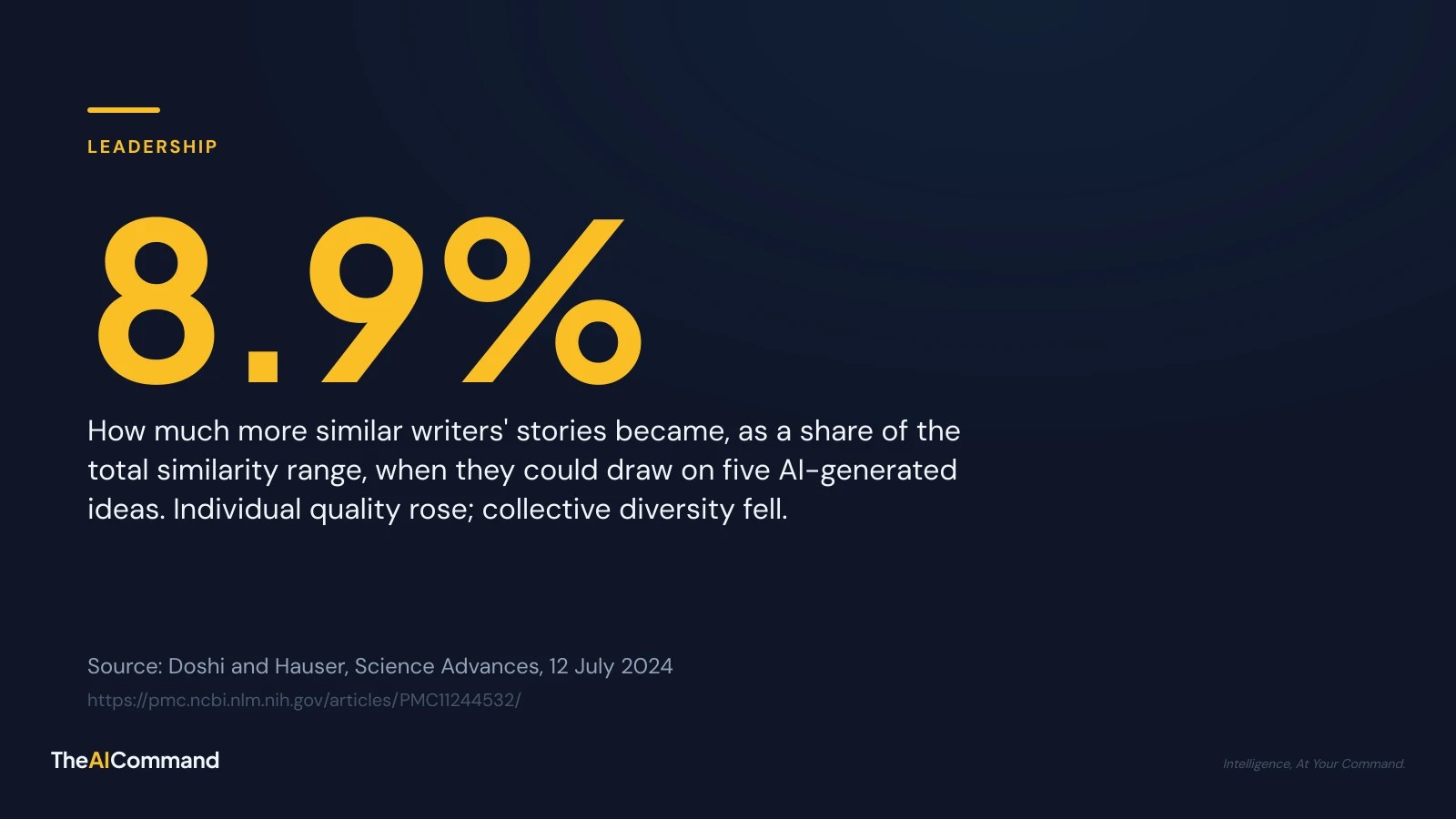
The collective result went the other way. Measuring how similar the stories were to one another, Doshi and Hauser found the AI-assisted stories converged, by 8.9% of the total range in the five-idea condition. Better stories, more alike. Their conclusion is blunt: "While these results point to an increase in individual creativity, there is risk of losing collective novelty."
They also name the mechanism, and the mechanism is the part that should hold your attention. They call it a social dilemma: "If individual writers find out that their generative AI-inspired writing is evaluated as more creative, they have an incentive to use generative AI more in the future, but by doing so, the collective novelty of stories may be reduced further." individual writers find out that their generative AI-inspired writing is evaluated as more creative, they have an incentive to use generative AI more in the future, but by doing so, the collective novelty of stories may be reduced further."
Read that as an operating problem rather than a research finding. Every individual is correctly incentivised to do the thing that collectively costs you variety. Nobody is behaving badly and nobody has a reason to stop. There is no version of this that an individual solves, because from inside their own experience there is nothing to solve.
Boussioux and colleagues put a price on the exchange. In The Crowdless Future? Generative AI and Creative Problem-Solving, published in Organization Science in 2024, 125 global solvers produced 234 solutions to a circular-economy challenge, and 300 evaluators judged them. Human crowd solutions "exhibited higher novelty, both on average and for highly novel outcomes", while human-AI solutions "demonstrated superior strategic viability, financial and environmental value, and overall quality". So the trade is legible. You are buying quality and viability. You are paying in novelty.
One caution before you act on any of it. This evidence comes from lab and crowdsourcing experiments on short stories, cartoon captions and business-idea challenges, run with crowdworkers and solvers, not from leadership teams doing real planning work. Applying it to your quarterly cycle is a reasoned extrapolation, not a measured finding. What travels is the mechanism: an incentive that acts on individuals and only shows up in the aggregate. Treat this as a reason to change your sequence, not as proof of what your team did last quarter.
The operating move: sequence it, do not restrict it
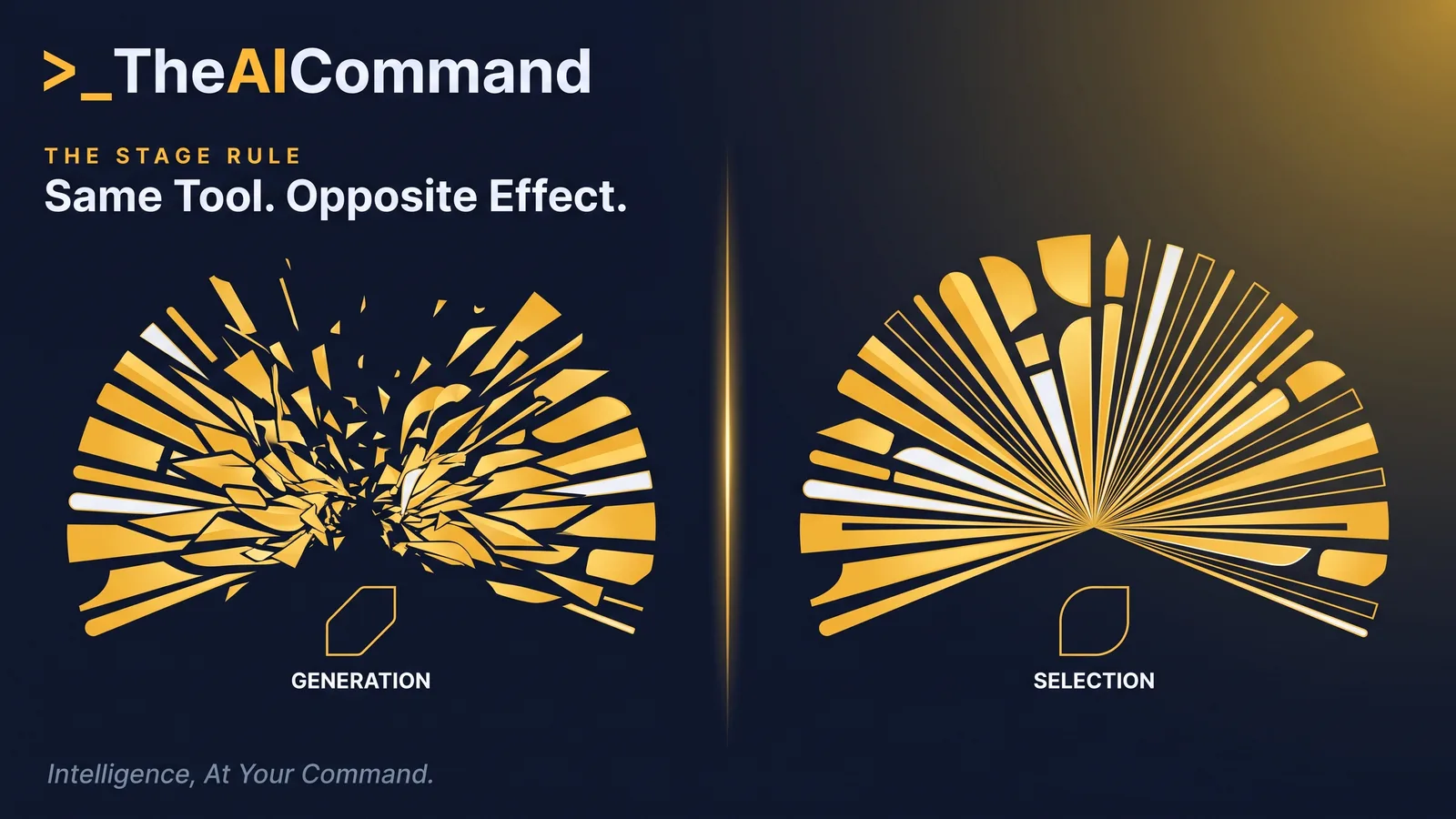
The most useful finding in this literature is that the damage is stage-dependent, not tool-dependent.
In The Hidden Cost of AI-Assisted Creativity, published in MIT Sloan Management Review in July 2026, Leonard Boussioux, Anil Doshi, Oliver Hauser and Kartik Hosanagar synthesise four studies and state the rule plainly: "AI in idea generation consistently reduced diversity, whereas AI in idea selection preserved variety at levels comparable to those of human-only work." Wharton's Human-AI Research group, where Hosanagar sits, puts it the same way: "when humans generate initial ideas and AI supports evaluation or refinement, diversity is preserved. But when AI is used in early ideation, outputs converge."
Hosanagar and Ahn point at the same lever in Designing Human and Generative AI Collaboration, an arXiv preprint from December 2024 that has not been peer-reviewed. They found more AI involvement pushed creators beyond their own experience but lowered aggregate diversity, and, critically, that "this effect was mitigated through human participation in early creative tasks."
<!-- style: split -->
So the decision in front of you is not whether the team uses AI. It is where in the process AI is allowed to enter. That is a sequencing call, and it is yours to make.
Here is the choreography we would run. None of this is in the research, which measures the effect but does not prescribe a meeting. This is our reading of what the stage rule implies for a real planning cycle.
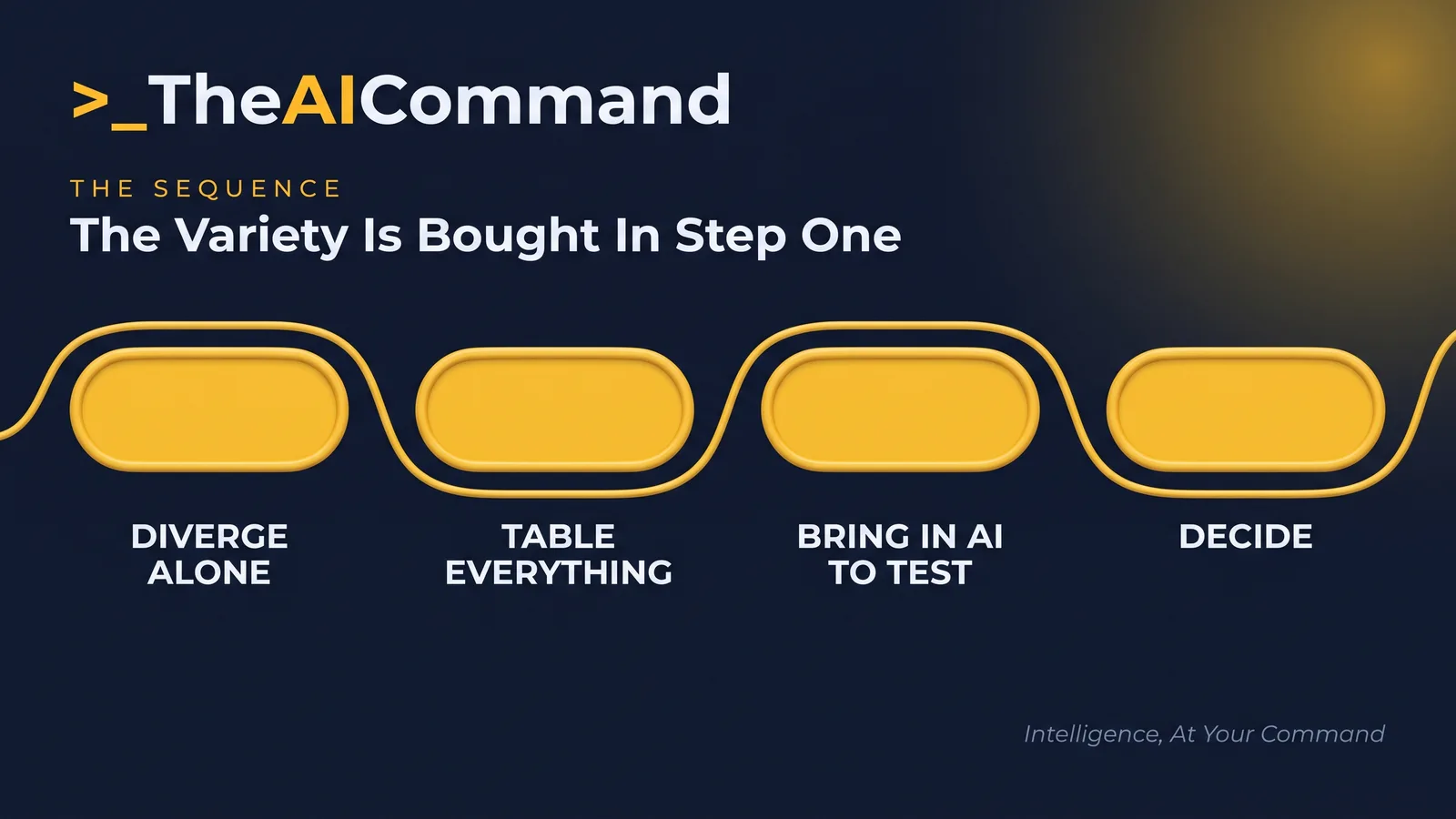
- Diverge before anything is opened. Before the meeting, each person spends a fixed block, we would give it 40 minutes, writing their options alone. No model open. No shared document. No visibility of anyone else's work. You are protecting two things at once here: the individual's own distribution of ideas, and the independence between people.
- Table everything before discussing anything. Options go up as written. Not summarised, not pre-merged, not ranked. The moment you allow a synthesis pass before the set is visible, you have thrown away the variety you just spent 40 minutes buying.
- Now bring AI in, and point it at selection. This is where the tool earns its keep and where the authors measured no diversity penalty. Pressure-test each option. Cost it. Find the failure modes. Model the second-order effects. Be precise about what that last part rests on: Boussioux and colleagues measured their quality and viability gains with AI generating the solutions, not selecting between them. Pointing the tool at pressure-testing instead is our inference about where those gains might be banked without paying for them in range.
- If AI must run upstream, vary how it is used. Sometimes you cannot buy 40 quiet minutes from six people. The MIT SMR authors give their own prescription for that case, and it is worth following as written: "Rotate prompts, role-play perspectives, integrate company-specific data, and run multiple models or agents", and design so that "different models or agents address the same challenge from distinct perspectives". Boussioux and colleagues add the sharpest version, from their peer-reviewed work: solutions produced through differentiated search, where prompts instruct the model to generate outputs deliberately distinct from previous iterations, outperformed those from independent search. If AI is generating, make it generate against itself.
<!-- style: process-flow -->
The judgement boundary
The shape of the option set is yours and you cannot hand it to a model.
The reason is structural. A model asked to broaden your pool is drawing from the same distribution that narrowed it. It can widen the phrasing. It cannot supply the thing that was never in the room. Ask it to generate the missing options and you are asking the mechanism to audit itself.
Accountability sits in the same place. When a decision is made from a narrow menu, the person answerable is whoever set the menu. Not the six people who each brought a genuinely good paper. Not the tool that made each paper better. You.
Now the honest cost, because this move has one and pretending otherwise would be selling you something. Divergence is slower. It produces worse average ideas, on purpose. Forty minutes of individual writing with no model open will generate material that is rougher, less polished and less immediately impressive than what the same people would have produced with help. You are deliberately trading average quality for range, and you are doing it on the belief that the best option in a wide set beats the median option in a narrow one. If you are not willing to defend that trade out loud, do not start it, because the first rough pre-read will end it.
There is a quieter way to lose. A leader who asks for variety and then, in the room, rewards only the most polished submission has taught the team exactly what to do next quarter. They will bring the polished thing. They will use AI to get it. The process will still be running and it will produce convergence anyway, because the incentive beat the agenda. Whatever you praise on the day is your real method.
A worked example
[TEAM] runs a quarterly planning cycle. Six people each bring an AI-assisted pre-read. The papers are strong, better written and better argued than last year's. Read together, they propose near-identical moves. The room mistakes this for alignment and [LEADER] almost signs it off.
Instead, [LEADER] re-runs the cycle. Each person gets 40 minutes to write their options individually, with no model open and no shared document. Everything gets tabled as written, before any discussion. Only then does AI come into the room, pointed at the tabled options: stress-test each one, cost it, name how it fails.
One option survives to the shortlist that was not in the first version at all. It comes from [DIRECT_REPORT], and it is not better written than the others. It is rougher. It simply exists this time, because the person who had it wrote it down before anything else told them what a good answer to this question looks like.
That is one cycle and one observation, not a result. It is also the only kind of evidence a leader ever actually gets.
Bottom line
Everyone's ideas got better and you have fewer of them, and Doshi and Hauser measured both halves of that trade in the same experiment: novelty and quality rose for individuals, most of all for the writers who scored lowest going in, while the stories converged as a set. The mechanism is what makes it a leadership problem rather than an individual one, because every person is correctly optimising the output they can see and none of them has any reason to stop. The damage is stage-dependent rather than tool-dependent, so AI in idea generation compresses variety while AI in idea selection preserves it. That makes the move a sequencing decision, not a restriction: let people diverge alone first, table everything as written, then bring the tool in to pressure-test and choose. The narrowing is only visible from the vantage point that holds the whole option set, which is yours.
Do this Monday
- Pull last quarter's pre-reads and read them as a set. Not for quality, for spread. If they cluster, you have your answer, and you had it all along without looking.
- Find the next real decision on your calendar. Pick one with genuine optionality, not a decision already made.
- Move the divergence upstream. Ask each person for their written options before the meeting, alone, no model. Say plainly that rough is the point.
- Say what you are buying and what it costs. Tell the team the first pass will look worse than last time, and that this is the intended outcome, not a failure of preparation. Unsaid, it reads as a step backwards. Said, it reads as a method.
The tool is not the problem and restricting it is not the answer. Where it enters the process is the whole decision, and it is one only you are positioned to make. Every leader is now running an idea portfolio, whether they choose to manage it or not.
References
- Anil R. Doshi and Oliver P. Hauser, "Generative AI enhances individual creativity but reduces the collective diversity of novel content", Science Advances, 12 July 2024, DOI 10.1126/sciadv.adn5290. Peer-reviewed.
- Leonard Boussioux, Jacqueline N. Lane, Miaomiao Zhang, Vladimir Jacimovic and Karim R. Lakhani, "The Crowdless Future? Generative AI and Creative Problem-Solving", Organization Science, vol. 35, no. 5, pp. 1589-1607, 2024. Peer-reviewed.
- Leonard Boussioux, Anil Doshi, Oliver Hauser and Kartik Hosanagar, "The Hidden Cost of AI-Assisted Creativity", MIT Sloan Management Review, 9 July 2026. Practitioner synthesis by the researchers.
- Kartik Hosanagar and Daehwan Ahn, "Designing Human and Generative AI Collaboration", arXiv:2412.14199, December 2024. Preprint, not peer-reviewed.
- Wharton Human-AI Research, "How AI Shapes Creativity: Expanding Potential or Narrowing Possibilities?", 6 October 2025.
TheAICommand. Intelligence, At Your Command.