
Your knowledge advantage just evaporated. When AI can hand anyone a competent synthesis in seconds, a leader's value shifts from knowing the most to exercising the judgement AI cannot: framing the real question, deciding what is right, and owning the outcome.
For most of the history of management, seniority tracked information. The leader knew the numbers, had seen the pattern before, held the relationships and the context, and could see further than the people in the room. That advantage justified the role. It is also exactly what AI now hands to everyone. The most junior person on your team can ask a model for a competent synthesis of a market, a competitor, a regulation or a strategic option, and get it in seconds. The thing that used to make you the most informed person in the room is now a utility.
That is not a threat to leadership. It is a change in what leadership is for. And a peer-reviewed study of how AI reshapes the skills of senior managers puts the shift about as sharply as it can be put.
Is the AI shift for leaders technological or human?
In "Strategic leadership at high altitude", published in the Journal of Business Research in 2026, Bevilacqua, Ferraris, Matzler and Kuděj examine how AI changes the skills top managers actually need. They identify four interdependent capabilities: an AI open mindset, the ability to act as an AI strategic co-thinker, the role of multi-level connector, and ethics risk management. The through-line, as one review of the study frames it, is that "the most profound shift identified in recent research is not technological. It is human."
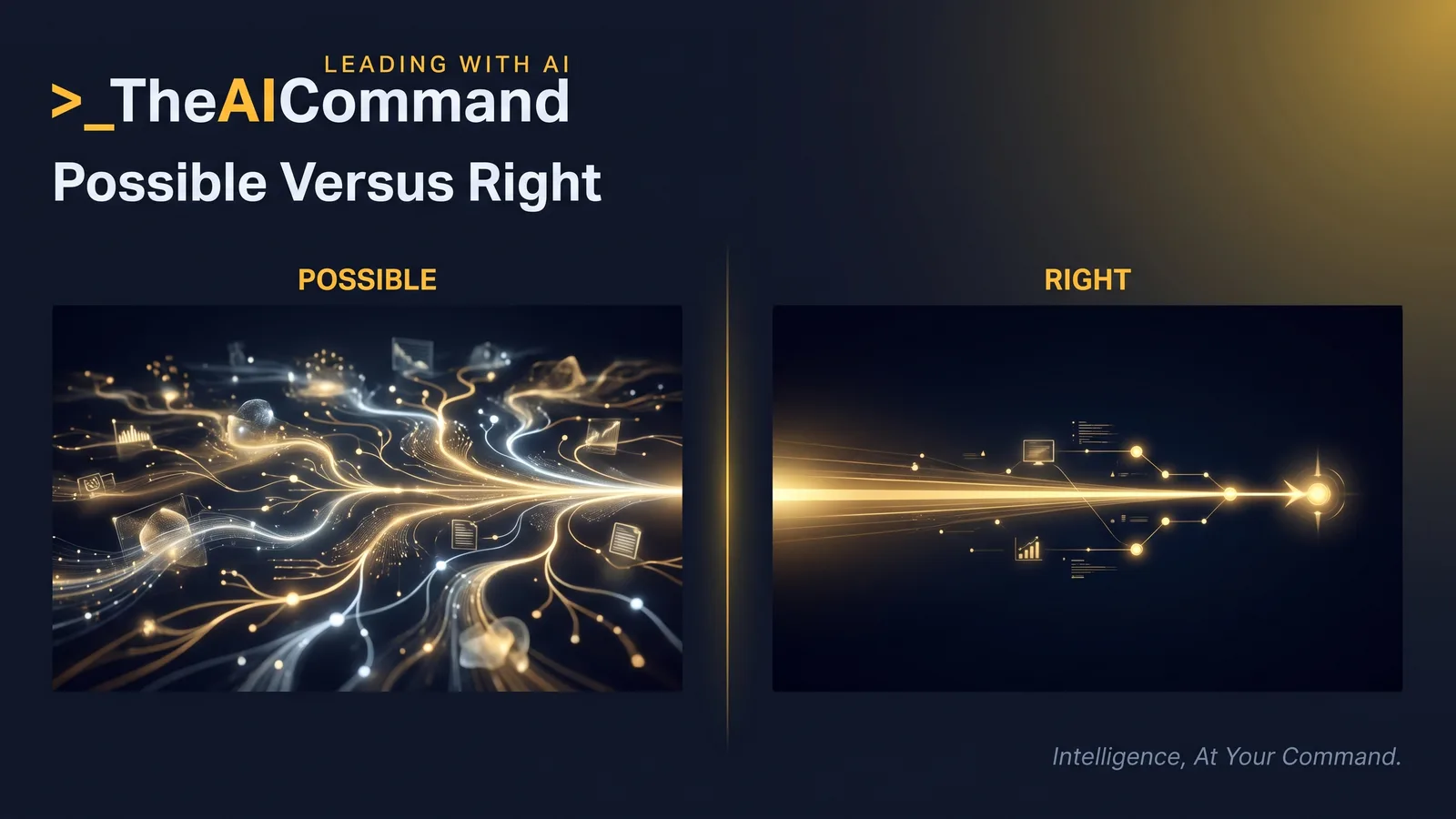
What AI takes away is the part of authority that rested on exclusive information and hard-won instinct. What it leaves, and makes more valuable, is judgement and meaning. When the model can generate the options, the leader's contribution is no longer producing the answer. It is deciding which question is worth answering, choosing what is right among the possibilities, and standing behind the choice. As the study is summarised, "AI can illuminate what is possible. Only leadership can decide what is right. And once the decision is made, only leadership can take responsibility for the outcome."
Read that as a reallocation of effort. The recall, the synthesis, the first-draft analysis, hand it to the machine that is now better and faster at it than any executive. Reserve your scarce attention for the three things the machine cannot do.
None of this means leadership got easier, or smaller. The parts of the job that were always the hard parts are the parts that remain. Setting a direction people will actually follow. Developing the person in front of you. Holding a room through uncertainty. Carrying the weight when a call goes wrong. AI touches none of them. What it removes is the scaffolding that let some leaders substitute knowing more for those harder things. A manager who led by being the most informed person in the room now has to lead by being the best judge in it, and those are not the same skill. For leaders who were already strong on judgement, this is a promotion. For leaders who leaned on their information edge, it is exposure.
What can AI not do in a leadership decision?
Framing the real question. A model answers the question you ask, fluently, whether or not it is the right one. The study's leaders "formulate the right strategic questions so the system is solving the real problem rather than the most obvious one." This is where context and priorities live, and AI does not hold either. Ask a model how to cut costs and it will tell you how to cut costs. Whether cost is even the problem is your call, and it is the highest-leverage call you make.
Deciding what is right. AI can lay out what is possible and what is likely. It cannot weigh a tradeoff against your values, your people and your obligations, because it does not carry them. Human values, as the study puts it, "remain the anchor for organisational choices." Two options can be equally viable on the evidence and profoundly different in what they cost the people involved, and choosing between them is a judgement, not a calculation.
Owning the outcome. Accountability cannot be delegated to a model. When a decision goes wrong, "the AI recommended it" is not an answer a leader can give. Responsibility is the part of the role that never moves, and it is precisely what makes the other two matter.
How do you think with AI without deferring to it?
The trap in all of this is quiet. A model is confident, articulate and agreeable, and it is very easy to slide from using it to think into letting it think for you. The moment you consume its output instead of evaluating it, you have handed away the judgement that is now your entire contribution. The study's answer is the strategic co-thinker: a leader who partners with AI as a genuine thinking companion and, crucially, "filters and refines outputs, questioning what might be flawed or incomplete."
Here is a protocol you can run on your next real decision this week.
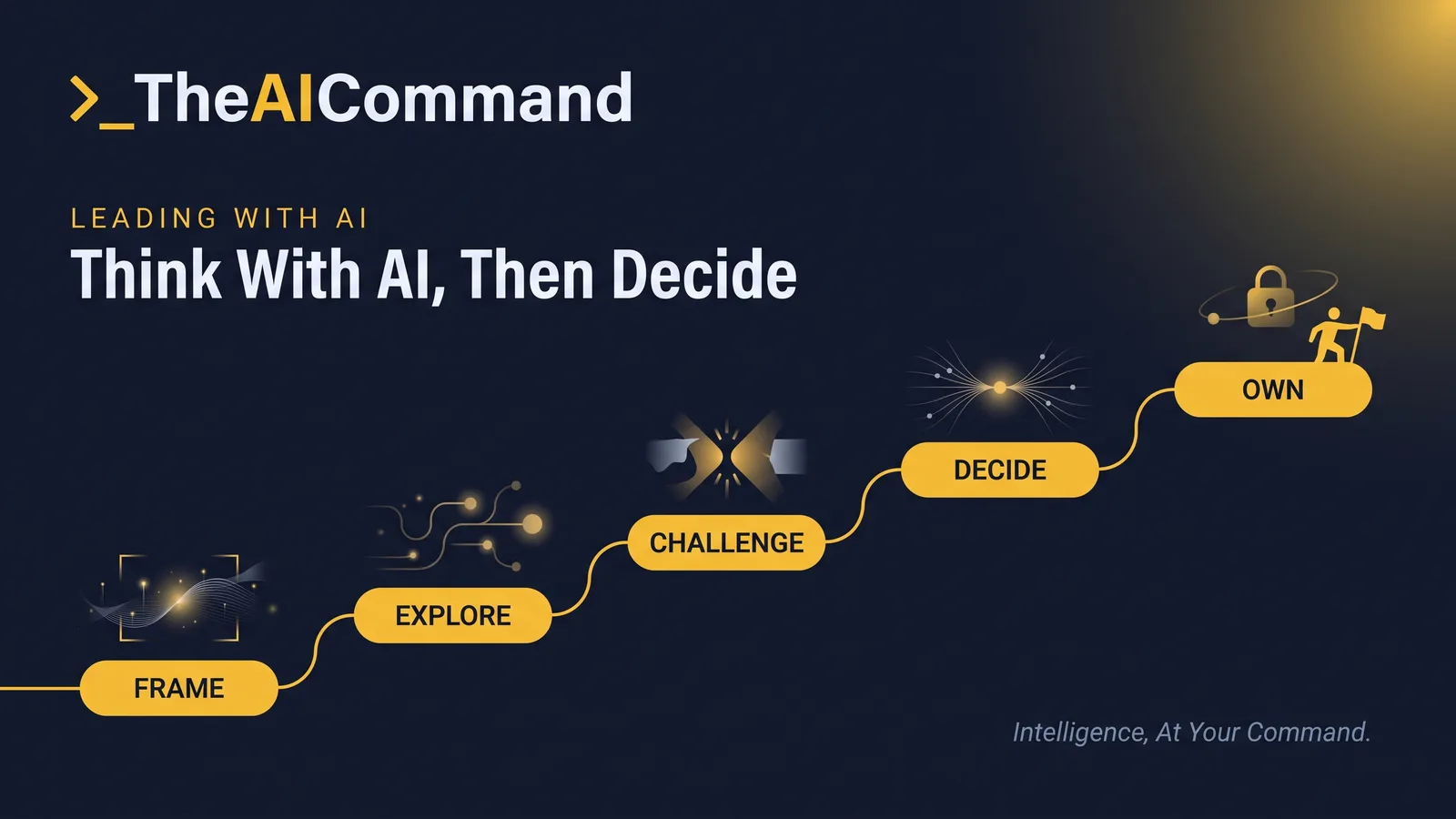
- Frame before you prompt. Write the real question down first, in one sentence, before you open the model. Force yourself to name the problem you are actually solving, not the obvious one. If you cannot state it cleanly, that is the work to do before AI can help.
- Explore for breadth. Ask the model for the range: the credible options, the evidence for each, and the perspectives you might be missing. This is what it is good at, so use it fully.
- Make it argue against itself. Before you trust anything, ask for the strongest case against each option, what the analysis assumes, and what it is likely missing. A model will agree with you by default, so you have to make it disagree before you decide. This is one move, not the whole job, but it is the move that keeps you an evaluator.
- Decide on your judgement. Now do the part only you can do. Weigh the options against your context, your people and your values, and choose. The model informed the decision. It did not make it.
- Own it in your own words. Write the decision and the reason yourself, in a sentence a person could hold you to. If the reasoning could only have come from the model, you have not actually decided anything.
The tell: are you thinking, or forwarding?
There is a simple test for whether you have crossed the line. Look at the last decision you made with AI in the loop and ask whether you could defend it without mentioning the model. If your reason is a version of "the analysis said so", you did not decide, you forwarded. If your reason is a judgement you can hold in your own words, with the model's work as an input rather than an authority, you thought.
The forwarding failure is seductive because it feels like rigour. The output is thorough, well structured and confident, and agreeing with it feels like diligence. It is the opposite. A model built to be helpful will tell you your idea is strong, your plan is sound and your instinct is right, because agreement is what keeps you using it. That tendency is not something you can prompt away entirely. It is something you have to counter on purpose. The leaders who stay sharp treat every confident answer as a claim to be tested. The ones who dull treat it as a shortcut, and slowly stop noticing that they have not disagreed with the machine in months.
The judgement boundary
The line to hold is simple to state and easy to cross. AI is now allowed to be more informed than you, and pretending otherwise wastes the tool. What it is not allowed to do is decide, because deciding requires values it does not have and accountability it cannot carry. A leader who uses AI to know more and still owns the judgement has become more effective. A leader who lets AI decide has quietly stopped leading and started forwarding. The difference does not show up in the meeting. It shows up when the decision is wrong and someone has to answer for it.
A worked example
[LEADER_NAME] runs [TEAM] and faces a call on whether to consolidate two functions. The old instinct is to be the most informed person in the room, so [LEADER_NAME] would have spent the week gathering the analysis and arriving with the answer. Instead, the week runs differently.
First, the question. Not "how do we consolidate these two functions" but "what problem would consolidating actually solve, and is it the problem worth solving now." Writing that down changes the exercise, because it surfaces that the real issue is a capability gap, not a structure one.
Then the breadth. A model produces the options, the evidence, and, when asked, the strongest case against each and the assumptions baked into the analysis. It flags that the consolidation case rests on a productivity gain the team has not actually demonstrated.
Then the judgement. [LEADER_NAME] weighs the options against what the change would cost the people in [TEAM] and what it would mean for a commitment made to them earlier, neither of which the model holds. The decision is to fix the capability gap first and revisit structure later, and [LEADER_NAME] writes that reason in one sentence, in their own words, and owns it.
There is a second move that matters as much as the first. [LEADER_NAME] takes the model's analysis into the leadership team and does not present it as the answer, setting the norm for how the team uses AI. The analysis becomes the shared starting point, and the conversation is about the judgement, not the facts, because the facts are no longer what people are arguing over. That is what changes when the information advantage is gone. The meeting stops being the place a leader proves they know the most. It becomes the place the team does the thinking the model cannot, out loud, together, with a person accountable for where it lands.
The model did more analysis than any executive could have done alone. The leadership was everything the model could not do.
The habit to build
You do not become this kind of leader in one decision. You become it by making the reallocation a habit: reaching for AI to know more, and reaching for your own judgement to decide, until the two feel like separate muscles. The commitment is small. On your next real decision, write the question before you prompt, make the model argue against itself before you trust it, and write your reason in a sentence you would put your name to. Do that ten times and the posture sticks. The leaders who will matter in an AI-saturated organisation are not the ones who resisted the tools, or the ones who deferred to them. They are the ones who used the tools to know more and stayed the judge.
Bottom line
AI has taken the information advantage that once defined senior leadership, so knowing more is no longer where your value sits. What remains, and grows more valuable, is judgement: framing the real question, deciding what is right, and owning the outcome, none of which a model can do. Use AI for breadth and speed, then stay the evaluator rather than the audience.
Do this Monday:
- Write the real question in one sentence before you open the model.
- Ask the model for the range of options, the evidence, and the perspectives you are missing.
- Make it argue the strongest case against each option and name the assumptions baked in.
- Decide on your own judgement, then write the reason in a sentence you would put your name to.
- Check where your own AI leadership habits stand and build the reallocation into a routine.
TheAICommand. Intelligence, At Your Command.