
Start with the sentence the evidence permits
The monthly departure report contains a neat conclusion: limited progression is driving people out. The source folder is less neat. Some people mentioned progression, one described an unrelated personal move, and several did not answer the question. The conclusion has travelled further than the records supporting it.
Before asking a model to improve the wording, ask what the organisation actually knows. There is a difference between a reason recorded by a departing employee, an interviewer's interpretation and a cause established through investigation. Put those in separate fields. Otherwise a confident summary can turn three different kinds of information into one apparent fact.
This article uses a fictional Australian private-sector employer and wholly constructed feedback. Its purpose is to teach a bounded analysis method, not to assess any person or organisation. The examples are editorial constructions, not outputs observed from an AI product. All quantities refer only to the teaching dataset.
The useful deliverable is a short thematic brief with an evidence trail. A reader should be able to see which responses support a theme, which challenge it, what is missing and what question remains. That makes the brief usable even when the sample is too limited for a workforce-wide conclusion.
Establish the collection boundary before grouping comments
Give the source pack a clear beginning and end. Record the reporting period, which departure types were included, who was invited, who responded and which questions were asked. Keep those facts outside the model's discretion. An assistant must not reconstruct invitation numbers from interview notes or assume that a missing file represents a refusal.
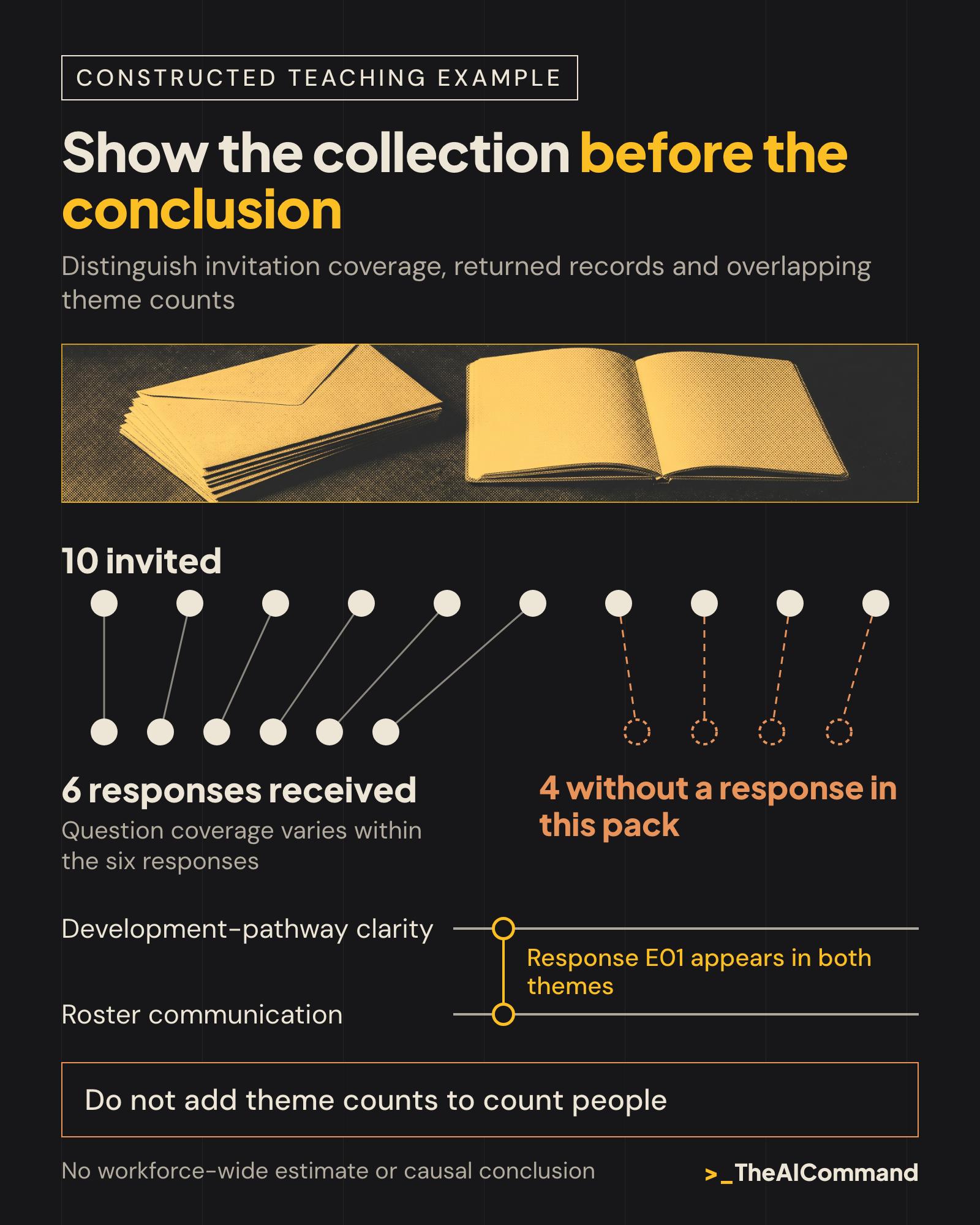
In the constructed example, ten people were invited to provide feedback and six supplied a response. That means four invitees have no response in the pack. It does not reveal their views. Nor does it establish whether their experiences resembled those of respondents. Report these counts as a description of the collection, not as an argument that the results represent all departures.
Question coverage matters within those six responses. Someone can complete an interview without answering the question about progression. A summary saying that half the respondents mentioned progression would hide a different issue if only three people were asked about it. Use the actual question record to establish the denominator for each claim.
Also record how the material was captured. A typed answer, an interviewer's paraphrase and a later recollection do not have identical provenance. The proposed workflow retains that distinction alongside each source ID. It does not assign a numerical truth score to any respondent, and it does not ask AI to decide whether someone was sincere.
Make the analysis pack smaller than the personnel file
Prepare a permitted extract before involving an assistant. Remove names, contact information, exact departure dates where unnecessary, unusual project details and references to identifiable colleagues. Keep the restricted source record with its authorised custodian. The model receives only the minimum material needed for the approved analysis.
Removing a name does not establish anonymity. The Office of the Australian Information Commissioner explains that de-identification depends on the context and possible re-identification, including the access environment. A distinctive account can remain recognisable to colleagues. Treat quote selection and audience selection as part of the same review. OAIC de-identification guidance.
For practice, use invented responses rather than transformed real interviews. This example contains no actual employee records. That makes it suitable for explaining the method, but it proves nothing about whether a future real dataset has been de-identified adequately. A practice exercise cannot confer privacy approval on an operational workflow.
The OAIC recommends, as best practice, avoiding personal information in publicly available generative AI tools. Its product guidance also emphasises checking suitability and access to inputs and outputs. Have the organisation's authorised privacy and technology reviewers approve the actual destination before using real material. OAIC guidance on commercially available AI products.
The Fair Work Ombudsman's workplace privacy guide distinguishes legal requirements from best practice. It explains that the Australian Privacy Principles do not apply to every business, that they do not cover personal information an employer holds about a person's current or former employment when the employer uses it directly in relation to that employment, and that contracted human resources service providers may need to comply with them. Do not read that distinction as blanket permission to send departure records to a vendor. The applicable setting and use need review. This article does not determine the employer's legal position. Workplace privacy guide.
Read the six responses before naming the themes
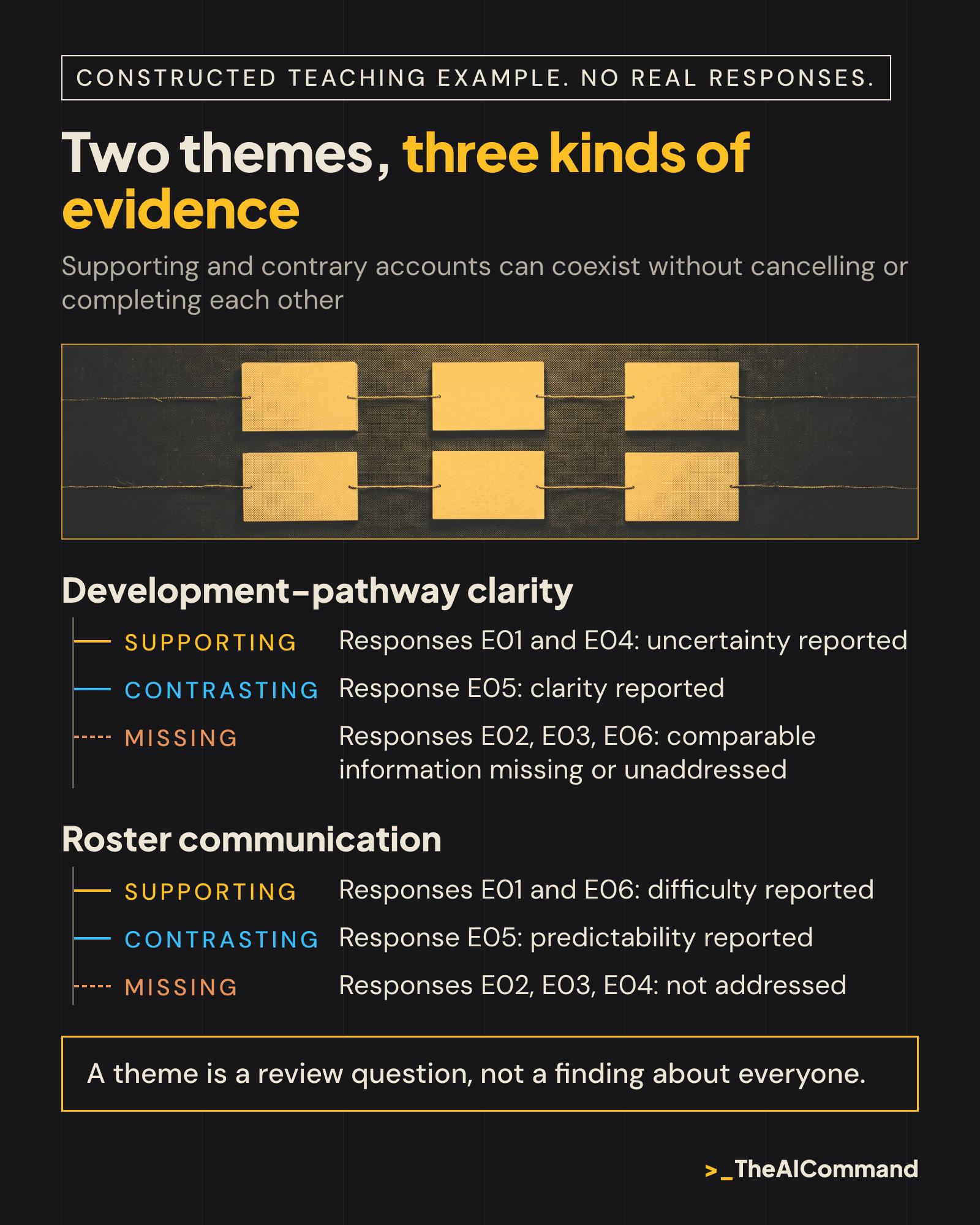
The first constructed response, E01, says the route to advancement was unclear and that short-notice roster changes complicated planning. E02 describes supportive supervision and says a relocation outside work drove the departure. E03 says a move to a different kind of work was attractive but leaves the progression question unanswered.
E04 says the respondent could not see the next development step, while also describing the immediate manager as helpful. E05 says internal opportunities were explained clearly and the roster was predictable. E06 leaves the reason-for-leaving field blank and asks for roster changes to be communicated earlier. The complete synthetic input is provided in the reusable material.
Two responses, E01 and E04, support a theme about uncertainty over development pathways. E05 supplies a different account. E03 leaves the progression question unanswered. E02 and E06 do not discuss it. The defensible statement is that the pack contains two reports of unclear pathways and one explicitly positive account, with other relevant coverage absent.
Roster communication has a similar pattern. E01 and E06 describe a difficulty, while E05 describes predictability. The difference is not a mistake for the model to resolve. It might reflect different experiences, times or arrangements, but those explanations are untested. The brief records the disagreement and asks what additional, appropriately authorised evidence could clarify it.
Do not combine the two supportive-manager comments into a claim that management was universally supportive. Equally, do not turn uncertainty about progression into a negative manager rating. A person can report helpful supervision and an unclear career route at the same time. Keeping these ideas separate prevents an overly tidy theme from changing what was said.
Give AI an extraction job with an explicit stopping point
The model's first job is to propose theme labels and attach source IDs. Require a short description of the underlying observation, supporting IDs, contrasting IDs and missing information. Ask for proposed wording that stays within the supplied pack. Do not ask for the root cause of turnover or a prediction about who will resign next.
A suitable draft row would name development-pathway clarity, identify E01 and E04 as supporting records and E05 as a contrasting record. Its limitations field would say that question coverage is incomplete and nonrespondents are not represented. The output can suggest checking how opportunities are communicated, but it cannot claim that communication explains the departures.
Keep evidence and follow-up in different columns. Evidence says what was reported. Follow-up says what a person could examine next. If both are placed in a single narrative, a proposed explanation can acquire the appearance of a finding. The distinction also makes it easier for a reviewer to reject a recommendation without discarding an accurately recorded observation.
The assistant must leave unknown fields unknown. It cannot fill a missing departure reason with the most common theme, infer a demographic characteristic from phrasing or translate emotional language into a psychological assessment. An unresolved field is useful information about the collection. An invented completion makes the analysis look stronger while weakening its basis.
Audit the theme as carefully as the wording
A human reviewer opens every referenced response and checks the proposed grouping. Does the source actually discuss the theme? Has the model counted two comments from one response as two respondents? Has it changed a qualified statement into a categorical one? Has an interviewer's paraphrase become a supposed direct quotation?
Then review the material that did not fit. Ask the assistant to list uncategorised passages and ambiguous assignments rather than forcing every sentence into a small set of themes. An awkward response may be the most useful challenge to a proposed conclusion. Keeping it visible reduces the pressure to produce a story that is consistent only because exceptions disappeared.
Use respondent counts only where source IDs support them. If one response discusses both progression and rosters, it contributes to each theme but remains one response overall. Theme counts can therefore overlap. Explain that if reporting several counts together. Adding them into a supposed total number of dissatisfied people would misrepresent the dataset.
The reviewer also checks whether the output preserves the collection's limits. A polished executive sentence can lose the caveat that appeared in a working table. Read the final brief without the source pack beside it. If it suggests a broad workforce finding, revise it until its scope is understandable on its own.
Turn limited feedback into proportionate follow-up
The constructed brief supports practical questions. Are descriptions of development opportunities accessible and consistent? How are roster changes communicated? Are the interview questions being asked in the same way? These are proposed lines of enquiry, not findings that a particular manager failed or that a particular process caused someone to leave.
Assign follow-up to a role and describe the evidence that could answer the question. For example, the HR operations owner could review the published development information against the wording used in interviews. The workforce planning owner could examine the approved communication process. Neither task requires circulating the original comments to every manager.
Keep serious allegations or urgent concerns outside routine thematic aggregation. The proposed method routes them to an authorised person under the organisation's existing processes. It does not wait for several similar comments before allowing a concern to be considered. A single account can warrant human attention without being described as a verified finding or a widespread pattern.
Do not use the theme sheet as a personnel scorecard. Its purpose is to organise feedback for review. Decisions about conduct, performance or employment require their own appropriate evidence and process. A departure summary cannot supply that foundation merely because it looks consistent or because an assistant has assigned a sentiment label.
Let limitations travel with the brief
A useful opening sentence for this example states that six of ten invited people supplied feedback, with uneven question coverage and no claim of workforce representativeness. The brief then describes the two themes, the contrasting accounts and the next questions. Place that scope statement where a reader will see it before interpreting the observations.
Prefer neutral paraphrases in the circulated version. A vivid quotation may make a presentation more memorable while also making the respondent easier to identify. Keep detailed source references in the restricted review record. The wider audience needs enough information to understand the issue and the limits, not every detail that made the original account distinctive.
Set a review date for the proposed follow-up and retain the version reviewed. If a source correction changes a theme, revise the summary and tell its recipients which conclusion changed. Do not silently overwrite the source record. The point is to preserve a usable explanation of how the organisation moved from feedback to a question and then to action.
For the next reporting cycle, start with the same evidence fields and check whether the collection process changed. A newly worded question or different invitation practice can alter what is being compared. Avoid a trend claim until a human has assessed whether the two collections support it. The routine becomes more useful when its limits remain visible.
What to do with the next departure pack
Begin with one small, authorised set of responses and build the source-to-theme table before drafting the management narrative. Read the contrary material, check the denominators and remove identifying detail from the circulated version. Ask the model for a bounded synthesis, then require a human to accept or revise every material observation.
The result may be less dramatic than a ranked list of reasons people leave. It is more useful for deciding what to examine next. An honest brief can show that a process deserves attention while remaining clear about what is unproven. Keep the source, the limitation and the follow-up together.
Worked-example evidence table
All six records are constructed. Theme counts overlap; no representativeness or causation is claimed.
Copyable synthesis prompt
Exit-interview synthesis materials
Constructed teaching pack, 22 October 2026. No real employee records and no model run.
Collection metadata
Fictional setting: Australian private-sector employer. Ten departing employees invited during a fictional reporting period; six responses received, four missing. The invitation count is supplied scenario metadata, not inferred from comments. No demographic or team breakdown. All source text below is newly constructed. Bracketed notes represent a missing response field, not a negative answer.
Synthetic input
Human-prepared theme key
Counts: 6 responding records; 4 invited people without responses. Each theme has 2 supporting records and 1 contrasting record. E01 belongs to both themes, so theme counts must not be added to estimate the number of dissatisfied people. No percentage, population estimate or cause of departure is inferred.
Copyable cautious synthesis prompt
Blank operational template
Human review checklist
- Confirm collection period, invitations and response count from authorised records.
- Confirm the analysis destination is approved for the permitted data.
- Remove direct and indirect identifying details before using real extracts.
- Check every theme-to-source assignment and all contradictory material.
- Keep question nonresponse separate from lack of a concern.
- Verify overlapping counts and avoid unsupported population or causal claims.
- Refer serious concerns to the existing authorised process without making findings.
- Review the intended audience and disclosure risk of quotes or small groups.
- Keep limitations in the circulated brief, with a version and review date.
This material is an original recommended workflow. It is not a regulator-issued statistical method, privacy approval or automated employment decision tool.
Related reading
- The Verified Draft Method
- AI Can Analyse Your Engagement Survey Without Surveilling Your People
- When a Declared Interest Needs a Closer Look, the companion article for 26 November
References
- Office of the Australian Information Commissioner: OAIC de-identification guidance
- Office of the Australian Information Commissioner: OAIC guidance on commercially available AI products
- Fair Work Ombudsman: Workplace privacy guide
TheAICommand. Intelligence, At Your Command.