
A declaration arrives before a procurement meeting. It mentions an outside committee role, says the employee knows someone connected with a supplier, and leaves the commencement date blank. The reviewer needs enough context to decide what happens next. A polished summary that describes a close commercial relationship would make the file less reliable, because the declaration did not say that.
This is a suitable place to consider a tightly bounded drafting aid. Ask it to extract the statements and their locations, then formulate clarification questions. Do not ask it to judge the person. The difference shows up in small wording choices: someone has declared an association; the association has not necessarily been independently confirmed or assessed.
The method below is an original administrative workflow, not a regulator-prescribed template. It uses a fictional Australian Public Service agency example so the public-sector context stays explicit. Private organisations can adapt the record structure under their own policy, but cannot assume that Australian Public Service requirements apply to them.
Establish the review context before summarising
The Australian Public Service Commission's guidance for managers discusses receiving declarations, assessing relevant circumstances, agreeing management arrangements and keeping records. It also addresses review when duties or circumstances change. These are responsibilities for the relevant people within an agency. The guidance does not delegate them to an AI system.
Start the working file with the applicable policy version, the activity being considered and the authorised reviewer. A declaration about an outside role cannot be usefully summarised in isolation from the employee's work. However, the assistant only receives a concise, approved description of those duties. It does not need a complete personnel file or an unrestricted connection to the agency's records.
Write down the immediate task. In this example it is preparing a review brief before a specified procurement meeting, not conducting a misconduct investigation. That boundary determines which sources are relevant, which questions can be drafted and which conclusions must remain absent. If the actual task changes, the data owner and reviewer reconsider the inputs and authority before continuing.
Check whether the team needs AI at all. Three short declarations might be faster to read directly. The workflow is useful where consistent extraction would reduce clerical work, provided a person can still check every material statement. Volume alone does not justify processing sensitive declarations in an unsuitable environment.
Keep statements attached to their source
Use a separate row for each declared proposition. Record the document identifier, the section or paragraph, the source wording and a restrained plain-language summary. A row can say that a declaration records a committee role. It cannot quietly become a statement that the employee controls the committee's purchasing decisions.
Distinguish a missing answer from a negative answer. An empty start-date field means that no date was supplied there. It does not mean the role has not started. Likewise, a statement that someone knows a supplier representative does not establish the relationship's nature, frequency or relevance. Those are questions for clarification, not invitations for the model to complete a plausible story.
Preserve qualifiers even where they make the summary untidy. Words such as occasional, proposed, unpaid and understood may be central to what the declarant actually said. Keep the original wording available to the authorised reviewer, and make any shortened wording visibly secondary. A reader must be able to return from the summary to the relevant passage without searching a whole folder.
Do not treat duplicate text as independent corroboration. A sentence copied from a declaration into an email remains the same underlying assertion. Record the relationship between the copies if it matters. A list of three documents is not three sources of confirmation when all three repeat one statement.
Worked example: three declarations, three different gaps
Everything in this example is constructed. The agency, activity, records, dates and expected outputs are fictional. No actual declaration or employee record was used, and the example is not a report of a tested model run. The labels show what an acceptable draft would contain for a person to check.
The fictional agency supplies policy extract P1, activity description A1 and declarations D1 to D3. P1 assigns review of declared interests relevant to the activity to the designated manager and requires the review brief to preserve declared wording and identify missing information. A1 describes a document-review role for a fictional procurement exercise. It does not say that the employee chooses the supplier or signs the contract.
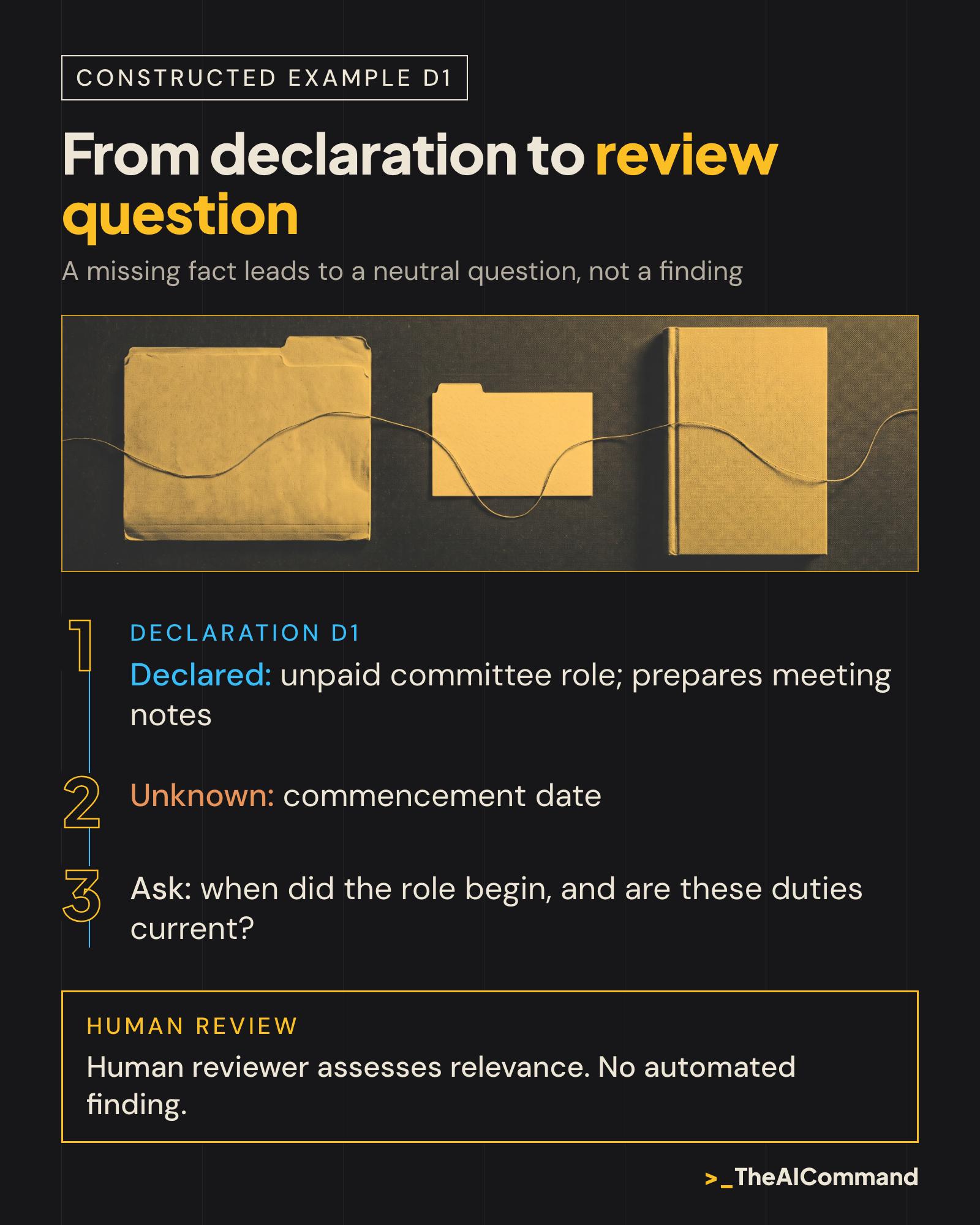
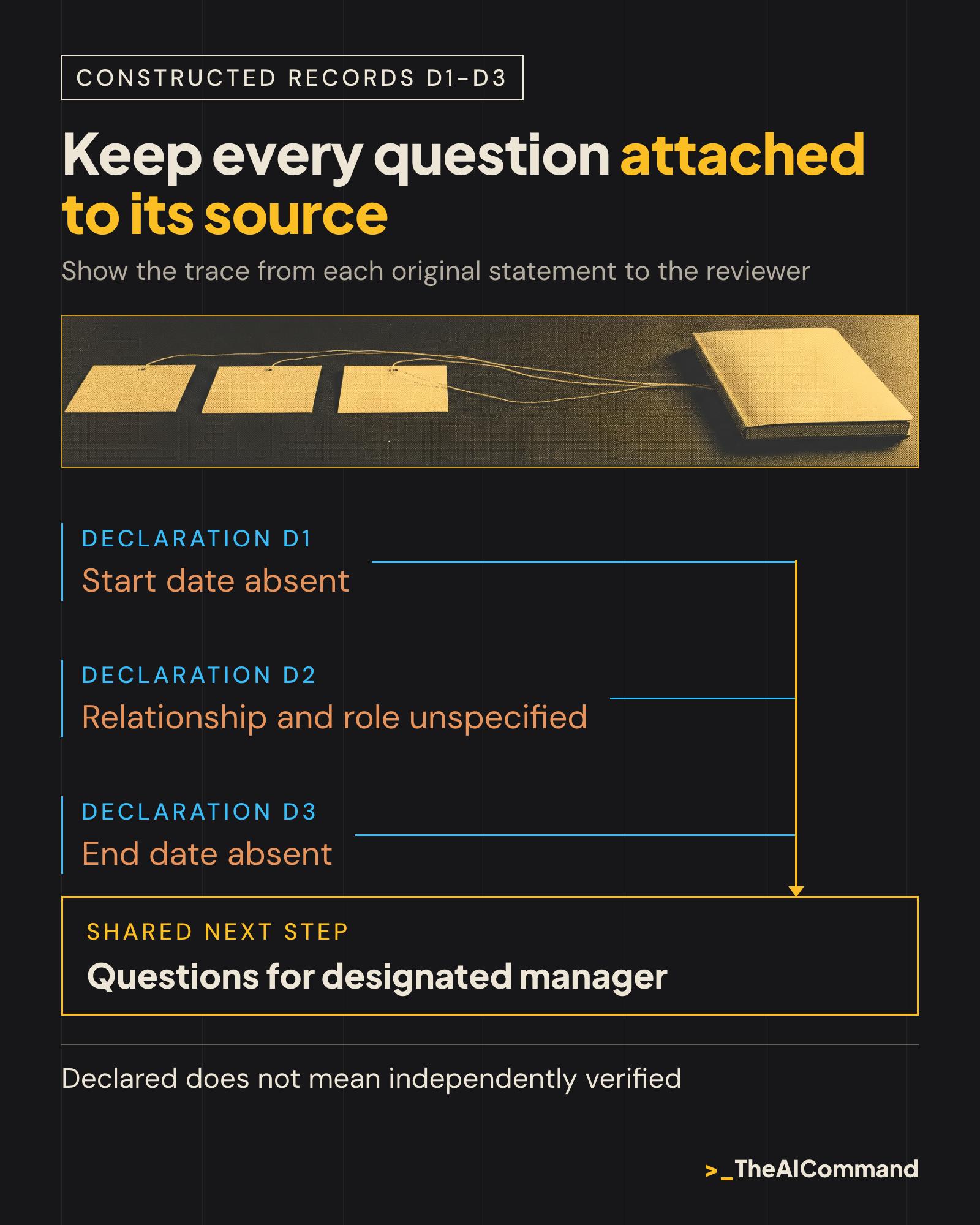
D1 records an unpaid committee role with an external organisation. Its duties field says that the role involves preparing meeting notes. The commencement-date field is empty. A satisfactory extraction preserves the unpaid and note-taking qualifications, identifies the empty field and asks for the commencement date and any relevant changes in duties. It does not label the employee an external decision maker.
D2 records that the declarant knows a person associated with a potential supplier. It gives neither the nature of that relationship nor the person's role. The expected review question asks for enough information to understand the connection's relevance to A1. It does not request a social-media search, family details or an account of unrelated private relationships.
D3 states that an outside role ended before the current activity, but provides no end date. The draft records this as the declarant's statement and marks the timing as unresolved. The reviewer may seek a date or other appropriate clarification. The assistant cannot conclude that the earlier role is irrelevant simply because the statement uses the past tense.
The three cases produce different questions. D1 needs timing and scope clarification. D2 needs the relevant nature of a connection. D3 needs enough chronology to assess the relationship between an earlier role and current duties. Combining them into a single high-risk category would obscure the information needed and introduce a judgement that the records do not establish.
The handover contains the three records and their gaps, not a recommendation to approve or exclude an employee. It identifies the meeting for which a response is needed and names the designated human reviewer. That reviewer decides whether clarification, specialist advice or an interim arrangement is required under the agency's policy.
Ask questions that do not make allegations
A useful clarification question identifies the missing information and its connection to the task. For D1, ask when the outside role began and whether the described duties remain current. Do not ask why the employee concealed the start date. The second formulation introduces both a motive and an allegation from an empty field.
Keep questions proportionate to the activity. If the declaration concerns a supplier connection, the reviewer needs relevant details of that connection, not an unlimited account of the person's private life. Where a question might collect sensitive information, a person decides whether it is necessary and how it should be asked and stored.
Avoid numerical confidence scores about honesty, bias or likelihood of misconduct. They are outside the extraction task and could be mistaken for an assessed finding. Instead, label the evidentiary state plainly: source present, wording ambiguous, field absent or conflicting statements. These labels explain the condition of the record without scoring the individual.
The reviewer also checks the tone of the covering message. A request for clarification should describe the information needed, the relevant activity and the response channel. AI can draft that message, but it cannot send it or select an escalation recipient without the organisation's authorised process.
Keep privacy controls ahead of the prompt
The Office of the Australian Information Commissioner recommends, as best practice, avoiding personal information in publicly available generative AI tools. Its commercial-AI guidance also stresses product suitability and human oversight. A declaration-processing workflow needs an approved environment and a specific assessment of its inputs and use.
Replacing a name with an employee code does not automatically make a declaration safe to disclose. A distinctive outside position or relationship may still identify someone. For learning and testing, create fictional statements from scratch. For operational use, follow the organisation's information-handling decisions and give the model only the approved minimum.
Keep the lookup that connects a working identifier to a person in the authorised record system. Do not append it to a reusable prompt. The reviewer may need that connection to perform the job; a general demonstration or prompt library does not. The resulting brief also needs controlled access because a neutral summary can still reveal private information.
Retain the original declaration according to the applicable records arrangements. Do not replace it with the AI summary, and do not invent a deletion period for the working material. Ask the responsible records and privacy functions to settle retention and access questions that the local policy does not answer.
Review the draft against deliberate failure cases
Before relying on an operational output, compare each row with its source. Confirm that the assistant has not converted a declared statement into a verified fact, lost a qualifier or merged separate people. Then check the questions: each should follow from a visible gap rather than from a newly invented concern.
Use deliberately awkward synthetic inputs to assess the proposed prompt. Include a blank date, two inconsistent dates, an unnamed relationship and a copied passage that appears in two documents. Set the expected behaviour before the trial. An unknown must remain unknown; a contradiction must remain visible; a duplicate must not become additional evidence.
A failed extraction is a reason to revise the prompt, source format or use of the tool. It is not evidence against the declarant. If the model repeatedly expands neutral wording into suspicion, stop using that output for the task. A manual brief is preferable to a fluent record that the reviewer cannot trust.
For repeated use, retain the approved input version, prompt and draft alongside the human corrections where authorised. The existing guide to AI run lineage explains the broader reconstruction problem. This workflow adds a more specific check: can a reviewer distinguish the person's words, the assistant's organisation and the human assessment?
Finish with an accountable handover
The review brief should tell the manager what is known from the supplied records, what remains unclear and which decision is being requested. Attach the source references and the applicable policy context. Keep an unverified clarification response separate until the reviewer has considered it and updated the record appropriately.
If a management arrangement is made, record the human decision and its basis in the organisation's system. Do not let the extraction table become an unofficial parallel approval register. A later reader needs to distinguish the date a declaration arrived, the date a question was answered and the date a decision was made.
Changes require another look at relevance. An outside role that remains unchanged can intersect differently with new duties. Conversely, a resolved question should not be carried into every later summary as an unexplained warning. Link the new review to the earlier record and explain what changed, without allowing AI to infer a new assessment.
For a small first exercise, use the three fictional declarations in the reusable material. Have a colleague inspect the expected outputs without seeing the drafting instructions. If they can trace every statement, identify every unknown and tell who decides next, the brief is serving its purpose. Refine that record before putting any real declaration into an approved workflow.
Reusable review table
Copyable prompt
Declared-interest review materials
All records below are fictional, created for this article. They are not actual declarations, approvals, tests or regulator examples. Do not substitute real personal information without an authorised workflow and appropriate data handling.
Synthetic source pack
P1: Fictional agency procedure, version 1
The designated manager reviews declared interests relevant to the specified activity. The review brief preserves the declared wording and identifies missing information. The manager decides what clarification or action is required and records that decision in the authorised system. This is constructed policy text, not statutory wording.
A1: Fictional activity description, version 1
The employee reviews procurement documents for completeness for a fictional agency. The activity description supplies no authority to select suppliers or sign contracts. Review is required before a procurement meeting on 26 November 2026. This date is a constructed operational choice, not a legal deadline.
D1: Declaration extract, version 1
- Outside role: unpaid committee member at [EXTERNAL_ORGANISATION].
- Duties: preparing meeting notes.
- Commencement date: field left blank.
D2: Declaration extract, version 1
- Statement: the declarant knows a person associated with a potential supplier in A1.
- Nature of relationship: not supplied.
- Person's role at supplier: not supplied.
D3: Declaration extract, version 1
- Statement: an outside role ended before the activity in A1.
- End date: not supplied.
Expected extraction, manually specified
This table is a teaching expectation, not an AI output or an approved assessment.
Copyable source-preserving prompt
Review and handover checklist
- [ ] Source pack and activity are authorised and specific.
- [ ] Each summary statement links to a supplied passage.
- [ ] Declared statements have not become verified facts.
- [ ] Missing dates, ambiguous relationships and contradictions remain visible.
- [ ] No inferred motive, allegation, risk score or finding appears.
- [ ] Questions are relevant and proportionate.
- [ ] Human reviewer and requested decision are identified.
- [ ] Original declarations and corrections remain in authorised records.
Blank handover record
No row has been prefilled with a fictitious result.
What you can do next
- Select the applicable policy and one specific activity.
- Practise with the supplied fictional declarations.
- Check every statement and question against its source.
- Agree the data handling and human review process before operational use.
Related reading
- Defensible AI Lineage Starts Before the Prompt
- What Can Exit Interviews Tell You Reliably?, the companion article for 26 November
References
- Australian Public Service Commission: guidance for managers
- Office of the Australian Information Commissioner: commercial-AI guidance
TheAICommand. Intelligence, At Your Command.