
The Act never says place of employment.
It says place of work. Subsection 4(1) of the Safety, Rehabilitation and Compensation Act 1988 defines that phrase in one inclusive line naming no address and no building. For most of the scheme's life that did not matter: a supervisor knew where people were and a swipe card confirmed it. Hybrid work broke that. Where an employee was at 10.40 on a Tuesday, and what they were doing, is now answered by systems rather than by anyone in the room.
Increasingly those systems assist the work: an assistant's activity history, a document's edit trail, an agent's run record. Comcare's own guidance already names IT access records. A liability question is now a data question.
What does section 6 actually deem?
Section 6 is expansionary. Subsection (1) opens with the words "Without limiting the circumstances in which an injury to an employee may be treated as having arisen out of, or in the course of, his or her employment", then lists ten paragraphs of circumstances treated as having so arisen. It adds, never replaces.
Primacy matters more than practitioners expect, and primacy is not sequence. Comcare's scheme guidance SRC312 records the Full Federal Court decision in Linfox Australia Pty Ltd v O'Loughlin, upheld by the High Court on 20 March 2019, as holding that where an injury arose under section 5A(1), the circumstances in section 6(1) and their clarifying and disqualifying provisions do not apply and cannot deny that finding. Where the connection cannot be established under section 5A(1), section 6 must be considered.
The traffic runs both ways. SRC312 says that where the connection between the injury and employment is unclear, it may be more efficient to consider section 6(1) first, and that a decision maker who finds no section 6(1) circumstance satisfied, or finds the application clarified by section 6(1C) or disqualified by section 6(3), must also consider whether section 5A(1) is satisfied. An injury arises out of or in the course of employment if either provision applies to the circumstances.
Subsection 6(3) withdraws the benefit of subsection (1) where the employee voluntarily and unreasonably submitted to an abnormal risk of injury, but only where section 6(1) is relied on and only where the injury was sustained at a place referred to in that subsection or during an ordinary recess. It does not reach a travel limb. The limb you land on changes which exclusions run.
Three of the ten carry the weight in hybrid work. Paragraph (b) covers an injury sustained while the employee was at the employee's place of work, for the purposes of that employment, or was temporarily absent during an ordinary recess. Paragraph (c) covers a temporary absence while undertaking an activity associated with the employment, or at the direction or request of the Commonwealth or a licensee. Paragraph (d) covers travelling at that direction or request, and subsection (1C) lifts the ordinary commute out: travel between residence and usual place of work is taken not to be at that direction or request.
Subsection (1A) starts a journey from a place of residence at the boundary of the land where the residence sits, and subsection (1B) treats contiguous parcels the employee owns or occupies as one. A fall in the driveway and a fall at the letterbox can land either side of a title boundary.
Where is the place of work when the work is at home?
Subsection 4(1) is short. Place of work, in relation to an employee, "includes any place at which the employee is required to attend for the purpose of carrying out the duties of his or her employment". The operative word is includes. The definition is open; the qualifier is the requirement to attend.
Comcare's guidance on home-based work, SRC336, works that through. A place of work may extend to the work area used in the home and to areas where the employee undertakes activities reasonably incidental to the employment. Where no formal arrangement exists, the guidance directs decision makers to consider whether there was an informal written or verbal agreement. Then the guidance states the boundary plainly: the home does not remain the employee's place of work 24 hours a day, rather the home is considered a place of work during the hours an employee is completing work-related activities.
The finding is bounded by time, not by address. The question is never whether someone works from home. It is whether this address was a place of work at 10.40 on that Tuesday, for the purposes of that employment.
Ordinary recess is where the time-bounding bites. The phrase is undefined in the Act, and Comcare treats it as a regular and expected break in a workday, asking whether it fell at a consistent time.
The guidance illustrates it with Demasi and Comcare, cited there as (2016) AATA 644. An employee working from home took an early break to go for a run and injured her hip. The Tribunal found her home was her place of work despite the lack of a formal working from home agreement, but did not consider a break at an irregular time to go running an ordinary recess, so the injury was not compensable. The pattern evidence was her time sheets, which showed her breaks regularly occurred around lunch time rather than the morning.
SRC336 is also clear that the general exclusions survive the move home, including reasonable administrative action taken in a reasonable manner.
The evidence is now systems evidence
SRC336 sets out what a decision maker may want. Contemporaneous statements. Job descriptions, terms of employment and working from home arrangements. Photographs of the physical environment. And, where a workplace computer is supplied, work logs, emails and phone records. On the paragraph 6(1)(b) question, the guidance names agreed work hours, patterns of work and IT access records.
None of that language is new. What has changed is what those records contain. Where an assistant is embedded in the productivity suite, the interaction is itself a stored record. Microsoft states that stored Copilot data includes the user's prompt and Copilot's response, with citations to any information used to ground it, held as the user's Copilot activity history, and that administrators can view and manage it through Content search or Purview. A prompt typed at 10.38 is a timestamped, discoverable record of presence and activity.
It is also not one record. One Tuesday morning can leave an identity sign-in, a network session, a document version history, an assistant activity history and an agent run record, each under a different owner and retention setting.
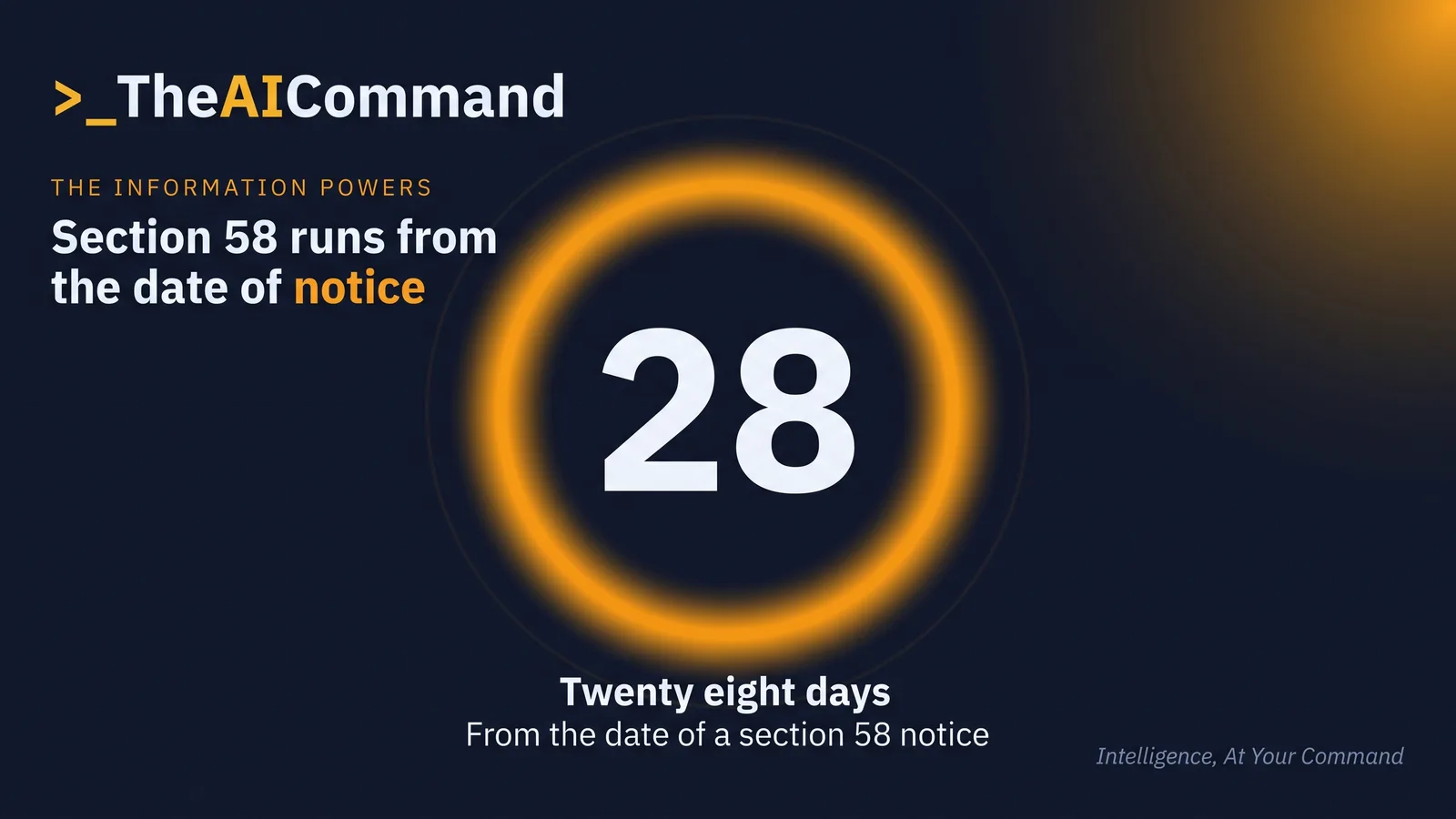
Both information powers reach it. Section 58 lets the authority request information or a document from the claimant, with 28 days running from the date of the notice. Section 71 lets Comcare require a principal officer to produce specified documents within the period the notice states, without delay. Section 59 runs the other way, obliging the authority on request to give the claimant any document it holds relating to the claim. Before any extract reaches a model, apply the de-identification discipline this work depends on.
What does a system log actually prove?
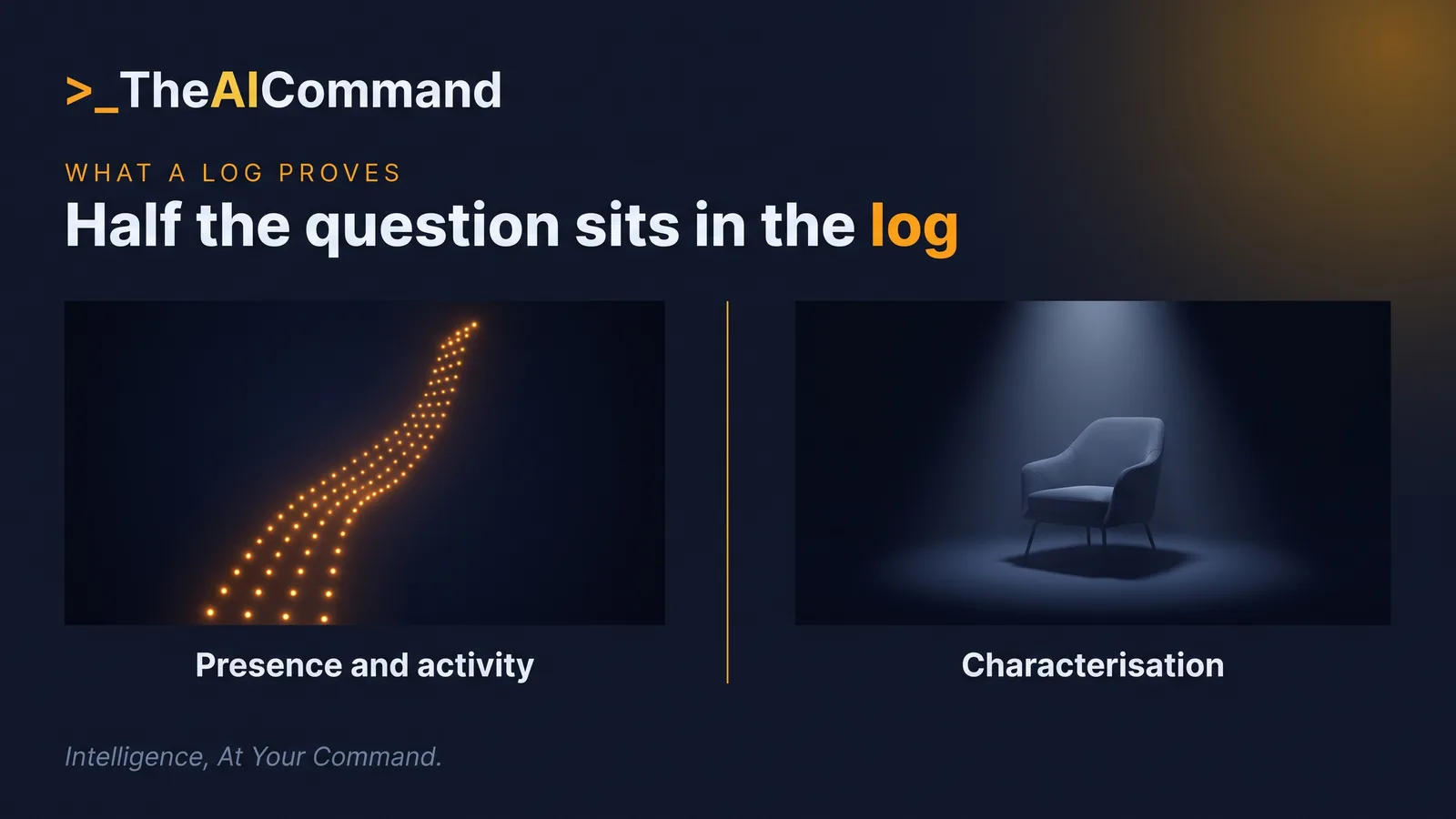
Presence and activity, at a time. That sits close to what paragraph 6(1)(b) asks.
It proves nothing beyond that. Whether an absence was temporary, whether a break was an ordinary recess, whether an activity was associated with the employment, whether a task was directed: each is a statutory characterisation, and each stays with the delegate. Section 72 directs Comcare, in determining claims made to it, to be guided by equity, good conscience and the substantial merits of the case, without regard to technicalities. A licensee with an authority to manage claims picks the same obligation up through paragraph 108E(d). A log has no view on the substantial merits.
Ask a model to summarise an activity export and it returns something like "the employee was on a short work break". That is not a summary. It is a finding, and the one the delegate is paid to make. Keep the output to what each record shows, with a source identifier against every line, as a statement summary carries source IDs rather than a narrative.
Then there is shelf life, shorter than the claim. All figures as at 21 September 2026. OpenAI removes deleted or unsaved conversations within 30 days unless law requires longer, and Anthropic, for its commercial products, removes a deleted conversation from back-end storage within 30 days. Google publishes three answers under one brand: Gemini in Workspace at 90 days to indefinite as administrators determine, the Gemini App at up to 36 months, and Gemini Notebook not retained after the session ends. Microsoft publishes no default: Copilot retention is set by the customer through Purview policies.
Set that against the claim timetable. The SRC Regulations prescribe 20 calendar days to determine an injury claim and 60 for a disease claim, counted from receipt, under an instrument commenced on 1 April 2024. A disease can surface long after the working pattern that contributed to it. A 30-day window can close before anyone knows a claim exists, and missing a statutory timeframe creates no deemed determination. A hold instruction costs an email. A reconstruction costs the claim.
The injury circumstance screen
Everything above collapses into one screen you can lift out and run on the next hybrid-work claim. It records; it does not decide.
Put the governing rule above the first field. A system log evidences presence and activity, never the characterisation. De-identify before any extract reaches a model, and hold the key separately.
- De-identification check. Confirm
[CLAIMANT_NAME],[CLAIM_NUMBER]and[DATE_OF_BIRTH]are replaced and the key is stored apart from the file. Do not continue until this field is signed and dated. - Preservation. The hold instruction issued, the systems it covers, who it went to, and the date. Complete this first.
- Where. The location at the moment of injury as a place, not an address: the work area in the home, elsewhere in the dwelling, land outside it and which side of the title boundary, a client site, or a route.
- When. Date and clock time to the minute, the source of that time, and whether it is local or system time.
- What activity. What the employee says they were doing, in their own words, recorded before anyone maps it to a paragraph.
- Arrangement in force. Formal agreement, informal written or verbal agreement, or none. Name the document, its date and holder.
- Systems holding a record. One row each: the system, the record type, the owner who can produce it, the retention setting, and the date that window closes.
- Route relied on. Section 5A(1) and section 6(1) are alternative routes, so record which one the finding rests on, and which limb if it is section 6(1): 6(1)(b) at a place of work, 6(1)(b) ordinary recess, 6(1)(c) temporary absence or 6(1)(d) travel. A section 5A(1) finding is not defeated by subsection 6(3). Subsection 6(3) becomes live only where section 6(1) is relied on and the injury was sustained at a place referred to in that subsection or during an ordinary recess. Where no section 6(1) circumstance is satisfied, or 6(1C) or 6(3) removes it, return to section 5A(1).
- What the record does not establish. Name it: the characterisation of the activity, whether an absence was temporary, whether a break was an ordinary recess, whether a direction was given, and the employee's purpose.
- Human finding still required. The delegate, the finding they must make, the evidence outstanding, and the date the file returns.
Field seven fails silently, so give the model a narrow instruction and no room to interpret.
Bottom line
Section 6 did not change when the work moved home. The facts it turns on now sit in systems with deletion clocks rather than in the memory of a supervisor three desks away. An activity log answers where and what with a precision no witness statement ever had, and answers nothing about whether an absence was temporary or a break ordinary. Preserve the record the day the injury is notified, keep the characterisation with the delegate, and write down which limb you rely on before you look for evidence to support it.
Do this Monday
- Ask your IT owner for a written list of every system that logs user activity, with its retention setting and deletion date.
- Add a preservation step to claim intake that issues a hold instruction the day an injury is notified.
- Rewrite your circumstance questions to ask when and what activity, never whether the employee works from home.
- Load the injury circumstance screen into your claim system as a form, with the de-identification check as a blocking field.
- Brief your team that no model output may characterise an activity, and require a source identifier on every line of an AI-assembled summary.
References
- Federal Register of Legislation, Safety, Rehabilitation and Compensation Act 1988, Compilation No. 82, 1 July 2026. https://www.legislation.gov.au/C2004A03668/latest/text
- Comcare, Scheme guidance - Claims for injuries and diseases arising from home-based work, SRC336. https://www.comcare.gov.au/scheme-legislation/src-act/guidance/scheme-guidance-claims-for-injuries-and-diseases-arising-from-home-based-work
- Comcare, Scheme guidance - Injury arising out of or in the course of employment, SRC312. https://www.comcare.gov.au/scheme-legislation/src-act/guidance/injury-arising-out-of-or-in-course-of-employment
- Comcare, Scheme guidance - Statutory timeframes for decision-making under the SRC Act. https://www.comcare.gov.au/scheme-legislation/src-act/guidance/statutory-timeframes-decision-making
- Microsoft Learn, Data, Privacy, and Security for Microsoft Copilot. https://learn.microsoft.com/en-us/microsoft-365/copilot/microsoft-365-copilot-privacy
- OpenAI, Enterprise privacy. https://openai.com/enterprise-privacy/
- Google, Generative AI in Google Workspace Privacy Hub. https://knowledge.workspace.google.com/admin/generative-ai/generative-ai-in-google-workspace-privacy-hub
- Anthropic, How long do you store my organization's data? (commercial products, including Claude for Work). https://privacy.claude.com/en/articles/7996866-how-long-do-you-store-my-organization-s-data
This article is general information and education only. It is not legal advice, and it is not advice about any individual claim. Decisions under the Safety, Rehabilitation and Compensation Act 1988 are made by human decision-makers on the individual merits of each claim, and claimants have reconsideration and review rights in respect of determinations. Seek advice specific to your scheme and circumstances.
TheAICommand. Intelligence, At Your Command.