
The date of injury for a disease is almost never the day the disease started.
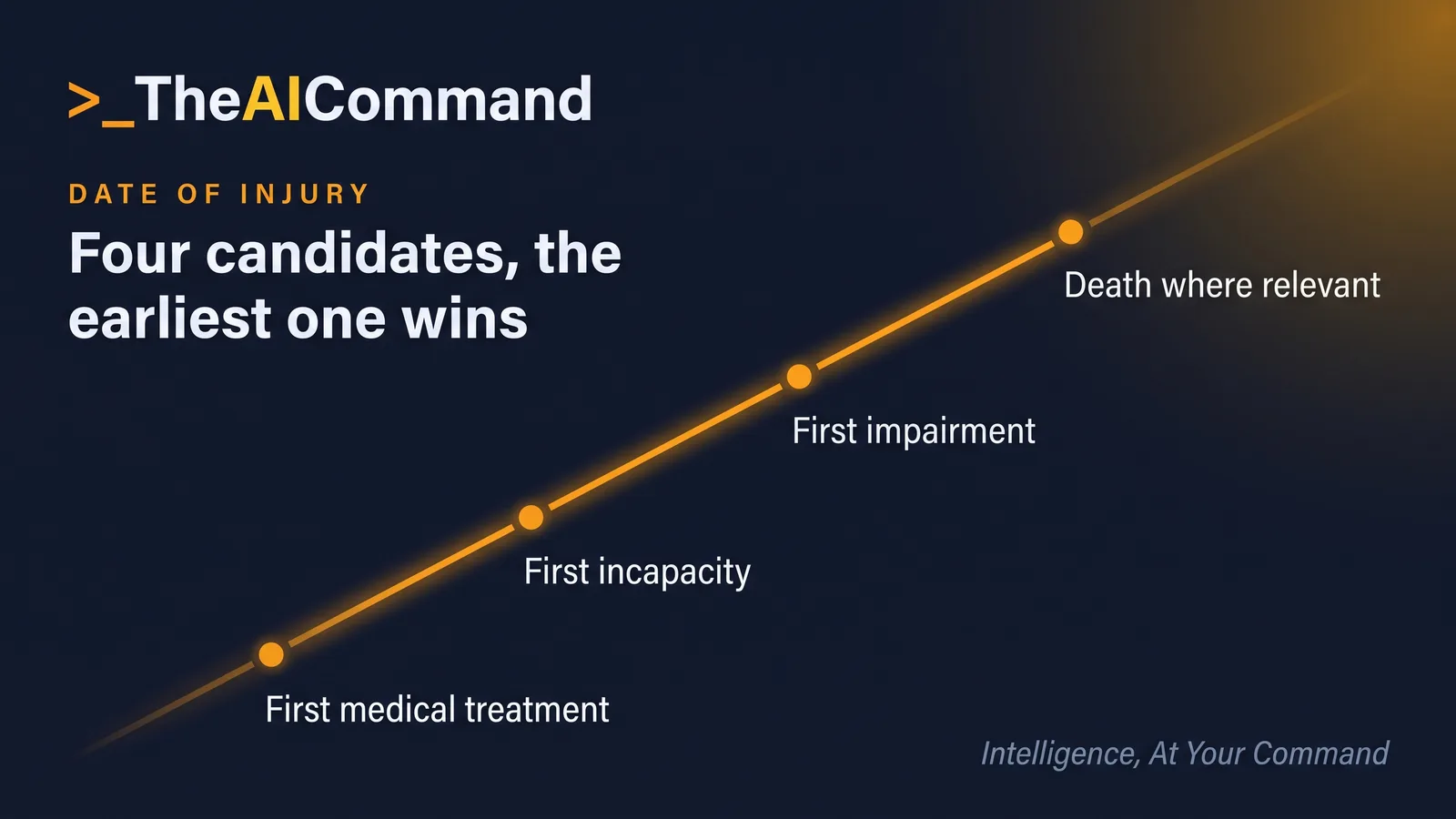
That is not a technicality. Under the Safety, Rehabilitation and Compensation Act 1988, section 7(4) fixes the day an employee is taken to have sustained an injury being a disease, or an aggravation of a disease, as the day the employee first sought medical treatment for it, or the day it resulted in death or first resulted in incapacity for work or impairment, whichever happens first. Onset does not appear in that rule. Lodgement does not appear in it either.
Section 7 is the provision this site has not covered, and it is the one where AI assistance is simultaneously most useful and most dangerous. Useful because both of its live questions are records problems. Dangerous because one of its limbs decides who carries the burden, and a model that gets confident about that limb is telling you something it has no standing to say.
What does section 7 do that section 5B does not?
Section 5B defines the thing. Section 7 changes how you get there.
Under section 5B(1), a disease means an ailment suffered by an employee, or an aggravation of such an ailment, that was contributed to, to a significant degree, by the employee's employment by the Commonwealth or a licensee. Section 5B(2) lists matters that may be taken into account in deciding whether that contribution occurred: the duration of the employment, the nature of and particular tasks involved in the employment, any predisposition of the employee to the ailment or aggravation, any activities of the employee not related to the employment, and any other matters affecting the employee's health. The subsection expressly does not limit the matters that may be taken into account. Section 5B(3) supplies the threshold: significant degree means a degree that is substantially more than material.
That is the ordinary path, and it is an evidence-gathering exercise with an open list of considerations.
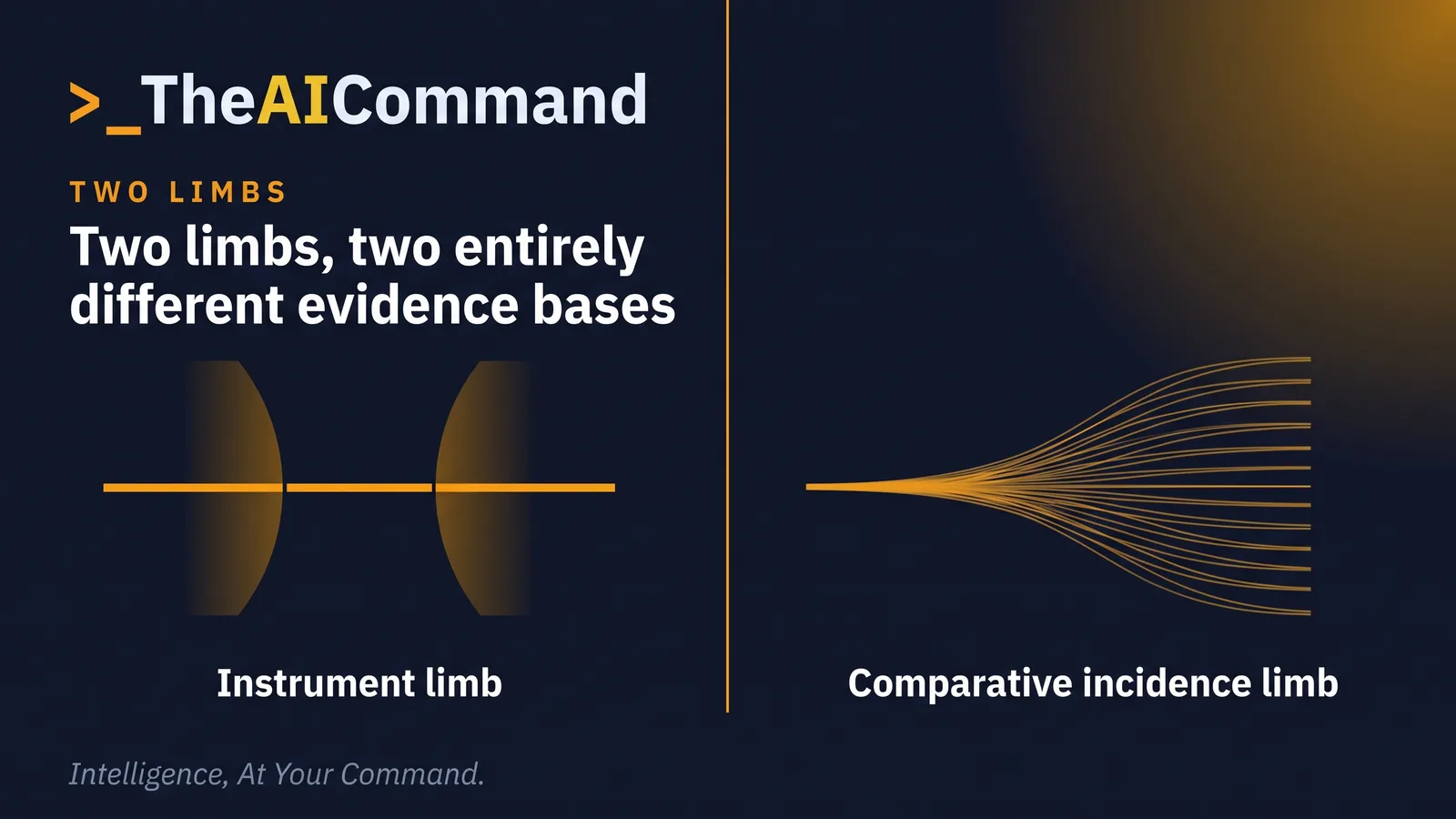
Section 7(1) provides a different path for particular combinations. Where an employee has suffered, or is suffering, from a disease or the death of an employee results from a disease, the disease is of a kind specified by the Minister by legislative instrument as a disease related to employment of a kind specified in the instrument, and the employee was, at any time before symptoms of the disease first became apparent, engaged by the Commonwealth or a licensed corporation in employment of that kind, then the employment is taken to have contributed, to a significant degree, to the contraction of the disease, unless the contrary is established.
Read the closing words. The presumption is rebuttable. On where the rebuttal sits, Comcare's guidance is explicit: liability is assumed unless the relevant authority can prove otherwise.
Section 7(2) supplies a second, separate limb that does not depend on any instrument. It applies where the incidence of the disease among persons who have engaged in that employment is significantly greater than the incidence among persons who have engaged in other employment in the place where the employee is ordinarily employed. Section 7(3) does the same for an aggravation. These are epidemiological comparisons, and they are a different evidentiary exercise from the instrument limb entirely.
Comcare's scheme guidance identifies the instrument for the section 7(1) limb as the Safety, Rehabilitation and Compensation (Specified Diseases and Employment) Instrument 2017, issued by the Minister on 3 October 2017 and applying to diseases contracted on or after 1 October 2017. As at 17 September 2026, that guidance records 44 specified diseases and employments in the list, most of which require a minimum employment period. The guidance also notes the list is based on Safe Work Australia's Deemed Diseases in Australia August 2015 report, and that not all diseases recommended in that report were specified.
Read the instrument itself, and its explanatory statement, before applying any item. Check you have the current version, Compilation No. 1 (F2019C00330), in force from 15 March 2019, rather than the as-made 2017 registration. Nothing in this article is a substitute for that.
Where does the work actually sit?
In three chronologies, none of them medical.
The employment chronology. Which kinds of employment, over which periods, with which employer entity. For most items on the list the minimum employment period matters, and Comcare's guidance is specific about how it is satisfied: the employee must have engaged in one or more periods of employment of a specified kind, and the period or the sum of the periods, whether consecutive or not, must be no less than the minimum employment period for that item. The guidance also states that any period of employment where the relevant authority would not be liable to pay compensation under the SRC Act should not be included, and that the employee need not have worked with that person, thing or agent, or undertaken the activity specified, every working day.
The exposure chronology. What the person actually did, as distinct from what their position title says. Comcare's guidance flags the trap directly: if the employee's employment did not involve the work or work activity that was typical for the specified kind of employment, the employment-related risk may be insufficient even if the minimum employment period was met. A title is not a work activity.
The clinical contact chronology. Every date of medical contact, with what was sought and for what. This is the raw material for section 7(4), and it is usually scattered across a general practitioner file, a specialist referral chain, imaging, and an employer's own incident or first aid records.
Every one of those is an assembly problem across many documents in inconsistent formats. That is the exact shape of work a model handles well, and the exact shape of work that consumes a case manager's week.
How do you run this with AI without crossing the line?
De-identify first, always. Use the canonical placeholder set from the site's de-identification toolkit for case managers, including [CLAIMANT_NAME], [CONDITION] and [INJURY_DATE], and add a consistent placeholder such as [EMPLOYER] for each employer entity. Keep [CLAIM_NUMBER] out of the model entirely. There is no version of this workflow where a claim number needs to leave your system.
Then run four steps.
Step one, extract the chronology. Give the model the de-identified documents and ask for a dated table with one row per event, each row carrying the source document and page or paragraph. Ask it to mark any date it inferred rather than read, and to list what it could not find.
Step two, separate the four section 7(4) candidates. Ask for four distinct outputs: the earliest date of medical treatment sought for the condition, the earliest date of incapacity for work, the earliest date of impairment, and, where relevant, date of death. Each with its source. Do not ask for the date of injury. Ask for the candidates, and let the delegate apply the whichever-happens-first rule with the file in front of them.
Step three, test the employment chronology against the item. Ask the model to lay the employment periods against the minimum employment period for the item you have identified, showing the arithmetic and flagging any period the file does not evidence. Ask it explicitly to list the periods it cannot verify.
Step four, produce the gap list. The most valuable output is what is missing. A model is good at noticing that a chronology jumps eighteen months with no records, or that a specialist letter refers to an earlier consultation that is not on file.
TheAICommand works to the Verified Draft Method: de-identify the inputs, ground the model in your own source material, keep a person at the decision point, verify against the primary source, and log what happened.
The human decision point here is not a formality. Whether the diagnosed condition is a disease of a kind specified in the instrument, whether the employment was of a specified kind, whether the minimum period is met, whether the contrary has been established, and what the date of injury is, are all determinations for the delegate under the Act. A model can put every relevant date on one page. It cannot form the state of satisfaction the Act requires, and a file that reads as though it did is a file with a problem.
A worked example
[CLAIMANT_NAME] lodges a claim for [CONDITION]. The employment history with [EMPLOYER] shows three separate engagements over eleven years with a two-year break in the middle.
The de-identified bundle goes to the model. It returns a 46-row chronology with sources. Four candidate dates come back separately: a general practitioner attendance recorded in the practice notes, a first certified period of incapacity from a certificate of capacity, an impairment date that the file does not evidence at all, and no death date.
The model flags three things a manual read had missed. Two of the three employment engagements are with entities the file does not clearly identify, so whether each is employment by the Commonwealth or a licensed corporation is unresolved. A specialist letter refers to an earlier consultation with no corresponding record. And the gap between the general practitioner attendance and the first certificate is fourteen months, which matters because section 7(4) takes the earlier of them.
The case manager writes a file note recording the four candidates and their sources, the two unverified engagements, and the two missing records, and requests the outstanding material. The delegate decides nothing yet, because the material to decide on is not there.
That is the correct outcome. The tool moved the file forward by finding what was absent, and the determination stayed where the Act puts it. Where the evidence is contested rather than missing, the site's guidance on mapping conflicting medical opinions covers the next step.
Why the date matters downstream
Because it propagates. The date of injury under section 7(4) feeds the section 14 liability question, the calculation of normal weekly earnings, and the statutory clocks the site set out in SRC Act statutory timeframes and AI. A date that was assumed rather than derived will be wrong quietly, in several places, for a long time.
It is also the field most likely to be auto-populated from a claim form. The claimant's stated onset date is useful context and it is not the section 7(4) date. If your intake process writes onset into the date of injury field, that is a systems fix, not a training issue.
For the broader framing of where AI belongs in determination work, see the SRC Act and AI-assisted determinations, and for the exclusion that sits alongside disease claims, the reasonable administrative action exclusion.
Do this Monday
- Open your five oldest open disease claims and check whether the file records how the date of injury was derived. If the field holds a date with no working, that is your remediation list.
- Check whether your intake process can write a claimant-stated onset date into the date of injury field. Close that path if it can.
- Read the Specified Diseases and Employment Instrument 2017, current Compilation No. 1 (F2019C00330), and its explanatory statement. Not a summary of it.
- Add a four-candidate date block to your disease claim template, one line each with a source field, so the section 7(4) working is visible on the file.
- Review your prompt library for any prompt that asks a model whether liability is established, or whether a presumption applies. Rewrite those to ask what the records show and where they are silent.
Bottom line
Section 7 hands the delegate two things a model cannot do and one thing it does very well. It cannot decide whether a disease and a kind of employment fall within the Minister's instrument, and it cannot form the view that the contrary has or has not been established. It can assemble eleven years of employment periods, four candidate dates and a list of missing records into one page, in an afternoon rather than a fortnight. Keep the assembly with the tool, keep the determination with the delegate, and make the working visible on the file either way.
References
- Safety, Rehabilitation and Compensation Act 1988 (Cth), Compilation No. 82, C2026C00285, in force 1 July 2026, sections 5B and 7. https://www.legislation.gov.au/C2004A03668/latest/text
- Comcare, Scheme guidance - Specified diseases and employment. https://www.comcare.gov.au/scheme-legislation/src-act/guidance/specified-diseases-and-employment
- Comcare, Guidance on applying the SRC Act. https://www.comcare.gov.au/scheme-legislation/src-act/guidance
Content disclaimer: This article is for general educational purposes only and does not constitute legal advice, liability determination guidance, or a substitute for professional judgement. Workers compensation decisions must be made by appropriately qualified and authorised persons under the Safety, Rehabilitation and Compensation Act 1988. All AI outputs described in this article require human review before use in any claims management context.
TheAICommand. Intelligence, At Your Command.