
The citation looked right. That is the problem.
Every citation has a recognisable shape, and shape is the cheapest thing a language model produces. Content is harder. So the reference that survives a quick glance often deserves the most work.
What follows is a procedure, not a warning: four checks, in order, before a citation reaches a determination, a board paper or a regulator.
Before reading this. Prompt Engineering Fundamentals and RAG Explained for Non-Engineers both help, but the procedure below stands on its own and needs nothing beyond a browser.
After reading this article, you will be able to. Run four checks on any citation an AI gives you, name the action when each fails, and tell a source that does not exist from one that exists and does not support the claim.
Why does a fabricated citation survive a casual look?
Because the parts of a citation that are easiest to invent are the parts that look most authoritative.
A DOI is a prefix beginning 10, a slash, and a suffix. A medium neutral citation is a party name, a year, a court abbreviation and a sequential number. A section reference is a number, sometimes with a letter. None carries any internal signal that it is real, so a wrong one and a right one look identical inside otherwise accurate prose.
Vendors do publish a rate, and it is not a rate you can use. OpenAI's own launch table for GPT-6 Astra, published September 2026, carries a hallucination benchmark row reading 4.2 percent for Astra against 12.2 percent for GPT-5.6 Sol, where lower is better. Both are vendor figures on a benchmark of their own choosing, under a footnote saying scores are the maximum at any effort. Read them as a floor, not a rate for your own citations.
Grounding the model in your own documents narrows the problem without removing it, as Ground the Model, Do Not Trust Its Memory sets out: retrieval can return a genuine document and the model can still describe it wrongly.
One boundary is worth naming. When the Other Side's AI Invents the Law deals with fabricated authority arriving in a proceeding from somebody else. This runs the other direction: the check on your own output before it leaves your desk, where you will wear it.
What are the four steps, and why does the order matter?
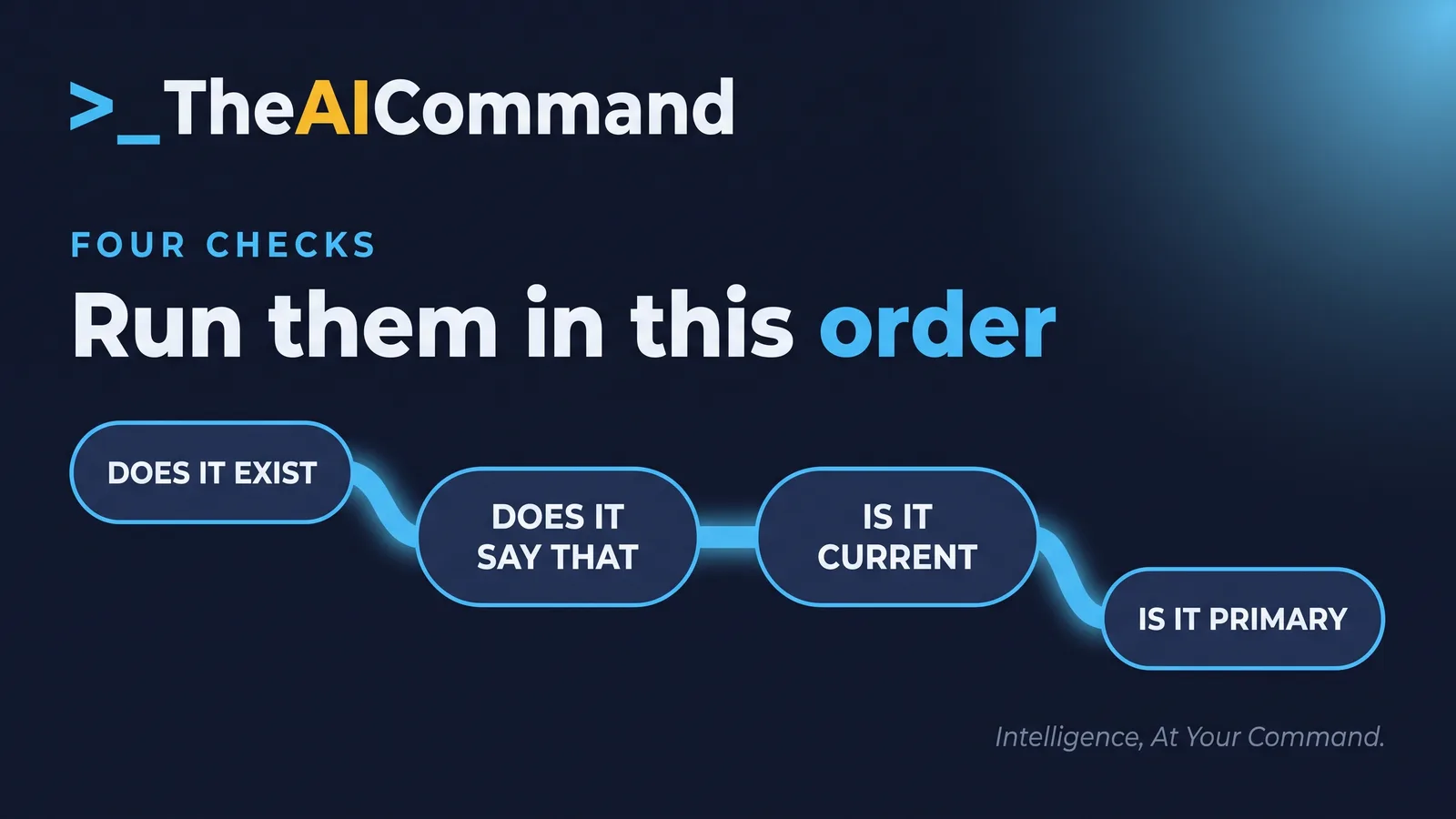
The four checks are: does the source exist, does it actually say that, is it current, and is it primary.
They run in that order because each costs more than the one before it, and any of them can end the review. Step one takes about fifteen seconds. Step four can take twenty minutes and a phone call.
Two mistakes follow from ignoring the order. Starting at step four assesses the source's reputation rather than the citation in front of you. Stopping at step one treats existence as verification, when existence is the weakest of the four tests and the only one most people run.
Does the source exist, and does it actually say that?
Step one is mechanical and should stay mechanical. For a journal article, paste the DOI after https://doi.org/ and load it. A registered DOI redirects to the publisher's page. An unregistered one returns an HTTP 404 and the words "This DOI cannot be found in the DOI System", checked 26 September 2026. For a machine readable answer, request https://api.crossref.org/works/ followed by the DOI, which returns metadata for a record Crossref holds and 404 with "Resource not found" for one it does not. Crossref is not the only registration agency, so a genuine DOI registered through another one can resolve at https://doi.org/ and still return 404 there. The resolver settles existence; Crossref adds the detail.
Existence carries a date. A model repository widely reported as fabricated was correctly recorded as not existing on 31 August 2026, created that same day, and had passed 133,000 downloads by 5 September. A check that was right is not permanently right, so record when you ran it.
Step two is where most of the value sits. Open the source and find the sentence. If you cannot quote the words that support the claim, step two is not finished, however real the source is.
Genuine sources fail this step in three ways. They support something weaker than the claim, they support it only under conditions the citation dropped, or they are about a related but different thing.
Published benchmark tables are a clean example, because every number in them is genuinely published. The Astra table labels its Humanity's Last Exam row a with tools figure, so quoting it beside a without tools score compares two different tests. Its OSWorld row is labelled a partial score, and Anthropic's own table reports 77.9 percent partial against 41.7 percent strict for Claude Fable 5.1 on that same benchmark. Drop the label and each figure stays accurate while the citation goes wrong.
That is the failure The Summary Kept the Number and Lost the Caveat describes, arriving through a citation instead of a summary.
Is it current, and is it primary?
Step three catches the citations that were right once. As at 26 September 2026 the Privacy Act 1988 page shows the Act in force, with the latest version registered as C2026C00227, compilation number C104, a compilation date of 4 June 2026, and 110 versions listed in total. A section quoted accurately from an earlier compilation is an accurate statement about a version nobody is bound by now. So the check is a comparison, not a reading: does the identifier you were given match the version marked latest in force.
For scholarly work, currency mostly means retraction. Crossref acquired the Retraction Watch database in September 2023 and made it a public resource, so retraction status now travels with the metadata. A 1998 paper in The Lancet, at DOI 10.1016/S0140-6736(97)11096-0, carries the word RETRACTED at the front of its title, and its Crossref record holds an updated by entry of type retraction dated 6 February 2010, sourced to retraction watch, checked 26 September 2026. The title is the tell a human notices; the metadata field is the one you check at speed.
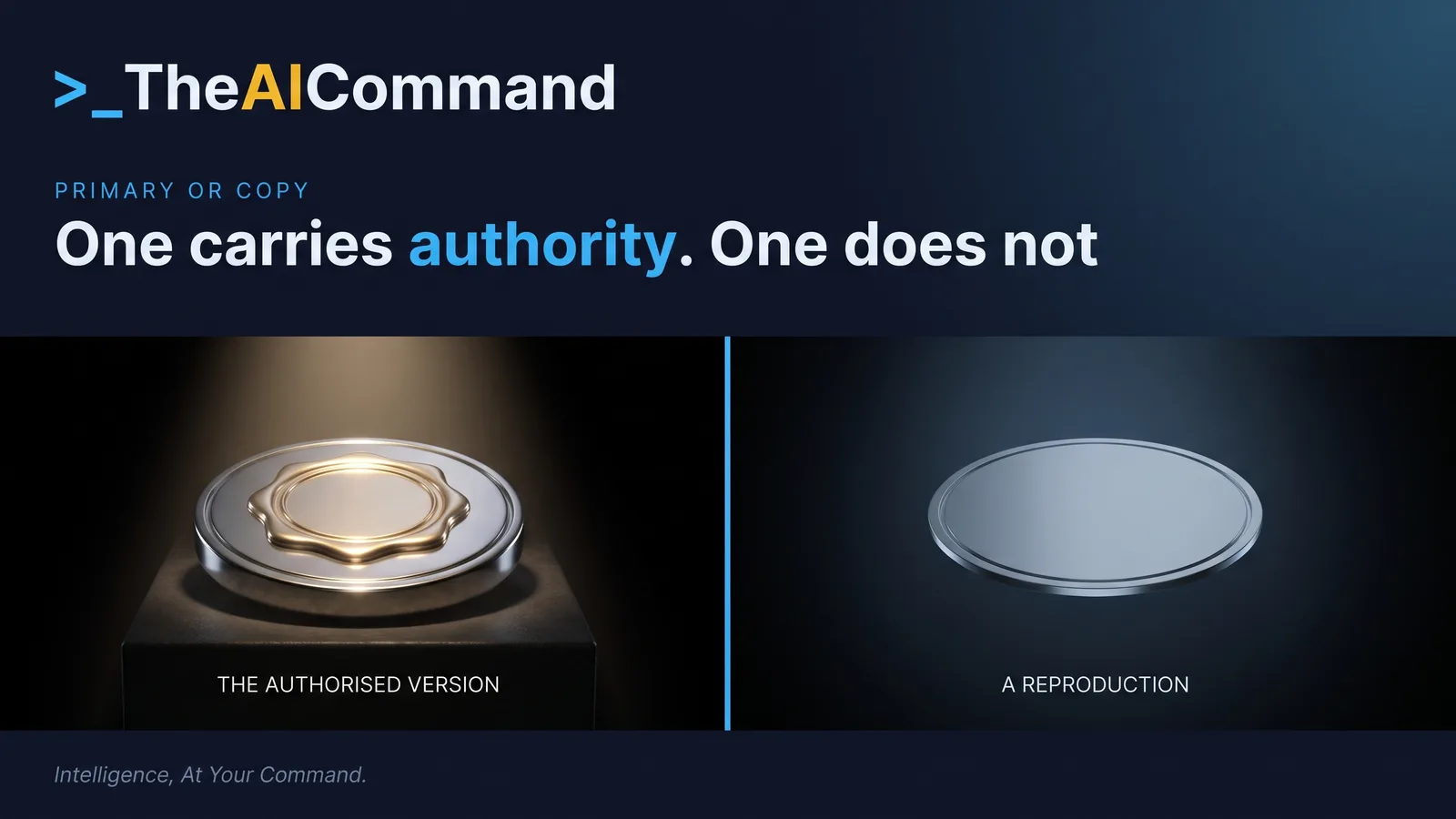
Step four asks what the document actually is. Primary means the document that carries the authority, not one that describes it. The Federal Register of Legislation states that the latest version of every in force law has an authorised version that can be relied on for the purpose of court proceedings, that authorised versions are always PDFs, and that a copy you download or print unchanged is also an authorised version. That status belongs to the file from the Register, not to text a model reproduced.
The test applies outside law too. Google states that results for non Gemini models in its own comparison tables are sourced from providers' self reported numbers unless otherwise mentioned. Citing a competitor's score from that table is citing a reproduction. The primary source is the other vendor's own published card.
TheAICommand works to the Verified Draft Method: de-identify the inputs, ground the model in your own source material, keep a person at the decision point, verify against the primary source, and log what happened. The card below runs that fourth control.
The four-step verification card
Lift this out. It works without the article around it and pastes into a review checklist.
Before you start, extract the citations into a list so the check is mechanical, not a reread.
Step 1. Does the source exist?
- The check: resolve the identifier at its own registry. A DOI at https://doi.org/, with https://api.crossref.org/works/ as a machine readable second look that covers only the DOIs Crossref registered. Legislation at legislation.gov.au, a decision in the deciding court's judgments, a vendor claim on the vendor's own documentation page.
- Pass: the identifier resolves to a document whose title and author match what you were given.
- Fail: it does not resolve, or it resolves to a different document.
- On fail: delete the citation and the claim resting on it. Never ask the model for a replacement for the same claim, because that invites a second fabrication in the same shape. Find a source yourself, or cut the sentence.
- Record the date you ran the check, because existence changes.
Step 2. Does it actually say that?
- The check: open the source, locate the supporting words, and paste them beside your claim.
- Pass: you can quote a sentence, with a page, paragraph, section or table reference, supporting the claim as written.
- Fail: you can only find something weaker, conditional, or adjacent.
- On fail: rewrite the claim down to what the source supports, keeping the conditions attached. If it cannot survive that, cut it.
- The trap: a number is not a quote. Carry the label that was attached to the number.
Step 3. Is it current?
- The check: for legislation, confirm the compilation identifier is the latest in force one on the Register and note the provision's commencement date. For scholarly work, check the record for a retraction or correction. For guidance, check it has not been superseded or withdrawn. For vendor documentation, check the page's last updated date.
- Pass: the version you cite is in force today, and you have recorded its identifier and date.
- Fail: it is superseded, retracted, withdrawn, or you cannot establish which version you are looking at.
- On fail: re-run steps 1 and 2 against the current version. Never assume the wording carried across unchanged.
- The trap: an accurate quotation from a superseded version is still the wrong answer today.
Step 4. Is it primary?
- The check: ask who has the authority to state this, then find that body's own published document.
- Pass: you are citing the instrument, the judgment, the regulator's own publication, the standard, or the vendor's own documentation.
- Fail: you are citing a summary, a media report, an aggregator, a competitor's reproduction, or a model's paraphrase.
- On fail: use the secondary source to find the primary one, cite that, then verify it at steps 2 and 3. A secondary source is a map, not a destination.
- The trap: the more useful the summary, the less likely anybody opens the original.
The highest risk failure. A plausible DOI, case citation or section number is the most dangerous item in an AI assisted draft. It is formatted correctly, it sits inside accurate prose, and a reviewer skimming for errors reads it as a signal of care. Check every formatted identifier, and check those first.
What stays a human decision. Four judgements here are not lookups. Whether the source carries the weight your claim puts on it. Whether a rewritten claim still supports your conclusion. Whether a superseded version is nonetheless the right one, because the matter concerns an earlier period. And whether to publish when a claim survives all four checks and still feels thin.
Try this
Take one AI assisted document you sent out last month and list its citations. Run all four checks on the three that look most formal and record how many survive. Most failures land at step two.
Where to go next
- How to Read an AI Tool Safety Card and Spot the Red Flags
- Build a Golden Test Set Before You Trust an AI Workflow
- Stop Detecting AI. Start Checking Provenance.
- When the Other Side's AI Invents the Law
Bottom line
A citation you did not check is a claim you did not make, dressed as one you did. Four checks separate them: the source exists, it says that, it is current, and it carries the authority. Run them in order, because the cheap check ends the expensive one, and because the identifier that looks most professional is both the most likely to be wrong and the least likely to be opened. Check the ones that look best first.
Do this Monday
- Pull the three most recent documents you sent out with AI assistance and list every citation.
- Resolve every DOI, section number and case citation on that list, recording the date of each check.
- Open the two sources carrying the most weight and paste the supporting sentence beside your claim.
- Confirm each legislative reference against the version marked in force on the Federal Register of Legislation.
- Add the four-step card to your review checklist so checking happens before sign-off, not after a complaint arrives.
References
- DOI Foundation. What is a DOI. https://www.doi.org/the-identifier/what-is-a-doi/
- DOI Foundation. DOI resolver. https://doi.org/
- Crossref. REST API, works endpoint. https://api.crossref.org/works/
- Crossref. News, Crossref and Retraction Watch. https://www.crossref.org/blog/news-crossref-and-retraction-watch/
- Federal Register of Legislation. About the Federal Register of Legislation. https://www.legislation.gov.au/help-and-resources/using-the-legislation-register/about-the-federal-register-of-legislation
- Federal Register of Legislation. Privacy Act 1988, all versions. https://www.legislation.gov.au/C2004A03712/latest/versions
- OpenAI. GPT-6 Astra, a new generation of intelligence. https://openai.com/index/gpt-6-astra/
TheAICommand. Intelligence, At Your Command.