
The last piece looked at the AI in your own filings. This one is about the submission that lands on your desk from the other side. Two 2026 decisions of the Fair Work Commission share an unusual feature: in each, a self-represented worker built an argument on cases and award clauses that do not exist, produced by an AI tool the worker had trusted to know the law. For the HR and employee relations teams answering those claims, the fabrication may not be in your draft. It may be in the application you have to rebut, and spotting it without looking like you are ambushing an unrepresented person is now part of the job.
What the Commission has already seen
In [Riley v Nuvei Australia Merchant Services Pty Ltd [2026] FWC 75](https://www.austlii.edu.au/cgi-bin/viewdoc/au/cases/cth/FWC/2026/75.html), decided by Commissioner Redford in Melbourne on 19 January 2026, Mr Riley appeared for himself in an unfair dismissal matter and told the Commission he had prepared his case with a "legally trained" artificial intelligence model. The Commission recorded that some of his references to legal principles or authorities "may have been AI hallucinations and lacked any legal basis". When he argued that a workers compensation certificate of capacity was merely administrative and cited several Commission decisions for that proposition, the Commission found those decisions "do not exist". Because Mr Riley did not press the invented authorities once they were queried, and conceded the point, the Commission described his conduct as competent and professional even as it dismissed his application.
[Hoverd v M & J D Pty Ltd [2026] FWC 1013](https://www.fwc.gov.au/documents/decisionssigned/pdf/2026fwc1013.pdf), decided by Deputy President Lake in Brisbane on 25 March 2026, went the other way. That worker, also self-represented, resisted a temporary roster change and built his general protections argument on provisions of his employment contract and the Waste Management Award 2020 that, the Deputy President found, do not exist. He admitted using AI tools to organise and draft his material. What separated this case from Riley was persistence. He kept relying on the non-existent clauses after being warned not to advance false or misleading material, and conceded only after being reminded that he was giving sworn evidence. The application was dismissed on a jurisdictional point, and the Deputy President invited the employer to apply for costs, in a jurisdiction where each side ordinarily bears its own. It is the first time the Commission has tied AI-generated fabrication directly to a costs risk.
The two cases set the range. A hallucinated authority that is withdrawn on challenge is forgiven. One that is defended to the end can shift costs. The deciding factor is behaviour after the fabrication is exposed, and that is exactly the moment a well-prepared respondent can control.
How to recognise an invented authority
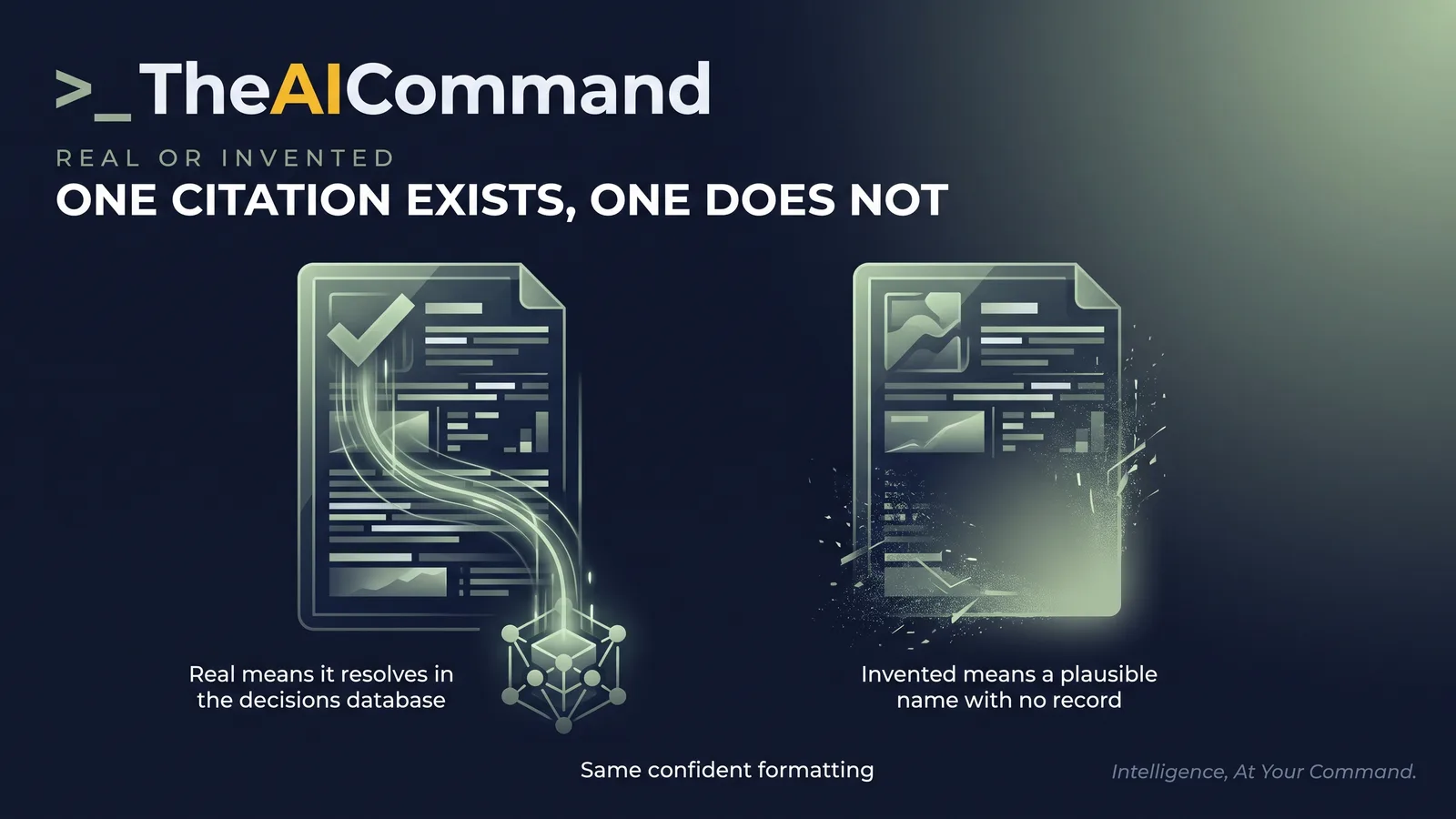
An AI-fabricated citation is usually plausible on its face and hollow underneath. The tells are consistent, and every one of them is checkable at a primary source in minutes:
- A case name that reads correctly but returns nothing in the Commission's decisions database or on AustLII.
- A medium-neutral citation whose number does not resolve, or resolves to an unrelated matter.
- A quoted passage that cannot be found anywhere in the judgment it is attributed to.
- An award or agreement clause cited by number that is not in the current instrument, or that says something the real clause does not.
- A section of an Act that does not match the provision it is quoted for.
- A confident statement of a legal principle with no traceable source, often phrased more tidily than real law ever is.
This is the same practice of grounding every claim in a source rather than trusting a model's memory that governs your own drafting. Applied to the other side's material, it turns a polished submission into a list of things to confirm.
Raise it as a verification question, not an accusation
When you find one, announcing that a case is fake is the wrong first move, especially against a self-represented applicant. The Commission is alert to fairness for unrepresented parties, and an aggressive ambush can rebound on the representative who launches it. Better to treat the problem as a verification gap and put the other side to proof.
Ask, in writing or on the record, for the full citation and a copy of each decision or clause relied on. A real authority can be produced. A fabricated one cannot, and the applicant is given the chance to withdraw it, which is the outcome the Commission rewarded in Riley. If the applicant persists after being unable to produce the source, the record now shows it, and the Hoverd path, including costs, is open to the Commission.
The first prompt turns the other side's submission into a verification worklist without ever confirming that anything is real. Run it only on a copy you have de-identified before it goes near a public model.
The second prompt drafts the neutral request for source, so the challenge stays professional and cannot be read as an attack.
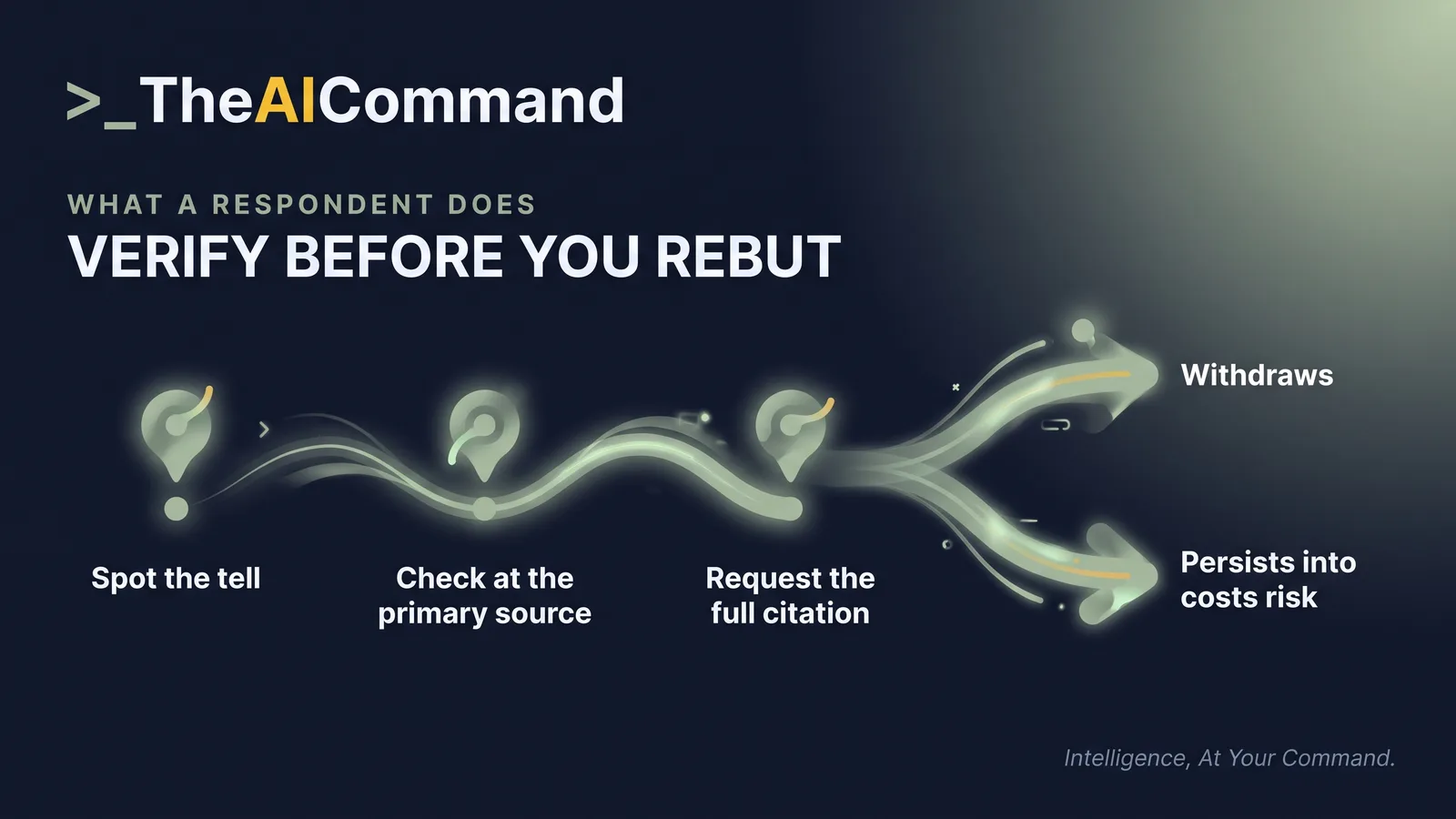
Keep the verification worklist with the claim file once each authority is checked. If the matter proceeds, the record of when you asked for each source, what was produced and what was not becomes part of the story the Commission sees, and it demonstrates that your side verified before it rebutted rather than trading accusations. The same discipline protects you in reverse: run your own submissions through the identical worklist before they are filed, because a fabricated authority is just as costly when it is yours.
A worked example
Consider a mid-sized employer, call it a facilities contractor, responding to a general protections application from a former [ROLE]. The applicant is self-represented and the submission is polished. It cites two Commission decisions for the proposition that a unilateral roster change is automatically a dismissal, and quotes a clause of the relevant award requiring employee agreement to any change of hours.
The ER officer runs the worklist. The statute references check out, but neither cited decision appears in the decisions database under the names given, and the award clause number does not exist in the current instrument, where the real clause says something narrower. Rather than open the response by calling the citations fake, the officer writes to the applicant asking for the reported citations and a copy of each decision and clause relied on, by a nominated date. The applicant cannot produce them and withdraws the two cases, narrowing the claim to its facts. Had the applicant instead insisted the authorities were real, that same record would have supported an application for costs, the position the worker reached in Hoverd.
Bottom line
AI-invented law is now something a respondent meets in the other side's material, not only a risk in their own. The pre-filing discipline that keeps a fabrication out of your documents is the same discipline that catches one in theirs: verify every authority at its primary source, treat what you cannot find as unverified rather than dishonest, and raise it as a request for the citation. Do that, and a hallucinated case becomes a point you win cleanly instead of a fight over an unrepresented worker.
Do this Monday:
- Add a verification pass to your standard response workflow for every claim you answer, not just the ones that look AI-drafted.
- Pull every case, section and award clause the applicant relies on into a single worklist.
- Open each at its primary source, the decisions database or AustLII for cases and the Federal Register of Legislation for statutes and awards, and read it rather than skim a snippet.
- Mark each authority found or not found, and treat "not found" as unverified, not as proof of bad faith.
- For anything you cannot locate, send a neutral written request for the full citation and a copy, with a date.
- Apply the same checks to every authority you cite yourself, so you never advance a fabrication of your own.
- Keep the worklist and the correspondence on file, because if the matter proceeds that record is your evidence that you raised the issue properly.
TheAICommand. Intelligence, At Your Command.