
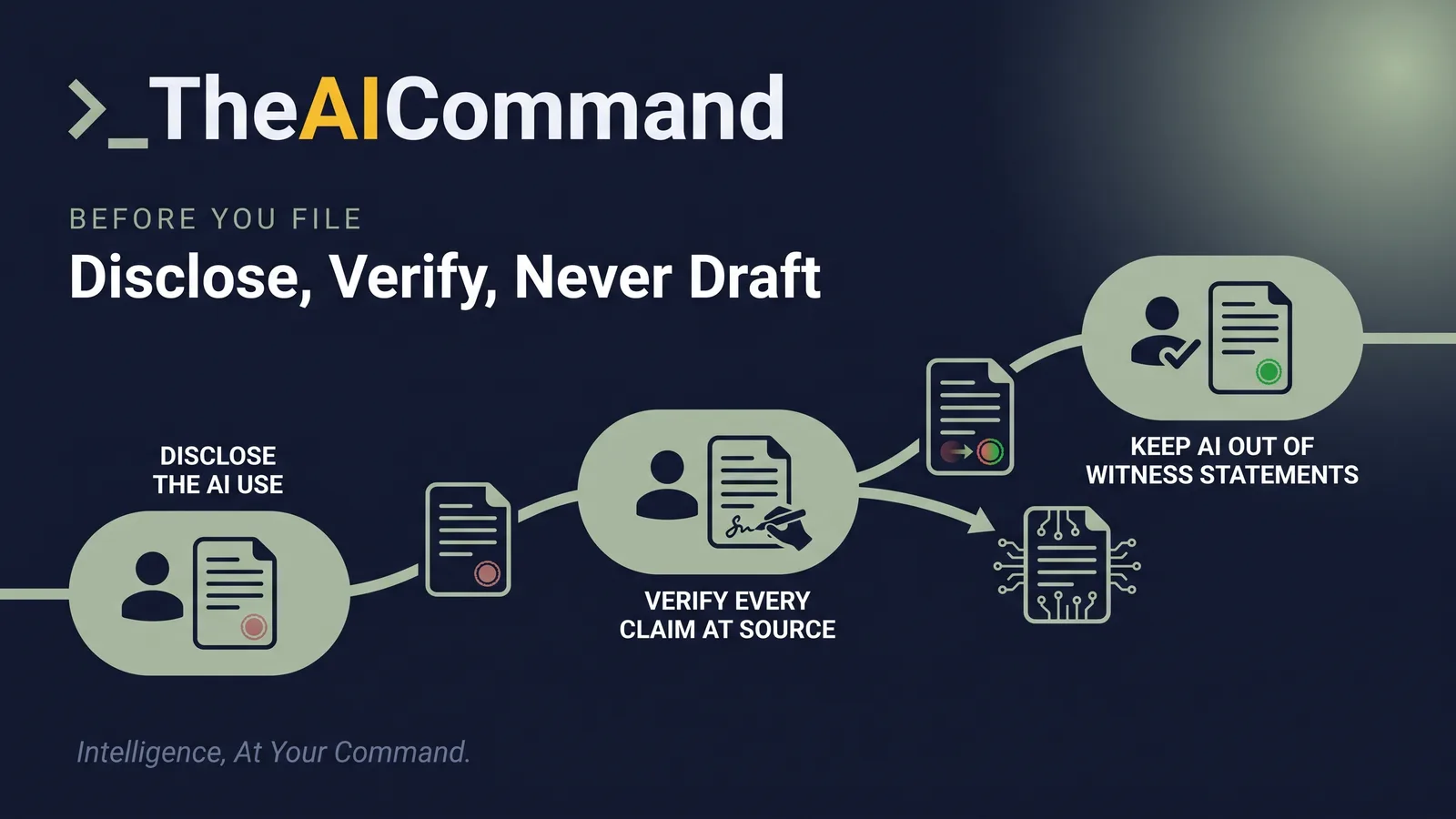
The Fair Work Commission's draft AI guidance sets three rules for any document you lodge: disclose that generative AI was used, verify every fact and citation against an authoritative source, and keep AI out of witness statements. An AI tool can now write an unfair dismissal application, a set of submissions and a witness statement in the time it takes to make a coffee. The Fair Work Commission has just told everyone who lodges one that speed is not the test. Accuracy is.
On 24 March 2026 the Commission published a President's statement and an exposure draft Guidance Note on the use of generative AI in Commission cases. It is the clearest signal yet of how an Australian tribunal will treat AI-written filings, and it lands squarely on the desk of every HR and employee relations team that responds to claims. The guidance does not ban generative AI. It sets three rules, and each one is a discipline your team should be running before its next filing, not after a Commission member finds an invented case on the record.
Why did the Commission write the rules?
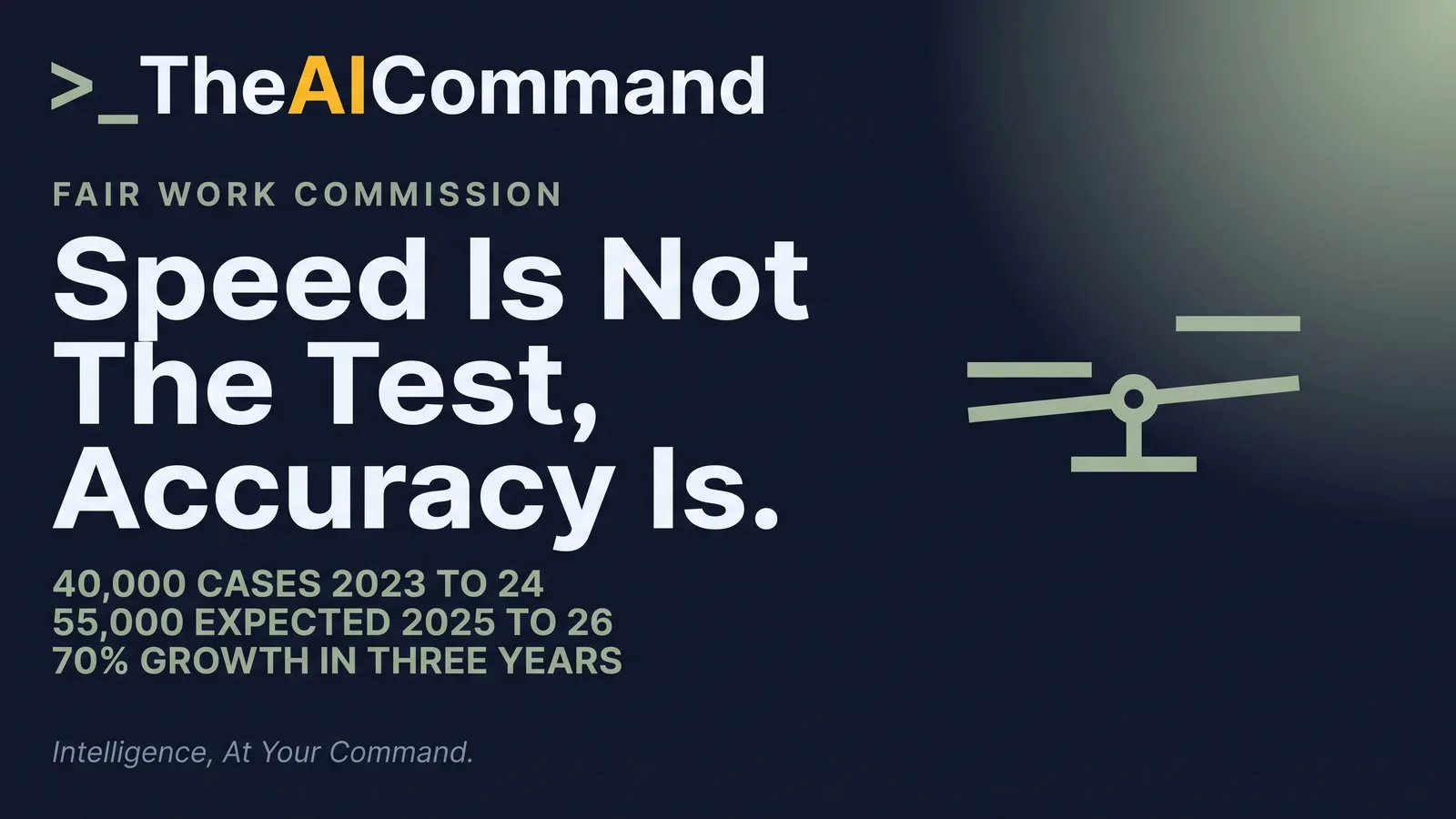
The rules exist because the workload has become a genuine operational problem, and the Commission has named the cause. Annual matters sat just above 30,000 until 2023, rose to about 40,000 in 2023-24, and reached 44,075 in 2024-25. The Commission expects between 50,000 and 55,000 matters in 2025-26. Across three years that is a rise of more than 70 per cent.
President Justice Adam Hatcher has attributed the surge to generative AI, in a speech to the Victorian Bar. The concern is not simply volume. It is that AI tools can give a person a false sense of the strength of their case, so claims get lodged with little or no legal basis. In one demonstration, ChatGPT produced a section 365 general protections application, a witness statement built on a substantially invented story, and a suggested compensation range of $15,000 to $40,000, all in under ten minutes. A machine that will confidently manufacture a claim will just as confidently manufacture the authorities that appear to support it.
That is the backdrop. The three rules are the Commission's answer, and they translate cleanly into a pre-filing standard for a people team.
Rule one: disclose that AI was used
The first rule is transparency. Where generative AI is used to write, create, modify or otherwise prepare any document lodged in a matter, that use must be stated in the document itself. The Commission has signalled it will build a dedicated "Use of GenAI" section into its forms so the declaration has a fixed home rather than being buried in a covering note.
For an HR or ER team this is not a formality to resent. It is a prompt to know your own process. If you cannot say whether AI touched a document, you do not control how the document was made, and that is the real exposure. Disclosure forces a team to decide, deliberately, where AI sits in its drafting workflow and to be able to describe it in a sentence.
Note the current boundary. The disclosure and hyperlinking obligations in the draft are aimed first at practitioners and paid agents, on the view that a self-represented person may struggle to insert links, and the Commission is seeking feedback on whether the requirement should extend to everyone who uses AI. An employer represented by an internal team or an external adviser sits on the side of the line where disclosure is clearly expected. Treat it as applying to you.
Rule two: verify every claim, and not with the AI
The second rule is the one that catches people out. Before a document is lodged, its author must verify that every fact, every legislative reference and every case citation is accurate. The crucial detail is the method. Generative AI cannot be used to check its own output. Asking the model that wrote the submission whether the submission is correct is not verification. It is the same source marking its own work.
The Commission points to the authoritative sources that do count. Facts and case law get checked against the Commission's own Benchbooks and its decisions database. Court judgments get checked against AustLII. Statutes and regulations get checked against the Federal Register of Legislation. Every authority in a document should be traceable to one of those, opened and read, not merely quoted. This is the practice of grounding each claim in a source rather than trusting the model's memory, and it is the difference between a document that holds and one a member can set aside.
This is where the tell-tale signs of a fabricated authority get caught. A case name that reads plausibly but returns nothing in the decisions database. A section number that does not match the provision it is cited for. An award clause that does not exist in the current instrument. A quotation that cannot be found in the judgment it is attributed to. The verification step is not about distrusting AI as a matter of principle. It is about the specific, documented failure mode where a model produces confident, well-formatted references to material that was never written.
The consequences of getting this wrong are set out plainly. A document that breaches the guidance can be given reduced weight, disregarded altogether, made the subject of a costs order, or lead to the application being dismissed. A Commission document also carries a declaration of truth. A knowingly false statement in one is a serious matter that can reach past the outcome of a single case.
Rule three: keep AI out of the witness statement
The third rule is the firmest, and it is specific. The draft guidance recommends that generative AI not be used to create the substantive content of a witness statement or declaration at all. The reasoning is not about drafting quality. A witness statement is evidence. It must be the witness's own account, in their own knowledge, tested by their own memory. A model that invents a coherent narrative produces something that reads like evidence and is not.
The guidance does leave room for AI to help with form. If a tool is used to edit or tidy a statement, the witness or declarant must read the document, make any changes needed so that it is based on their own knowledge and true to the best of that knowledge, and then declare in the document that it is based on their own knowledge. The boundary is between polishing a person's account and generating one. The first is administration. The second contaminates the evidence.
For HR teams this is the rule to write into policy in the plainest possible terms. A drafting model may help structure submissions and organise argument. It must never be handed the job of composing what a witness says happened. This is the same line that governs AI in a workplace investigation, where a tool can organise the file but never reach the finding. The person who lived the events is the only valid source for the statement that describes them.
What did the June law change add?
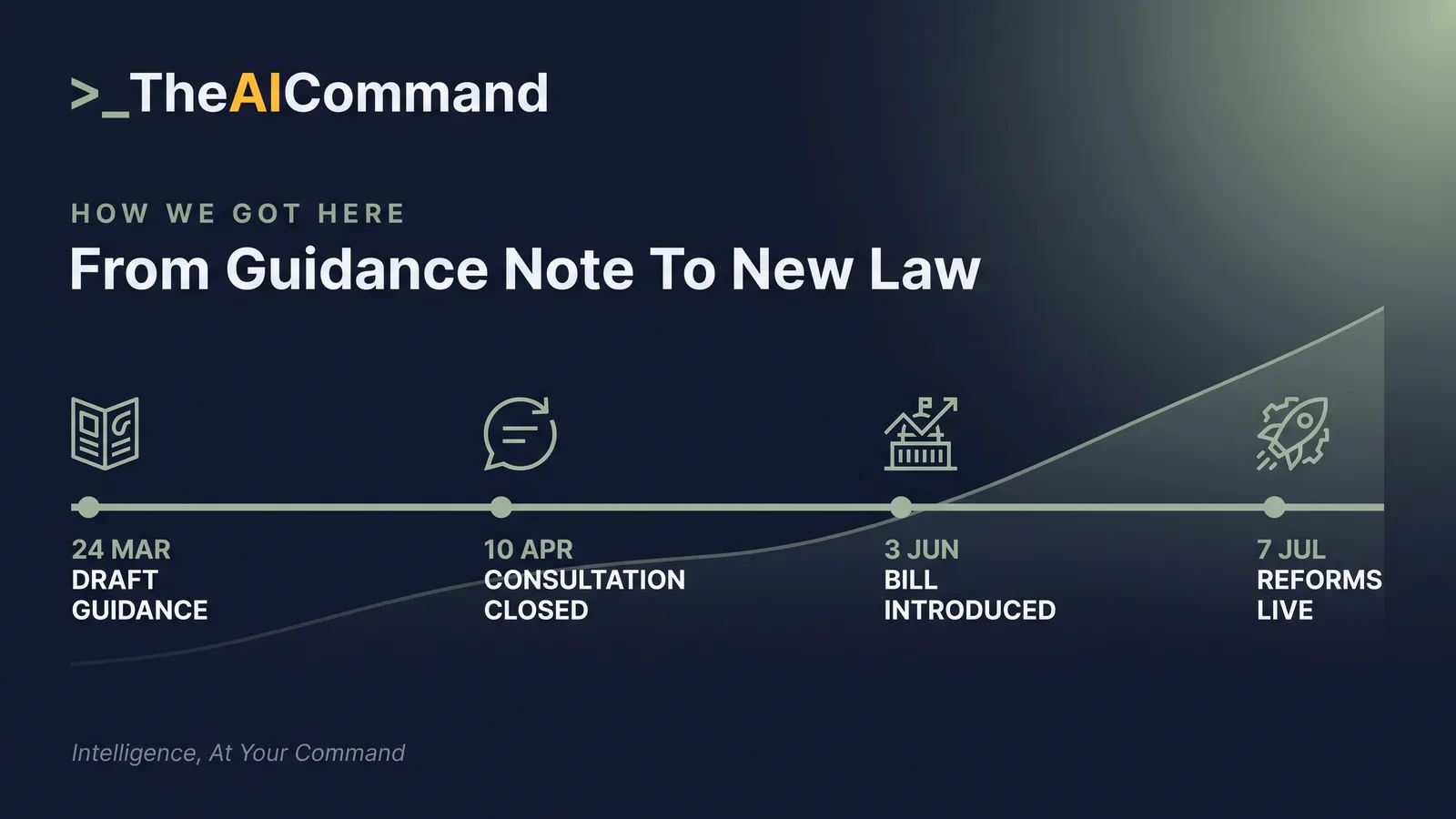
The guidance is not the only thing that moved. The government responded to the same caseload pressure with legislation. The Workplace Relations Legislation Amendment (Building Cooperative Workplaces No. 1) Bill 2026 was introduced into Parliament on 3 June 2026, has passed, and its relevant reforms take effect from 7 July 2026. The Fair Work Ombudsman's summary of the Building Cooperative Workplaces reforms sets out the detail for employers.
Three procedural changes matter for anyone handling a matter. The Commission can now begin dealing with a general protections or unlawful termination dispute without first determining whether a dismissal actually occurred, which removes a slow and costly jurisdictional hearing at the front of many cases. Where appropriate, the Commission can determine matters on the papers, without a formal hearing. And a person whose application has been dismissed as frivolous, vexatious or with no reasonable prospects of success can be barred from lodging a further application on the same footing.
Read together with the guidance, the message is consistent. The Fair Work system is being retuned to move AI-inflated claims through faster and to close off the weakest of them earlier. That cuts both ways. It compresses the time an employer has to respond, and it rewards a response that is accurate, verified and lodged clean. A submission built on unverified AI output is now more likely to be dealt with quickly, and quick is not the direction you want when the document has a problem in it.
What should a pre-filing routine include?
Turn the three rules into a routine your team runs on every Commission document, regardless of how it was drafted.
- Decide and record where AI sat in the drafting of the document, so you can complete the disclosure accurately rather than guessing.
- List every factual assertion, statute, regulation, award clause and case citation the document relies on. This is your verification worklist.
- Open each item at its authoritative source: the Commission's decisions database and Benchbooks, AustLII for judgments, the Federal Register of Legislation for statutes and award instruments. Read the source, do not skim a snippet.
- Mark each item verified only when you have seen it at the source. Anything you cannot confirm comes out of the document. It does not get softened, it gets removed.
- Confirm no witness statement or declaration was composed by AI. If a tool touched one, the witness re-reads it, corrects it to their own knowledge, and signs the declaration that it is their own account.
- Complete the "Use of GenAI" disclosure honestly, describing the assistance in a plain sentence.
- Have a second person who did not draft the document run the same verification worklist before it is lodged.
- Keep the worklist. If the document is ever questioned, your record that every claim was checked at source is the evidence that you met the standard.
Two prompts that build the discipline in
Used well, a model helps you run the verification, without ever being the verifier. Both prompts assume the input has been de-identified before it goes into a public model, so no real names or case details leave your control. The first prompt turns a draft into a structured checklist of everything a person must confirm at source.
The second prompt keeps AI on the safe side of the witness-statement line, helping structure a statement the witness has already given in their own words, and refusing to invent content.
A pre-lodgment checklist
Run this list before any document goes to the Commission.
- The "Use of GenAI" disclosure is completed and describes the actual assistance used.
- Every fact in the document has been checked against a source a person opened and read.
- Every statute and regulation reference has been confirmed on the Federal Register of Legislation.
- Every case citation has been found and read on AustLII or the decisions database, with the quoted passage located in the judgment.
- Every award or agreement clause matches the current instrument, clause number and wording.
- No claim rests on the AI's own assurance that it is correct.
- No witness statement or declaration was composed by AI; each is the witness's own account, read and adopted by them.
- A second person has independently run the verification worklist.
- The verification worklist has been saved with the file.
A worked example
Consider a mid-sized employer, call it a logistics operator, responding to a general protections application. An internal ER officer uses a model to help draft the response and to organise the argument, the same way a team might use AI to draft a performance warning without letting it invent the facts. The draft comes back polished. It cites a Commission decision that appears to support the employer on the timing of a dismissal, and it quotes a passage from that decision.
The officer runs the verification worklist. The statute references check out on the Federal Register of Legislation. The award clause matches the current instrument. But the cited decision cannot be found in the decisions database, and the quoted passage does not appear in any judgment under that case name. The model produced a plausible authority that does not exist. Because the officer verified at source rather than asking the model to confirm its own work, the fabricated citation is caught before lodgment, not by a Commission member afterward.
The officer removes the false citation, rebuilds that part of the argument on a decision that is real and has been read, completes the AI disclosure describing how the model was used, and confirms that the two witness statements were written by the witnesses themselves. A second colleague repeats the checks. The response is lodged clean, and the worklist is filed. The document is not slower for it. It is simply true, which under the new guidance is the only version worth lodging.
The three rules are not a hurdle placed in front of AI-assisted work. They are the standard that separates a document a Commission will rely on from one it can set aside. Disclose the use, verify every claim at its source, and never let a machine speak for a witness. Build that into the pre-filing routine, and the tool becomes an asset instead of a liability the day a member starts reading closely.
Bottom line
The Commission's draft guidance does not ban generative AI, it sets a standard: disclose the AI use, verify every claim at its source, and never let AI compose a witness statement. With the Building Cooperative Workplaces reforms letting the Commission move matters faster and close off the weakest ones earlier, an unverified AI-drafted filing is now more likely to be dealt with quickly. Accuracy, not speed, is the test.
Do this Monday:
- Record where AI sat in the drafting of any document you lodge, and complete the "Use of GenAI" disclosure honestly.
- Build a verification worklist and check every fact, statute and case citation at the Benchbooks, the decisions database, AustLII or the Federal Register of Legislation, never with the AI.
- Remove anything you cannot confirm at its source rather than softening it.
- Confirm no witness statement was composed by AI, and have the witness read, correct and adopt their own account.
- Have a second person run the verification worklist before lodgment, and keep the worklist on file.
TheAICommand. Intelligence, At Your Command.