
Once you have had the honest conversation about AI and jobs, write it down as something the team keeps: a charter that names which tasks go to AI, which stay human, and when every line gets reviewed. The conversation is the start. The charter is the practice.
The honest conversation about AI and jobs is the hard first move, and most leaders still have not made it. Nearly one in three Australian workers carries some fear that AI will replace their job, on Finder's April 2026 survey, and silence hands that fear to rumour. But a conversation has a short half-life. People leave the room reassured, the week resumes, the tools keep arriving, and within a fortnight the anxiety is back with nothing concrete to hold. The promise made in that conversation, that role changes will be fair and people will have a say, needs something durable to live in. That something is a charter.
Why the conversation needs an artefact
A conversation reassures. An artefact commits. The difference matters because the fear a leader is managing is specific: the fear of things being decided about you, without you, by a force you cannot see. A speech about fairness does not touch that fear for long, because the next AI decision still arrives from somewhere above, unexplained. What settles it is being one of the people who decides.
That is what a charter does that a conversation cannot. It turns the abstract question hanging over the team, what will AI do to our work, into a concrete one the team answers together, task by task: what will we hand to AI, what will we keep, and how will we know when to change our minds. The moment a person helps decide that their judgement-heavy work stays human and the tedious first draft can go to a model, AI stops being a thing happening to them. It becomes a set of choices they made, and the anxiety loses the quality that made it corrosive, the sense of being acted upon.
A charter also forces the team to be specific where fear thrives on vagueness. "AI is coming for our jobs" is unanswerable. "The weekly report summary moves to draft-and-check, the client call stays entirely human" is something a person can look at, argue with, and live with. Specificity is the antidote to dread, and the charter is where it gets written down.
What the delegation data says about where to start
There is real evidence about what healthy delegation looks like, and it is more encouraging than the anxiety suggests. Anthropic's Economic Index report published in June 2026, drawn from a survey of roughly 9,700 users linked to their actual usage, found that heavier delegation tracks with more optimism, not less. Across all six dimensions it measured, pay, job security, the ability to find a new job, meaning, autonomy and human interaction, people who handed more of their work to AI reported feeling more positive about its effect on their working future than those who used it only to assist. The largest effects were in expectations about future pay and the ability to find work.
Read that honestly as a correlation, not a promise: people who delegate more may see the real capabilities up close and worry less, or the already-optimistic may be the ones most willing to delegate. Either way, the direction is the useful part. Deliberate delegation is not where the anxiety concentrates. Vague, imposed, unexplained AI is. A charter is deliberate delegation made visible, the version associated with people feeling more in control of their future, not less.
The same report gives a practical starting point for the charter's first rows. It found that around 93 per cent of conversations produced a recognisable artefact, most commonly explanations, documents and reports, and guidance. That is a map of where delegation already works: first drafts, summaries, the structured-output layer of knowledge work. Those are the safe early lines, the tasks with the least judgement at stake, and the place to begin before touching anything closer to the bone.
What a delegation charter is, and how it differs from a decision-rights map
A delegation charter is one row per recurring task, with five plain fields. It is deliberately low-tech, because the value is the shared clarity, not the artefact.
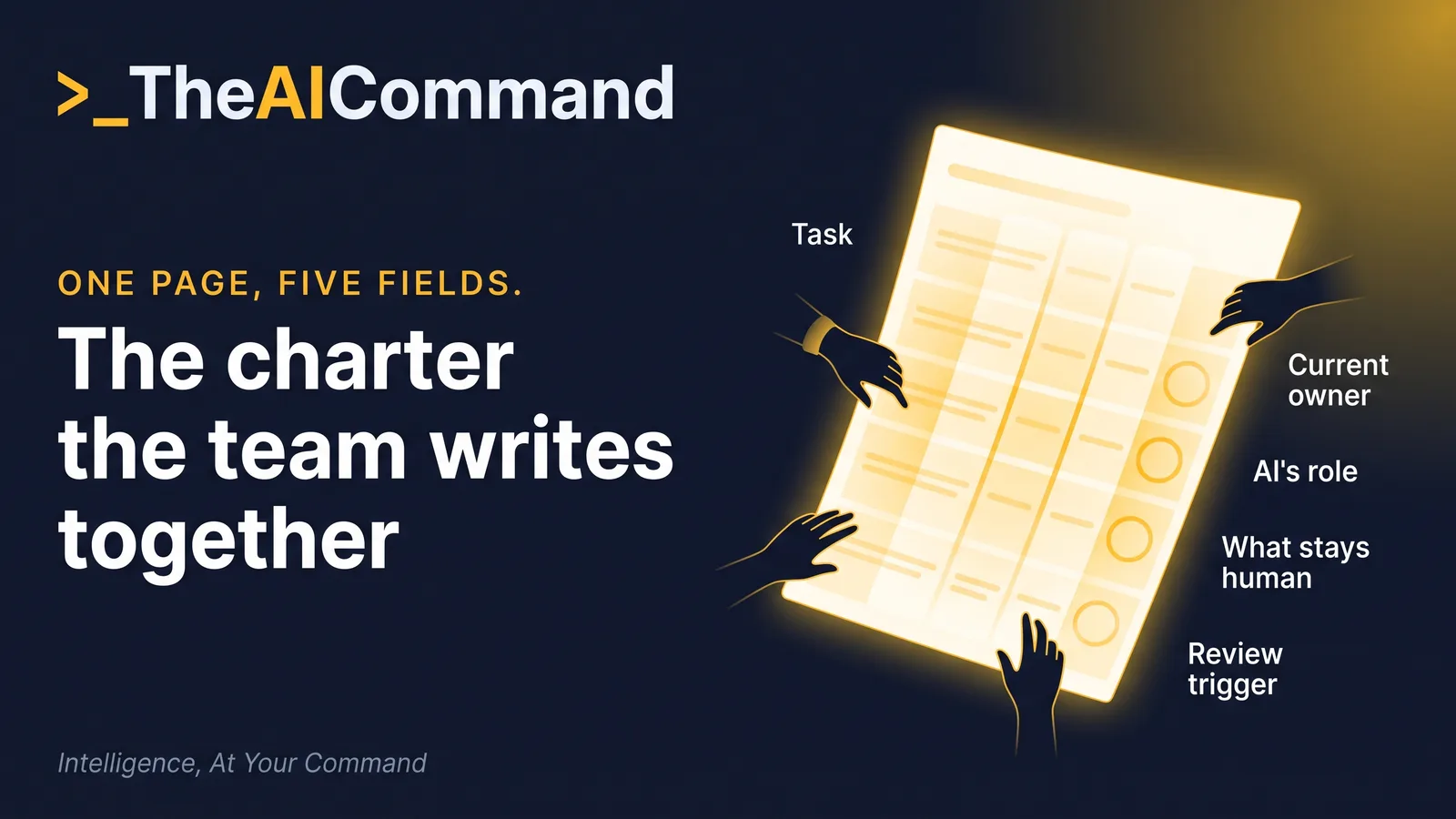
- Task. The specific recurring piece of work, named the way the person who does it would name it. "Draft the weekly client update", not "reporting".
- Current owner. The person who owns it today. A role, not "the team". Naming an owner is what stops a task falling into an accountability gap the moment AI touches it.
- AI's role. One of four plain settings: none, draft (AI produces a first pass, a person finishes it and owns it), assist (AI helps inside the task while the person drives), or do-and-check (AI completes it inside a set boundary and a named person checks it before it counts).
- What stays human. The part of this task a person keeps no matter the setting: the judgement, the client relationship, the final sign-off. Writing it down makes the boundary a choice rather than a thing that quietly erodes.
- Review trigger. When this line gets looked at again: a date, plus the events that force an earlier look, a new tool, a new rule, or a near-miss.
This differs from a decision-rights map, and the two are easy to confuse. A decision-rights map answers who decides, placing AI on a ladder of inform, recommend or act. A delegation charter answers which tasks the team hands to AI and which stay human. One governs authority over decisions, the other governs the work itself, and they are complements. A task can sit on the charter as draft-and-check while any decision buried inside it, whether to send, whether to escalate, stays governed by the map. Build the charter for the work, and reach for the map when a task turns out to contain a real decision.
How to build it with the team
The charter only does its job if the team writes it, because the whole point is the say. A leader who arrives with a finished charter has rebuilt the exact thing the honest conversation was meant to dismantle: a decision made about people, without them.
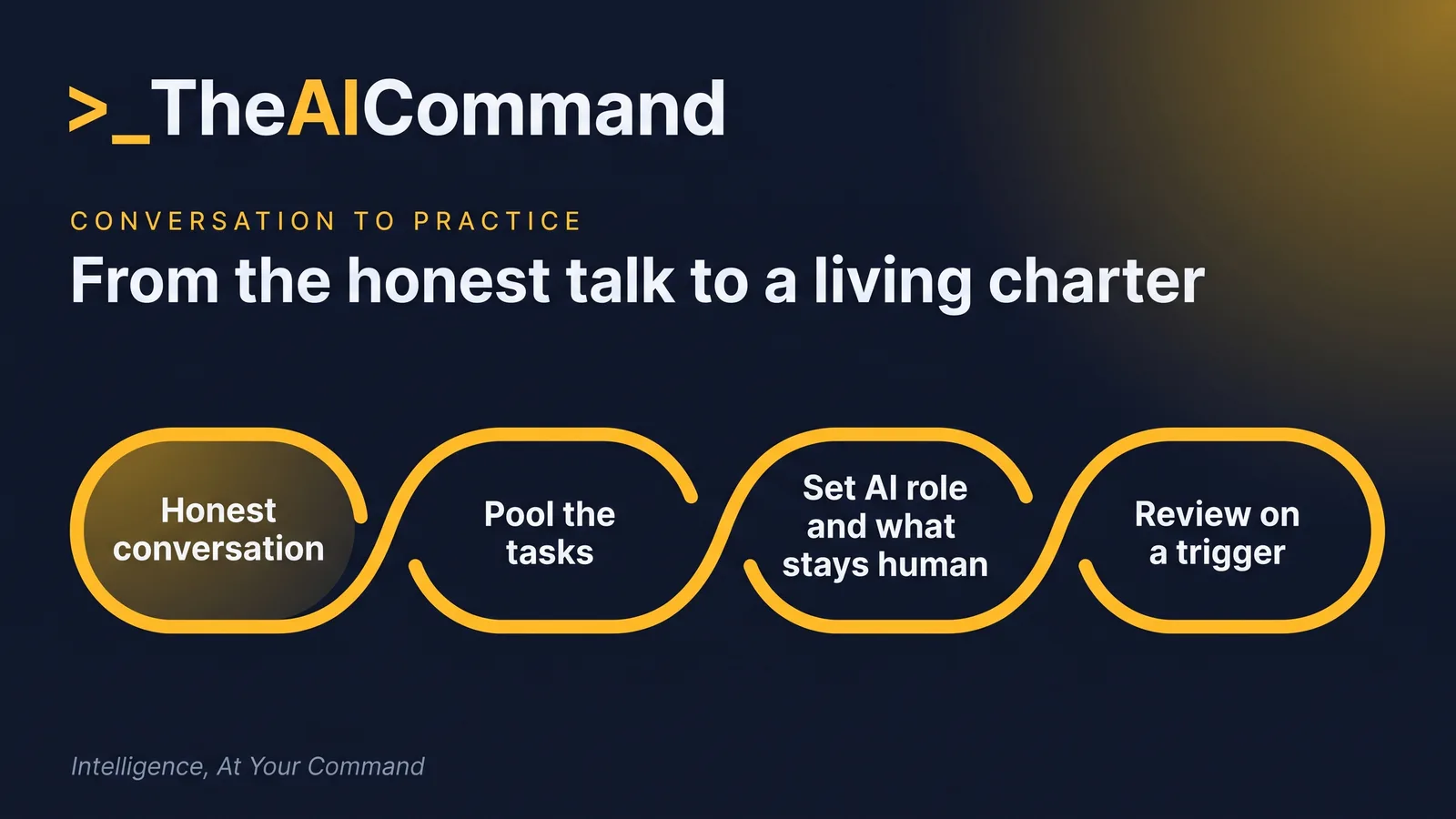
So run it as a working session, not a briefing. Ask everyone to bring the recurring tasks that fill their week, with a rough sense of how often each runs. Pool them on one surface, and sort the obvious first-draft candidates, the explanations and summaries the Economic Index data shows are already safe to delegate, apart from the judgement-heavy work where a person's read of a situation is the value. Then go line by line and decide, together, the AI role, the part that stays human, and the review trigger. The argument is the work. When the team disagrees about whether a task is safe to hand over, that is a real boundary surfacing, and the person who does the task daily usually knows where it sits better than the leader does. Where you cannot agree, default to the more human setting and write down why, so the next review has something to test.
What never goes on the charter as AI alone
A charter is a delegation tool, which means its most important lines are the ones that refuse to delegate. Three categories stay human on purpose, and the charter should name them as deliberately as it names what it hands over.
The first is anything where a wrong result could reach a customer, harm a person, or corrupt the record before a human sees it. Those never sit at do-and-check; they are draft or assist at most, with a person between the output and the world. The second is the judgement, the relationships and the accountability a leader cannot hand to a model no matter how capable it becomes: AI can change what work gets done, but it cannot own who is affected or answer for the result. The third is quieter and easier to miss: the tasks that are how someone builds a skill. Hand every first draft to a model and the junior who learned the craft by writing first drafts never learns it. Protecting those reps is a deliberate charter decision, and the review trigger is where you catch a team that has quietly automated away its own apprenticeship.
Do this Monday
Here is the whole play as one session and a follow-through, not a theory.
- Book a 45-minute team session within a fortnight of the honest AI-and-jobs conversation, while the trust is fresh. Bring no charter of your own; the point is that the team writes it.
- Ask everyone to bring their own recurring tasks in advance, each with a rough sense of how often it runs, so the room starts with real work rather than abstractions.
- Pool every task on one surface, then split the obvious first-draft candidates, explanations, summaries and first passes, from the judgement-heavy work where a person's read is the value.
- Run the first prompt below over the pooled list to get a first-draft charter, then argue with it line by line as a team. The argument is where the boundaries get found.
- For every task, agree the AI role, the part that stays human, and a review trigger. Where the team disagrees, default to the more human setting and note the reason.
- Run the second prompt to red-team the draft for over-delegation and deskilling before you adopt it, and fix what it flags.
- Put the charter where the team can see it, name an owner for keeping it current, and set the first review date, quarterly at the latest.
Two prompts: one to draft the charter, one to attack it
Use these in ChatGPT, Claude or an equivalent. The first turns a raw task list into a first draft for the team to argue with. The second is the reason you do not adopt your own first draft, because a leader is the worst judge of whether they have over-delegated.
Then make the same tool attack the result before anyone commits to it.
Before you adopt it: a charter-is-ready checklist
Adopt the charter only when every line below is true.
- Every row names a specific task, a current owner, an AI role, what stays human, and a review trigger.
- The team wrote it together, and no line was set by the leader alone.
- Nothing is set to do-and-check where a wrong result could reach a customer or harm a person before a human checks it.
- The tasks that build a junior person's skill are kept human on purpose, and the charter says so.
- No decision is disguised as a task; decisions live in the decision-rights map, not here.
- Each line has a review trigger, and the whole charter has a quarterly review date and a named owner.
- It is visible to the team, not filed in a drawer, because a charter no one can see is not a shared agreement.
A worked example
Take [TEAM_LEAD], who runs a twelve-person marketing team. The honest conversation went well a fortnight ago, but some quiet anxiety has crept back, and rather than offer more reassurance they book the charter session. The team pools its recurring work, and the first-draft candidates surface quickly: drafting social captions, summarising campaign reports, first passes of creative briefs. The first prompt proposes draft for the captions, assist for the briefs, and do-and-check for the report summaries.
Then the team argues, and the argument is where the value is. [TEAM_MEMBER], the most junior, points out that writing first-pass briefs is exactly how they are learning the craft, and handing briefs to a model would quietly take that away. The team keeps briefs human on purpose and writes the reason on the charter. The red-team prompt catches something else: captions at do-and-check would let an unreviewed caption reach a client, so they drop to draft with a human sign-off recorded as what stays human. Report summaries stay at do-and-check, but only for internal reports, with a named checker.
What [TEAM_LEAD] does not do is decide any of this alone. They name a charter owner, set a quarterly review, and add a trigger for any new tool. Three weeks later a new tool lands, the trigger fires, the owner books a fifteen-minute review, and one line moves from assist to draft on the team's own judgement. The abstract dread, what will AI do to us, has become a page the team wrote and keeps rewriting. That is the shift: not a promise that nothing will change, but a standing say in how it changes.
The teams that come through this period best will not be the ones whose leaders gave the most reassuring speech. They will be the ones who turned the speech into an artefact the team owns, and kept it alive. The conversation named the fear. The charter is how a team acts on it, together, and keeps acting.
Bottom line
An honest conversation about AI and jobs reassures for a fortnight; a delegation charter the team writes together makes the fairness durable. It names, task by task, what goes to AI, what stays human, and when each line gets revisited, which turns AI from something done to a team into a set of choices the team made. Build it with the team, keep the judgement and the reps human on purpose, and review it on a cadence and on real events.
Do this Monday:
- Book a short team session within a fortnight of the honest conversation, and bring no charter of your own.
- Pool the team's recurring tasks and start delegation with the safe first-draft work: explanations, summaries and first passes.
- For each task, agree the AI role, what stays human, and a review trigger, defaulting to the more human setting when unsure.
- Keep the judgement, the accountability and the skill-building reps human on purpose, and write down why.
- Name an owner and a quarterly review date, and put the charter where the whole team can see it.
TheAICommand. Intelligence, At Your Command.