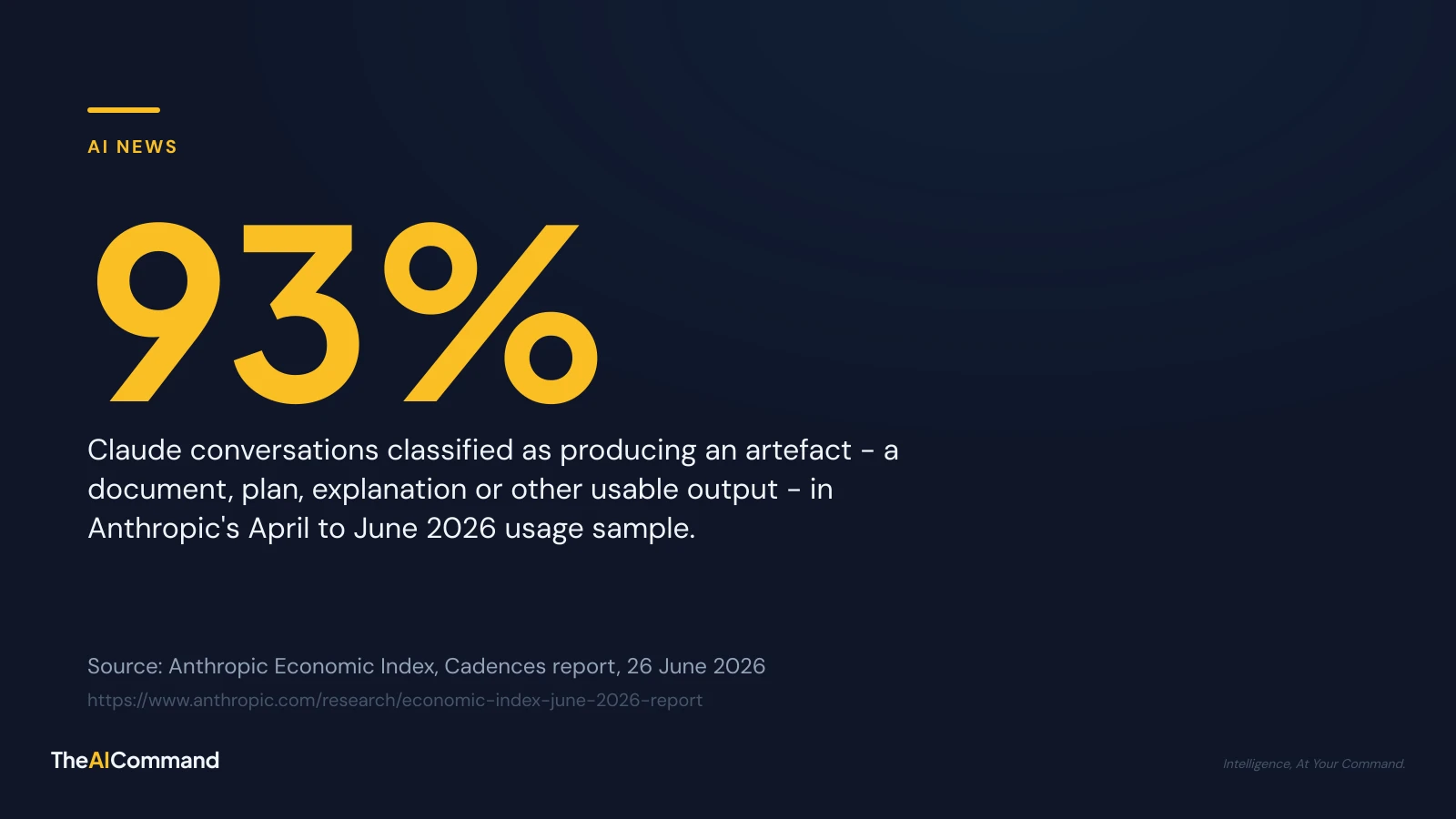
Anthropic's June 2026 Economic Index, Cadences, drew on about 9,700 real Claude users matched to their actual usage, and found that 93% of conversations produce a recognisable artefact and that the heaviest delegators feel most optimistic about their careers. Most arguments about what AI is doing to work run on anecdote. One manager's team saved a morning, another's junior analyst looks nervous, and the debate circles without landing. On 26 June 2026 Anthropic published something rarer: primary behavioural data on what roughly 9,700 real users actually do with an AI assistant, matched to what those same people believe about their own careers. For anyone setting an upskilling policy in an Australian workplace, it is a chance to argue from evidence instead of vibes.
The report is the latest Anthropic Economic Index, subtitled Cadences. It is worth reading not as vendor marketing but as one of the few large, well-instrumented looks at how committed users actually behave.
What does the Cadences report actually measure?
Cadences combines three things: hourly sampling of usage, a classifier that labels the main output of each conversation, and a survey of about 9,700 users whose answers were linked to their real activity through a privacy-preserving system. The usage data covers chat and Cowork conversations sampled between 10 April and 10 June 2026.
Read it with one caveat in front. These are Anthropic's own users of Anthropic's own product, so the sample skews toward engaged adopters, not the whole workforce. The honest framing is not "this is everyone" but "this is a large, carefully measured sample of people who have already leaned in". That still tells you a great deal about where committed use is heading.
Ninety-three per cent of the time, something gets made
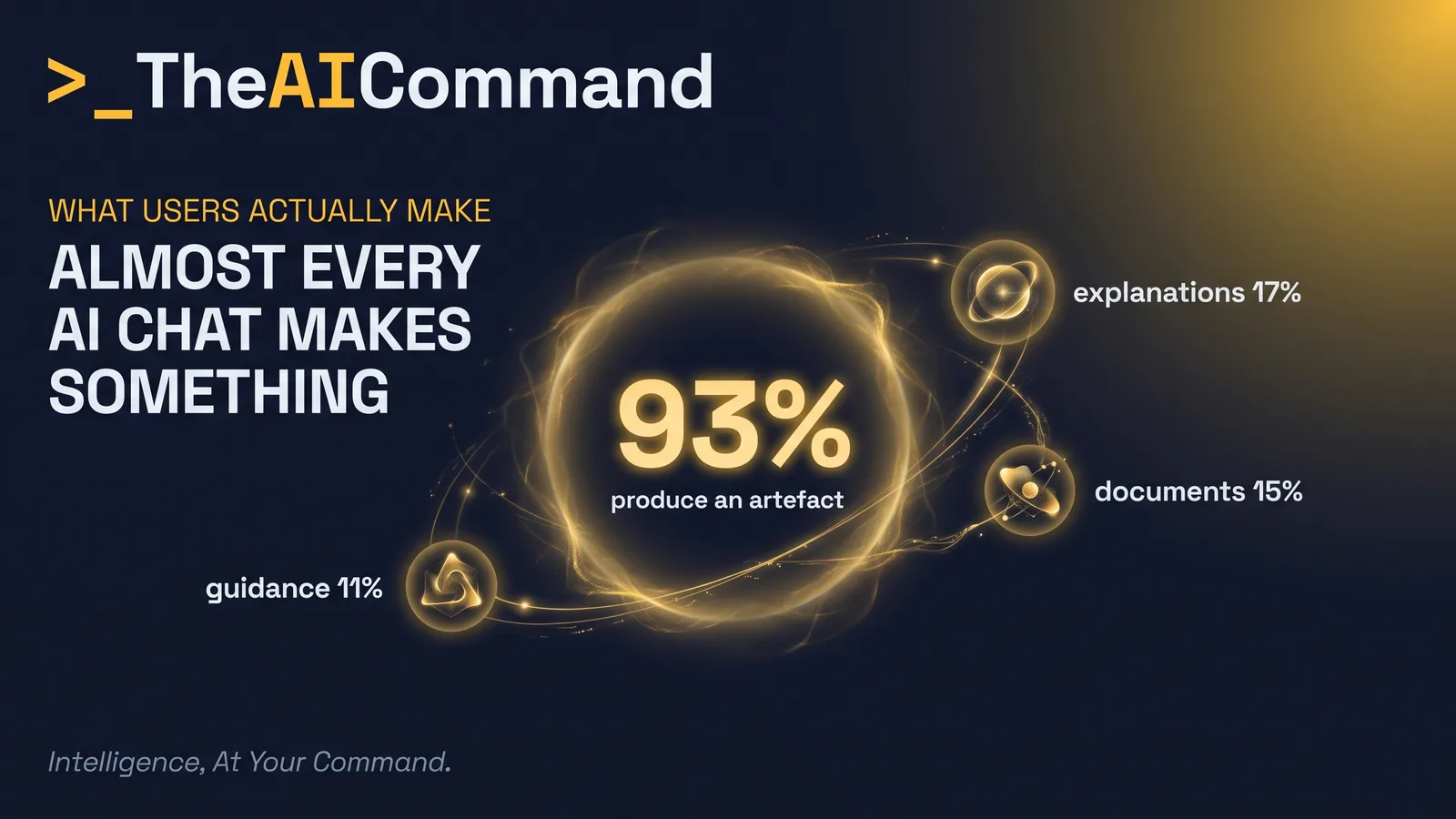
The first finding is about output. The classifier identified a recognisable artefact, a document, an explanation, a piece of code, a report, in 93% of conversations. The most common were explanations at 17% of conversations, documents and reports at 15%, and guidance at 11%. Grouped up, conversational outputs like explanations and guidance make up roughly a third, written deliverables like documents and presentations another third, and code and technical work about a sixth.
The split between work and personal use is sharper than the averages suggest. More than 80% of conversations producing marketing content, blog or article drafts, and database queries are work-related. More than 80% of creative writing, guidance and recipe conversations are personal. Translation lands near the middle.
The practical point for a people leader is that this is production, not idle chat. When almost every session ends in something made, the upskilling question shifts. It is no longer "will people use the tool" but "what are they producing with it, and is it good enough to rely on".
Do the heaviest AI delegators feel better about their careers?
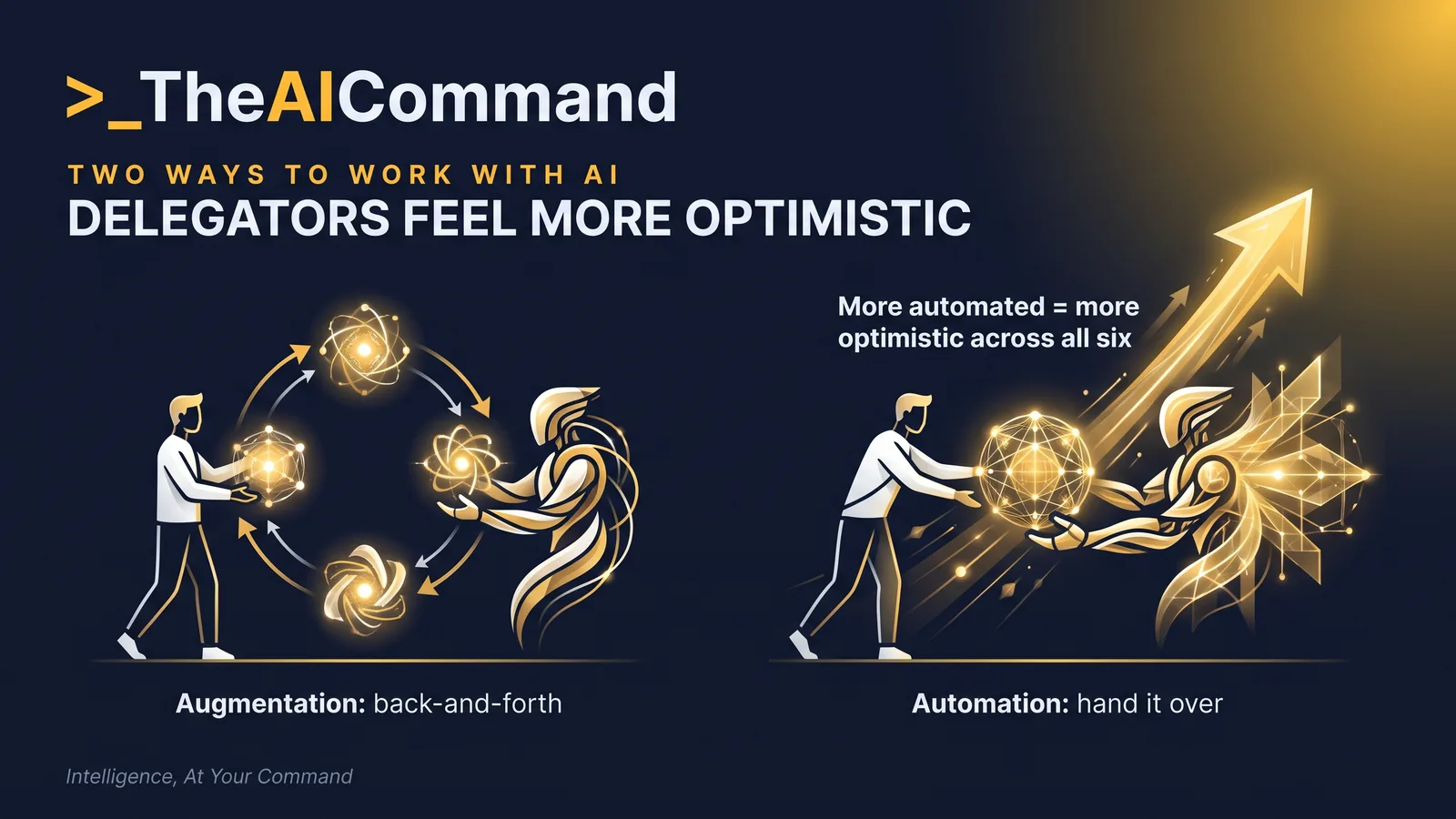
The more interesting finding is about how people work with the model, and how they feel about it. Cadences separates two modes. Automation is when a user hands over a whole task with little further input. Augmentation is the more collaborative, back-and-forth style. The report measured six dimensions of job quality: pay, job security, the ability to find a new job, meaning, autonomy, and human interaction.
Across all six, people with a higher share of automated sessions were more optimistic about the effect of AI on their work over the next year. The heavier delegators were also more likely to say their skills feel more valuable, not less. In the survey, 57% felt AI had made their skills more valuable and 68% said they were learning more. Large majorities reported productivity gains: 86% in speed, 82% in scope, and 69% in quality.
That is the signal worth carrying into a strategy conversation. The people getting the most out of AI are not the ones treating it as a faster search box. They are the ones comfortable handing whole tasks over, then checking the result.
The caveat that keeps it honest
Correlation is not causation, and the report is candid about it. The obvious alternative explanation is selection: the people most enthusiastic about AI are also the most willing to delegate to it, so optimism and delegation could simply travel together. Anthropic notes the relationship holds when you control for how long someone has used Claude, which weakens the "novelty wearing off" story but does not settle the question. Delegating more does not guarantee you will feel better about your career.
The sentiment data also carries real anxiety, and it is asymmetric. People worry more about others than themselves: a third of respondents put the probability of a junior colleague losing their job in the next year above 60%, while only about 10% rated their own job loss as likely. The adoption base is uneven too. Women made up just 12% of the linked sample, with a lower share of automated and coding sessions. So "delegate more, feel better" is a genuine pattern in the data, sitting next to genuine worry about junior roles and an uneven starting line.
What should a people leader do with this?
The evidence points one way for upskilling design. Teaching tool familiarity, which buttons to press, is the low-value half. The higher-value skill is delegation done well: choosing which tasks to hand over whole, briefing the model properly, and verifying what comes back. That is also the skill the data associates with people who feel their careers improving. It complements, rather than repeats, the case made in the site's earlier piece on why upskilling needs work redesign: the redesign gives people room to delegate, and delegation is the habit that pays off.
Two prompts help put the finding to work. Both are safe to run on a de-identified sample of your team's own activity.
Do this Monday
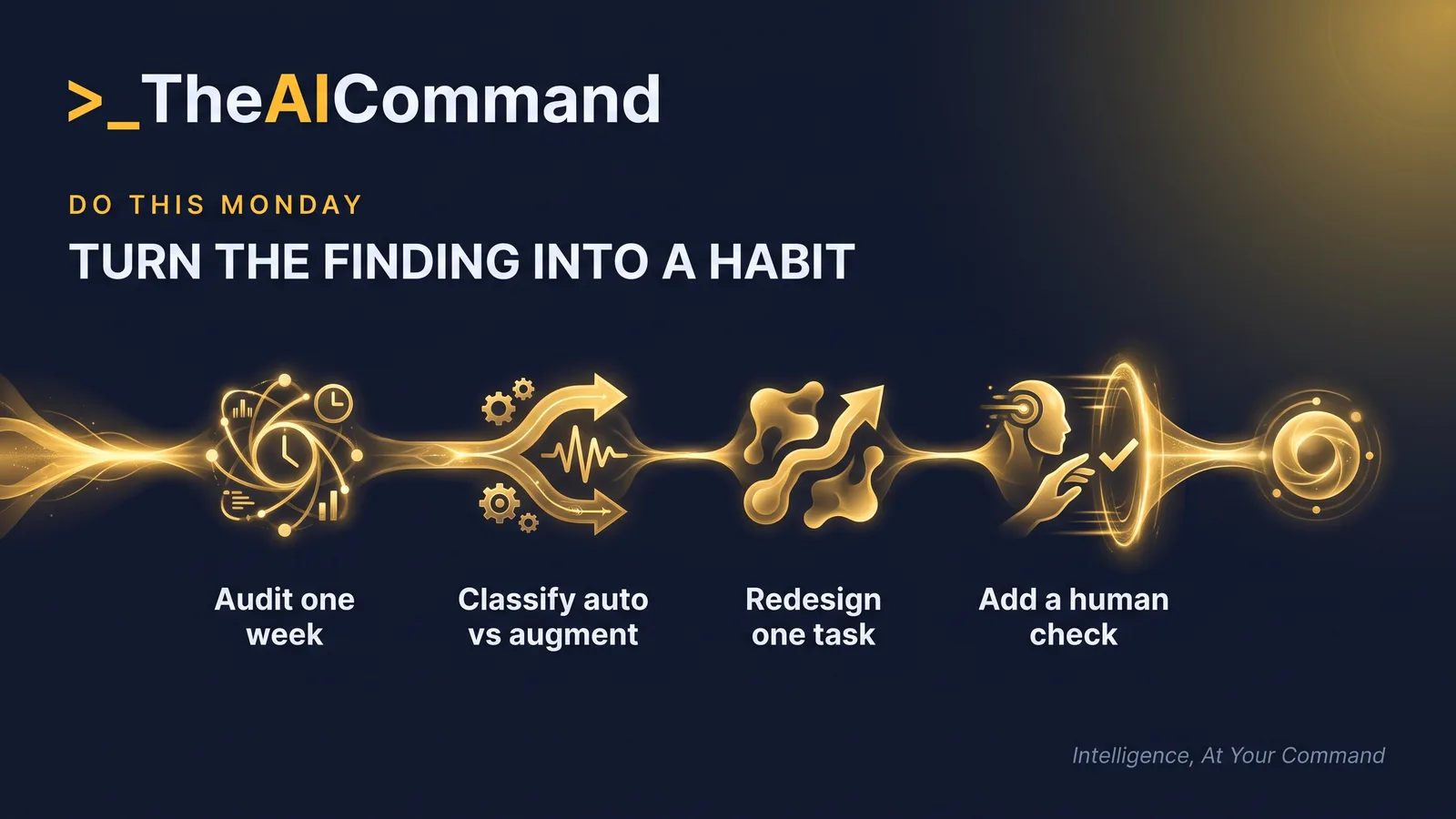
- Pick one team and one week. Ask five people to note, in a shared doc, the tasks they used AI for and roughly how each one ended.
- Classify each entry as automation (handed over whole) or augmentation (worked on together), using the first prompt above if it helps.
- Find your augmentation-only users. These are the people most likely to be treating AI as a search box, and the ones the data suggests have the most to gain.
- Pick one recurring, low-risk task per person that could be delegated whole, and redesign it with the second prompt.
- Add a verification step to each redesigned task, so a human still checks the output before it is used.
- Run it for a fortnight, then compare time spent and confidence in the result against the old way.
- Keep what worked, drop what did not, and write the delegation pattern into your team's AI guidance so the next person inherits it.
A quick self-check
Use this list to gauge whether your team's AI use is healthy rather than merely busy:
- Most AI sessions end in something usable, not an abandoned chat.
- People can name which tasks they delegate whole and which they only assist with.
- Every delegated output passes through a human check before it is relied on.
- Newer or lighter users are getting coaching on delegation, not just tool access.
- Confidence about AI is grounded in results people can point to, not fear or hype.
A worked example
A mid-sized Australian finance team ran the one-week audit. Most entries were augmentation: staff pasted a question, got an explanation, and rewrote it themselves. Two analysts, by contrast, were delegating whole first drafts of month-end commentary, then editing. Those two also happened to be the most positive about where their roles were heading. The team took the pattern, redesigned the month-end commentary task so everyone drafted by delegation and edited against a checklist, and kept a mandatory human sign-off before anything reached the board pack. Three weeks later the drafting time had roughly halved and, more tellingly, the augmentation-only staff reported feeling less behind.
Hype check
None of this proves that delegating to AI causes career optimism, and it is one vendor's users, not the labour market. The junior-job worry in the same survey is a reminder that the mood is not uniformly sunny. What the data does support is narrower and useful: committed users overwhelmingly produce real work with AI, and the ones who delegate whole tasks and verify the output tend to feel their skills growing. Build your upskilling around that habit, measure it, and treat the optimism as a signal to test rather than a promise to bank.
Bottom line
Cadences is not proof that AI causes career optimism, but it is a large, well-measured signal: committed users overwhelmingly produce real work with AI, and the ones who delegate whole tasks and then verify the output tend to feel their skills growing. For a people leader, the lever is not tool familiarity but delegation done well, taught, verified, and written into your team's AI guidance.
Do this Monday:
- Run a one-week, de-identified audit of how one team actually used AI, and classify each entry as automation or augmentation.
- Find the augmentation-only users, the ones treating AI as a search box, and coach them on delegating whole tasks.
- Redesign one recurring, low-risk task for clean delegation, with a mandatory human check before the output is used.
- Measure time spent and confidence in the result against the old way before you scale it.
TheAICommand. Intelligence, At Your Command.