
Workday just moved AI agent-building inside the HR system. At its DevCon conference in Las Vegas on 2 June 2026, Workday launched Developer Agent and Agent-Ready Tools, which let someone describe an agent in plain language and have it built in minutes, alongside Agent Passport, which tests and verifies agents before they go live. The significance for HR is not the product line. It is that building an AI agent is no longer an IT project you queue for; it is something a capable person in your own function can now do, and that changes who has to answer the governance questions.
This lands right before the site's workspace-setup series, and that timing is the point. Whether an HR team builds an agent natively in Workday or assembles one in a general-purpose workspace like ChatGPT Enterprise or Claude Cowork, the same four questions apply: what employee data can it touch, what decisions can it influence, who signed off before it went live, and what happens when it gets something wrong. Workday is trying to answer those questions inside the platform. In a general-purpose tool, nobody answers them unless HR does.
What Workday actually shipped
Three pieces landed at once, and each answers a different question.
Developer Agent lets people build AI apps and agents in plain language from the agentic tools they already use. It draws on an open standard called AgentSkills, so agents can be shared, audited and extended rather than locked in a proprietary format, and it pulls from a library of more than 50 reusable agent skills. In Workday's demonstration, a request like "build an agent that alerts finance when a department is trending to go over budget this quarter" had Developer Agent pick the connectors, wire up the data and pull in the documentation, turning days of setup into minutes. It is in early access now through Workday Extend Professional, with general availability projected for the second half of 2026.
Agent-Ready Tools are the controlled connectors that give an agent governed access to HR and finance data over the Model Context Protocol, the Agent2Agent protocol and other open protocols. The claim that matters for governance is inheritance: when an external system uses these tools, its actions inherit Workday's data governance, security frameworks and business processes, so the guardrails travel with the data whether the agent is customer-built, third-party or Workday's own.
Agent Passport is the verification layer. It tests every AI agent, Workday-built or third-party, before it reaches production and continuously monitors it after, producing a signed record that the agent was tested against the most serious risks: prompt injection, jailbreak and goal hijacking, system prompt extraction, leaks of employee data, and unsafe outputs. Each attestation is tied to a public standard, such as the OWASP LLM Top 10, the NIST AI Risk Management Framework and MITRE ATLAS, and the testing is performed by an independent attestor, starting with Cisco. Agent Passport reaches early access in the second half of 2026, with general availability projected before the end of the year.
Together, the three move enterprise agent deployment from a trust-and-hope model toward a verified, governed one. Two caveats keep this honest. General availability is still months away, and Agent Passport in particular is not a shipped control yet. And all of this governance is native to Workday. The moment an HR team builds an agent somewhere else, none of it comes along.
The real shift is who can build
For years, an HR agent meant a request to IT, a backlog, a scoping document and a build. That friction was also a control. It meant a small number of technical people, inside a governed system, decided what got built and what it could reach. Plain-language agent-building removes the friction, and with it the accidental control.
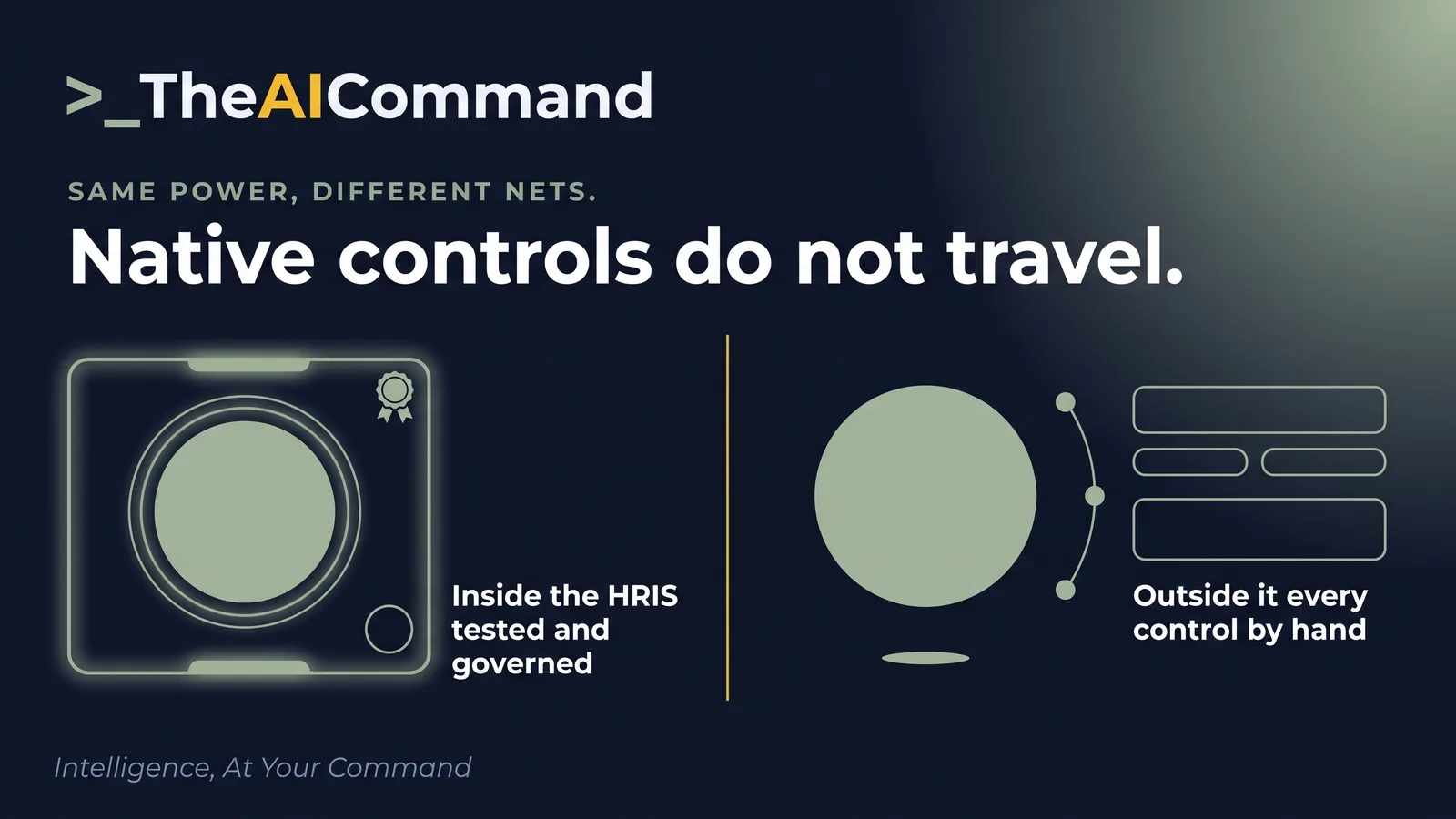
The exposure is sharpest not inside Workday, but in the general-purpose tools most teams already have. A People Analytics lead can open a Claude or ChatGPT project, paste a set of instructions and a spreadsheet of employee data, and stand up a working agent in an afternoon. There is no Agent-Ready Tools layer making that agent inherit the organisation's data governance, and no Agent Passport testing it against prompt injection before it runs on real records. The controls Workday is building into its platform are exactly the controls a team has to supply by hand when it builds anywhere else. The convenience is identical. The safety net is not. So read Workday's announcement not as a buying decision but as a specification, one an HR team can use whether or not it ever runs Workday.
Read Agent Passport as a build checklist
Strip Agent Passport back to the questions it tests for, and it becomes a pre-build and pre-go-live checklist any HR team can apply to an agent built in any tool:
- Can the agent be hijacked? Test whether a poisoned input, a pasted CV, a candidate message, a document, can override its instructions. This prompt injection and goal hijacking risk is live the moment an agent reads text a stranger wrote.
- Can it leak employee data? Check what the agent can read and where its outputs go. An agent with broad read access and a chat interface can surface one employee's information to another user, or send it to a vendor's servers, unless the scope is deliberately narrowed.
- Will it reveal its own instructions? System prompt extraction can expose the rules, thresholds and data sources you built in, which is both a security and a fairness problem if those rules should not be public.
- Does a human stay in the loop? Confirm a named person reviews outputs before any decision, rather than the agent's output becoming the decision.
- Is there an auditable record? You should be able to show what the agent can do, what it was tested against, and who approved it, mapped to a recognised standard such as the OWASP Agentic Top 10.
None of these needs a Workday licence. They need a person to run the check and a rule that no agent goes live until it passes.
The Australian rules that apply the moment an agent touches employee data
An HR-built agent does not sit outside the law because a person built it in an afternoon. Four familiar regimes apply, and the agent softens none of them.
The Privacy Act 1988 governs the employee data the moment the agent collects, reads or holds it. Australian Privacy Principle 3 limits collection to what is reasonably necessary, so an agent handed a whole HR export when it needs three fields is collecting far more than it should. Australian Privacy Principle 5 requires notification about how personal information is collected and used. Australian Privacy Principle 6 limits use to the purpose the data was collected for, so employee data gathered for payroll should not quietly become context for an unrelated agent. And Australian Privacy Principle 11 requires reasonable security, and an agent with broad access and an open interface is a new security surface to assess, not an afterthought.
The transparency duty tightens this further. From 10 December 2026, new automated decision-making obligations are inserted into Australian Privacy Principle 1 by the Privacy and Other Legislation Amendment Act 2024. As the OAIC guidance on APP 1 explains, where an entity arranges for a computer program to make, or do something substantially and directly related to making, a decision that could reasonably be expected to significantly affect a person's rights or interests, the privacy policy must disclose the kinds of personal information used and the kinds of decisions made. An HR agent that screens, scores, ranks or drafts decisions about employees is a strong candidate for this. The privacy policy disclosure should be prepared now, not after the deadline.
Fair Work is where a build decision becomes an employment risk. If an agent's output drives a performance, disciplinary or termination outcome, the general protections in the Fair Work Act 2009 still apply, and they carry a reverse onus: if a protected reason is alleged, the employer must prove it played no part. An agent that flags an employee, and a manager who acts on the flag, is exactly the causal chain those protections are built to test. The rule that keeps this defensible is simple: the agent can prepare, but a person owns any decision that significantly affects an employee.
The through-line is the one the site returns to across the HR pieces on AI worker monitoring: the tool does not carry the legal responsibility, the employer does, and building the tool yourself does not change that.
Who should be allowed to build, and the gate before go-live
The governance answer is not to ban HR-built agents. It is to make building a deliberate, gated act rather than an accidental one.
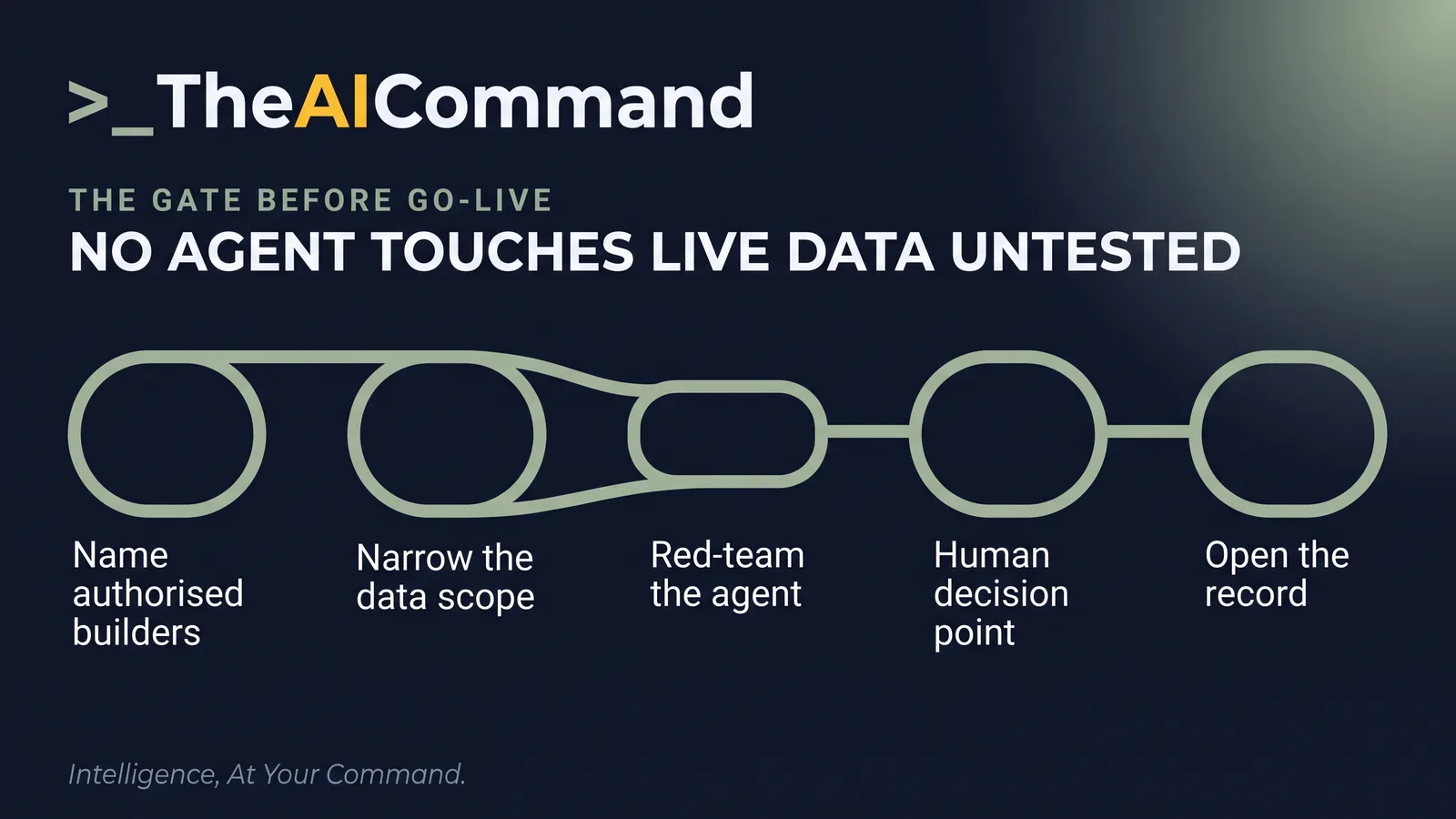
Name a small set of authorised builders. Not everyone with access to a workspace should be standing up agents that read employee data. Decide who may, give them the checklist above, and make clear that an experiment on synthetic data is fine while a build on live records is not, until it passes the gate.
Then define the gate itself, as a bullet-point standard every proposed agent has to clear:
- Purpose and scope named in one paragraph: what the agent does, and the smallest set of employee data it needs to do it.
- Data access confirmed and narrowed: exactly what it can read and write, with anything beyond the stated purpose removed.
- Adversarial testing done: run prompt injection and jailbreak attempts against it, and confirm it cannot be steered off task by a hostile input.
- Data-leak check passed: confirm outputs cannot expose one person's information to another user or to an external service outside your control.
- Human decision point built in: a named person reviews outputs, and no agent output stands as a decision that significantly affects an employee.
- Record opened: what the agent can do, what it was tested against, who approved it, and the review date.
This is the manual version of what Agent Passport automates. A large vendor is spending real engineering effort to make it native, but until that is generally available, and for every agent built outside a platform that offers it, HR runs the gate itself.
Two prompts to run before you build
Use this first prompt to triage a proposed HR agent before anyone builds it. It forces the scope and risk questions into the open on de-identified information:
Use this second prompt as an adversarial go-live check, mirroring the risks Agent Passport tests for, before the agent runs on live data:
Do this Monday:
- List every AI agent your HR function has already built or is running, in Workday, in ChatGPT Enterprise, in Claude Cowork or anywhere else, and note what employee data each one can read.
- Decide who in the function is authorised to build agents that touch employee data, and make clear that nobody else builds on live records.
- For each existing agent, run the go-live red-team prompt above and fix or pause anything that returns a FAIL on injection, data leak or human oversight.
- Narrow every agent's data access to the smallest scope that meets its purpose, to satisfy APP 3, and confirm outputs cannot reach anyone or anywhere they should not.
- Build a named human decision point into any agent whose output could influence a performance, disciplinary or hiring outcome, so no agent output stands as the decision.
- Open a one-page record for each agent covering purpose, data scope, what it was tested against, who approved it, and a review date.
- Diarise the automated decision-making privacy policy disclosure so it is in place before 10 December 2026.
A worked example
A mid-sized Australian employer, [ORGANISATION], has no Workday agent tooling, but its People Analytics lead, [ANALYST], has a Claude Cowork licence. To save time in a restructure, [ANALYST] builds an agent that reads the full HR export, including performance notes and personal contact details, and drafts a ranked list of roles to consider for redundancy, with a short rationale for each name.
Before it runs on live data, [ORGANISATION] puts the agent through the gate. The triage prompt flags two problems at once. The data scope is far wider than the purpose needs: the agent was handed the entire export when it required only role, tenure and current performance rating. And the decision impact is severe, because a ranked redundancy list significantly affects people's interests, which means a human must own it and the automated decision-making rules are engaged. The red-team prompt then finds a third issue: because the agent reads free-text performance notes, a note that happens to contain instructions, left by an earlier manager or pasted from another document, can steer the agent's rationale. That is a prompt injection path into a redundancy recommendation, and it fails the check.
[ORGANISATION] does not scrap the idea. It narrows the agent to three structured fields, strips the free-text notes, and rebuilds it to produce a neutral summary of tenure and ratings rather than a ranked list of names. A named manager makes the selection decisions using that summary, and the reasoning is recorded against the organisation's consultation and selection obligations. The agent still saves time. It just no longer makes, or quietly biases, a decision a person is accountable for. The convenience survived the gate. The risk did not.
Bottom line
Workday moving agent-building inside the HR system is a real advance, and a signal: the friction that kept agent-building inside IT is gone, and the controls it stood in for now have to be deliberate. Workday is building those controls natively, but general availability is still months out, and none of it follows an agent a team builds in a general-purpose workspace. Treat the announcement as a specification, not a purchase: decide who may build, run the gate before anything touches live employee data, keep a person accountable for any decision that affects an employee, and get your privacy disclosure ready for 10 December 2026. The power to build an agent is now in everyone's hands. The responsibility for what it does was always yours.
TheAICommand. Intelligence, At Your Command.