
This week the biggest AI story was not a launch. It was a takedown. On 12 June 2026 a United States government directive forced Anthropic to suspend access to two frontier models it had released only three days earlier. That is the first time a government has compelled the removal of a publicly deployed frontier model. Around it sat a cluster of quieter but consequential changes from OpenAI, Apple and Google that touch shadow AI, vendor risk and change control.
This is general guidance and education only. It is not legal, compliance, financial or professional advice. Verify anything time-sensitive with the relevant people in your own organisation before you act on it.
AI Week in Review is built to be repeatable. The front half is the verified news for the week. The back half is a method you can reuse every week to turn a noisy feed into a short list of decisions with named owners. The aim is steady curiosity matched with discipline, not a scrapbook of links.
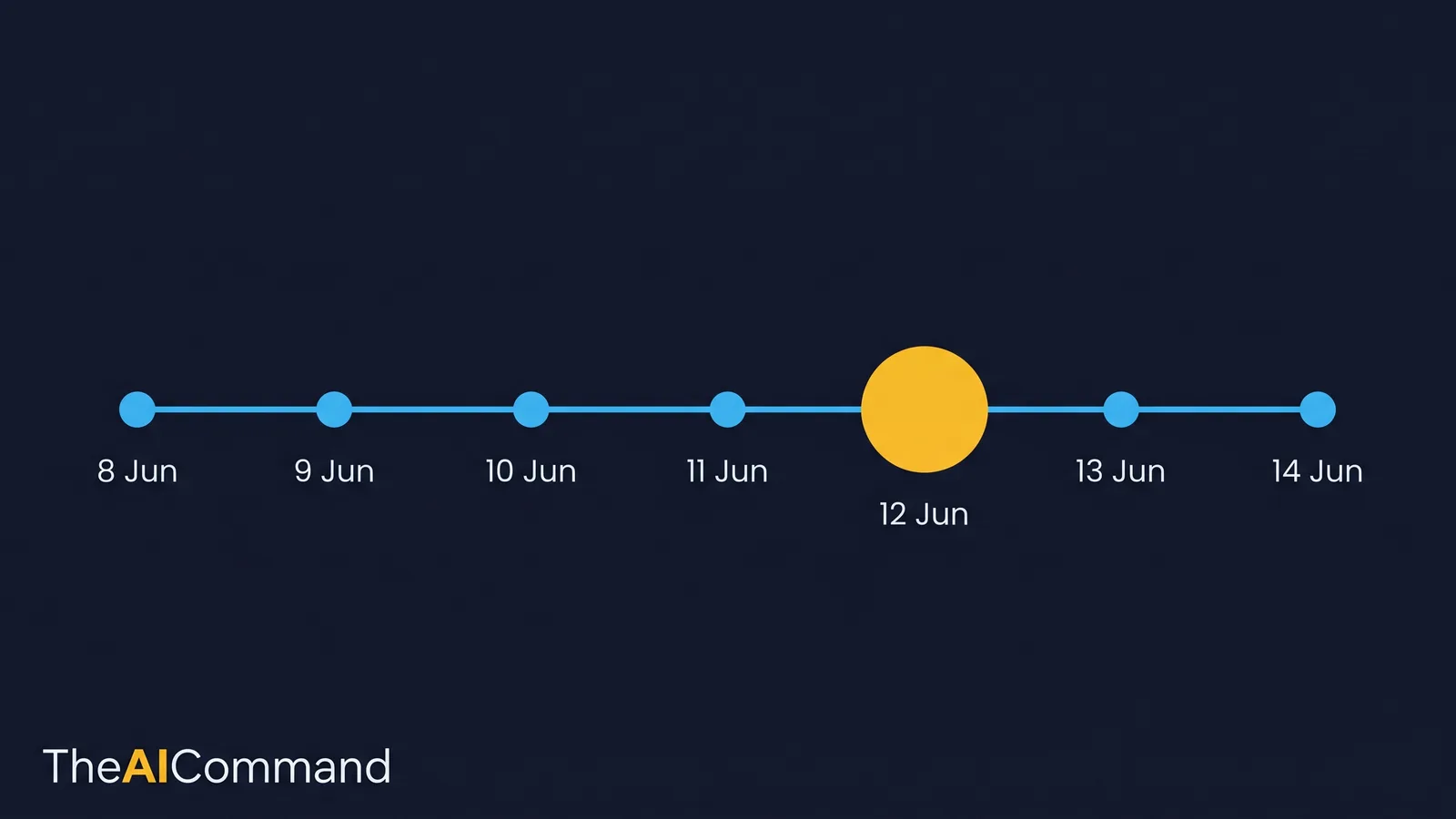
Why did a government order take two frontier models offline?
On 9 June 2026 Anthropic released Claude Fable 5 and Claude Mythos 5, both at the top of its capability range with a one-million-token context window [1]. Three days later, on 12 June at 5:21pm United States Eastern Time, Anthropic received an export-control directive citing national security authorities [2]. The directive suspends access to both models by any foreign national, whether inside or outside the United States, and reportedly covers Anthropic's own foreign-national staff [2].
The trigger was narrow. According to Anthropic, a jailbreak "essentially consists of asking the model to read a specific codebase" [2]. Because Anthropic cannot filter foreign nationals from United States users in real time, it disabled both models for every customer rather than only the affected group [2]. United States news coverage named Commerce Secretary Howard Lutnick and the Commerce Department's Bureau of Industry and Security as the source of the order [3][4].
Status as at 14 June 2026, and this may change: Fable 5 and Mythos 5 are offline for everyone. Anthropic says it is "working to restore access as soon as possible" but has given no date [2]. Every other Anthropic model is unaffected. Claude Opus 4.8 is now the most capable model available; Claude Sonnet 4.6 and Claude Haiku 4.5 remain online too [1]. For Australian readers, who are foreign nationals under the directive, the practical position is simple. The two new models are not available; the rest of the lineup is.
The so-what for Australian teams is concrete. A vendor's flagship can disappear by order of a foreign government, with no notice and no restoration date. That is a continuity risk, not a quality risk. Any workflow or AI Readiness assessment that names a specific model now carries a single point of failure that sits outside your control and outside your vendor's control.
What changes on Monday: if any pilot or production workflow depends on a single named model, write down a fallback model and the steps to switch to it. Treat "the model we use can be withdrawn by regulation" as a logged continuity scenario, not a hypothetical.
What were the other six AI developments that matter?
The Anthropic order led the week, but six other verified moves carry direct governance, privacy and change-control weight for Australian professionals. The summary table below maps each one to a source and a Monday action. The detail follows.
OpenAI files confidentially for an IPO
On 8 June OpenAI said it had confidentially submitted a draft S-1 registration statement to the United States Securities and Exchange Commission, with the filing dated 9 June [5]. Reporting put the target valuation above one trillion United States dollars, with Goldman Sachs, Morgan Stanley and JPMorgan leading. OpenAI stressed that no listing date is set and that the timing "could be a while" [5].
A public OpenAI, following Anthropic's own June filing, means a core AI vendor will face quarterly-earnings pressure and disclosure scrutiny. For GRC and procurement teams that is a vendor-risk and continuity factor worth logging against SRC Act vendor-management expectations and APRA's CPS 230 operational-risk obligations [6]. Monday action: add "foundation-model vendor going public" to your AI vendor-risk register, and note the IPO as a trigger to review contract terms, pricing-change clauses and exit and continuity plans at your next vendor review.
Apple ships a Gemini-powered Siri
At its WWDC 2026 keynote on 9 June, Apple announced a rebuilt Siri for iOS 27, iPadOS 27, macOS and visionOS, powered by Google Gemini models running partly on-device and partly through Apple's Private Cloud Compute [7]. Developer access opened the same week, with a public beta to follow [7].
A far more capable assistant baked into staff iPhones and Macs means work content, including claimant details, board papers and case notes, can flow to a cloud model by default. That expands shadow-AI and Privacy Act exposure on devices an organisation may not fully control, and engages the security obligation in Australian Privacy Principle 11 [8][9]. Monday action: check your mobile-device-management settings and acceptable-use policy now, and decide whether the new Siri and Apple Intelligence cloud features are permitted on managed devices. Disable or restrict them before iOS 27 lands if staff handle personal or sensitive information.
Google removes the Gemini 3.5 Flash opt-out
A Gemini Enterprise release note dated 9 June confirmed that the feature-management toggle for Gemini 3.5 Flash is being retired [10]. The model is now enabled by default for all users in the Gemini Enterprise app and cannot be disabled [10].
If your organisation runs Google Workspace or Gemini Enterprise, a feature you may have switched off is now mandatory. That matters for change control and model-governance documentation [10]. Monday action: confirm whether your tenant is affected, document the forced model change in your AI change log, and brief staff on what Gemini 3.5 Flash can and cannot be used for under your data-handling rules.
ChatGPT's model picker collapses to effort tiers
On 10 June OpenAI replaced ChatGPT's named-model and separate reasoning-effort selectors with a single set of effort tiers, Instant, Medium, High and Pro-only options, across web, iOS and Android [11]. An optional auto-switch can move a task from Instant to higher reasoning without the user choosing it [11].
Teams that wrote prompts, standard operating procedures or audit evidence referencing specific model names now have stale documentation. The auto-switch means the underlying model handling a task can change mid-flow, which complicates reproducibility and record-keeping [11]. Monday action: update any internal ChatGPT guidance, prompt libraries and assessment procedures that name specific models, and decide whether to leave the Instant-to-higher auto-switch on or off for staff handling regulated work.
Codex gains Computer Use on Windows
OpenAI's 11 June update brought Computer Use to Codex on Windows, letting the agent drive a desktop environment for debugging and tasks, alongside a browser-debugging mode and a shared workspace Library for Enterprise and Education accounts [12][13]. An agent that can operate a Windows desktop crosses from suggesting actions to taking them.
That raises the human-in-the-loop and access-control bar for any GRC, audit or claims team piloting agentic tools on corporate machines [13]. Monday action: before anyone enables Codex Computer Use, define which systems it may touch, require human approval for actions on live data, and confirm it cannot run unsupervised against systems holding claimant or personal information.
ChatGPT can now send email and build charts in chat
On 8 June OpenAI rolled out a batch of ChatGPT features, including the ability to draft and send emails directly when Gmail or Outlook is connected, native interactive charts, full-screen writing tools, and message editing with attachments on iOS [11]. Letting ChatGPT send email from a connected mailbox turns a drafting tool into an action that leaves your organisation.
That creates a real risk of unreviewed or non-compliant correspondence going out under a staff member's name to claimants or regulators [11]. Monday action: decide whether to allow ChatGPT's Gmail or Outlook send connector at all. If you permit it, mandate that every AI-drafted email is reviewed and sent manually by the staff member rather than dispatched by the assistant.
The week at a glance
Use this table as a working artefact, not decorative content. Copy it into a planning document, adapt the fields, and brief a manager, analyst or risk owner from it.
How do you filter AI news before you act on it?
The discipline that separates useful adoption from headline-chasing is a filter. Each item gets one of five labels: ignore, monitor, test, brief or adopt. The label is a decision, and "ignore" is often the right one. The point is to stop treating every announcement as urgent while still catching the ones that change model routing, tool setup, training or governance.
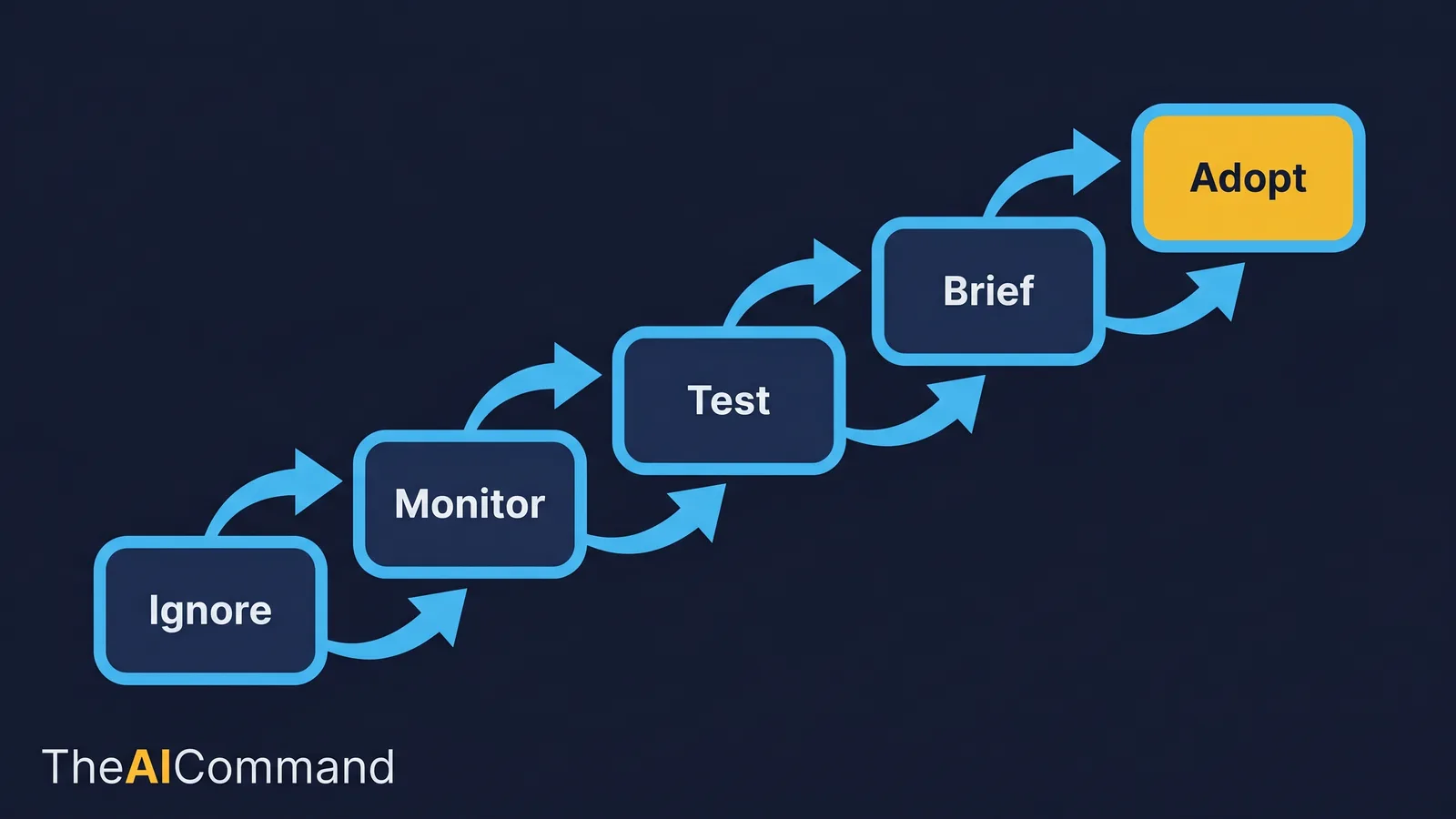
The table below sets the criteria for each label. Score an item against credibility, workflow relevance, risk, effort and governance impact, then place it.
The mistakes this filter prevents are predictable. Confusing recency with relevance, treating unofficial commentary as source of truth, over-adopting from a headline, and failing to update internal guidance after a model or product change. A useful governance habit is to ask what the model is not allowed to do, and to make that boundary visible in the workflow, prompt, interface and review checklist. A boundary that lives only in someone's head will be missed under time pressure.
Trust the base of the pyramid first
Every claim in this review is anchored to a primary source. That is the rule that keeps a weekly brief honest. A simple source hierarchy makes the rule easy to follow.
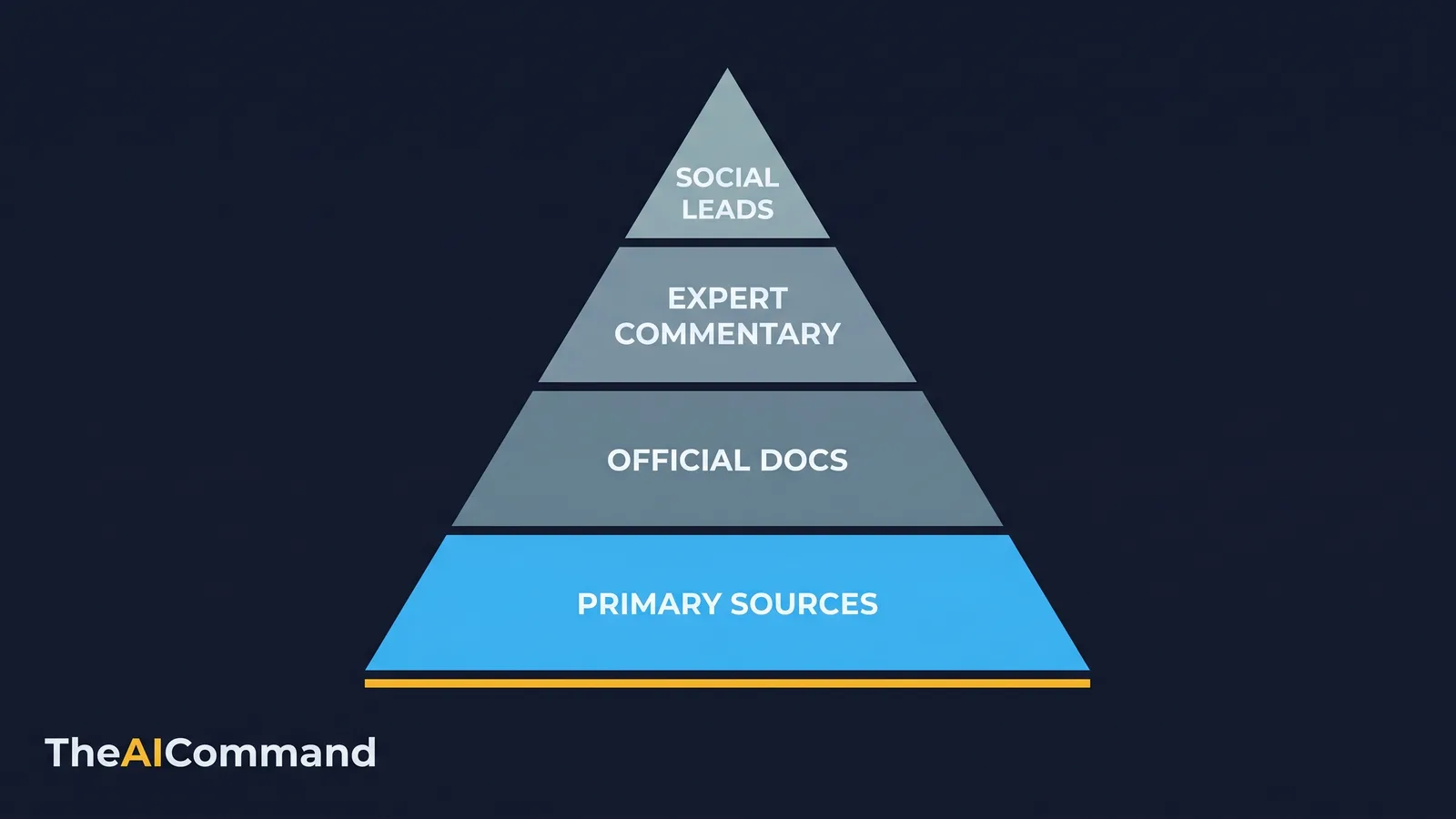
Work from the base of the pyramid up. First, vendor and regulator primary sources, such as the Anthropic access notice and OpenAI's own filing announcement [2][5]. Second, official product and model documentation, such as the Gemini Enterprise release notes and the OpenAI Codex docs [10][12]. Third, expert commentary to understand implications, including reputable reporting that named the responsible agencies [3][4]. Fourth, social posts, used only as leads to verify elsewhere, never as the evidence itself. When a source is incomplete, the correct output is a gap list, not a confident paragraph. That matters most in HR, GRC and workers compensation work, where a settled tone can make an unsupported claim look proven.
Turning the week into a Monday action board
A weekly brief is finished when every item has a source, a practical implication and a decision. The next step is to convert those decisions into a board where each update has an owner and a review date. Awareness without an owner is just reading.
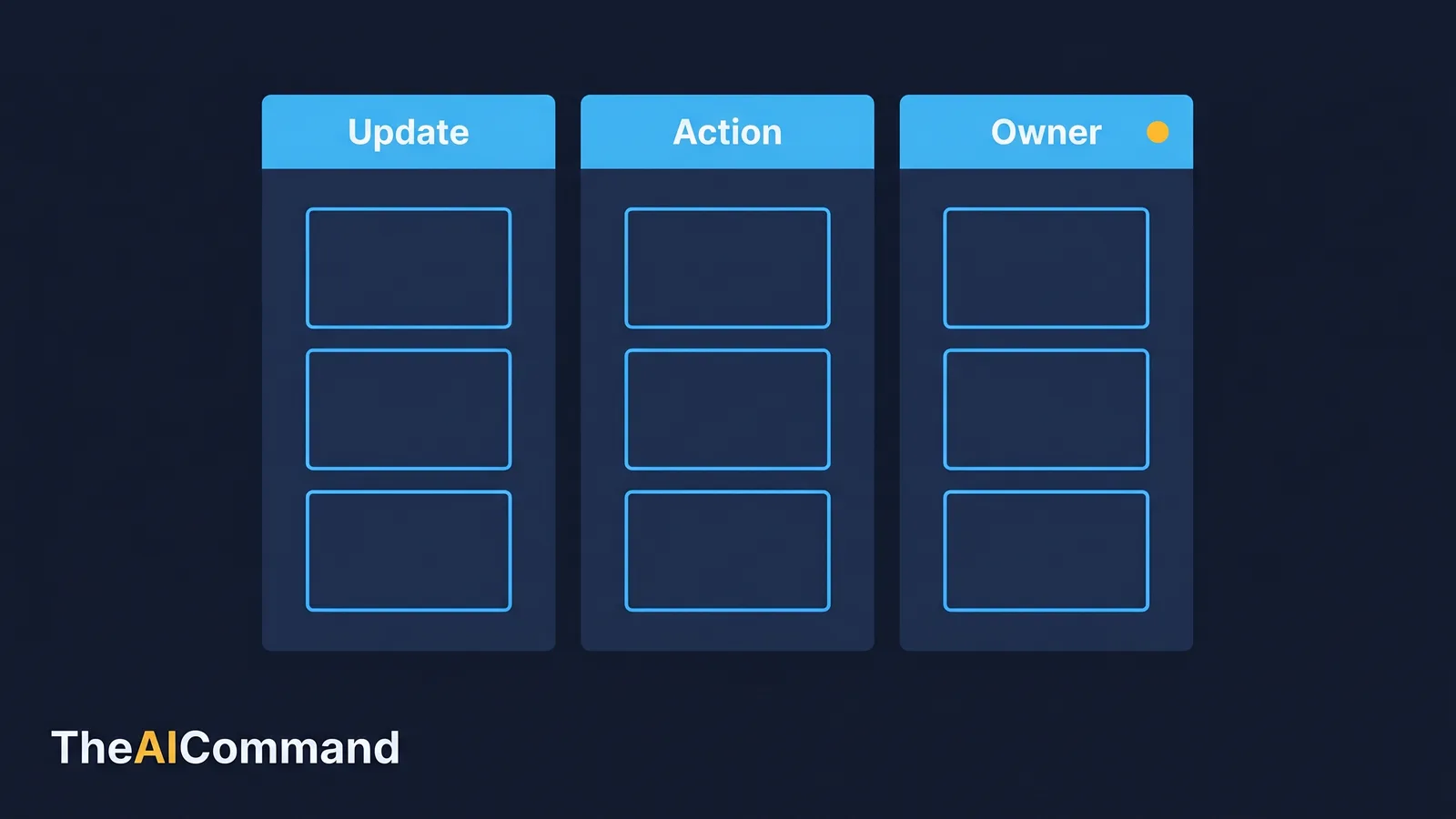
Three roles keep the board moving. The domain owner confirms what an update means for the work. The AI workflow owner maintains prompts, files and tool behaviour. The reviewer checks that outputs are grounded, proportionate and safe to use. Small teams can combine the roles, but they should still name the hats. Run a short review meeting with the board visible on screen, and treat each AI output like a junior analyst draft: useful, quick and incomplete until checked. Record every correction as a source issue, a prompt issue, a process issue or a judgement issue, so the team improves the system rather than fixing one document.
The prompt stack
The prompt stack is staged on purpose. The first prompt narrows the task to verified sources. The middle prompts classify and summarise. The final prompts protect against over-claiming and keep internal guidance current. That order reduces the chance of a polished but unsafe output. The prompts below are runnable as written; replace the bracketed placeholders with your own sources and context.
Build the verified weekly log
Apply the adoption filter
Write the leadership note
Refresh internal guidance
Design a 20-minute team session
What good looks like, and what to do next
A strong weekly brief is short, sourced and decision-led. The first one takes time because the source list, categories and scoring rules are new. By the fifth, the team has a stable source register, a standard adoption filter and a rhythm for updating internal guidance. The aim is not to become a newsroom. It is to keep AI adoption current without making leaders chase every announcement. One source log can feed several audience views: implication and investment for executives, tool and workflow changes for practitioners, governance and assurance for risk teams, and capability gaps for learning leads.
For this week, the smallest useful version is a single board: log a fallback model and switch plan after the Anthropic order, add "vendor IPO" to the vendor-risk register, review device policy before iOS 27, record the forced Gemini change, update model-named documentation, scope any Codex Computer Use pilot, and set a manual-send rule for AI-drafted email. None of that requires a large programme. It creates controlled momentum and a record you can show.
Bottom line
The week's headline was a takedown, not a launch: a US government order pulled Claude Fable 5 and Mythos 5 worldwide with no restoration date, which is a continuity risk that sits outside your control and your vendor's. Six other verified moves from OpenAI, Apple and Google touch shadow AI, vendor risk and change control. Treat the week as a short list of sourced decisions with named owners, not a scrapbook of links.
Do this Monday:
- Log a fallback model and a switch plan for any workflow that depends on one named model.
- Add "foundation-model vendor going public" to your AI vendor-risk register.
- Review your mobile-device-management and acceptable-use policy before iOS 27 lands.
- Record the forced Gemini 3.5 Flash change in your AI change log, and update any documentation that names specific models.
- Set a manual-review-and-send rule for AI-drafted email, and scope any Codex Computer Use pilot before enabling it.
This article is general information and education only. It is not legal, compliance, privacy or financial advice, and it does not account for your organisation's specific obligations. The developments described are verified to their primary sources as at 14 June 2026 and may change. Before changing a policy, control or workflow, verify the current position with the relevant people in your own organisation, including your legal, privacy, risk and procurement teams.
For more practical AI workflow ideas, follow TheAICommand on Instagram at @the_aicommand and X at @TheAICommand.
References
- Anthropic, Models overview. https://platform.claude.com/docs/en/about-claude/models/overview
- Anthropic, Update on access to Claude Fable 5 and Claude Mythos 5. https://www.anthropic.com/news/fable-mythos-access
- CNBC, Anthropic disables access to Fable 5 and Mythos 5 to comply with government directive. https://www.cnbc.com/2026/06/12/anthropic-disables-access-to-fable-5-and-mythos-5-to-comply-with-government-directive.html
- Tom's Hardware, US export-control order forces Anthropic to disable Claude Fable 5 and Mythos 5 worldwide. https://www.tomshardware.com/tech-industry/artificial-intelligence/us-export-control-order-forces-anthropic-to-disable-claude-fable-5-and-mythos-5-worldwide
- OpenAI, OpenAI submits confidential draft S-1. https://openai.com/index/openai-submits-confidential-s-1/
- APRA, CPS 230 Operational Risk Management. https://www.apra.gov.au/operational-risk-management
- Engadget, Everything announced at Apple's WWDC 2026 keynote. https://www.engadget.com/2189698/everything-announced-at-apples-wwdc-2026-keynote/
- OAIC, Australian Privacy Principles. https://www.oaic.gov.au/privacy/australian-privacy-principles
- OAIC, Chapter 11: APP 11 Security of personal information. https://www.oaic.gov.au/privacy/australian-privacy-principles/australian-privacy-principles-guidelines/chapter-11-app-11-security-of-personal-information
- Google Cloud, Gemini Enterprise release notes. https://docs.cloud.google.com/gemini/enterprise/docs/release-notes
- Releasebot, OpenAI ChatGPT updates. https://releasebot.io/updates/openai/chatgpt
- OpenAI Developers, Codex documentation. https://developers.openai.com/codex/
- Releasebot, OpenAI updates. https://releasebot.io/updates/openai
TheAICommand. Intelligence, At Your Command.