
You cannot fairly mark someone down for breaking a rule you never wrote.
That is an old principle, and it has quietly become the weakest point in Australian hiring. Over the past two years, employers have put real effort into deciding what they may do with AI in recruitment: whether a model can screen, who reviews, what the record must show. Very few have done the other half, which is telling candidates what is expected of them, in writing, before anyone applies.
The Australian Public Service has done both halves and published them. As at 17 September 2026, the Australian Public Service Commission maintains three documents: principles for agency use of AI in recruitment, principles for candidate use, and a guide for managing candidate use. The guidance hub page records a publication date of 20 April 2026 and a last-updated date of 29 April 2026, and states that agencies were expected to implement the agency principles by 1 June 2026.
The candidate half is the part almost nobody else has, and it is the part worth copying.
What has the APS actually published?
Three linked documents, each doing a different job.
The principles for candidate use are addressed to the applicant, not to the panel. They state that candidates are able to use AI tools when participating in an APS recruitment process, except where an agency has specifically requested they do not. They then set expectations under headings including "Be transparent, authentic and truthful" and "Use AI to support, not substitute your own experience or capabilities".
The operative sentences are worth reading closely. It is the candidate's responsibility to ensure the details in their resume and written application are factually correct and a true representation of their own experiences, qualifications and capabilities. Agencies may ask whether AI tools were used, and if asked, candidates are expected to provide truthful information about how they used them, to be prepared to fully explain which tools were used and at what stages, and to be able to demonstrate what their own contribution to the final product was.
The consequences are stated plainly. Misrepresenting capabilities and experience can compromise the integrity of the process, damage a reputation, lead to failed background checks, or result in removal from the recruitment process. For someone who becomes an employee, it can lead to formal sanctions up to and including termination.
The principles for agency use run the other direction. Agencies are required to adopt and implement them, including ensuring that recruitment providers acting for the agency align with them. Under the heading "Human-centred Oversight and Decision-making", the principles state that AI tools should assist, not replace, human judgement, particularly at critical stages, and that relying solely on AI tools for decisions risks undermining the fairness and integrity of the process. Where AI assists with shortlisting, the process should incorporate human oversight through a moderation process or a review of a random sample of applications by the selection panel, with the size of that sample sufficiently robust to give the panel and delegate assurance that the AI tools are consistent with the panel's assessment. Agencies are encouraged to start small and build capability while maintaining human oversight throughout.
The guide for managing candidate use is the practical one. It names where candidates are most likely to use AI: resume and CV writing, written applications, interview preparation including mock interviews and pre-prepared responses, and online assessments not monitored by human oversight, including real-time answers during interviews.
It then imposes a distribution obligation that is the whole point of this article. Agencies must either link to or provide a copy of the candidate principles in the candidate pack or the recruitment system advertisement, or link to their own equivalent principles. It goes further and says agencies should clarify expectations of candidates about AI use, and suggests one way to do that is advising candidates which stages of the process require authentic, unaided input.
Why does publishing first change anything?
Because the alternative is a hidden standard, and a hidden standard produces three problems at once.
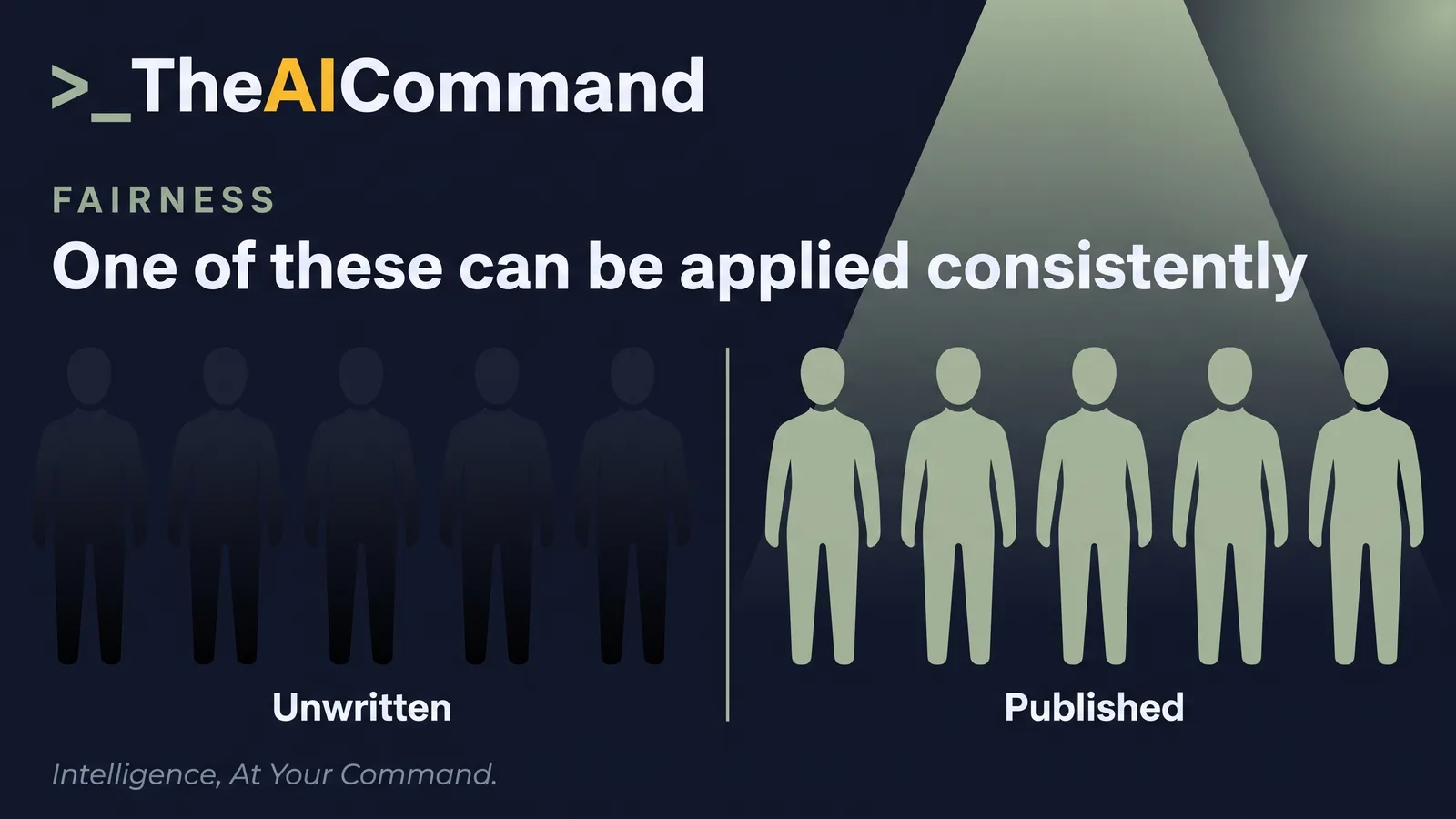
The first is fairness. If your panel discounts an application that reads as AI-assisted, you have applied a criterion the candidate could not see and cannot answer. Two candidates with identical experience get different outcomes based on drafting style, which is not a merit distinction. The site has covered the assessment side of this in assessing the person when every application reads perfectly. The point here is upstream of assessment: the standard has to exist before the assessment applies it.
The second is inconsistency. Unwritten rules are enforced differently by different panels, and in practice they are enforced hardest against the candidates who are least sure what the norm is. That is a bias risk, and it sits squarely inside the ground the site covered in AI hiring and performance tools under the positive duty.
The third is that you lose the information. A candidate who has been told that disclosure is welcome, and that you are interested in how they use AI, will tell you. A candidate who suspects disclosure will be held against them will not. The guide makes exactly this point. It says most roles in the APS are going to require employees to be able to use AI in their day-to-day role, so when advertising a role agencies should consider what level of AI capability it requires, whether that belongs in the selection criteria, and how capability will be assessed. If you want to know how a candidate works with these tools, the fastest route is to say so and ask.
What goes in your published statement?
Four things, and the APS model gives you the shape of each.
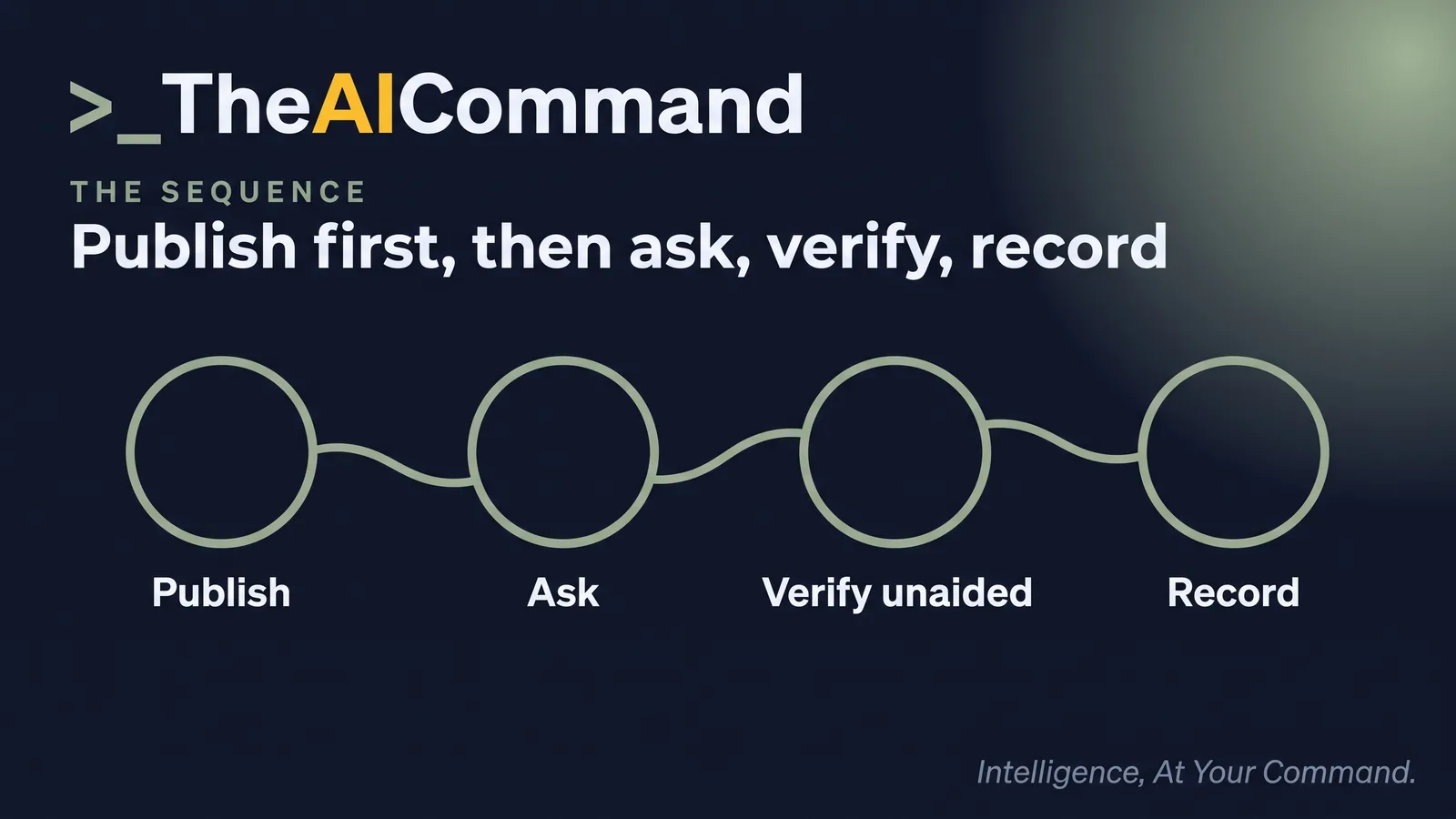
What is allowed. State the default. Allowed unless otherwise specified is a defensible default and it matches how people actually work. If you take the opposite position for a particular role, you need a reason you can say out loud.
Which stages require unaided work. This is the sharpest idea in the guide and the one most employers miss. A written application drafted with AI assistance is a different thing from a live technical exercise. Name the stages where you need the person's own unaided output, say so before that stage, and design the stage so it is actually observable.
What you will ask, and why. If you intend to ask about AI use, publish the question in advance and say what it is for. The APS sample transparency question opens by telling candidates the agency is supportive of them using AI tools, and says the disclosure is there to assist in assessing their capability to use those tools. That framing is the difference between honest answers and defensive ones.
What crosses the line. Not "using AI". Misrepresenting your own experience, qualifications or capabilities, or being unable to explain and stand behind what you submitted. That is a conduct standard you already have, and it survives contact with any tool.
Publish it where candidates will see it before they start: in the advertisement or the candidate pack, not buried in a careers portal footer.
The companion artefact for this piece, what to publish about candidate AI use, is that one page written out with the transparency question, the unaided-stage block and a panel-side checklist. It is free, ungated, and meant to be edited rather than adopted whole.
A worked example
[ORGANISATION] is hiring a [ROLE] in [TEAM]. The advertisement links to a one-page candidate AI statement.
The statement says AI assistance is welcome for drafting and preparing the written application. It says the second-stage exercise is a live 45-minute session with no AI tools, and explains that this stage exists to observe reasoning rather than output. It says the application form will ask whether AI was used and at what stages, that the answer does not disadvantage the applicant, and that the panel may ask the candidate to talk through how they arrived at a particular claim.
[CANDIDATE_NAME] discloses that they used a model to restructure their selection criteria responses and to run a mock interview. At interview the panel asks about a claim in the application regarding a [PROJECT_TYPE] delivery. The candidate explains the work, the constraints, and what they would do differently. The panel records the answer.
Nothing unusual has happened, and that is the point. The disclosure did no harm, the unaided stage did its job, and the panel tested the claim rather than the prose. Had the candidate been unable to explain the claim, the finding would have been about a misrepresented capability, against a standard published before they applied.
Where the human decision has to stay
The agency principles are explicit that AI assists and does not replace human judgement at critical stages, and that sole reliance on AI for decisions risks the fairness and integrity of the process. If a model helps you shortlist, a person moderates or samples the output before the outcome stands. The site set out what that record has to contain in when a recruiting agent screens before a human.
The same discipline applies to your own use of AI in drafting the statement, the advertisement and the criteria. TheAICommand works to the Verified Draft Method: de-identify the inputs, ground the model in your own source material, keep a person at the decision point, verify against the primary source, and log what happened. A model can draft your candidate AI statement from the APS documents in a few minutes. A person has to decide which stages require unaided work, because that is a judgement about the role.
Two related boundaries. Do not use disclosure of AI use as a screening criterion in itself, because that penalises honesty and tells you nothing about capability. And keep the transparency question separate from anything that collects personal information you do not need, which also matters for the broader automated decision-making transparency requirements arriving under the Privacy Act from 10 December 2026, as at 17 September 2026. The site's coverage of who sees the ad deals with the upstream targeting question that sits before any of this.
What never to automate
Do not let a tool decide that an application is AI-generated and reject it. Detection is unreliable, and the finding you actually need is about misrepresentation, which requires a conversation.
Do not automate the final selection decision, or the reasons for it.
Do not run an unaided stage without telling people it is unaided, and do not use covert monitoring to enforce it. If a stage matters enough to be unaided, it matters enough to be designed as an observed exercise.
Do this Monday
- Read the three APSC documents. They are short and they are free, and one of them is addressed to an audience you have never written to.
- Draft a one-page candidate AI statement covering the four elements above, and get it approved by whoever owns your recruitment policy.
- Pick your next advertised role and link the statement in the advertisement or the candidate pack.
- Add the transparency question to the application form, with the reason for asking stated on the form.
- Identify one stage of that process that requires unaided work, and design it so the requirement is observable rather than assumed.
Bottom line
The Australian Public Service has published what it expects candidates to do with AI, and required agencies to put that document in front of candidates before they apply. That is the missing half of nearly every private-sector AI hiring policy. Publish your expectations, name the stages that need unaided work, ask the question openly, and you convert an uncomfortable and inconsistent judgement into a standard you can apply the same way every time.
References
- Australian Public Service Commission, AI in recruitment, published 20 April 2026, last updated 29 April 2026. https://www.apsc.gov.au/working-aps/hr-practitioners/recruitment-aps/ai-recruitment
- Australian Public Service Commission, Principles for candidate use of AI in recruitment. https://www.apsc.gov.au/sites/default/files/2026-04/Principles%20for%20candidate%20use%20of%20AI%20in%20recruitment_accessible.pdf
- Australian Public Service Commission, Principles for agency use of AI in Recruitment. https://www.apsc.gov.au/sites/default/files/2026-04/Principles%20for%20agency%20use%20of%20AI%20in%20recruitment_accessible.pdf
- Australian Public Service Commission, Guide for managing candidate use of AI in Recruitment. https://www.apsc.gov.au/sites/default/files/2026-04/Guide%20for%20managing%20candidate%20use%20of%20AI%20in%20recruitment_accessible.pdf
- Privacy and Other Legislation Amendment Act 2024 (Cth), No. 128, 2024, section 2 (commencement of Schedule 1, Part 15). https://www.legislation.gov.au/C2024A00128/asmade
TheAICommand. Intelligence, At Your Command.