
AI literacy is a management skill, not a one-off training module: managers make it real by modelling and reinforcing five daily behaviours, prompting, verification, privacy hygiene, escalation and review. AI literacy is often misunderstood as a simple training checkbox for staff, something to be ticked off in an annual compliance course or a one-time workshop. However, for managers, AI literacy is far more than that. It is a critical operational skill that must be demonstrated and reinforced through daily team behaviours and practical routines. Without this, organisations risk superficial compliance, unchecked AI errors, privacy breaches, and ultimately, loss of trust in AI-assisted work.
Embedding AI literacy means managers must cultivate and model behaviours such as effective prompting of AI systems, rigorous verification of AI outputs, strict privacy hygiene, timely escalation of concerns, and regular review of AI use and outcomes. These behaviours transform AI governance from abstract policy statements into practical, observable actions that reduce risk and build confidence in AI tools.
The Australian Government's Policy for the responsible use of AI in government and the Guidance for AI adoption provide a valuable framework for managers across sectors. They emphasise accountability, use case registers, human oversight and continuous monitoring as essential components of responsible AI use. Meanwhile, the Stanford AI Index 2026 reveals that while AI adoption is widespread, responsible AI practices such as verification and escalation are lagging behind, highlighting the urgent need for managerial leadership.
This article offers practical steps managers can take to make AI literacy visible and habitual within their teams, moving beyond generic upskilling to embed responsible AI use in everyday work.
Why should managers own AI literacy?
Research from Microsoft's Work Trend Index 2026 shows that organisational culture and manager support have twice the impact on AI effectiveness compared to individual effort alone. While AI tools like Copilot are widely used, 86 percent of users treat AI output as a starting point rather than a final answer. This means AI is a tool to augment human judgement, not replace it.
Managers are the frontline accountable officials responsible for ensuring their teams comply with organisational AI policies and government requirements. The Australian Government's responsible AI policy mandates clear accountability for AI use cases and internal registers to track AI adoption. Managers must translate these mandates into practical team behaviours and routines.
Without active managerial involvement, teams risk overreliance on AI outputs, which can be flawed, biased or incomplete. Managers must therefore coach their teams to maintain human judgement, question AI outputs, and escalate issues when necessary.
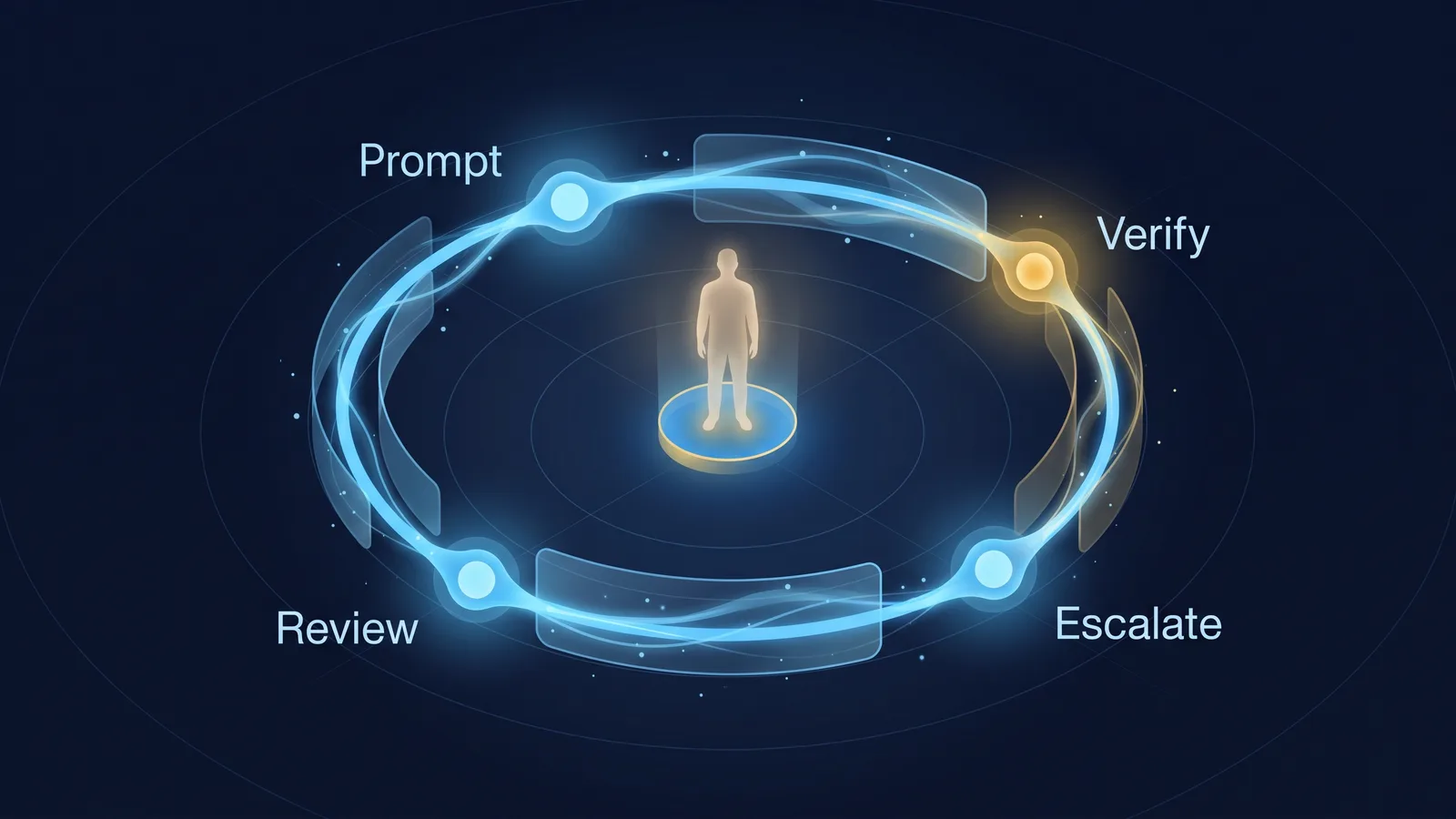
What AI literacy behaviours should managers expect?
To embed AI literacy effectively, managers should observe and reinforce these five core behaviours in their teams:
These behaviours align closely with the Voluntary AI Safety Standard's 10 guardrails, particularly those relating to accountability, human control, challenge processes and record keeping. The guardrails emphasise that these are ongoing activities, not one-off tasks, and require both organisational and system-level obligations.
Managers should not treat AI literacy as a theoretical concept but as a set of practical, observable behaviours that can be coached, measured and improved.
How do you embed verification and escalation in daily work?
Verification is the cornerstone of responsible AI use. AI systems, including generative models, can produce outputs that are plausible but incorrect, incomplete or biased. Managers must require team members to:
- Identify the source of AI outputs and check them against official records, policies or expert advice. For example, if an AI suggests a financial calculation or legal interpretation, it must be cross-checked with authoritative documents or qualified personnel.
- Question outputs that appear inconsistent, incomplete or unexpected. This critical thinking prevents blind reliance on AI.
- Document verification steps and any changes made before finalising work products. This creates an audit trail and supports accountability.
Escalation protocols are equally important. Not every AI output can be verified by the user alone, especially when outputs have legal, compliance or safety implications. Managers must define clear decision rights and escalation paths for:
- Outputs with potential legal, compliance or safety risks.
- Situations where AI outputs conflict with known facts or expert advice.
- Cases involving sensitive personal or organisational data that require specialist handling.

By embedding verification and escalation into daily workflows, managers ensure that human judgement remains central to decision-making and that risks are identified and managed promptly.
Privacy Hygiene: A Non-Negotiable Behaviour
Privacy concerns are intensifying. The Office of the Australian Information Commissioner's recent findings highlight that 86 percent of Australians are more concerned about privacy than five years ago, and 93 percent believe it is unfair for organisations to use personal information for training AI models without consent.
Managers must enforce privacy hygiene by:
- Training teams on what data can and cannot be input into AI systems. For example, personal identifiers, sensitive health information or confidential business data should never be entered into AI tools without explicit consent and safeguards.
- Monitoring AI use to prevent inadvertent disclosure of personal or confidential information. This includes reviewing chat logs, prompts and outputs for privacy risks.
- Ensuring AI tools comply with organisational privacy policies and legal requirements, such as the Privacy Act and data protection regulations.
Privacy hygiene is not just about compliance; it builds trust with customers and staff, reduces complaint risks, and aligns with the Australian Government's responsible AI policy transparency requirements. For teams handling regulated data, privacy-safe AI practices turn these rules into a working routine.
Making Review a Routine, Not an Afterthought
Regular review of AI use and outcomes is essential to adapt to evolving risks and improve practices. This is where designing the checking becomes a deliberate part of a manager's AI operating rhythm, not an afterthought, and where treating review as a standing review tax on AI adoption keeps quality from slipping. Managers should:
- Schedule periodic team discussions to reflect on AI-assisted work outputs, challenges encountered, and lessons learned.
- Encourage sharing of mistakes and near misses related to AI use, fostering a culture of openness and continuous learning.
- Use review findings to update team AI use guidelines, training materials and escalation protocols.
This continuous improvement cycle supports the Guidance for AI adoption's emphasis on feedback, redress and monitoring systemic issues.
Regular review also helps identify emerging risks, such as new types of AI errors or privacy concerns, enabling proactive management.
Practical Steps for Managers: A Checklist
Managers can use this checklist to audit their team's AI literacy maturity and identify areas for improvement, remembering that a team's AI norm follows how the manager uses it.
Example Scenario: Applying AI Literacy in a Customer Service Team
Consider a customer service team using an AI chatbot to draft responses to client queries. A team member receives an AI-generated reply suggesting a solution that conflicts with company policy.
Using AI literacy behaviours, the team member would:
- Prompt the AI with more precise information to clarify the response, such as specifying the relevant policy section or customer context.
- Verify the suggested solution against the official policy documents or consult a supervisor.
- Escalate the issue to a supervisor if the AI output remains inconsistent or risky.
- Maintain privacy hygiene by ensuring no personal customer data is shared unnecessarily in the AI prompt or output.
- Participate in a team review meeting to discuss the incident and update AI use guidelines to prevent recurrence.
This scenario illustrates how embedding AI literacy behaviours reduces risk, improves service quality, and maintains compliance.
Summary Table: AI Literacy Behaviours and Managerial Actions
Conclusion
AI literacy is not a one-off training module but a management skill that must be embedded through visible and habitual behaviours. Prompting, verification, privacy hygiene, escalation and review form the practical pillars managers should build into team routines. This approach aligns with Australian Government responsible AI policy, the Voluntary AI Safety Standard, and insights from the Stanford AI Index and Microsoft research.
By making AI literacy visible and habitual, managers reduce risk, maintain human judgement and build trust in AI-assisted work. This is essential as AI becomes increasingly integrated into everyday operations and decision-making.
Bottom line
AI literacy is a management skill that shows up in daily behaviour, not a box ticked in an annual course. Managers who model and reinforce prompting, verification, privacy hygiene, escalation and review keep human judgement central and build trust in AI-assisted work.
Do this Monday:
- Name the five behaviours your team is expected to demonstrate: prompting, verification, privacy hygiene, escalation and review.
- Require team members to document what they checked and what they changed before finalising any AI-assisted output.
- Define clear escalation paths for outputs with legal, compliance or safety implications.
- Set one privacy rule on what data must never be entered into AI tools without consent and safeguards.
- Schedule a short recurring review to share AI mistakes and near misses and update your team guidelines.
This article provides general educational information only. It is recommended that organisations seek advice from suitably qualified professionals to tailor AI literacy practices to their specific context and compliance requirements.
TheAICommand. Intelligence, At Your Command.