
The safest sentence in an AI-assisted paper may be the one an expert deleted. The most valuable contribution may be a caveat restored, an assumption exposed or a recommendation stopped before it reached a customer.
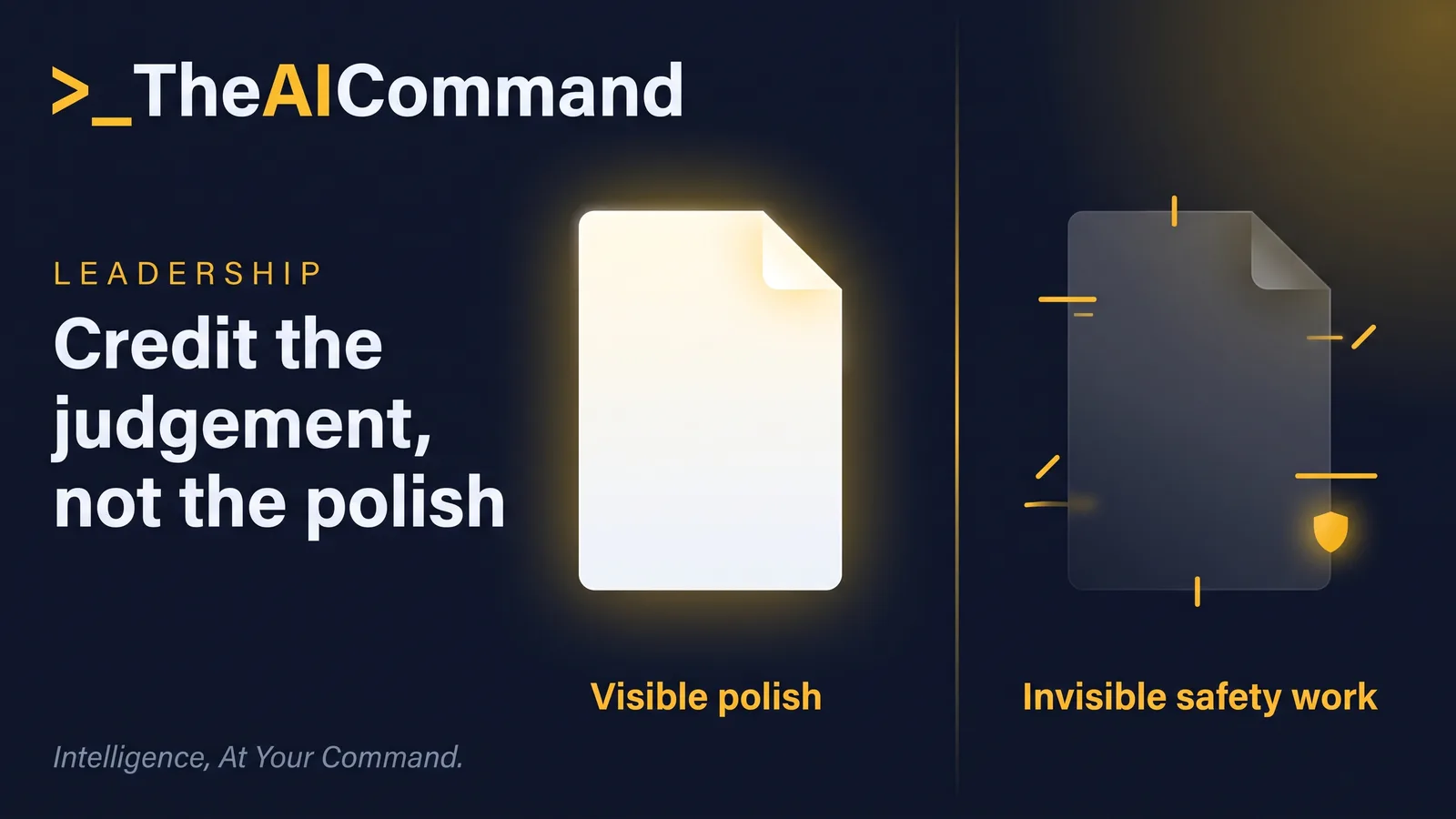
Yet the finished artefact hides that work. Everyone sees a polished brief. Few see that [ANALYST_NAME] rejected a false comparison, found the governing source and changed a confident answer into a conditional one.
Your recognition system needs a new unit. Credit the judgement-changing intervention: a verified human act that materially changes what the work claims, how certain it appears, who may act on it or whether it should proceed. Record those interventions in a small safety-edit ledger, then use them in handovers, team learning and recognition conversations.
What work disappeared inside the polished output?
AI can make surface quality a poor signal of contribution. Fluency, structure and formatting now arrive early. The difficult work moves into deciding which claim deserves belief, which source governs, which exception matters and where a professional must stop the workflow. That is interpretive work, and it is close cousin to the review burden we have called the AI review tax.
It often removes rather than adds. A risk specialist changes "the control is effective" to "the supplied sample supports operation during [TEST_PERIOD], subject to [EVIDENCE_GAP]". A claims leader removes an invented causal link. A compliance expert notices that a rule cited for one product has been applied to another. The page may become shorter while the contribution becomes larger. It is the same failure surface we mapped when the summary lost the caveat.
Recent peer-reviewed research gives this problem a useful shape. Leonardi and Leavell compared two western United States planning bodies using the same AI-supported simulation technology. They found that highly detailed representations could create an illusion that uncertain futures were definitively knowable. Experts at one site amplified the technology's apparent precision. Experts at the other moderated how outputs were presented and integrated, keeping uncertainty visible and preserving a role for interpretation (peer-reviewed comparative study).
The study was published online in February 2026, but it was a comparative field study of urban planning and simulation, not a trial of generative AI in Australian financial services. It does not establish that every polished output misleads. It shows why expert value can reside in calibrating what a representation appears to know, even when the technology produced most of its visible detail.
Recognition can be distorted in the other direction too. Four preregistered experiments reported in PNAS found that people expected and received a social evaluation penalty for AI assistance. In one study, employees described as receiving AI help were rated as lazier, less competent and less diligent than employees receiving equivalent non-AI help or no stated help. Other studies found that task fit and evaluators' own AI use affected the result (PNAS study).
Those experimental and hypothetical settings do not prove that your managers hold the same views. They do warn against credit by instinct. A leader can over-credit visible polish, penalise disclosed AI use, or praise the named drafter while missing the expert who made the work defensible.
How do you make invisible judgement visible?
Do not demand a diary of every prompt and edit. That creates administration, rewards narration skill and can turn tool traces into performance theatre. Capture only an intervention that changed a material claim, boundary or action.
Use a five-field safety-edit ledger attached to selected high-consequence artefacts:
- Before: the claim, assumption, omission or proposed action as it arrived for review.
- Intervention: what the human added, removed, reframed, verified or stopped.
- Basis: the source, policy, evidence, expertise or escalation that warranted the change.
- Effect: what changed for the reader, customer, decision owner or control.
- Credit: who exercised the judgement and who independently confirmed it.
The ledger should cover four kinds of contribution:
Use this prompt to find candidate interventions by comparing an AI-assisted draft with the human-reviewed version. A human reviewer must verify every difference against the underlying evidence, decide whether it was material and confirm attribution. AI must not award credit or assess performance.
Here is a fictional worked example. An AI-assisted briefing for [PRODUCT_NAME] stated that a proposed customer communication "meets all applicable requirements". [SUBJECT_MATTER_EXPERT] found that the source pack contained no evidence about [DISTRIBUTION_CHANNEL] and that approval remained with [ACCOUNTABLE_ROLE]. The expert changed the sentence to a scoped statement, inserted the missing evidence request and returned approval to the accountable person.
The finished briefing looks less confident. That is the point. The ledger records the original unsupported assurance, the expert's intervention, the policy and evidence basis, the prevented misstatement and the independent review by [REVIEWER_ROLE]. It does not claim that harm would certainly have occurred. It makes the real contribution discussable without inventing a counterfactual.
A CHI 2025 survey of 155 knowledge workers reinforces the need to define the unit of credit. Respondents assigned different credit depending on contribution type, amount and initiative, while assigning AI less credit than a human partner for equivalent contributions (IBM Research). The survey measured perceptions about attribution, not the quality or safety of actual workplace outputs. Its practical lesson is modest: "AI was used" is too coarse to explain contribution.
What should recognition change?
Recognition is not a decorative thank you. It signals which work the organisation values. If leaders celebrate output volume and presentation quality while expert corrections remain invisible, that signal favours what can be seen.
Use verified ledger entries at three moments. At handover, name the material human interventions beside the final artefact. At a monthly calibration, examine one de-identified entry and ask what made the issue detectable. In a development or recognition conversation, discuss the judgement demonstrated, the conditions that supported it and where that capability should be used again. Keep formal performance documentation on its own procedurally fair track.
Do not turn the ledger into a league table. One prevented error is not automatically more valuable than another, and absence of entries does not prove absence of expertise. Some work starts with better inputs. Some assignments carry fewer material uncertainties. Some people prevent problems upstream, before a draft exists. The ledger is evidence for a conversation, not a complete measure of contribution, and the habit it builds is the one we have argued for before: measure work improved, not prompts counted.
This prompt turns a human-verified entry into a concise contribution note. The manager must check the wording with the contributor, remove sensitive detail and decide how recognition fits the organisation's normal process. AI must not assign a rating, promotion or reward.
For banks, insurers and superannuation trustees regulated by APRA, this is also operationally relevant. APRA's April 2026 industry letter said regulated entities should establish ownership and accountability across the AI lifecycle, retain human involvement and accountability for high-risk decisions, and train staff on AI limitations and secure use (APRA). The letter states APRA's observations and supervisory expectations for regulated entities. It is not a universal recognition framework or a substitute for an entity's obligations and policies.
There is also a people-risk dimension. Safe Work Australia's guidance on managing the risks of digital technologies identifies psychosocial risks that may arise where there is a reduction of meaningful human feedback. Its guidance also notes that automation may leave people with more complex work or more output-review tasks (Safe Work Australia). Safe Work Australia develops model-law guidance, while the Commonwealth, states and territories regulate and enforce WHS laws. Check the applicable jurisdiction and obtain advice for your circumstances.
Use this checklist before recognising an intervention:
- Was the original issue material to a claim, action or human decision boundary?
- Is the intervention supported by an approved source or accountable expertise?
- Has a second person confirmed the description and attribution where consequences are high?
- Does the note describe what changed without claiming an unevidenced disaster was prevented?
- Can the contribution be shared without exposing personal, customer, security or privileged information?
- Does the recognition reinforce a repeatable capability, not prompt volume or visible busyness?
Do this Monday
- Choose one artefact class. Start with a recurring, reviewable item such as a control brief, policy comparison or customer-communication recommendation. Do not log every email or low-consequence draft.
- Publish the five fields. Give the team the Before, Intervention, Basis, Effect and Credit template. Explain that the unit is a material judgement-changing intervention, not number of edits.
- Run one retrospective. Select a completed, de-identified artefact and reconstruct up to three verified safety edits with the people who did the work. Keep uncertainty where the effect cannot be proved.
- Name the contribution at handover. Add a short human contribution note to the artefact or review record, subject to information-handling requirements and the contributor's confirmation.
- Review the pattern after four weeks. Ask whether the ledger reveals a training need, a recurring weak input or a capability worth spreading, before quiet deskilling erodes the reps that built it. Do not rank people by entry count.
Bottom line
When AI makes polish cheap, expert value moves into the interventions that keep the work true, conditional and properly owned. Make those interventions visible with a small, verified safety-edit ledger. Credit the human judgement, not the volume of generated text or the drama of a hypothetical harm. The finished page should show less certainty when the evidence supports less certainty.
This article is general information and education only. It is not legal, compliance, financial or professional advice. Obligations vary by organisation and circumstance. Verify current requirements against the primary sources cited and seek advice specific to your situation.
References
- Paul M. Leonardi and Virginia Leavell, "Knowing Enough to Be Dangerous: The Problem of 'Artificial Certainty' for Expert Authority When Using AI for Decision Making and Planning", Organization Science, vol. 37, no. 2, 2026, published online February 2026. https://pubsonline.informs.org/doi/10.1287/orsc.2023.18224
- Jessica A. Reif, Richard P. Larrick and Jack B. Soll, "Evidence of a social evaluation penalty for using AI", PNAS. https://doi.org/10.1073/pnas.2426766122 (published 8 May 2025).
- "Which Contributions Deserve Credit? Perceptions of Attribution in Human-AI Co-Creation", Jessica He, Stephanie Houde and Justin D. Weisz, CHI 2025. https://research.ibm.com/publications/which-contributions-deserve-credit-perceptions-of-attribution-in-human-ai-co-creation
- Australian Prudential Regulation Authority, "APRA Letter to Industry on Artificial Intelligence", 30 April 2026. https://www.apra.gov.au/news-and-publications/apra-letter-industry-artificial-intelligence-ai
- Safe Work Australia, "Artificial intelligence (AI) and digital technologies - Managing risks", accessed 31 July 2026. https://www.safeworkaustralia.gov.au/safety-topic/hazards/digital-technologies-ai/managing-risks
TheAICommand. Intelligence, At Your Command.