
A job title does not explain what must happen on Wednesday
The handover says that the finance officer will cover the operations coordinator. On Wednesday, a payment batch needs releasing. The finance officer can prepare it but has no release authority. A supplier confirmation is also overdue, and the status note cannot be completed without it. The handover named a substitute while leaving the work unresolved.
A task-based cover plan makes those distinctions visible before the absence begins. It records what must continue, when it is due and what the temporary owner can actually do. It also identifies work that must wait or needs an escalation. Assigning a name to every row is not the same as establishing workable cover.
AI can help organise the source information and challenge omissions. It can compare a task list with the supplied roster and flag missing authority or dependencies. It cannot establish someone's capacity from a job title, infer an absence reason or create a delegation. Those facts need confirmation through the organisation's normal process.
The worked example is a fictional private-sector service team. It uses five roles and ten tasks, with one deliberately uncovered approval and one external dependency. The assignments are constructed for teaching, not a tested staffing recommendation. No real employee records or leave circumstances are used.
Keep the leave decision and the continuity task distinct
A cover exercise answers how the work can continue during an agreed absence. It does not decide an employee's entitlement or, for annual leave, whether refusing the request would be reasonable. Begin with the absence period supplied by the authorised person, then identify the work and decisions that need attention. Do not ask the model to assess whether someone deserves time away.
For employers and employees in the national workplace relations system, Fair Work Ombudsman guidance explains that the process for requesting annual leave is often set out in an award or registered agreement, company policy or contract of employment. The national system covers most Australian workplaces, but many state public sector employers are covered by a state system instead. Check the relevant coverage and arrangements through the responsible people. The task matrix is an operational aid, not an interpretation of every employment instrument or a basis for a model-generated leave decision. Source: Fair Work Ombudsman
Use the minimum information needed to plan the work. A role being unavailable for a defined period may be sufficient. Medical details, caring responsibilities or other private explanations generally add nothing to a task-dependency exercise. Keep them outside the demonstration pack and follow the organisation's information-handling rules for any real process.
Do not equate a roster entry with consent to additional duties. A proposed substitute may lack time, access or relevant experience even when the task appears related to their usual work. The manager needs a conversation and confirmation. A model's assignment is an item for review, not a new employment instruction.
Describe the work at the level someone can take over
Start with a finite task list for the cover period. Replace broad descriptions such as manage operations with activities a temporary owner can recognise. Checking an intake queue each morning, preparing a payment batch and issuing an internal status note are different tasks with different dependencies and authority requirements.
For each task, identify the deadline or frequency, the input needed and the expected output. Include where the work is recorded and the role that accepts it. A substitute should be able to tell when a task is ready to start and what completion looks like without reconstructing the absent colleague's private working habits.
Capture decision boundaries explicitly. Someone may draft a response but need approval before sending it. They may check a pack without accepting its substantive conclusions. They may follow up a supplier without being authorised to change a contract. Keep these verbs in the source list so the model cannot flatten them into a generic owner field.
Mark dependencies by task ID where possible. If the weekly pack uses the status note, which depends on a supplier response, that chain should remain visible. A deadline can be realistic only when the necessary input is available. If the dates conflict, the plan needs a decision rather than a more confident paragraph.
Build the five-role roster
The constructed team contains a service manager, operations coordinator, finance officer, customer liaison and quality reviewer. The operations coordinator is unavailable from 9 to 13 November 2026. The other roles have supplied boundaries for the listed work, but their spare capacity has not been quantified. That limit stays visible in the example.
The service manager can resolve priorities and review the handback. The finance officer can prepare the payment batch but cannot release it under the supplied rules. The customer liaison can perform intake and communication tasks. The quality reviewer can maintain the evidence register and check the weekly pack. These permissions apply only to the fictional exercise.
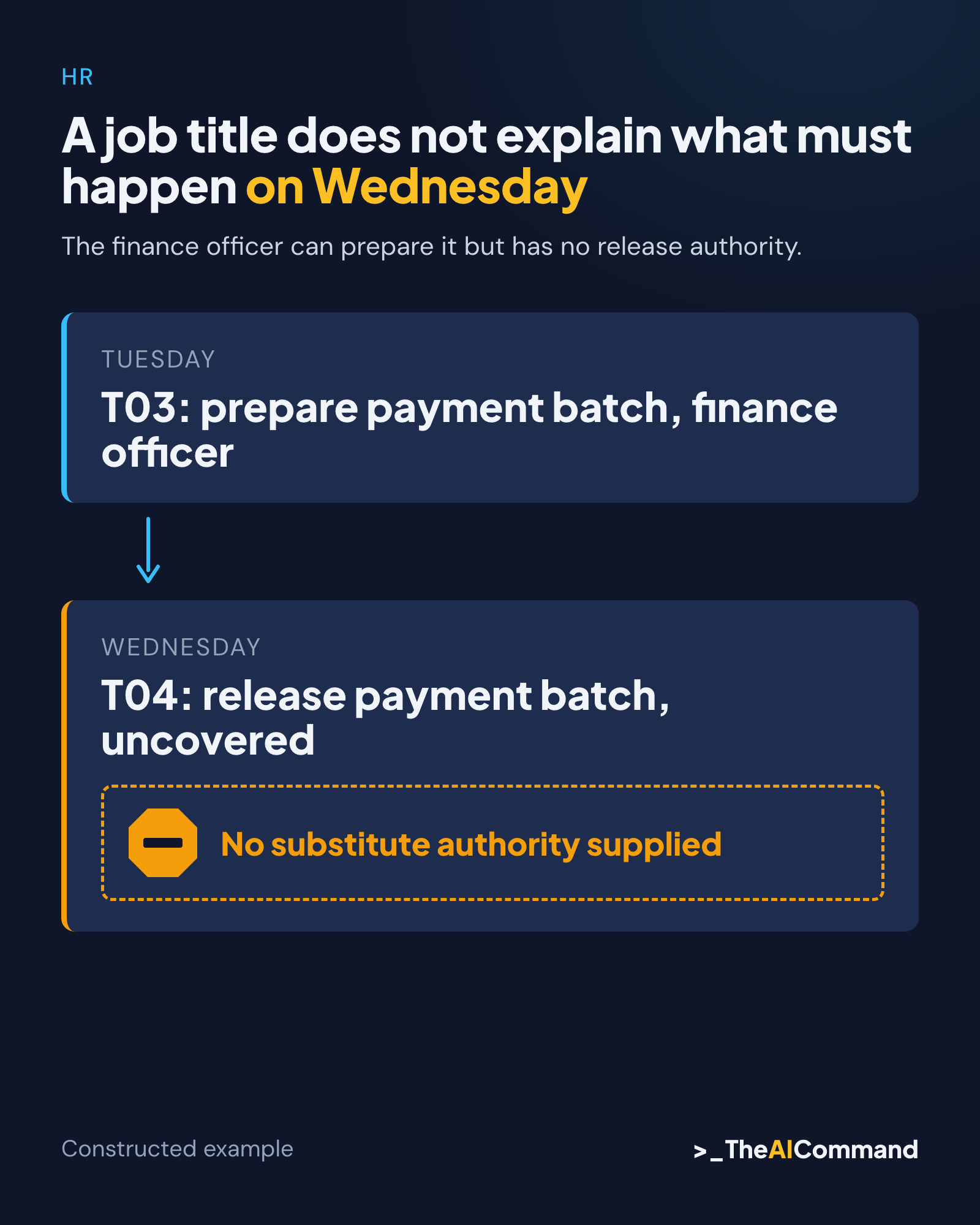
The source pack contains no authorised substitute for payment release. Do not infer that the service manager automatically holds that authority. A senior title is not a delegation record. The plan must ask the responsible manager to obtain a valid arrangement or choose another authorised course of action.
Keep the roster separate from the task register. One records the roles and their stated availability; the other records what must happen. A third, short authority note connects the permitted actions to the roles. This separation helps a reviewer identify whether an assignment rests on actual source information or the model's assumption.
Walk through the ten tasks
T01 is the daily intake check. T02 updates the equipment schedule on Monday. The source rules permit the customer liaison to cover both, subject to workload confirmation. The proposed plan retains that condition rather than treating the existence of a permitted substitute as proof that the person can absorb every task.
T03 prepares the payment batch on Tuesday, using approved invoices. The finance officer is the proposed cover. T04 releases that batch on Wednesday. It remains uncovered. Placing the two tasks next to each other shows why a plan that assigns finance work as one block would conceal an important boundary.
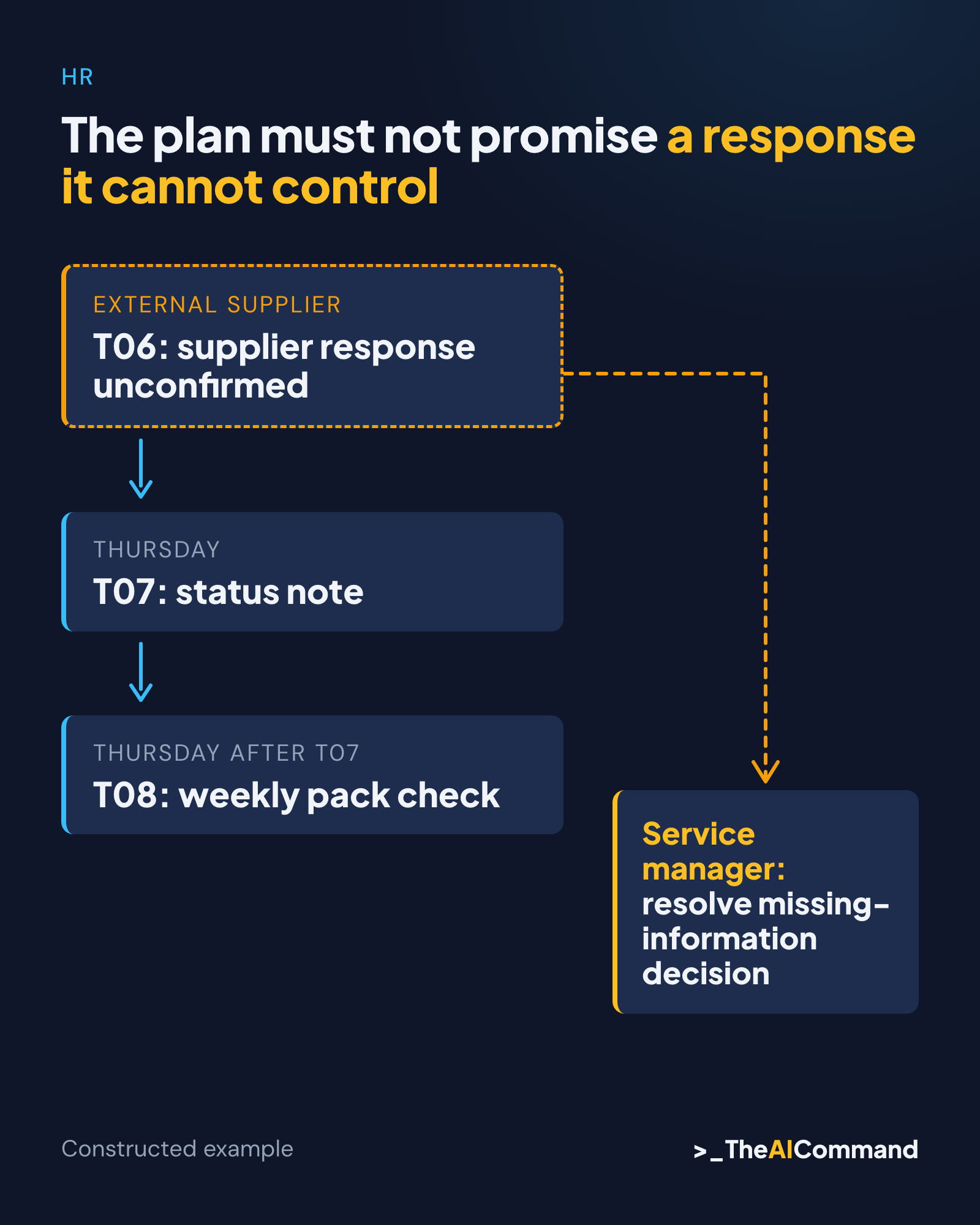
T05 updates the evidence register on Tuesday and is proposed to the quality reviewer. T06 seeks supplier status by Wednesday and is proposed to the customer liaison for follow-up. The supplier controls the response. A follow-up task can be assigned internally, but the plan cannot promise the external information will arrive on time.
T07 drafts an internal status note for Thursday, using the supplier information if available. It must identify an outstanding response if T06 is unresolved. T08 checks the weekly pack later that day and depends on T05 and T07. The quality reviewer can check the supplied pack, while the manager resolves any decision about missing information.
T09 drafts a procedure-change note on Friday, with service-manager review. T10 reconciles the handback log on Friday using updates from all cover roles. These closing tasks matter because temporary work can otherwise return as a collection of messages with no clear account of what changed during the absence.
The illustrative output therefore contains ten rows, one uncovered approval and an explicitly unconfirmed external dependency. It is useful because it preserves the problem the team must resolve. A fully populated matrix that invents release authority or a supplier response would be less complete in the practical sense, despite looking tidier.
Ask AI to find the gaps before writing the handover
Supply the roster, ten-task register and authority note with clear versions. Ask the model to return exactly one row per task ID. Require the proposed owner, due point, dependency, source authority and unresolved question. Then ask for a separate gap list, so important exceptions are visible without reading the entire matrix.
State what the model must not infer. Availability cannot be derived from presence in the roster. Authority cannot be derived from seniority. Capacity cannot be derived from the number of tasks assigned. An external response cannot be assumed because it is needed. These constraints are simple enough to check against the example output.
Ask for a draft communication only after the gaps have been reviewed. Otherwise, the model may turn a provisional matrix into an apparently final instruction to colleagues. The handover note should retain conditions and identify who confirms the plan. Sending it is a separate action through the organisation's approved process.
Use only information approved for the chosen tool. The OAIC's guidance on commercial AI products raises questions about information access and product settings. In this exercise, role labels and invented tasks avoid a need for real employee information. A later operational use requires its own assessment. Source: OAIC
Review capacity, access and escalation with people
A task count does not measure workload. A five-minute intake check and a complex supplier issue each occupy one row. Ask the proposed owners to assess the work using the information they need, including expected volume and competing responsibilities. Where those inputs are missing, retain the capacity question rather than inventing an estimate.
Confirm access before relying on an assignment. A person may understand the task but lack access to the required register or system. Do not share credentials as a shortcut. Any necessary access follows the organisation's approved process and scope. Record whether it has been established rather than assuming it will be available on the first day.
Define what happens when a deadline or dependency fails. In the example, an unanswered supplier follow-up affects the status note and pack. The service manager needs a clear escalation point and enough time to decide how the missing information will be represented. Repeated reminders alone do not resolve the decision.
For the uncovered payment release, the manager confirms the authorised route before the due point. The outcome might involve an existing alternate process or a documented temporary arrangement. The model cannot choose it from general practice. The plan records the question, its owner and the time by which an answer is needed.
Keep temporary cover current during the absence
Use one agreed place to record task status and significant changes. A substitute who completes a task should record the output reference and any unresolved issue. Avoid marking work complete merely because a draft exists. The receiving role needs to know whether it was prepared, reviewed, approved or sent.
If a new task appears during the week, give it an identifier and assess its authority and dependencies before assigning it. Do not silently insert it into the existing plan as though it had been reviewed with the original ten. The change record explains what was added and who confirmed the arrangement.
When the supplier responds, record the actual response time and source. Update the status note accordingly. If the reply introduces a new issue, preserve it rather than presenting the dependency as simply closed. Completion of the follow-up task and resolution of the underlying supplier matter may be different states.
Keep uncertainty visible in any AI-assisted status summary. A concise update can help the manager, but it must retain material gaps and cite the task register. Check it against the current records before sharing. A summary generated from yesterday's source pack can misstate today's cover even when every sentence sounds reasonable.
Plan the return as carefully as the departure
The handback needs to identify completed work, decisions made, pending items and changed deadlines. Include references to the actual outputs so the returning role can continue without asking each substitute to reconstruct the week. T10 exists in the example to make this a deliberate task rather than an informal final message.
Review temporary responsibilities after the absence ends. Record which arrangements have expired and which follow-up work remains with a cover role. A temporary authority must not become an assumed permanent responsibility through repeated reuse of an old matrix. The next absence starts with current information and a fresh confirmation.
Use what the exercise revealed to improve task documentation. If a single uncovered approval caused the main difficulty, resolve that continuity issue through the appropriate governance process. Do not generalise from one week into a broad judgement about an employee's performance or the team's staffing needs.
Begin with ten tasks and the facts the team can confirm. Let AI expose the gaps, then have people settle capacity, access and decision authority. A workable cover plan tells colleagues what they can do, what must wait and where to take the unresolved question.
Reusable materials
Leave-cover matrix and gap-finding pack
Constructed private-sector example, 9 to 13 November 2026. No actual employee information, model run, delegation or workload assessment.
Five-role roster
Ten-task proposed cover matrix
Gap list
Prompt
Handback template
Human review
- Confirm all five roles and ten tasks, including the uncovered approval.
- Confirm capacity, access and authority through the proper process.
- Set an escalation for the supplier dependency and dependent work.
- Reconcile the handback and expiry of temporary arrangements.
Related reading
References
- Fair Work Ombudsman, Taking annual leave, content last updated 10 August 2026: https://www.fairwork.gov.au/leave/annual-leave/taking-annual-leave
- Fair Work Ombudsman, The Fair Work system, content last updated 28 October 2026: https://www.fairwork.gov.au/about-us/workplace-laws/fair-work-system
- Office of the Australian Information Commissioner, Guidance on privacy and the use of commercially available AI products, published 21 October 2024 and updated 17 January 2025: https://www.oaic.gov.au/privacy/privacy-guidance-for-organisations-and-government-agencies/guidance-on-privacy-and-the-use-of-commercially-available-ai-products
TheAICommand. Intelligence, At Your Command.