
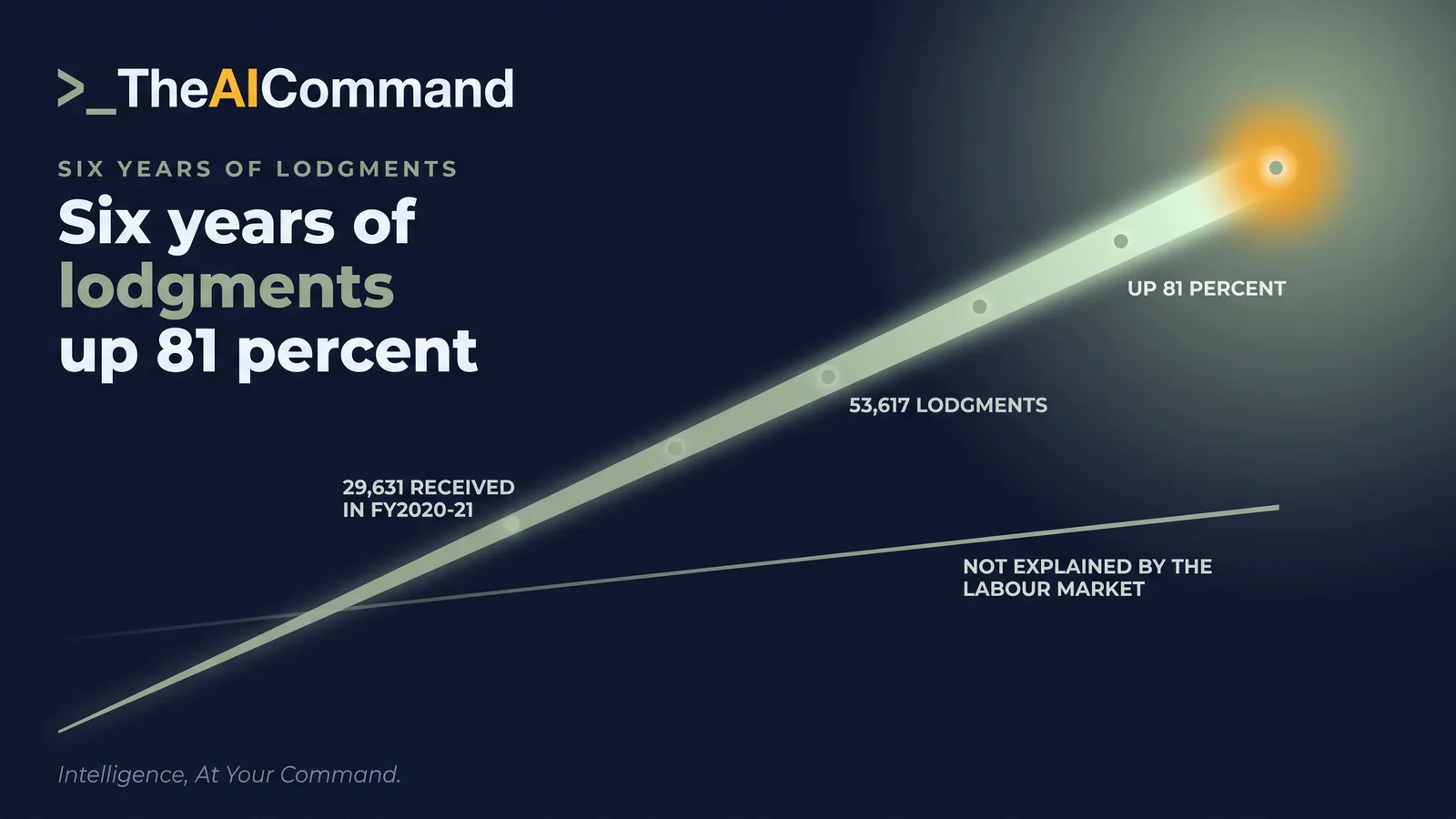
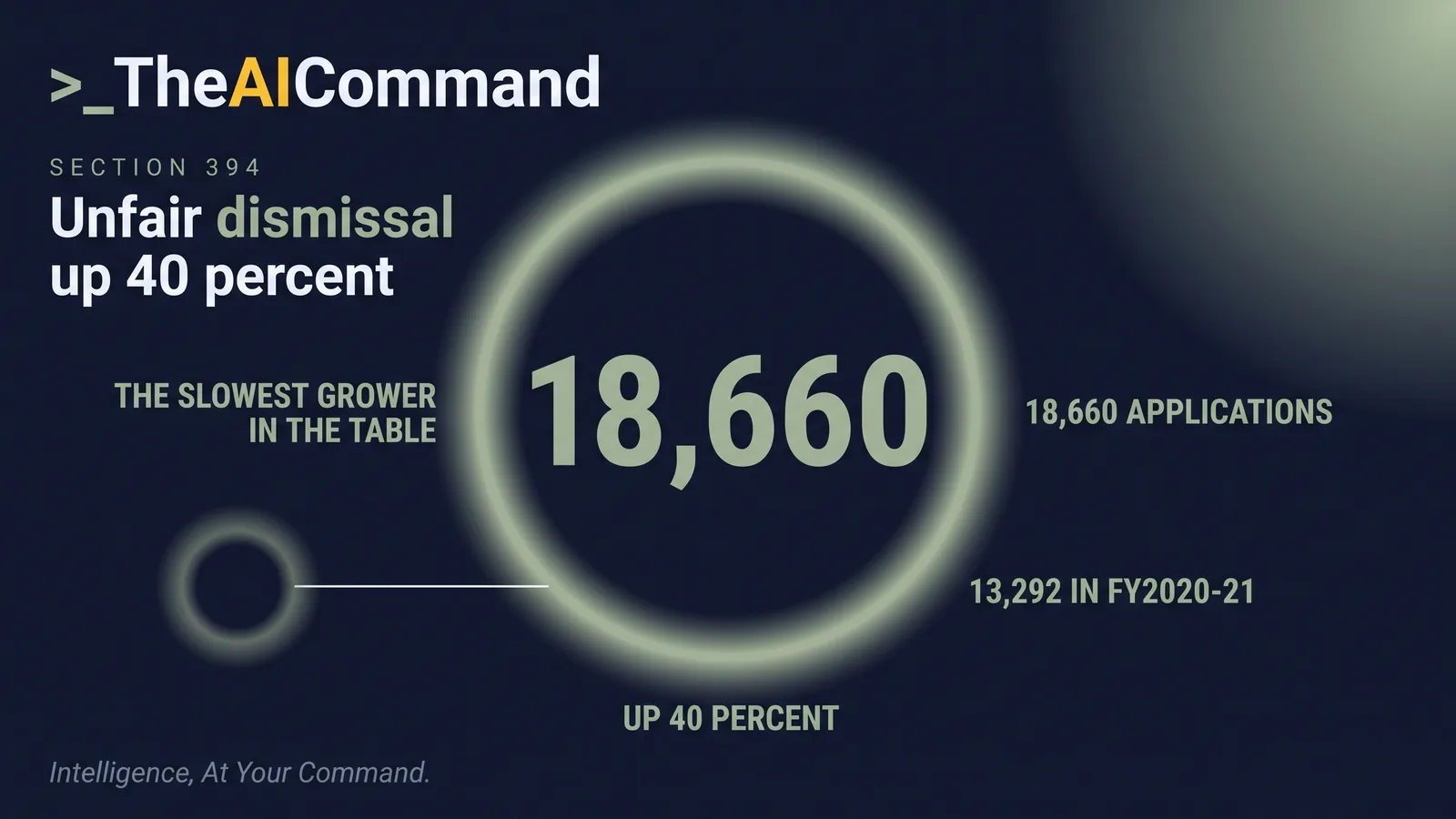
Unfair dismissal lodgments are up forty percent. The comparison is the Fair Work Commission's own and it is not a forecast: 18,660 applications under section 394 of the Fair Work Act 2009 (Cth) in FY2025-26, against 13,292 in FY2020-21, an increase of 40 percent. Across every matter type the Commission received 53,617 lodgments in the same year. From 20 October 2026, the day after this article publishes, the Commission's AI requirements apply to all Commission matters, and the modified forms carrying the disclosure field take effect the same day across individual rights matters. An applicant discloses whether generative artificial intelligence (AI) was used, and declares the document has been checked.
Two consequences follow for an employer, and both are budgetary before they are legal. A dispute provision built on FY2023-24 volumes is understated against the Commission's own published growth rates. And every application lodged from 20 October carries a dated, structured signal about how it was built, worth designing the first hour of the response around, although it reaches the desk on a lag.
This is general information and education, not legal advice.
The dataset, named, dated and quoted
The figures come from a presentation by the President of the Fair Work Commission, Justice Adam Hatcher, to the Australian Industry Group PIR Conference in Canberra on 8 September 2026, published as Maintaining focus in an age of disruption. The President states that "in FY 2025-26, the number of applications before the Commission reached a new record of well over 53,000". The chart behind that sentence puts the total at 53,617.
Six financial years of data, and an increase of 81 percent on FY2020-21. The Commission's own Annual Report 2024-25, transmitted on 30 September 2025, records the FY2024-25 total of 44,075 as a 10 percent increase on the 40,193 applications received in FY2023-24, correcting its own earlier FY2023-24 total of 40,190. The September 2026 chart still carries the pre-correction figure, so 40,193 is the one to quote in a board paper.
The series does not track a downturn, and the President is explicit that the labour market does not explain the growth.
Where does the growth actually sit?
The headline is 53,617. The distribution is what changes a decision.
The change column is cumulative across the five years between those two columns. The annual equivalent is the compound rate implied by the same two counts, and it is what a 12 month projection uses. The category in the title is the slowest grower in the table.
The general protections path is harder to exit early. Under the Fair Work Act 2009 (Cth), Compilation No. 73 of 7 July 2026, section 368(1A) provides that "the FWC is not required to determine whether or not the person was dismissed" before dealing with the dispute. A respondent who expected a threshold argument about whether a dismissal occurred will not necessarily get one before conciliation.
The outcome data cuts the other way. On the President's September figures, about 62 percent of general protections matters were resolved by the Commission in 2025-26, and about 17 percent of all applicants ever proceed to Court.
Is artificial intelligence really the cause?
The Commission says it is the principal driver. That is an inference, not a finding from a controlled study, and the distinction is worth preserving when the number is repeated internally.
The President's statement on the use of AI in Fair Work Commission proceedings of 24 August 2026 puts applicant use at approximately 40 percent of surveyed applicants who reported using AI to prepare or manage a case. The underlying research is the Pivot Research Report: GenAI use research, published by the Commission on 24 August 2026 and built on 18 semi-structured interviews and surveys of 408 applicants and 211 respondents.
Four findings from that report are load-bearing for an employer.
- Tool concentration. The report states that "ChatGPT was the most frequently used GenAI, reported by approximately 77% of the GenAI-using applicants in the survey", with about 60 percent of those users on the free tier.
- Who uses it. Use concentrates among self-represented applicants, those under 45, and applicants in professional and managerial roles. Applicants whose first language is not English were about twice as likely to use it.
- A spectrum, not a class. The report separates assisted users from dependent users. The risk of an inflated or poorly grounded case concentrates at the dependent end, not across the whole 40 percent.
- Expectation setting. Dependent users arrive anchored on remedy figures produced by the model rather than on conciliated outcomes, which makes early settlement conversations harder.
The President's statement offers three mechanisms for the volume effect: the tools redirect applicants who are ineligible for unfair dismissal into the general protections jurisdiction, they lower the administrative, cognitive and emotional barriers that used to stop a person lodging, and they reduce the uncertainty around the decision to apply by supplying a procedural roadmap and an assessment of prospects. The report itself carries the caveat that the precise scale of the volume effect needs further research.
One limit travels with the numbers: the 40 percent is a survey figure from 408 applicants, not a census of lodgments. The Commission says these tools can improve access to justice, which is not the same story as a wave of meritless claims.
What changes on 20 October 2026?
The guidance note on the use of generative artificial intelligence in Commission cases, published 24 August 2026, states that "This Guidance Note commences on 20 October 2026." The Commission's Using GenAI in your case page says the same. On 19 October 2026 that commencement is one day away, and the field reaches employers on a lag, because a claim lodged before 20 October arrives on the unmodified form.
The guidance note sets three requirements and they are short. Generative AI use, and how it was used, is stated in the document. The document is checked, and the person filing states in it that the check was done. Where the document is a witness statement or declaration, the witness states it is in their own words and on their own knowledge, and declares it true to the best of their knowledge. Use limited to spelling, grammar and formatting does not attract the disclosure requirement. Non-compliance is not costless: the guidance note contemplates the material being given less weight, costs consequences, and dismissal of the application.
A separate instruction at paragraph 14 reaches both sides. The Commission says users should not put personal or confidential case information, including personal information about another person involved in the case, into a public tool. An employer running an AI-assisted response is inside the same instruction. That is why every worked example below uses placeholders, and why the de-identification step is cited to the Commission rather than asserted as preference.
The requirements are not one sided. An employer who uses generative AI to prepare a Form F3 or any other lodged document states in it that generative AI was used and how, and that the document has been checked.
What the surge has done to the Commission's capacity
The Commission finalised 50,139 matters in FY2025-26, a clearance rate of 94 percent. The Annual Report 2024-25 records 43,053 finalisations and a 98 percent clearance rate the year before. Four points of clearance across more than 50,000 matters is a growing tail, and it shows up directly: matters on hand allocated to Members were up 75 percent on the same time a year earlier, on the President's 8 September 2026 figures, an increase of 1,611, and matters allocated to staff were up 127 percent, an increase of 3,115. The median age of matters on hand moved from 28 days at 1 July 2025 to 39 days at 1 July 2026.
Funding has not moved with the volume. The President's September table records operating revenue from government of $111.036m in 2024-25, $109.560m in 2025-26 and an estimated $110.075m in 2026-27, the out years published as estimates. In his 18 February 2026 presentation to the Victorian Bar Association the President reported that the Commission had fallen below its 90 percent benchmark for the first time in many years, with 85 percent of reserved decisions issued within 12 weeks year to date.
The practitioner consequence is narrow. Assume a longer average open period per matter than the last internal model used, and that a claim filed near the end of a financial year is resolved in the next one.
Re-baselining the dispute provision
Three published figures size the exposure, each indexed on 1 July for the year the dismissal occurred.
- The compensation cap is $95,050 for a dismissal that occurred on or after 1 July 2026, as at 26 September 2026. That figure is the upper bound: under sections 392(5) and (6) the cap is the lesser of it and 26 weeks of the employee's remuneration.
- The same cap is $91,550 for a dismissal that occurred on or after 1 July 2025 and before 1 July 2026, as at 26 September 2026. An earlier dismissal carries the cap indexed for its own year.
- The high income threshold is $190,100, applying from 1 July 2026, as at 26 September 2026, which limits eligibility only for employees not covered by a modern award and to whom no enterprise agreement applies.
Any provision built on a prior year figure understates the per-claim ceiling before volume is considered.
The cap is a ceiling, not an expectation. The Commission publishes no distribution of compensation amounts, so the cap sits at the top of the range, not in the middle of it. Multiplying expected claim volume by the cap produces a number no finance team will accept. Applying the published growth rates to the organisation's own three year history, with the cap stated separately as the tail, produces a range that survives challenge.
TheAICommand works to the Verified Draft Method: de-identify the inputs, ground the model in your own source material, keep a person at the decision point, verify against the primary source, and log what happened.
De-identification is a step, not a placeholder. Before anything is attached, strip every name, address, date of birth, contact detail and site name, replace each person with a token such as [EMPLOYEE_ID], and keep the key offline in the case system. Run these prompts in a private or enterprise instance where inputs are not used for training, never in a public consumer tool.
What to check: confirm every input figure in the output appears either in the attached extract or in the prompt, and that the only new numbers are the projected low and high, each reproducible from an input figure and a stated rate. Reject the output if any other number has appeared. Check that the assumptions list is separate from the range rather than embedded in it, and that the model has not quietly applied the unfair dismissal rate to a general protections row. Confirm every application type in the attached history appears in the output, including any held flat as unrated. Check the counts and the cumulative percentages against Table 1 of the presentation, which publishes both, and re-derive the annual equivalents, which are this article's calculation and not the Commission's.
How does the disclosure field change the response workflow?
The response clock is short and fixed. An applicant has 21 days after the dismissal took effect to file under section 394(2) of the Fair Work Act, and 21 days under section 366(1) for a general protections dismissal dispute, with a further period only where the Commission is satisfied there are exceptional circumstances, under section 394(3) and section 366(2) respectively. On the Commission's employer guidance for responding to an unfair dismissal claim, a response is asked for within seven days of the Commission notifying the employer, on Form F3, as at 26 September 2026. That page links the Form F3 page, which carries the content list, so copy it into the second prompt below as the checklist item 2 works against.
Seven days is the capacity constraint, not the hearing date.
From 20 October 2026 the disclosure field sits on the front of that process. Read it and record it before the Form F3 is drafted, because it tells the responder whether the application was assembled with a tool, and the research says a dependent user is more likely to arrive anchored on a remedy figure the model produced rather than on conciliated outcomes.
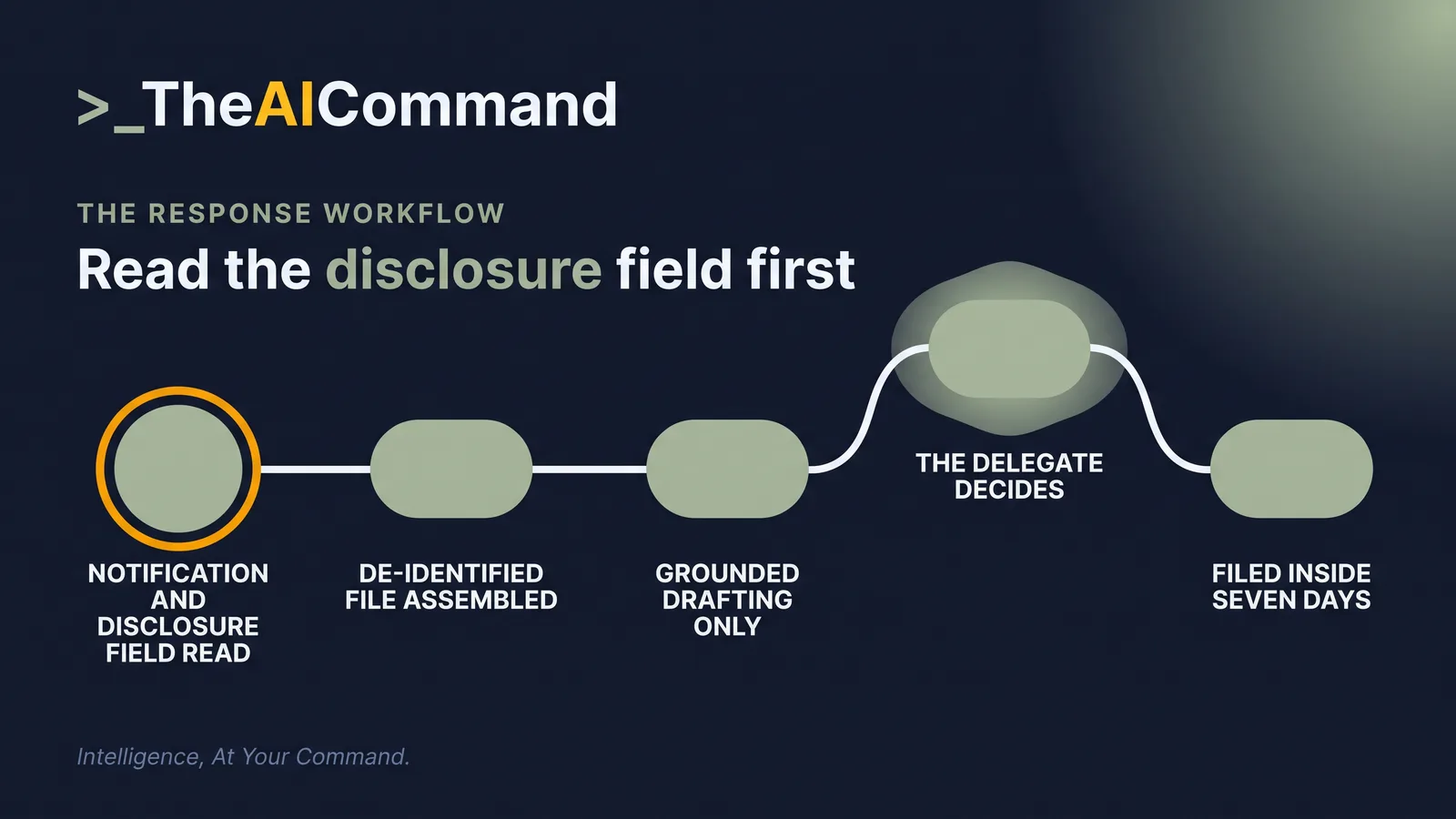
What to check: open the attached file and confirm each chronology row against the document and page cited, because an uncited row is a fabricated one. Confirm the MISSING list is genuinely missing rather than present and overlooked. Confirm no name or identifier has entered the output that was not in the de-identified file, and that the delegate, not the model, writes the position.
The third prompt is the employer-side counterpart to the set-up prompts the Commission publishes for applicants on its GenAI page.
What to check: verify that each of the three points is anchored to a document in the file and not to a general proposition about dismissals. Treat every NONE as a task with an owner and a due date before the seven day window closes, and keep the output internal, because it is a candid assessment of the organisation's own evidence.
Do this Monday
Build a one-page Dispute Exposure Re-baseline. The owner is the HR Manager or the Employee Relations lead, whichever holds the provision conversation with finance.
- De-identify before anything is attached to a model, as set out above, and keep the key offline in the case system.
- Pull the last three financial years of the organisation's own dismissal and dispute counts, by application type, de-identified to [EMPLOYEE_ID]. Fifteen minutes if the data sits in a case system, an hour if it does not.
- Build the range from the annual equivalents in this article, not the cumulative rates. Low case: that application type's three year average held flat. High case: its most recent full year uplifted once by its annual rate. Write the assumptions beside the range.
- State the per-claim ceiling separately, on the lesser-of test above, so the ceiling is stated per claim rather than as one figure for all. The cap is an unfair dismissal remedy limit and does not cap a general protections outcome, so the section 365 and section 372 rows carry no published ceiling and are stated as a separate, uncapped line.
- Name a primary and a backup, by role, for every week of the next quarter. Then size it: average the hours one Form F3 response took across the last three, multiply by the section 394 high case from step 3 divided by 52, and compare that to the hours the named primaries have free in one seven day window. If the free hours are fewer, the roster is short by the difference, and that weekly gap goes to the manager. Size the section 365 and section 372 load separately on the same basis, because those rows grow faster.
- Add one row for the AI disclosure field: who reads it, where it is recorded, and what changes when it is marked yes. On this article's sources, three things change. The stress-test prompt is run against the file before the Form F3 is drafted. The conciliation attendee is briefed on the published cap and the Commission's resolution rate, so the expectation gap is handled at conciliation rather than at hearing. The disclosure is recorded in the matter file, so the pattern can be read at the next re-baseline.
The check that proves it worked has two halves. Within five days, the range and its assumptions go to the finance contact who owns the provision, and every assumption survives being read back without a figure changing. Then, for the first claim received that carries the disclosure field, the field is read and recorded before the Form F3 response is drafted, and the response is filed inside the seven days. If either half fails, the artefact is decorative.
The bottom line
The Commission has published its own count of the surge and its own explanation for it, and both are quotable: 53,617 lodgments in FY2025-26, up 81 percent on FY2020-21, with section 394 unfair dismissal up 40 percent and section 372 general protections disputes up 151 percent. The causal claim is the Commission's inference, the 40 percent AI use figure is a survey of 408 applicants, and neither is a finding that applicants are filing meritless claims. What is certain is the arithmetic and the date: a provision built on FY2023-24 volumes is understated, and every individual rights application filed from 20 October 2026 carries a disclosure field that an employer can read on day one. Build the re-baseline first. Then build the roster.
TheAICommand. Intelligence, At Your Command.