
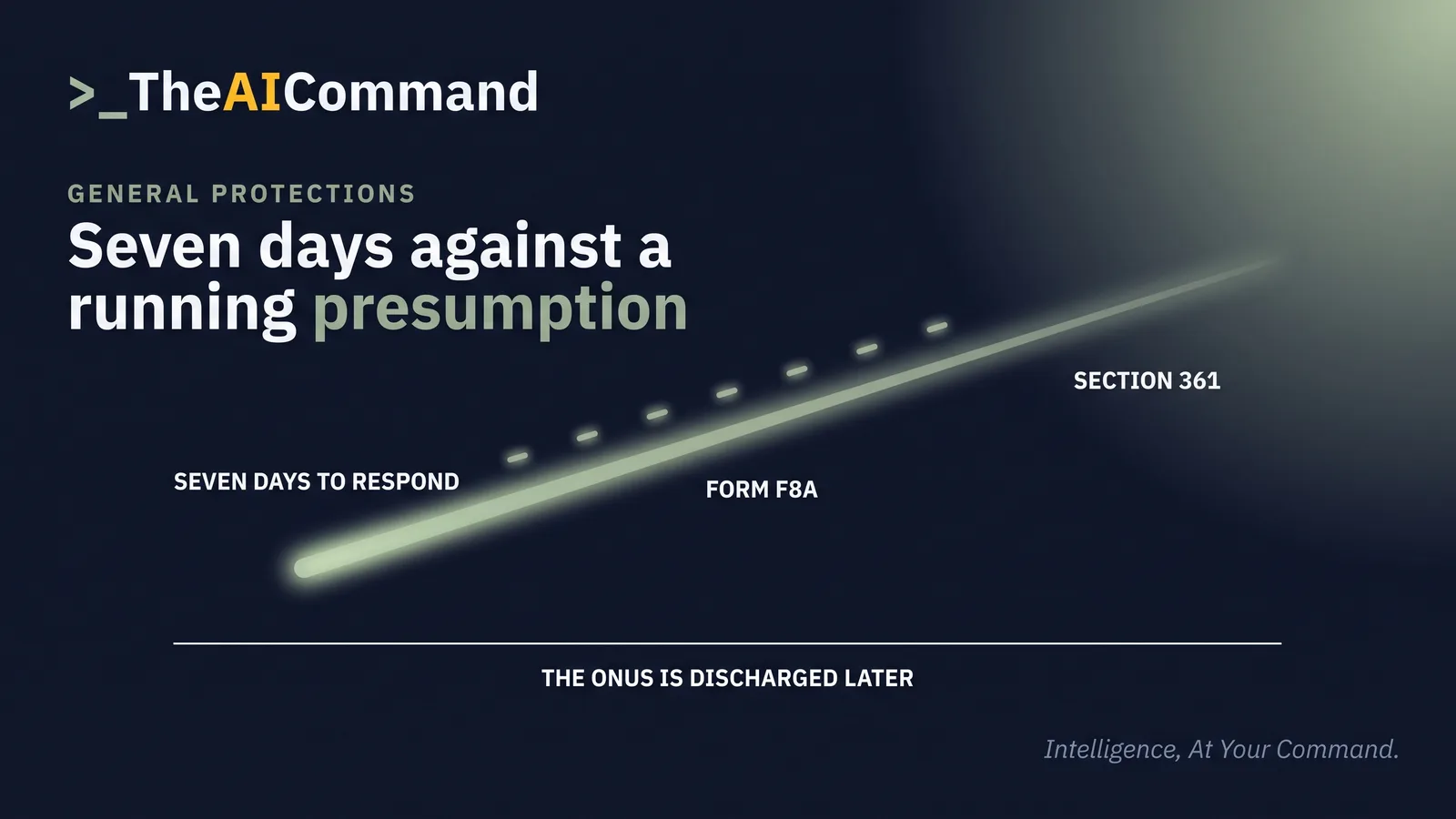
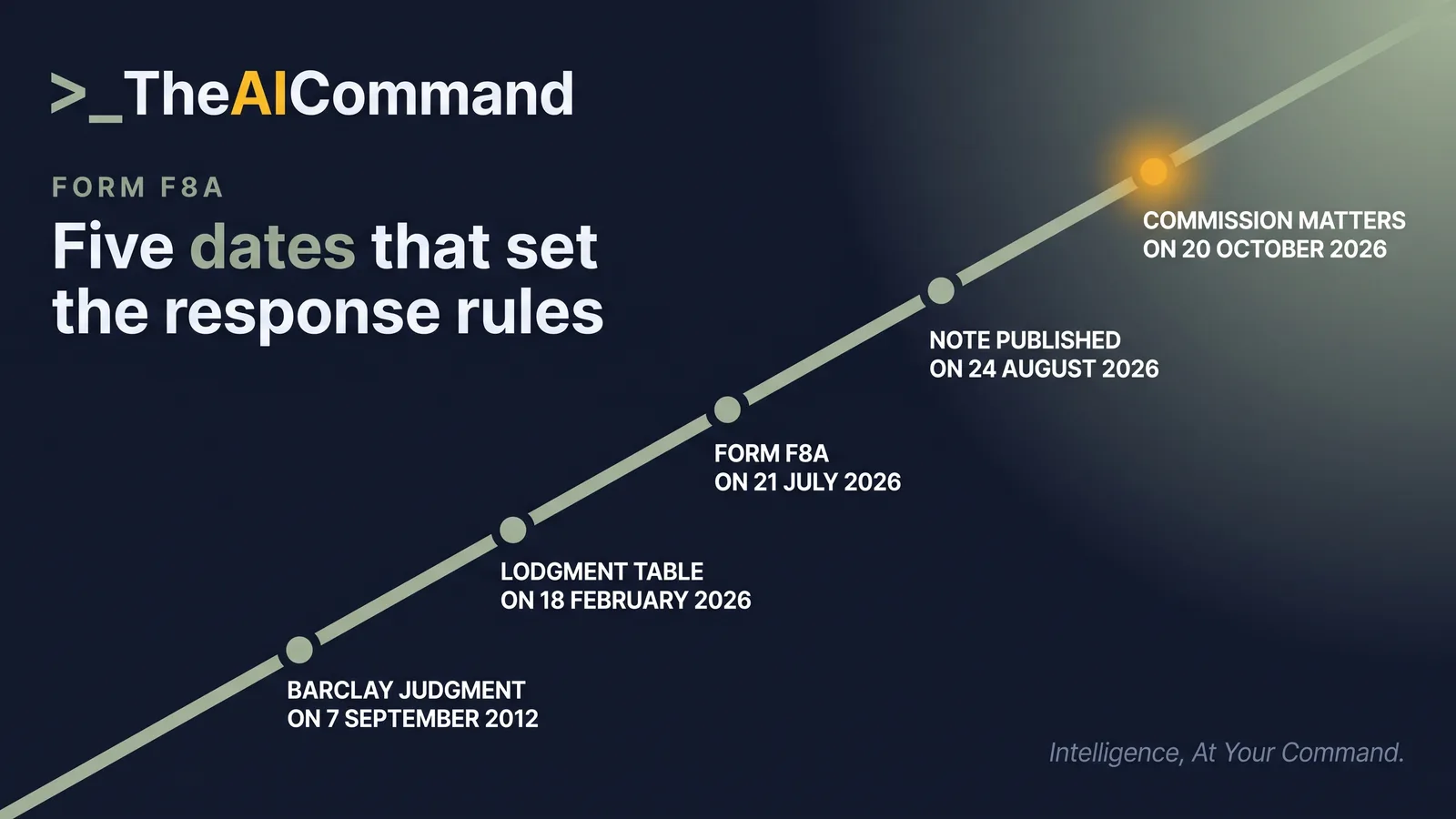
Seven days to answer. That is the window the Fair Work Commission allows an employer served with a general protections dismissal application, and as at 24 September 2026 the Commission's Form F8A page states it: "You must respond within 7 days using Form F8A."
The clock is not the hard part. The hard part is section 361 of the Fair Work Act 2009 (Cth), which starts the matter with the applicant's version of the reason already presumed true.
What the seven days are actually for
The Federal Register of Legislation compilation of the Fair Work Act 2009 (Compilation No. 73, compilation date 7 July 2026) puts subsection 361(1) this way: where an application alleges that a person took action for a particular reason or with a particular intent, and taking that action for that reason or with that intent would contravene Part 3-1, "it is presumed that the action was, or is being, taken for that reason or with that intent, unless the person proves otherwise".
That single sentence reshapes the task. The employer is not answering a claim. The employer is discharging an onus, although not inside the seven days. The Commission's Form F8A page sets out what follows the response: a conference, then a certificate if the sides cannot agree, and then the applicant's choice to take the case to a federal court. The presumption falls to be proved there, not in the response. A well written response that asserts a lawful reason, without evidence behind it, leaves it exactly where it started.
So the seven days are an evidence assembly window. Every assertion in the applicant's Form F8 has to be met with a document the organisation already holds, or acknowledged as unanswered, and the person who made the decision has to say why, in their own words, on the record.
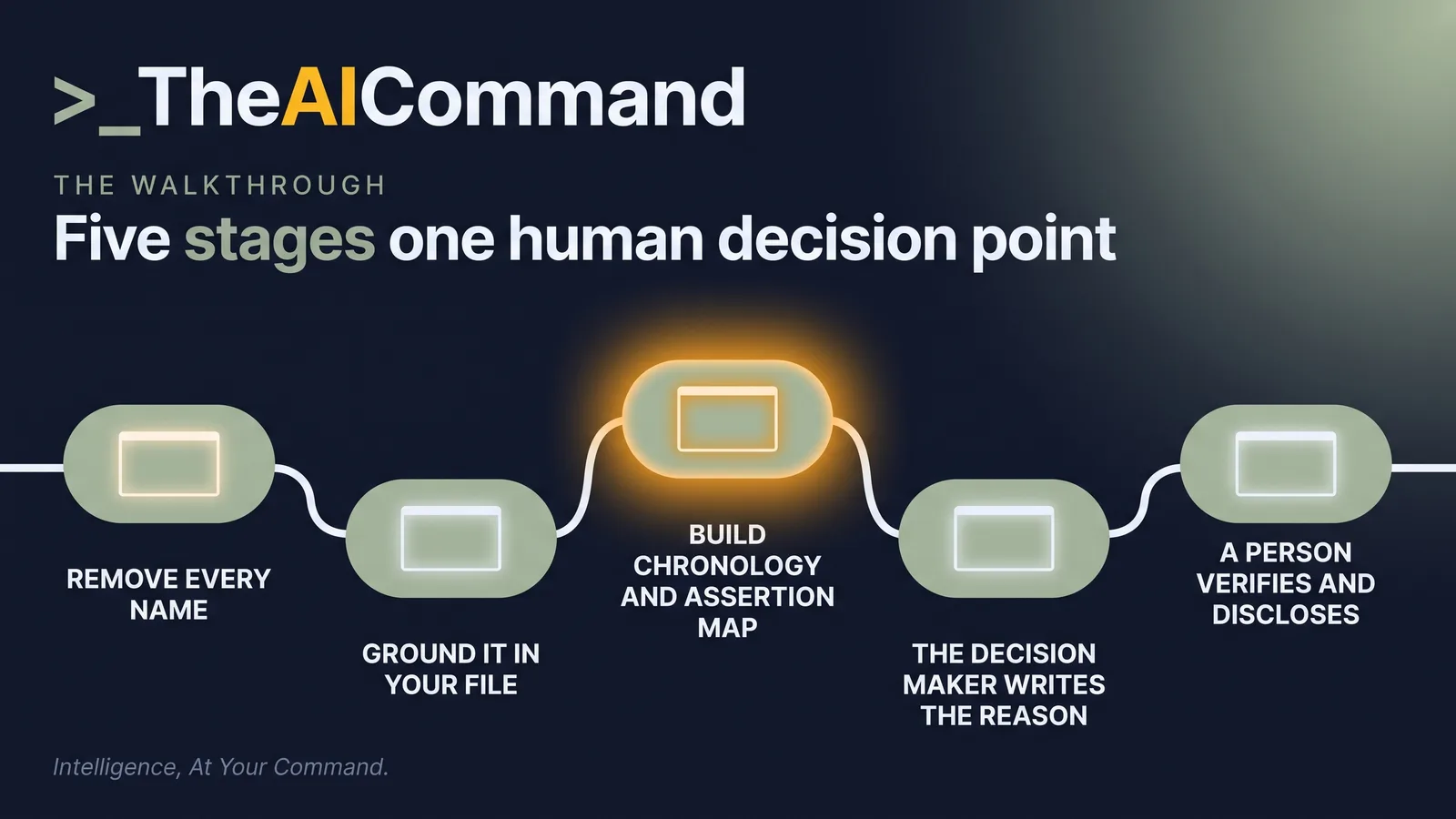
An assistant can help with that division of labour, in one direction only. Confined to the organisation's own file, a model can build a dated chronology and map each numbered allegation to the document that answers it. It cannot supply the reason. TheAICommand works to the Verified Draft Method: de-identify the inputs, ground the model in your own source material, keep a person at the decision point, verify against the primary source, and log what happened.
Why is section 361 so hard to displace?
The Part being invoked is Part 3-1, and its operative prohibition is short. Subsection 340(1) provides that "A person must not take adverse action against another person" because that other person has, exercises or proposes to exercise a workplace right. Item 1 of the table in subsection 342(1) confirms that an employer who "dismisses the employee" has taken adverse action. Subparagraph 341(1)(c)(ii) puts a workplace right in the hands of an employee who "is able to make a complaint or inquiry" in relation to their employment.
Section 360 then closes the obvious escape. A person takes action for a particular reason "if the reasons for the action include that reason". A performance problem that genuinely existed does not answer the claim if the complaint was also in the mix.
Section 365 is the application itself, available where a person alleges "that the person was dismissed in contravention of this Part". Subsection 366(1) of Compilation No. 73, 7 July 2026, requires it within 21 days after the alleged dismissal took effect, extendable only for exceptional circumstances.
That resistance is settled at the highest level. In Board of Bendigo Regional Institute of Technical and Further Education v Barclay [2012] HCA 32, decided 7 September 2012, French CJ and Crennan J held that "Generally, it will be extremely difficult to displace the statutory presumption in s 361 if no direct testimony is given by the decision-maker acting on behalf of the employer". Their Honours also held that direct evidence of the reason can still be rejected where objective facts contradict it.
The reason comes from a person, and the documents have to be consistent with what that person says. A narrative reconstructed afterwards by anyone else, human or model, does neither job.
What is arriving, and what it is arriving with
The volume is not stable. In a presentation to the Victorian Bar Association on 18 February 2026, Justice Adam Hatcher, President of the Commission, published a lodgment table covering 1 July to 31 December 2025.
The table is a fixed historical record for that half year, and the presentation notes that the three year comparison period itself contained two record years, so each percentage increase is measured against an already elevated baseline. Justice Hatcher draws the inference expressly. In his view, the only reasonable inference is that the growth is principally caused by the increasing use of AI tools by potential litigants. He puts that against a statistical relationship with the labour market that has broken down. The Commission's own user research is more cautious, finding several ways generative AI may be contributing but unable to isolate that contribution.
The full year result came later. In a speech to the Australian Industry Group PIR Conference on 8 September 2026, Justice Hatcher reported a record of well over 53,000 applications in 2025-26 and a 70 percent increase in total workload over three years.
The February presentation tells an employer what its file has to answer. Justice Hatcher observed that "By far the most common basis upon which section 365 claims are brought is that the dismissal was motivated by the fact that the employee complained to the employer at some stage about something". That is the claim shape to prepare for: a complaint months before the dismissal, and a line drawn between the two.
The generative AI (GenAI) user research final report prepared for the Commission by Pivot, released on 24 August 2026 and surveying 408 applicants and 211 respondents, found that about 40 percent of surveyed applicants had used generative AI for their case, concentrated among self-represented, younger, professional and managerial applicants. It records that "Over half (57%) of respondents indicated they felt the applicant had been using GenAI for their case at the Commission."
Two qualifications belong in any internal briefing: the report rests on a self-selected, self-reported sample, and its employer side evidence base includes only six respondent interviews. Respondents with frequent exposure to generated applications reported a consistent pattern: the tools fixate on procedural fairness and generate detailed objections regardless of the substantive merits of the dismissal. An employer file that cannot evidence notice, an opportunity to respond and consideration of that response will be pressed on exactly that ground.
Step one: de-identify before anything is pasted
Nothing goes into a tool with a name on it. The Commission's guidance for parties using AI is direct: "Do not enter personal information about yourself or other people, or confidential case information, into public GenAI tools." The Commission's guidance note on the use of generative artificial intelligence in Commission cases, published 24 August 2026, puts the same point operationally, naming as one way to reduce the risk not giving a model the names of individuals.
Build a key, hold it outside the tool, and replace consistently: [EMPLOYEE_NAME], [DECISION_MAKER], [MANAGER], [EMPLOYER], [POSITION_TITLE] and [MATTER_NUMBER]. Strip addresses, phone numbers, employee identifiers and client names from the documents themselves, not just from the prompt. Every date inside the documents stays real, because a date carries no identity and the chronology cannot be ordered without it. The date placeholders in the prompts below stand for the real dates you type in.
The working example through the walkthrough is the common one: [EMPLOYEE_NAME], a [POSITION_TITLE] at [EMPLOYER], dismissed on [DATE_OF_DISMISSAL], who alleges the reason was a complaint made on [DATE_OF_COMPLAINT].
Step two: ground the assistant in the file you already hold
The Commission's Form F8A page tells respondents to include only documents directly relevant to the claim. The same boundary holds for the model: the dismissal file, nothing outside it, and no law from the model's own memory.
What to check: open each document and confirm it appears in the list with the date the document itself carries, not a date inferred from the text around it. Confirm no placeholder has been replaced with a name. Read the NOT ON FILE list as the first real output, because a gap found on day one is recoverable and one found on day six is not.
Step three: build the chronology and the assertion map
Two artefacts do the work. A chronology establishes the objective facts, which is what Barclay says can contradict and defeat the decision maker's own evidence about the reason. An assertion map turns the applicant's assertions into a checklist with a status against each one.
What to check: take a random sample of at least five chronology rows and open the document cited for each, checking the date and the event against the source rather than the table. Count the factual assertions in the Form F8 yourself before running the prompt, then count the rows in the assertion map against your own number, because a quietly dropped assertion is the failure mode that matters most here. Any row where the status was softened from UNANSWERED to PARTLY ANSWERED without a document reference gets set back to UNANSWERED.
The rows marked BEFORE COMPLAINT usually carry the employer's answer, because a performance record predating the protected act is an objective fact the decision maker's evidence has to sit with.
Sample rows from each, the chronology first:
Step three and a half: what will the other side's file say?
This use of the assistant is adversarial, and it runs before the decision maker writes anything. Start a new chat and attach the same de-identified documents.
What to check: read the EVIDENCE TO OBTAIN list against the GAPS list from the second prompt, because both are built from the same file and any item in one but not the other is a sign the model has drifted. Then test one of the procedural fairness answers by opening the document named and confirming it says what the output claims. This pass does not change the response. It tells you, before the decision maker signs, which assertions the file cannot meet.
Who can say why the decision was made?
Step four cannot be delegated.
The named decision maker reads the chronology, corrects it, and writes the reason for the decision in their own words. Not the human resources (HR) adviser's words, not a polished version, and not a model's reconstruction. Barclay is the authority for why: without direct testimony from the decision maker, the presumption in section 361 will generally be extremely difficult to displace.
The words stay theirs, and the account covers:
- what was decided, and on what date;
- what material was in front of them;
- which other people they consulted;
- what they knew of the complaint, and when; and
- what weight, if any, it carried.
The Commission's guidance note addresses the point directly: "You should not use GenAI to create the factual content of a witness statement or declaration."
Section 678 of the Fair Work Act adds a further reason for care where the statement is sworn or affirmed. The offence in subsection 678(1) applies where a witness gives sworn or affirmed evidence in a matter before the Commission and the evidence is false or misleading, and the penalty is imprisonment for 12 months, as set out in Compilation No. 73 dated 7 July 2026. A statement assembled by a tool and signed by a person who has not verified every line carries that exposure.
If the person who made the decision has left the organisation, that is a fact to establish on day one, not on day six.
Step five: check it, and disclose it from 20 October 2026
The guidance note sets three requirements, taken apart in the three rules for AI in a case, and they apply to all Commission matters from 20 October 2026:
- a party that used generative AI states that it was used and how it was used;
- a party verifies the document and states that the check was done; and
- for a witness statement or declaration, the party confirms the content is the witness's own knowledge and words.
The verification requirement has a specific edge from 20 October 2026: the checking is done by a person, not by another model. A second tool asked to confirm the first tool's citations satisfies nothing.
From 20 October 2026 the guidance note treats an HR adviser employed by the party as a professional representative, which brings an additional obligation, where the representative used generative AI in preparing the document, to hyperlink any case law referred to in it, where available. An internal HR team is not outside the regime because it is internal.
Non-compliance from that date carries consequences the note names: material may be given less weight, a costs order may follow, and an application or case may be dismissed.
As at 24 September 2026 the mechanics do not line up, and the practical answer is to write the disclosure into the document. The version of the Form F8A approved with effect from 21 July 2026, published as the Commission's approved Form F8A, carries no question about generative AI. It asks:
- at question 1.2, whether the Respondent agrees with the date of alleged dismissal given by the Applicant;
- at question 2.1, optionally, an extension of time case against the five exceptional circumstances matters;
- at question 3.1, the response to the alleged contravention; and
- at question 4.1, the outcome sought.
It instructs respondents to answer in numbered paragraphs, and states that "You must include in this form any jurisdictional objections the Respondent wishes to raise", so every objection is identified inside the seven days rather than held back.
In its news item "Use of AI in Commission cases" of 24 August 2026, the Commission said: "Our application and response forms will also be updated by 20 October to help parties comply with the new requirements." Check the approval date on the form in front of you, because this version can be replaced before you file, and until it asks the question put the disclosure at the beginning of the document, stating that generative AI was used and how, and that the details have been checked.
The Commission publishes its own set-up prompts for parties at fwc.gov.au/genai, worth reading as a regulator's published standard for an acceptable instruction to a model.
Do this Monday
The artefact is a one page assertion map for the most recent general protections application on foot, or the last one closed. The owner is the employee relations manager or HR business partner who holds the matter file.
The first hour, in order:
- Write the de-identification key, replacing every person with a placeholder, and save it outside any AI tool;
- De-identify the applicant's Form F8 and two documents it points at, and attach all three to an approved assistant;
- Run the grounding prompt, and check the document list it returns against the originals;
- Run the chronology and assertion map prompt, and verify five rows against the source documents; and
- Name the person who made the decision at the top of the page, and book 30 minutes with them this week to read and mark it up.
With no approved tool available, do steps 3 and 4 by hand on the same three documents.
The check that proves it worked: every assertion numbered in the Form F8 has either a document reference or the word UNANSWERED against it, and the person who made the decision is named on the page with a booked time to read it. If either is missing, the map is not finished.
The bottom line
Section 361 of the Fair Work Act presumes the applicant is right about the reason for the dismissal until the employer proves otherwise, and Barclay holds that the presumption will generally be extremely difficult to displace without direct testimony from the person who made the decision. A response is therefore an evidence assembly task compressed into seven days, and an assistant grounded in the organisation's own file does that well: the chronology, the assertion map, the gap list. The reason itself is not assembled; it is given by a named person who can be cross-examined on it. From 20 October 2026 the Commission requires the use to be disclosed, the checking to be done by a person, and a witness statement to be the witness's own knowledge and words. Build the workflow that way now.
This article is general information and education only. It is not legal, compliance, financial or professional advice.
TheAICommand. Intelligence, At Your Command.