
The offence does not ask whether the model read the award correctly.
Since 1 January 2025, intentionally underpaying an employee's wages or entitlements has been a criminal offence under the Fair Work Act. The Fair Work Ombudsman puts the boundary in one sentence: this does not include honest mistakes. The interpretation sits in the part of the offence carrying no fault element at all. The fault sits elsewhere, on the conduct and the result. So when an AI tool produced that interpretation and somebody encoded it as a standing payroll rule, the question is not whether the model was right. It is what the record says the organisation meant.
What the offence actually asks
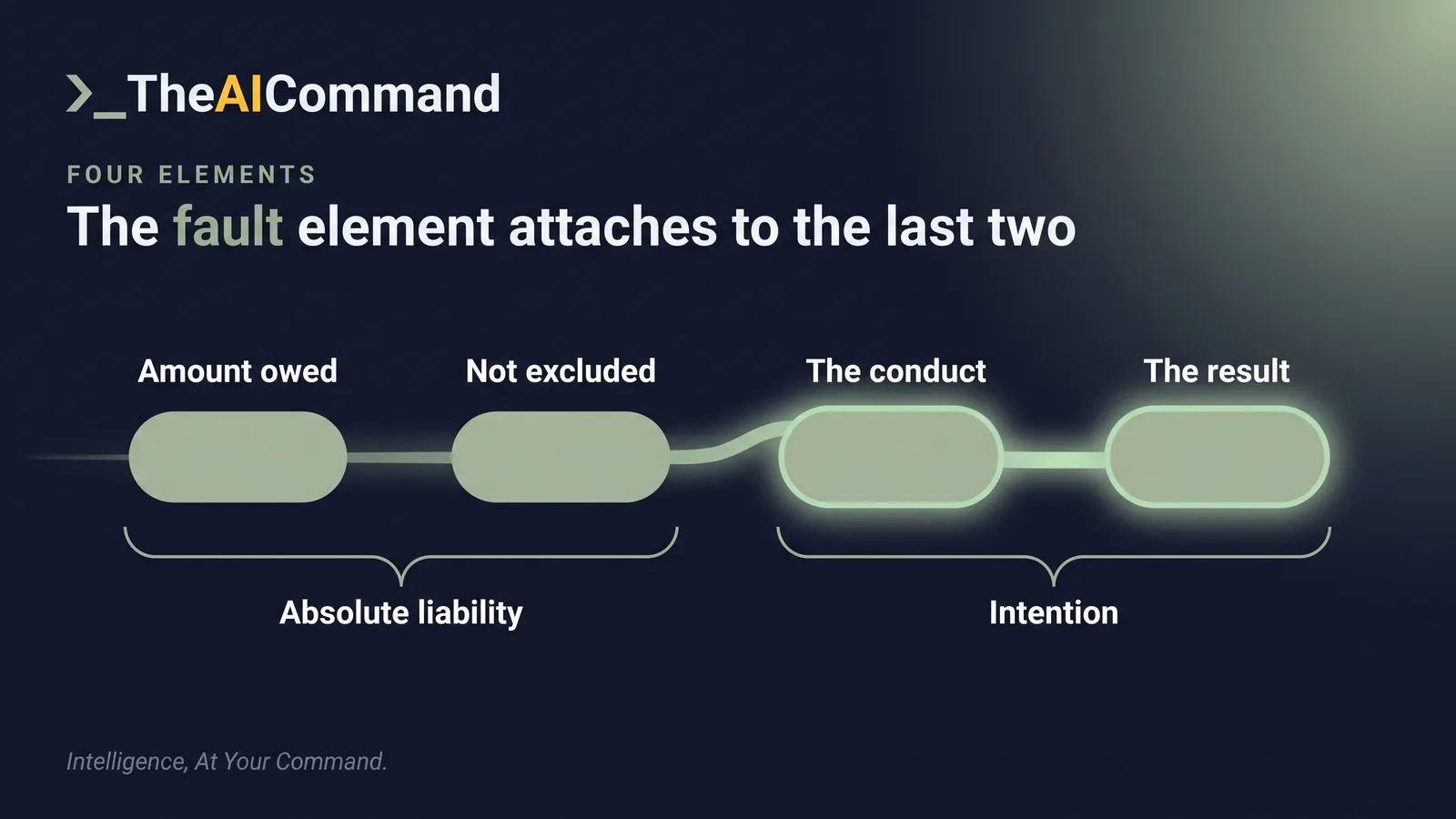
Section 327A(1) sets four elements. The employer is required to pay a required amount to or for the benefit of an employee under the Act, a fair work instrument or a transitional instrument. The amount is not excluded by section 327A(2). The employer engages in conduct. That conduct results in a failure to pay the required amount in full on or before the day it was due.
Section 327A(3) then splits the offence in two. Absolute liability applies to paragraphs (1)(a) and (b). The fault element for paragraphs (1)(c) and (d) is intention.
That split is the whole argument. Under section 6.2(2) of the Criminal Code, where absolute liability applies to a physical element there are no fault elements for it and mistake of fact is unavailable in relation to it. Under section 5.2, a person has intention as to conduct if they mean to engage in it, and as to a result if they mean to bring it about "or is aware that it will occur in the ordinary course of events".
So whether the money was owed is never a state of mind question, and the second limb of intention does quiet work: awareness is not the same as wanting.
The stakes are why this matters. Section 327A(5) allows up to 10 years imprisonment for an individual, a fine, or both, and a fine on a body corporate. Section 327A(6) sets that fine at 5,000 penalty units for an individual and 25,000 for a body corporate, or the greater of that and "3 times the underpayment amount" where the court can determine it. As at 21 September 2026 the Ombudsman publishes those ceilings as $1.82 million and $9.1 million. Those figures rest on the penalty unit indexed to $364 on 1 July 2026 and, under section 4AA(8) of the Crimes Act 1914, they apply only to offences committed on or after that day. Conduct between 1 January 2025 and 30 June 2026 is priced at $330 a unit, which is $1.65 million and $8.25 million, and the Ombudsman's cooperation agreements guide still publishes that earlier pair. Under section 327C only the Commonwealth Director of Public Prosecutions or the Australian Federal Police can prosecute, and section 327C(2) allows proceedings to be commenced at any time within six years of the offence, so both sets of ceilings are live law.
Where does the model's award interpretation actually land?
In paragraph (1)(a), which carries absolute liability.
That has two consequences, and organisations notice only the comfortable one. Getting the award wrong is not the offence. A prosecutor still has to prove intention on the conduct and the result beyond reasonable doubt, which the Ombudsman's cooperation agreements guide calls a higher standard of proof than applies to other breaches of the Act. Most payroll errors will never come near it.
The second is not comfortable. With no fault element on paragraph (1)(a), mistake of fact is unavailable in relation to it. An employer cannot answer the entitlement question by saying it believed the rate was right. That belief matters only if it bears on whether the conduct and the result were intended, a different argument, and one to be evidenced rather than asserted.
One scoping point keeps this honest: the Ombudsman's guide states the offence does not reach additional amounts an employer agrees to pay in a contract of employment.
None of this is about reading an award safely. AI Can Read the Award. It Cannot Set the Pay. covers the reading loop and the sign-off on the figure. This piece starts one step later, when a figure stops being an answer and becomes a rule that runs every fortnight unwatched.
How does a company form an intention?
Not through the provision most employment practitioners reach for.
Section 793 is the Fair Work Act's own attribution rule: conduct by an officer, employee or agent within the scope of their authority is conduct of the body corporate, and that person's state of mind is the body's. Section 793(3A) switches that off for the section 327A offence and for the related offence provisions that attach to it, and section 793(4) does the mirror image: it disapplies Part 2.5 of the Criminal Code, which deals with corporate criminal responsibility, for every other offence in the Act. Part 2.5 would otherwise reach all of them, since Criminal Code section 2.2 applies Chapter 2 to every Commonwealth offence. So it governs the section 327A offence and those related offence provisions, which section 12 of the Act defines as section 6 of the Crimes Act 1914 and Part 2.4 of the Criminal Code so far as they relate to that offence, and nothing else in the Act.
Section 12.3(1) requires intention to be attributed to a body corporate "that expressly, tacitly or impliedly authorised or permitted the commission of the offence", and section 12.3(2) lists, without limiting them, four ways that authorisation may be established: the board carried out or authorised the conduct; a high managerial agent did; a corporate culture existed that "directed, encouraged, tolerated or led to" non-compliance with the provision; or the body corporate failed to create and maintain a corporate culture requiring compliance.
Section 12.3(6) defines the term. Corporate culture means "an attitude, policy, rule, course of conduct or practice existing within the body corporate generally or in the part of the body corporate in which the relevant activities takes place".
A payroll configuration is a rule. Running it every cycle is a practice. Payroll is the part of the business where the relevant activity takes place. That is the definition applied to its plainest case, and the Ombudsman restates the same routes in its cooperation agreements guide in almost the same words.
One asymmetry matters before leaning on a governance framework. Section 12.3(3) offers a due diligence answer, but only to the high managerial agent limb. There is none for either culture limb. On those two, diligence is not a defence raised afterwards but the absence of the thing being proved, so it has to be visible in the record.
What the configuration record has to hold
This is not a run lineage question. Defensible AI Lineage Starts Before the Prompt. covers reconstructing what a model was given for one output. A payroll rule is a different object: one decision, applying to a whole classification until somebody changes it. What has to be reconstructable is the decision, not the generation.
Six things, and the sixth decides cases.
- The rule that changed, in the system's own terms, and the date it took effect.
- The instrument and clause it implements, named specifically enough to be checked.
- What produced the interpretation, which tool, and what it was given.
- Who verified it against the primary source, and which version.
- Who approved the change, by name, and when.
- What was raised about the rule afterwards and what happened to it.
The sixth matters because of that second limb of section 5.2(3). A ticket saying the rule underpays a cohort on public holidays, open across four pay runs, is not a record of an honest mistake. It is a record of awareness. Closed inside a cycle with the remediation attached, the same ticket is the strongest evidence the shortfall was never intended. The shape is familiar: When a System Auto-Triggers a Performance Improvement Plan describes an employer left with no decision maker to put in the witness box. Same gap, different forum.
Be exact about what record-keeping law reaches. A payroll configuration is not a time and wages record, so regulations 3.31 and 3.44 of the Fair Work Regulations, which require those to be legible, in English and not altered except to correct an error, do not govern it. Those are enforceable regulations carrying civil remedy consequences, not regulator guidance, and regulation 3.44(4) is confined by its own terms to a record the employer is required to keep under the Act or the Regulations. The section 557C reverse onus is civil, attaching to records required by sections 535 and 536. Neither creates a duty to keep a configuration history, but both are the standard to hold one to. A history that exists only as system state, or is overwritten on each deployment, will not survive being read by anyone but its author.
The prompt below drafts that record from a change already made. It drafts. A person verifies and signs.

The rungs below the offence, and the two exits
Intention is the top of a ladder, not the whole of it.
One rung down sits the serious contravention in section 557A: knowingly contravening the provision, or recklessness, which section 557A(2) defines as awareness of a substantial risk of the contravention where, on the circumstances known to the person, it is unjustifiable to take the risk. That is civil, and a materially lower bar. The open ticket that would be awkward evidence in a prosecution sits comfortably inside recklessness. Below it sits the ordinary contravention, where the Ombudsman notes the maximum civil penalty for an underpayment related contravention by a non-small business employer can, in certain circumstances, be the greater of three times the underpayment and the relevant penalty unit amount.
There are two exits from the criminal path and both are documentary. The first is the Voluntary Small Business Wage Compliance Code, declared under section 327B by the Voluntary Small Business Wage Compliance Code Declaration 2024. Where the Ombudsman is satisfied a small business employer complied with it, it must not refer that conduct for prosecution. The factors include taking reasonable steps to work out correct pay rates, seeking advice from a reliable source, and giving that source information the employer reasonably believed was accurate. It reaches employers with fewer than 15 employees only, so most readers sit outside it. Read it anyway, as the regulator's own description of what not intending an underpayment looks like.
The second is a cooperation agreement under sections 717A and 717B, where a person self-reports. While one is in force the Ombudsman must not refer the covered conduct, and in deciding whether to enter one it must have regard to whether the person made "a voluntary, frank and complete disclosure of the conduct, and the nature and level of detail of the disclosure". An organisation that cannot reconstruct how a rule was configured cannot make that disclosure. The Ombudsman also states it will not enter an agreement with a person who has unintentionally underpaid an employee, so the two exits are not interchangeable.
As at 21 September 2026 no decided case has tested how the intention element applies to a rule a model produced, and none was located for this piece. The framework around it is not settled either. The Closing Loopholes Review final report, tabled in Parliament on 20 August 2026, recommended a targeted review of the wage theft offence provisions within a year of publication, that the Ombudsman be funded to build decision support systems for wage compliance, and that government work with industry on compliance tools that integrate with employer payroll software. Build the record now rather than wait.
Bottom line
Being wrong about an award is not the offence, and being right about it is not the defence. Section 327A puts absolute liability on whether the money was owed and reserves intention for the conduct and the result, so the argument is never about the quality of the interpretation, always about what the organisation knew and did once the rule was running. For a company it narrows further: section 327A is the only offence in the Act Part 2.5 of the Criminal Code still reaches, along with the related offence provisions that attach to it, and a rule and a practice inside the part of the business that runs payroll is what corporate culture is defined to mean. The record of how the rule was configured, verified, approved and maintained is the evidence. Build it at the change, because it cannot honestly be built afterwards.
Do this Monday
- Pull the last twelve months of payroll configuration changes and mark every one where nobody can name the instrument and clause it implements.
- Add three fields to your payroll change form capturing what produced the interpretation, who verified it against the primary source, and who approved it.
- Sweep the ticket backlog for pay shortfalls and treat every open item older than one pay cycle as an escalation, not a queue entry.
- Check that configuration history survives a deployment, is legible to someone who did not build the system, and is not overwritten.
- Read the Voluntary Small Business Wage Compliance Code factors even if you are not a small business employer, and score your process against each.
References
- Fair Work Act 2009 (Cth), Compilation No. 73, C2026C00355, in force 7 July 2026, sections 327A to 327C. https://www.legislation.gov.au/C2009A00028/2026-07-07/2026-07-07/text
- Fair Work Act 2009 (Cth), Compilation No. 73, C2026C00355, sections 12, 23, 535, 536, 557A, 557C, 717A to 717D and 793. https://www.legislation.gov.au/C2009A00028/2026-07-07/2026-07-07/text
- Criminal Code Act 1995 (Cth), Compilation No. 174, C2026C00243, in force 30 June 2026, sections 2.2, 5.2, 6.2, 12.3 and Part 2.5. https://www.legislation.gov.au/C2004A04868/2026-06-30/2026-06-30/text
- Fair Work Ombudsman, Criminal prosecution. https://www.fairwork.gov.au/about-us/compliance-and-enforcement/criminal-prosecution
- Fair Work Ombudsman, Criminalising wage underpayments and other issues, published 12 April 2024, updated 16 December 2024. https://www.fairwork.gov.au/about-us/workplace-laws/legislation-changes/closing-loopholes/criminalising-wage-underpayments-and-other-issues
- Fair Work Ombudsman, A guide to cooperation agreements. https://www.fairwork.gov.au/sites/default/files/2025-01/a-guide-to-cooperation-agreements.pdf
- Fair Work Ombudsman, Voluntary Small Business Wage Compliance Code. https://www.fairwork.gov.au/about-us/compliance-and-enforcement/criminal-prosecution/voluntary-small-business-wage-compliance-code
- Voluntary Small Business Wage Compliance Code Declaration 2024, F2024L01635. https://www.legislation.gov.au/F2024L01635
- Fair Work Ombudsman, Record-keeping. https://www.fairwork.gov.au/pay-and-wages/paying-wages/record-keeping
- Fair Work Regulations 2009 (Cth), Compilation No. 56, F2026C00521, in force 20 June 2026, regulations 3.31 and 3.44. https://www.legislation.gov.au/F2009L02356/2026-06-20/2026-06-20/text
- Crimes Act 1914 (Cth), Compilation No. 167, C2026C00368, in force 27 August 2026, section 4AA. https://www.legislation.gov.au/C1914A00012/2026-08-27/2026-08-27/text
- Crimes (Amount of a Penalty Unit) Instrument 2026 (Cth), F2026N00424, made 15 June 2026, commenced 1 July 2026, section 5. https://www.legislation.gov.au/F2026N00424
- Department of Employment and Workplace Relations, Review of the Closing Loopholes Acts, final report tabled 20 August 2026, recommendations 24, 27 and 28. https://www.dewr.gov.au/workplace-relations-australia/review-closing-loopholes-acts
TheAICommand. Intelligence, At Your Command.