
You are now a professional representative. Nobody told you.
On 24 August 2026 the Fair Work Commission published the final version of its guidance note on the use of generative artificial intelligence in Commission cases. It commences on 20 October 2026. Most of the coverage has gone to the three requirements, which have been public since the March exposure draft and which this site set out in July.
The requirements are not the news. The definitions page is.
What actually changed between the draft and the final?
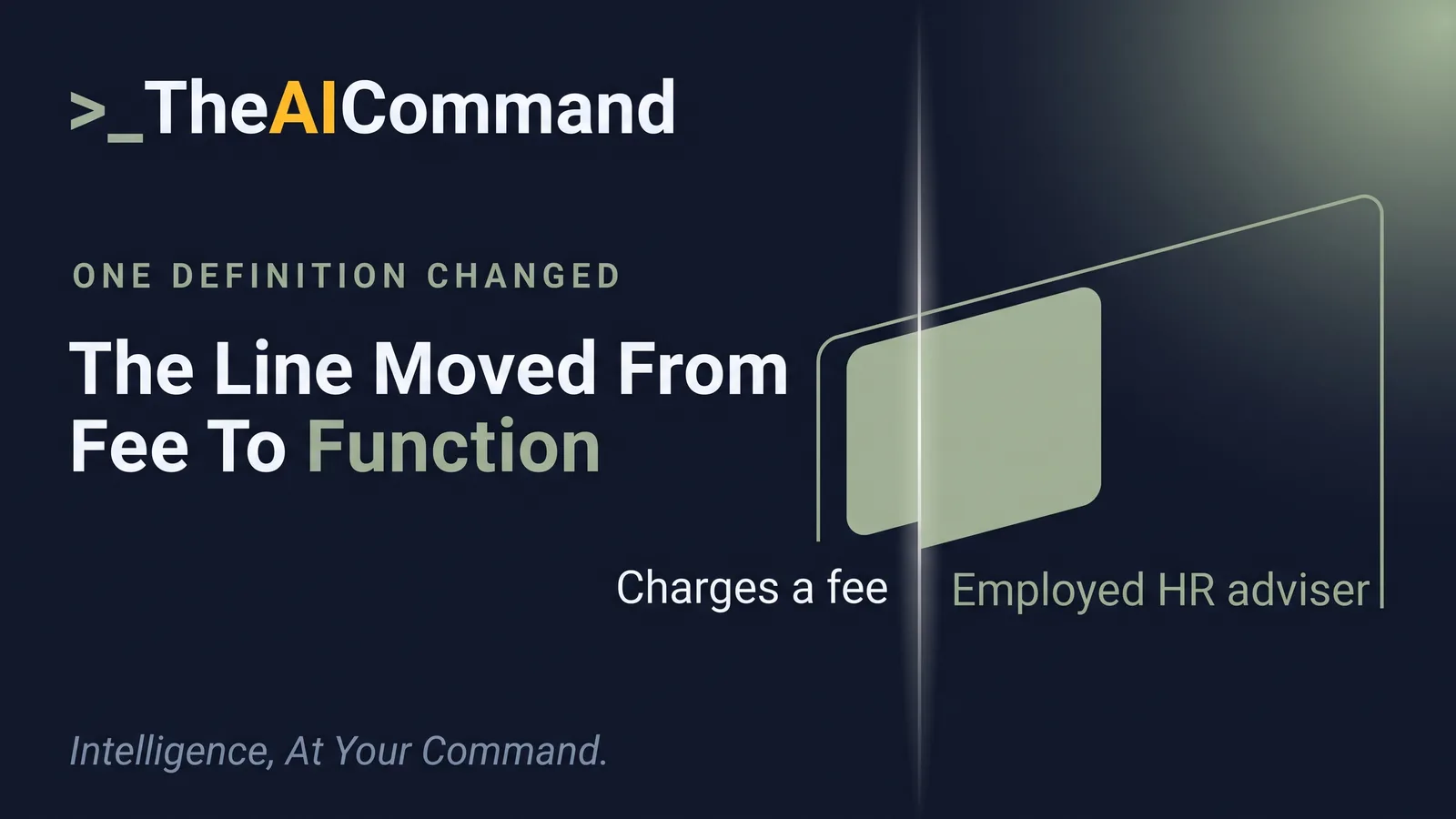
The exposure draft published on 24 March 2026 placed one extra obligation on a narrow class of people. Paragraph 39 of the draft read that "a legal practitioner or paid agent who uses GenAI in preparing any document that is to be lodged in a Commission case, must include in the document hyperlinks to all case law referred to in the document". The draft then defined a paid agent as "an agent who charges or receives a fee to represent a person in a Commission case".
An in-house HR adviser charges no fee. On the draft, that duty was somebody else's.
The final note replaces the whole category. Paragraph 45 now applies to "a professional representative", and paragraph 46 defines that term as a person representing another person in a Commission case who is a lawyer or paid agent, including one who is an employee or officer of the other person, an employee or officer of a union, employer organisation, peak council or not-for-profit body, or a human resources adviser employed by the other person.
The phrases "professional representative" and "human resources adviser" appear nowhere in the exposure draft. They appear for the first time in the document published on 24 August.
Why the reclassification matters more than the rule
The hyperlink duty on its own is administratively trivial. Paste a link next to each case. Ten minutes.
What matters is that the Commission has now drawn a line through the population of people who lodge documents, and put unrepresented employers who use their own HR team on the professional side of it. The same employer that saves the external legal fee by running its own unfair dismissal response now carries an obligation the applicant across the table does not. Requirement 2 recommends hyperlinks for everyone. For a professional representative, paragraph 45 makes them mandatory.
That asymmetry is deliberate, and it rewards reading the rest of the note carefully rather than skimming the three requirements. It also flips a familiar risk around. The failure mode most employers have watched for is the other side citing authority that does not exist. From October, the verification standard applies to your own filings, with your own name on the declaration.
What the three requirements demand of the responding employer
Two details in that table do more work than they look like they do.
The first is the definition of document. Paragraph 46 defines it as any record of information and states expressly that it includes Commission forms, Commission template documents, submissions, chronologies, declarations, witness statements, statements of agreed facts and other evidentiary materials. The Commission's own news item confirms that both application and response forms are being updated. The regime is not confined to the applicant's originating claim.
The second is paragraph 31. You cannot discharge the checking obligation by running the document past another model. The note is unambiguous: "the checking must be done by a person". It then names the acceptable sources, which are the case law benchbooks and legal textbooks for principles, Find decisions and orders for Commission decisions, AustLII and Jade for court decisions, and the Federal Register of Legislation for Commonwealth legislation.
What the pre-lodgement routine looks like
This is a verification problem with a filing deadline, and it is the kind of work AI does well right up to the point where it must not be trusted. TheAICommand works to the Verified Draft Method: de-identify the inputs, ground the model in your own source material, keep a person at the decision point, verify against the primary source, and log what happened. The guidance note is close to a statutory restatement of the same sequence.
A workable routine, run on de-identified material using placeholders such as [EMPLOYEE_NAME], [MANAGER_NAME] and [TEAM]:
- Decide what the tool is allowed to see. Paragraph 40 says not to give personal information about another person in the case, or confidential information, to public GenAI or to any GenAI that may not keep it secure. Paragraph 43 gives the practical form of that: do not give it names or any other detail that could identify someone. Your enterprise tenancy does not automatically satisfy the second limb, so check the terms rather than the logo.
- Ground the draft in your own material. Feed it the de-identified chronology, the policy extracts and the decision record you already hold. A chronology assembled to a fixed structure is the highest-value input here, because chronologies are named in the definition of document and will be checked as one. Nothing the tool produces about the law survives without step 4.
- Have it list every authority it relied on, separately. Ask for the citations in a discrete block rather than woven through the prose. You are building the checking worklist, not a bibliography.
- Check each one by opening it. Find decisions and orders, AustLII, Jade, the Federal Register. Confirm the case exists, that it says what the draft says it says, and that any quote is accurate. Paste the hyperlink as you go, which discharges paragraph 45 as a by-product rather than as a separate task.
- Send the witness statement back to the witness. Not for sign-off. For rewriting in their own words, because that is what requirement 3 asks of them.
- Complete the disclosure honestly. Name what the tool did. Organising a chronology and drafting a submission are two different entries on the form.
What never gets automated
The factual content of a witness statement. Paragraph 35 states that you should not use GenAI to create it, and that a statement or declaration must reflect the witness's or declarant's own knowledge, not AI-generated content. Transcription and translation are allowed under paragraph 36, and the distinction is worth holding: converting a person's words is assistance, and supplying words the person did not have is not.
The checking itself, per paragraph 31.
And the risk sits with named individuals, not with the function. The note reproduces the offence for knowingly giving false or misleading information to the Commission, punishable by imprisonment for up to 12 months, and the offence for false or misleading evidence by a witness, carrying the same maximum. Those provisions have always been there. What changes on 20 October is that the person lodging the document signs a declaration confirming they did the checking.
The declaration you sign even when you used no AI
The President's statement accompanying the note sets out the modified forms and says plainly that "regardless of whether AI was used to prepare the form, all users will be required to" complete a section on the use of AI and complete a declaration confirming they have checked the details entered.
That converts a routine response form into a certified document for every employer, whether or not a model was involved. It also raises a question most HR functions have never had to answer: who is authorised to press lodge? The person who signs the declaration is asserting they did the checking. If the person who signs is not the person who checked, the form is wrong before it arrives.
Context for why the Commission moved. The President's statement records that by the end of financial year 2025-26 the Commission's total workload had increased by over 70 per cent in three years, growth "not explained by any developments in the labour market". The accompanying research report found AI use among applicants is widespread, with approximately 40 per cent of surveyed applicants reporting using AI to prepare or manage their case, and that sycophantic or hallucinatory outputs may reinforce an applicant's position and elevate their expectations. The employer-side finding is quieter and more useful: respondent use is real but more restrained, largely confined to organising responses, drafting submissions and supplementing professional advice rather than replacing it.
Do this Monday
- Name the lodging person. For your next Commission matter, decide now who completes the GenAI section and signs the checking declaration. That person needs to have done the checking.
- Write the citation rule. Any draft assembled with AI assistance returns its authorities as a separate list. No exceptions, because a citation buried in prose is a citation nobody opens.
- Check your tenancy, not your vendor. Paragraph 40 turns on whether the tool may keep information secure from disclosure. Confirm which of your tools clear that, in writing, before October.
- Brief your witnesses once. Managers who give statements need to know that the words have to be theirs, and why. Five minutes now beats an evidentiary argument later.
- Reread your own template pack. Chronologies and statements of agreed facts are inside the definition of document. If your standard bundle was built before this note, it was built to a different standard.
- Diarise 20 October. The forms change on that date, and so does the population the extra duty applies to.
Bottom line
The Fair Work Commission did not add a rule for HR. It moved HR into a category that already had one. From 20 October 2026, an employed human resources adviser running the employer's own case is a professional representative, which means every case cited in a GenAI-assisted document must carry a hyperlink, and the checking behind it must be done by a person against a source known to be correct. Nothing about that makes AI unusable in a Commission matter. It makes the verification step a filing obligation rather than good practice, and it puts a name on the declaration at the end of it.
References
- Fair Work Commission, Guidance note: Use of generative artificial intelligence in Commission cases, published 24 August 2026, at paragraphs 5, 7, 8 to 15, 25 to 33, 35, 36, 40, 43, 45 and 46. https://www.fwc.gov.au/documents/resources/guidance-note-use-of-generative-ai-in-commission-cases.pdf
- Fair Work Commission, Guidance Note on the use of GenAI, exposure draft, published 24 March 2026, at paragraphs 39 and 40. https://www.fwc.gov.au/documents/consultation/guidance-note-on-the-use-of-gen-ai-exposure-draft-2026-03-24.pdf
- Justice Hatcher, President, Statement: Use of AI in Fair Work Commission proceedings, 24 August 2026, at paragraphs 1, 6, 7, 8, 10, 11 and 12, and footnote 1. https://www.fwc.gov.au/documents/consultation/presidents-statement-use-of-ai-in-fwc-proceedings-2026-08-24.pdf
- Fair Work Commission, Use of AI in Commission cases, news item, 24 August 2026. https://www.fwc.gov.au/about-us/news-and-media/news/use-ai-commission-cases
TheAICommand. Intelligence, At Your Command.