
The employer was procedurally fair and still lost.
In [Lee v Superior Wood Pty Ltd [2019] FWCFB 2946](https://www.fwc.gov.au/documents/decisionssigned/html/2019fwcfb2946.htm), decided on 1 May 2019, a Full Bench of the Fair Work Commission held that a direction to a worker to submit his fingerprint data to a site scanner was not a lawful direction, and that his refusal was not a valid reason for dismissal. The technology in the case is old and the holding is not, because it turns on consent rather than on the scanner.
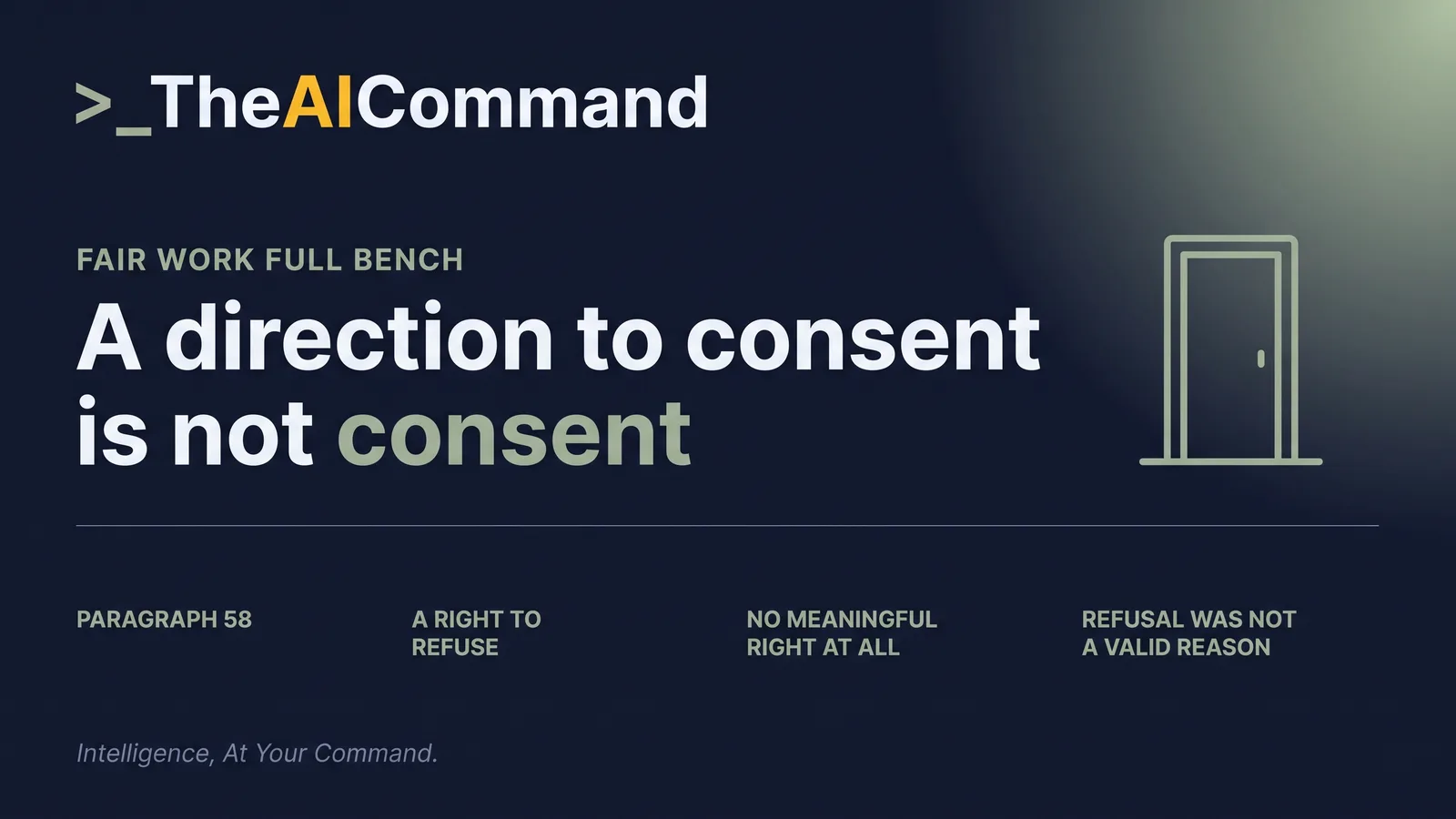
The sentence that carries forward sits at paragraph 58: "A necessary counterpart to a right to consent to a thing is a right to refuse it. A direction to a person to give consent does not vest in that person a meaningful right at all." The Full Bench said it in the alternative, on reasonableness, having already held the direction unlawful for want of consent.
That is the test every face template, voice profile and behavioural model in a human resources (HR) stack has to pass, because the enrolment step is identical wherever it appears. A meeting room camera that attributes speech builds a face profile, a transcription tool that labels speakers builds a voice profile, and a time and attendance terminal builds a fingerprint or palm template. Each is a collection of sensitive information before any employee record exists.
The practitioner consequence is one question, asked of every tool that creates or stores a biometric template. Could a named worker decline, keep the role, and suffer no detriment?
What the Full Bench actually decided
The chronology is the reason the case is useful. On the Full Bench chronology the scanners were announced on 25 October 2017, the first direction to register a fingerprint issued on 1 November 2017, a site attendance policy followed on 21 December 2017, warnings ran through January 2018, the dismissal took effect on 12 February 2018, and the appeal was decided on 1 May 2019. The direction preceded the policy by seven weeks, so at the moment the worker was told to enrol there was no policy and no collection notice to point him at, which is the state a stack is in on the day a vendor default switches on.

Three holdings do the work, in order.
First, at paragraph 56, the employee records exemption did not reach the data the employer wanted. The Full Bench held that "A record is not held if it has not yet been created or is not yet in the possession or control of the organisation. The exemption does not apply to a thing that does not exist or to the creation of future records." The exemption in section 7B(3) of the Privacy Act 1988 is drafted around an employee record held by the organisation, and a fingerprint that has never been scanned is not one.
Second, at paragraph 57, the Australian Privacy Principles therefore applied up to the point of collection, and the exemption was enlivened only once the data was collected. That ordering is the point: the obligation bites at the moment the template is created, which is the moment the register below is built to capture.
Third, at paragraph 58, the direction failed. Because Australian Privacy Principle (APP) 3.3 does not permit the collection of sensitive information without consent, and the worker did not consent, the direction was not lawful. The Full Bench held it unnecessary to decide whether the direction was reasonable, then decided it in the alternative anyway, holding that a right to consent with no right to refuse vests no meaningful right and that the direction was therefore unreasonable.
The statutory hook was ordinary unfair dismissal law. Section 387(a) of the Fair Work Act 2009, at Compilation No. 73 of 7 July 2026 and current as at 26 September 2026, with the section text read on the AustLII Commonwealth Consolidated Acts, requires the Commission to consider "whether there was a valid reason for the dismissal related to the person's capacity or conduct". There was no valid reason, because the refusal was lawful. Process did not save the outcome.
The holding has not been disturbed. The worker filed two judicial review applications, one seeking to quash the 1 May 2019 decision, and in [Lee v Fair Work Commission [2020] FCA 733](https://www.judgments.fedcourt.gov.au/judgments/Judgments/fca/single/2020/2020fca0733) the Federal Court dismissed both on 6 February 2020, without deciding the merits. His applications for leave to appeal that judgment were dismissed on 21 August 2020, and the holding stands as at 26 September 2026.
Why does a direction to consent fail as consent?
Because consent is defined by what a person could have done instead.
The regulator says the same in its own vocabulary. The Office of the Australian Information Commissioner (OAIC) APP Guidelines Chapter B: Key concepts, version 1.4 of December 2022, sets out four elements of consent: the individual is adequately informed, the consent is voluntary, it is current and specific, and the individual has capacity. On voluntariness it states that "Consent is voluntary if an individual has a genuine opportunity to provide or withhold consent", and that it is not voluntary where there is "duress, coercion or pressure that could overpower the person's will".
An employment relationship supplies pressure as a matter of structure. That does not make consent impossible, and neither the Full Bench nor the OAIC guidance says it does. It means voluntariness is tested against the alternatives actually open to the person and the seriousness of declining, not assumed from a signature on an acknowledgement form.
Notice is a separate obligation and it does not substitute. The OAIC guidance on privacy and the use of commercially available AI products, published 21 October 2024 and updated 17 January 2025, states that "Consent cannot be implied merely because an individual was notified of a proposed collection of personal information." The same guidance requires consent to sensitive information to be current and specific to the circumstances of use, which is why a consent collected for a door scanner in 2019 does not cover a speaker labelling model switched on in 2026.
The OAIC puts the practitioner question plainly in Facial recognition technology: a guide to assessing the privacy risks, published 19 November 2024 and updated 29 July 2026, as at 26 September 2026. The guide asks: "If an individual does not consent to the collection of their biometric information or withdraws their consent, is an alternative process available which will not result in detriment to the individual?" That is the paragraph 58 question restated as an audit step.
Where does this land in an AI-era HR stack?
At the enrolment step, every time, and usually before anyone has called the tool a biometric system.
Start with the statutory definition, because the category is wider than a fingerprint reader. The Privacy Act 1988, at Compilation No. 104 of 4 June 2026 and current as at 26 September 2026, defines sensitive information in section 6(1) to include "biometric information that is to be used for the purpose of automated biometric verification or biometric identification; or (e) biometric templates". A stored voice profile used to label a line of a transcript is squarely inside that.
APP 3.3 then provides that "An APP entity must not collect sensitive information about an individual unless: (a) the individual consents to the collection of the information", subject to the exceptions in APP 3.4. APP 3.5 requires collection "only by lawful and fair means", and an enrolment prompt is a solicited collection.
Australian authority has confirmed that a collection need not last long to be a collection. After the Administrative Review Tribunal decided [Bunnings Group Limited and Privacy Commissioner (Guidance and Appeals Panel) [2026] ARTA 130](https://www.austlii.edu.au/cgi-bin/viewdoc/au/cases/cth/ARTA/2026/130.html) on 4 February 2026, the OAIC welcomed confirmation "that even momentary collection of personal information by advanced digital tools constitutes a collection under the Privacy Act". The Privacy Commissioner stated on 5 March 2026 that the Commissioner had not appealed the decision, so it stands as at 26 September 2026.
Two limits travel with it. The case concerned customers in retail stores, not employees, so its proportionality reasoning does not transfer. The Tribunal also set aside the Privacy Commissioner's finding that Bunnings breached APP 3.3 and substituted a decision that it did not, while otherwise affirming the determination, including the contraventions of Australian Privacy Principle 1 and Australian Privacy Principle 5.
Two limits of the employee records exemption matter for HR. The OAIC page on the employee records exemption, published December 2015, states that "The exemption does not cover future employment relationships" and will not apply to collection about "prospective employees who are subsequently not employed by an organisation". The page also states that the exemption is unlikely to apply to organisations providing recruitment or human resource management services under contract to an employer.
Candidate-stage tools that capture a face or a voice therefore sit outside the exemption for applicants who are not subsequently employed, and an outsourced screening or recruitment tool raises the contractor question for every enrolment it runs.
The live example is in a vendor's own documentation, and it shows both sides. Microsoft's Overview and configuration of voice and face enrollment, last updated 15 September 2026 and as at 26 September 2026, states that "By default, voice and face enrollment is enabled for all users in the organization." The same page states that "Users have full control over their voice and face data. They can choose to opt in or opt out of enrollment at any time through their desktop client", so the organisation level default makes the feature available and the individual still creates the template. Vendor defaults move, so treat that as a dated example and check the tenant.
The Attorney-General's Department opened a privacy reform consultation on an exposure draft on 31 August 2026, with submissions closed on 18 September 2026, and the consultation page states that "The Bill remains subject to further consideration by government." As at 26 September 2026 nothing in that draft has commenced, so build the register against the law in force and not against a draft. This piece deals with the Privacy Act 1988 and the Fair Work Act 2009 only, and state and territory workplace surveillance legislation is a separate question not covered here.
The register that answers the question
One table, one row per enrolling feature, and one column that decides the outcome.
The worked column is built only from the vendor documentation cited above, not from any tenant, and the face profile is a second row.
The refusal column is the finding. A row that cannot describe what happens to a worker who declines is a row where consent has not been tested, and voluntariness is the element that column exists to test.
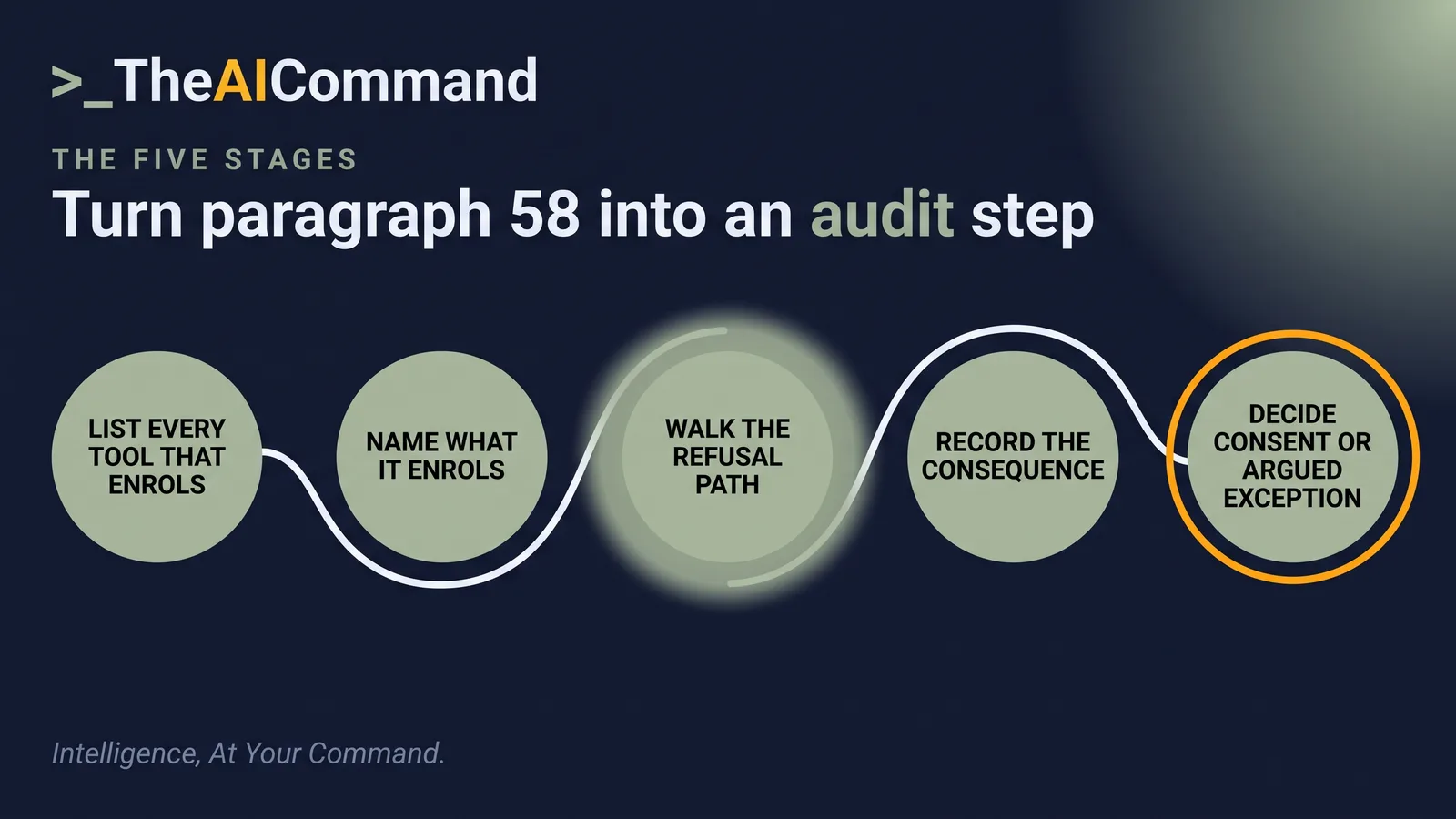
The order of work is the five stages below. The inventory prompt produces stages one and two, the refusal path prompt stages three and four, and the accountable owner decides at stage five. The notice prompt runs alongside it, filling the collection notice column.
Three prompts, and the person who signs each one
TheAICommand works to the Verified Draft Method: de-identify the inputs, ground the model in your own source material, keep a person at the decision point, verify against the primary source, and log what happened.
The first prompt surfaces the enrolments nobody registered.
What to check: every cell either quotes the page or says not stated on the page, so delete any cell that summarises what the product probably does. Write in the date you checked yourself, because the vendor's last updated date is not evidence that anybody looked, and fill the accountable owner column by hand, naming a role. Take the not stated rows to the system owner.
The second prompt tests voluntariness the way the Commission and the regulator test it.
What to check: read the detriment labels first and confirm each is tied to a clause rather than an impression, because an unsourced label is the one a reviewer will strike. Confirm every silent line reads the policy is silent and nothing is drafted in its place, because the gap between the policy and what a manager says at the counter is where voluntariness is lost. This is the pass that answers the register's question, could a named worker decline, keep the role, and suffer no detriment, and an accountable person signs that answer.
The third prompt attacks the notice, which is where the employer in the case also failed. Paste the text of Australian Privacy Principle 5 from Schedule 1 to the Privacy Act 1988 into the prompt, because the model is told to use nothing else.
What to check: confirm the gap list covers every paragraph of the pasted text, names no matter that is not in it, and names the other entities with access, because the vendor page and the notice frequently disagree and the notice binds the employer. Check that no line offers replacement wording, since a drafted notice needs a human author and a review date.
Do this Monday
The artefact is the biometric enrolment register, the eight columns above, in whatever tool the team uses.
The owner is the human resources systems or operations lead. The administrator settings usually sit with information technology, but only HR can state what a worker is told on declining and whether the consequence is a detriment.
The first step fits in an hour, working from vendor documentation pages and the settings an administrator can already see:
- write one row for every tool in the stack that creates or stores a template of a face, a voice, a fingerprint or palm, or a behavioural pattern;
- fill four columns only, being tool and feature, what it enrols, the enrolment trigger, and the default state quoted from the page with the date you looked;
- leave the other four visibly blank, including the consequence half of the refusal column, because only the employer's policy text and the second prompt can establish what happens to a worker who declines.
The check is a comparison, not a count. Put the register beside the system list it was built from, confirm every system that enrols anything has a row, and confirm each default state cell either quotes the vendor page or reads not stated on the page. Any default state cell that does neither was written from memory, and that row is walked again against the page. The first not stated row goes to the accountable owner the same week.
A row closes when an alternative path of equal standing exists and declining costs the worker nothing: a card or manual sign in for attendance, manual speaker labelling for meeting tools, an assessor read transcript for candidate tools. Where none exists, the row stays open until the exception under APP 3.4 is written down, dated and signed by the accountable owner, and the enrolment stays off until it is.
The bottom line
A Full Bench of the Fair Work Commission held on 1 May 2019 that a direction to submit fingerprint data was not lawful where the worker did not consent, and said in the alternative that a direction to a person to give consent vests no meaningful right at all. It also held that the employee records exemption does not reach a record that does not yet exist, so the Australian Privacy Principles apply up to the point of collection, and that holding has not been disturbed as at 26 September 2026. Every AI-era enrolment in an HR stack passes through the same step, because a face template for meeting attribution and a fingerprint for a turnstile are both collections of sensitive information before any record exists. The control is a register with one row per enrolling feature and a refusal column, and the test is whether a named worker could decline, keep the role, and suffer no detriment.
This is general information for practitioners, not legal advice, and an organisation takes its own advice on its own facts.
TheAICommand. Intelligence, At Your Command.