
Mandating a tool is a requirement. Requirements have a legal test.
Most AI rollouts are planned as change management and communications. Pick the tool, licence it, train people, set an expectation that it gets used, measure adoption. The rollout itself may also trigger a consultation clause before anyone reaches the legal test below. What almost never appears on the rollout plan is a question with a statutory answer behind it: can every person we are asking to use this actually use it, and if not, what have we done about that?
The Australian Bureau of Statistics recorded 5.5 million Australians with disability in its 2022 Survey of Disability, Ageing and Carers, 21.4 per cent of the population, up from 17.7 per cent in 2018. Among working age people with disability, 56.1 per cent were employed, against 82.3 per cent of people without disability. Disability is already present in almost every workforce of any size, and much of it is not visible to the person running the rollout.
Why is a mandate a legal event?
Section 6(1) of the Disability Discrimination Act 1992 defines indirect disability discrimination. It applies where a person "requires, or proposes to require, the aggrieved person to comply with a requirement or condition", where "because of the disability, the aggrieved person does not or would not comply, or is not able or would not be able to comply", and where the requirement "has, or is likely to have, the effect of disadvantaging persons with the disability".
An instruction that a team will use a named AI assistant to draft, summarise or triage work is a requirement or condition. That is not a stretched reading. It is the ordinary meaning of the words.
Section 6(2) covers the adjacent case. It applies where the person could comply only if reasonable adjustments were made, and the employer does not make them.
Then comes the provision HR should build its process around. Section 6(3) says subsections (1) and (2) do not apply "if the requirement or condition is reasonable, having regard to the circumstances of the case". Section 6(4) says the burden of proving that reasonableness "lies on the person who requires, or proposes to require, the person with the disability to comply".
The onus sits with the employer. Not with the employee who could not use the tool. That single allocation is why an AI rollout needs an evidence trail created before go-live rather than an explanation assembled after a complaint.
The adjustments duty, and where it stops
Section 5(2) makes a failure to make reasonable adjustments a form of direct discrimination where that failure means the person is treated less favourably because of the disability. Section 5(3) removes a common objection in advance: circumstances "are not materially different because of the fact that, because of the disability, the aggrieved person requires adjustments".
Section 4 defines the outer limit. An adjustment "is a reasonable adjustment unless making the adjustment would impose an unjustifiable hardship on the person". Section 11(1) lists what a court weighs on hardship, including the nature of the benefit or detriment to anyone concerned, the effect of the disability, the employer's financial circumstances and the estimated expenditure required, the availability of financial and other assistance, and any relevant action plans given to the Commission under section 64. Section 11(2) again puts the burden on the party claiming hardship.
Section 15 is the employment provision. Section 15(1) reaches the arrangements made for determining who should be offered employment, the decision itself, and the terms on which employment is offered. Section 15(2) reaches the terms and conditions afforded to an employee, "denying the employee access, or limiting the employee's access, to opportunities for promotion, transfer or training, or to any other benefits associated with employment", dismissal, and "subjecting the employee to any other detriment".
Read section 15(2)(b) next to a typical AI rollout. If proficiency with a specific AI tool becomes the route to interesting work, to a development pathway, or to the projects that get noticed, and a person cannot use that tool because of a disability and no adjustment was offered, the connection to that paragraph is short.
One thing to be accurate about. The DDA does not impose a positive duty in the way the Sex Discrimination Act does for sex based discrimination and harassment. There is no standing obligation under the DDA to take proactive measures policed by a regulator. The DDA works through the discrimination prohibitions and the adjustments duty, and it bites when someone brings a complaint. That distinction matters because it changes the risk shape, not the good practice.
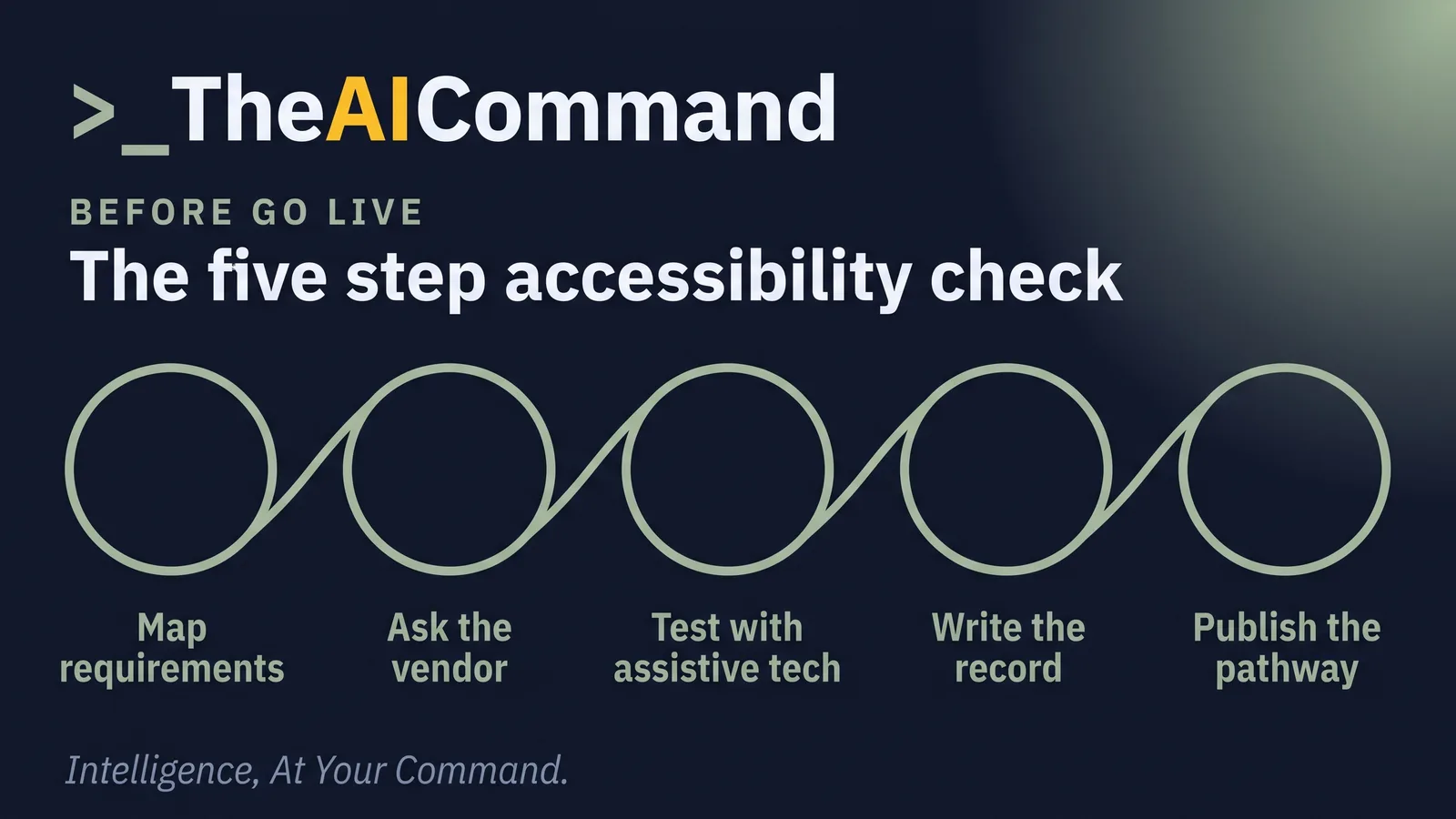
The accessibility check to run before go-live
This is a five step pass. It takes a working session, not a project.
1. List what the tool actually requires of a person. Not features. Requirements. Does it need sustained reading of dense output on screen. Does it rely on colour to convey meaning. Is voice input the fast path. Does the interface work with a screen reader end to end, including the parts vendors often miss such as streaming responses and modal dialogs. Does it require fine motor control or rapid switching between panes. Is there a time pressure built into how it is used.
2. Ask the vendor for the accessibility conformance statement, in writing. Most enterprise vendors publish one against WCAG. Ask specifically about the AI surfaces rather than the general product, because chat panes, streaming text and generated tables are frequently the least tested parts. File the answer. If there is no answer, that is also evidence, and it belongs in the record.
3. Test with real assistive technology, not a checklist. A short session with a screen reader and keyboard only navigation on the three workflows you are actually mandating will tell you more than a vendor document. Where you have employees who use assistive technology and are willing to help, involve them and pay for their time.
4. Write the reasonableness record. One page. What the requirement is, why the organisation is imposing it, what alternatives were considered, what the accessibility testing found, what adjustments are available, and who approved it. This is the section 6(4) evidence. Create it while the reasoning is real.
5. Publish the adjustments pathway with the rollout, not after it. People should not have to disclose a disability to a project team to find out whether an alternative exists. Name the contact, state that alternatives are available, and make clear that not using the tool through an agreed adjustment carries no performance consequence.
You can use an AI assistant to prepare the first draft of the requirements list and the reasonableness record. Claude or ChatGPT will produce a competent structure from a description of the tool and the workflows. What it cannot do is the testing, and it cannot tell you what your people need.
A worked example
[TEAM] is moving to an AI assistant for first draft case summaries. The rollout note says every summary will be drafted in the tool from 1 September.
The requirements list surfaces three things. The tool streams its output as live updating text, which some screen readers announce erratically. The comparison view uses colour alone to mark changed text. The keyboard shortcut to accept a draft conflicts with a common voice control command.
[EMPLOYEE_NAME] uses voice control and a screen reader. Under the mandate as written, they either work far more slowly than peers or stop using an approved workflow, and either outcome shows up in their performance record.
The reasonable response is not to exempt [EMPLOYEE_NAME] quietly. It is to record the three defects, ask the vendor for a fix timeline, provide an agreed alternative workflow that produces the same output at the same standard, confirm in writing that the alternative is fully acceptable, and adjust the mandate language from "every summary will be drafted in the tool" to a statement about the output standard rather than the instrument. Then note the whole sequence in the reasonableness record.
The adjustment is cheap. The version where nobody asked, and it surfaces in a complaint eighteen months later against a performance file, is not.
The same test, one step earlier
Section 15(1)(a) reaches "the arrangements made for the purpose of determining who should be offered employment". That is the recruitment process itself, not just the hiring decision.
AI has moved into that process as an instrument candidates are required to operate. Asynchronous video interviews with generated follow up questions. Timed assessment platforms. Chat based screening that expects a candidate to hold a conversation at pace. Each is a requirement or condition imposed on the candidate, and the section 6 analysis runs the same way, with the same reverse onus under section 6(4).
The practical difference is that candidates are far less likely to ask for an adjustment than employees. They have no relationship with the organisation, no confidence that disclosure is safe, and a rational fear that asking marks them out. A process that only makes adjustments available on request will therefore look compliant and quietly exclude people.
The fix is not complicated. State the alternative pathway in the advertisement and again in the invitation, before any assessment begins. Name a contact who is not the hiring manager. Allow extra time as a default option rather than an exception that must be justified. Keep the accessibility testing evidence for the assessment tool alongside the tool's other documentation, because it is the same section 6(4) record.
When the tool genuinely is necessary
Sometimes the requirement is reasonable and the answer is not an exemption. A regulated workflow may require a specific system. Section 6(3) exists for exactly that case, and an employer who can prove reasonableness is entitled to rely on it.
The record that supports that position should say what the business need is in operational terms, why an alternative instrument would not produce an equivalent outcome, what adjustments were made available within the tool, and what support was funded. Section 11(1)(c) and (d) make expenditure and the availability of assistance relevant to hardship, so an employer relying on cost should know what the adjustment would actually cost and what external assistance exists, rather than asserting it is too expensive.
What not to automate away
Do not let an adoption dashboard become a performance signal on its own. Low usage by an individual may be a disability, a caring arrangement, a legitimate professional judgement, or a defect in the tool. A metric cannot tell those apart and a manager acting on the metric alone is making a decision on an unexamined inference.
Do not ask an AI system to decide whether an adjustment is reasonable. That determination weighs the person's circumstances, the operational context and the organisation's capacity. Section 11 makes it a whole of circumstances judgement carrying a legal burden. It belongs to a person who can be asked to explain it.
Do not collect disability information through the rollout that you did not need and cannot justify holding. An accessibility check is about the tool, not about auditing who has what condition.
And do not treat a vendor's accessibility claim as your compliance. The requirement is imposed by you. The burden under section 6(4) is yours.
Bottom line
An AI rollout is a change to the conditions of work. The law that governs changes to the conditions of work did not pause while the tooling changed. The test is not whether the tool is good. It is whether requiring it was reasonable, and whether the people who could not comply were offered a real alternative before it cost them anything.
That is a question with a documented answer or no answer at all. Write it down before go-live.
Do this Monday
- List what each mandated tool requires of a person. Reading load, colour reliance, voice input, screen reader coverage end to end, motor control and built-in time pressure, for the workflows actually being mandated.
- Ask every vendor for the accessibility conformance statement in writing. Ask specifically about the AI surfaces, and file the answer. No answer is also evidence, and it belongs in the record.
- Book one assistive-technology test session. A screen reader and keyboard-only pass on the three mandated workflows, with employees who use assistive technology involved and paid for their time.
- Write the one-page reasonableness record. The requirement, why it is imposed, alternatives considered, what testing found, what adjustments are available and who approved it. That is the section 6(4) evidence.
- Publish the adjustments pathway with the rollout, and add the alternative pathway to live recruitment advertisements. Name a contact, state that alternatives exist, and make clear an agreed adjustment carries no performance consequence.
TheAICommand. Intelligence, At Your Command.