
HR teams can use an approved AI assistant to build and run fictional practice simulations, but a person, not the model, decides whether anyone passed, is competent or faces an employment consequence. Synthetic practice needs a real employment boundary.
Practice simulations are useful because work rarely arrives as a clean policy question. A manager needs to recognise a weak performance claim inside a tense conversation. A recruiter needs to challenge an apparently neutral criterion. An HR adviser needs to ask for the missing fact before recommending the next process step.
Generative AI can play the other person without tiring, reset the conversation and introduce a realistic complication. That makes practice cheaper to repeat. It does not make the model an assessor, and it certainly does not make a chat score an employment decision. This is a capability-building workflow: AI builds and runs the rehearsal, and an authorised person owns every standard, every piece of evidence and every pass.
What can AI actually do in a practice simulation?
General-purpose tools such as ChatGPT, Claude, Gemini and Copilot can follow a role brief, respond to a learner's questions and generate variations. In HR, that can support rehearsal for consultation meetings, difficult feedback, candidate conversations, policy explanations and escalation practice, in the same way a manager might rehearse a hard conversation with AI before holding it. The useful capability is controlled interaction, not automated judgement.
The privacy risk appears even when the prompt says "fictional". The Office of the Australian Information Commissioner's guidance on privacy and commercially available AI products records a work health and safety training company that used an AI chatbot to generate fictional psychosocial hazard scenarios for a course delivered at an Australian prison. One "fictional" case study turned out to be a real scenario involving a former employee, complete with the full names of the people involved and details from an ongoing court case. The OAIC warns that personal information can appear in both AI inputs and outputs, and recommends as best practice that organisations do not enter personal information, particularly sensitive information, into publicly available generative AI tools.
The answer is not better redaction after the fact. HR builds wholly synthetic scenarios, uses an approved environment and reviews every output before it reaches a participant.
Assessment also needs an external standard. For nationally recognised vocational education and training, ASQA's assessment practice guide under the revised Standards for RTOs requires assessment systems consistent with the principles of assessment, fairness, flexibility, validity and reliability, and the rules of evidence, so that assessors reach accurate and consistent judgements of competency. Those rules apply to RTO assessment, not to every internal HR exercise. The design lesson still travels: define what good performance looks like before the model starts improvising.
The practitioner play
Build the simulation as an HR workflow with six controlled steps.
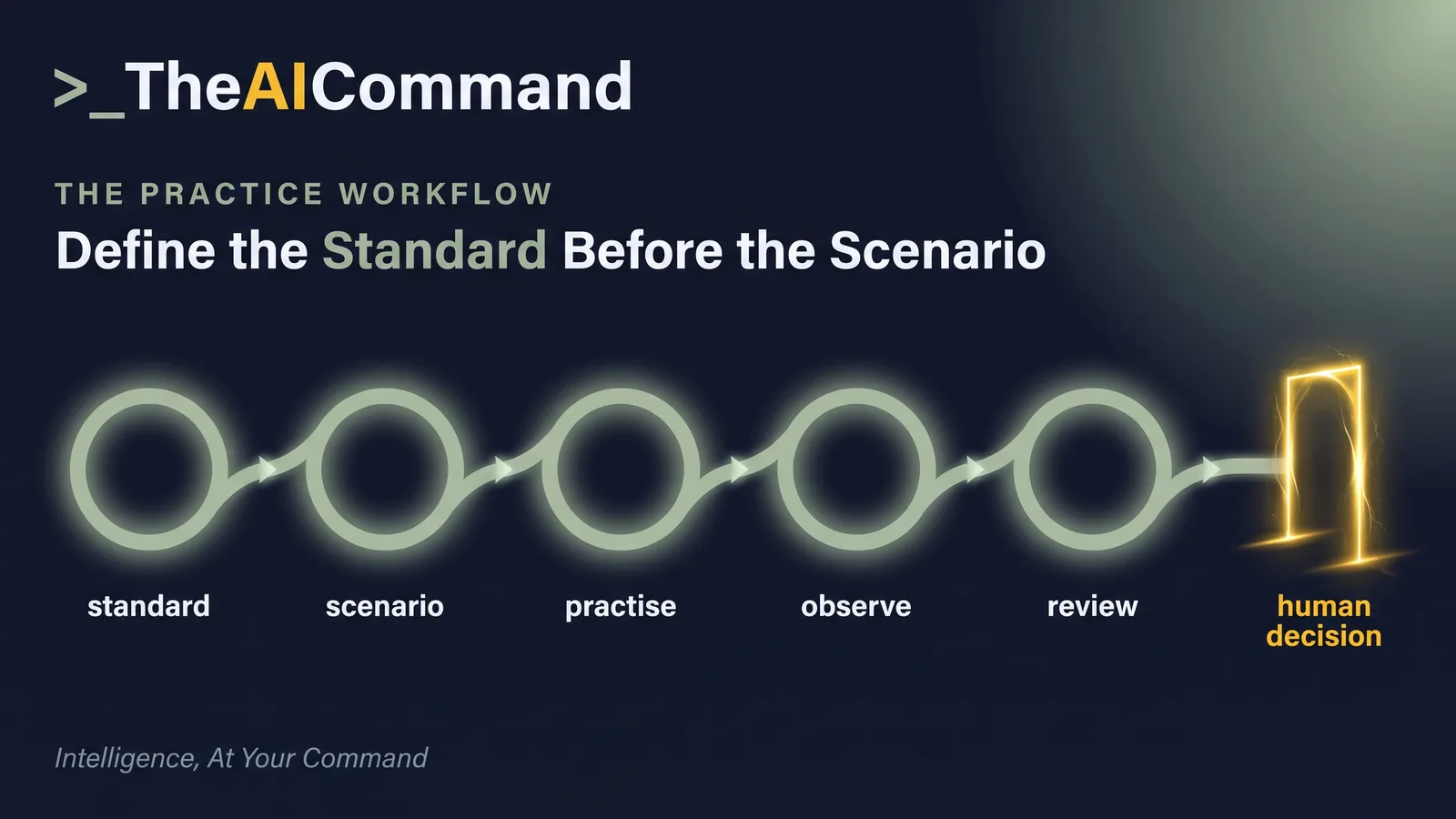
1. Name the practice purpose
Start with the behaviour the employee or manager needs to practise. "Improve difficult conversations" is too broad. "State the observed behaviour, explain the work impact, ask for the employee's perspective and agree a review point" is observable.
Record whether the exercise is coaching, capability development, formal assessment or preparation for a real meeting. Consequence determines control. A voluntary rehearsal can allow retries and hints. A result used in performance, promotion, accreditation or work allocation needs a formal standard, stronger evidence and qualified advice.
2. Write the human standard first
Set three to six observable criteria and one or two critical errors before asking AI for a scenario. A criterion should describe what a reviewer can see or hear. Avoid personality labels such as confident, committed or culturally aligned.
For each criterion, state the evidence, who observes it, what context matters and who can decide the outcome. Where safe task performance or a regulated qualification is involved, use the applicable workplace, training-product and jurisdictional requirements. A generic AI rubric is not a substitute.
3. Create a synthetic scenario envelope
Use placeholders such as [EMPLOYEE_NAME], [MANAGER_ROLE], [TEAM], [WORKPLACE_ISSUE] and [REVIEW_DATE]. Invent the facts. Do not copy a memorable employee case and change the name.
The envelope should state:
- the learner's role and objective
- facts available at the start
- facts revealed only after appropriate questions
- allowed emotional and factual variation
- prohibited personal or sensitive content
- stop conditions and an escalation path
- an instruction not to coach or score during the attempt
The National AI Centre's Guidance for AI adoption asks organisations to set clear roles for how AI is governed and used, define acceptance criteria and test methods before deployment, and give people a documented way to report faults, contest outcomes and escalate. Treat the role-play as a small workflow that needs the same discipline.
4. Separate practice from assessment
Practice mode can allow pause, retry, coaching and different branches. Assessment mode, if genuinely required, needs stable conditions, a versioned scenario, known evidence rules and an authorised human observer. Do not quietly turn a practice transcript into a performance rating.
Tell participants what the AI does, what is recorded, who can see it, how long it is retained and whether the exercise affects any employment decision. Give them a way to report an inaccurate or inappropriate response. If reasonable adjustments are needed, a person decides how to preserve the practice purpose without disadvantaging the participant.
5. Debrief from evidence
AI may draft a transcript summary or place quotes beside the criteria. Require source quotes and leave every rating blank. The facilitator checks whether the model omitted a question, invented an intent or softened a harmful statement.
The human debrief should ask what the participant noticed, what they would change and what support would help. Coaching can be direct without becoming a hidden disciplinary process. If the exercise reveals a real workplace concern, stop the simulation and move it into the organisation's approved HR, WHS or reporting pathway.
6. Pilot, challenge and version
Run the scenario with several capable practitioners. Test whether the model rewards the intended behaviour, keeps hidden facts hidden and stays inside the difficulty range. Change demographic details that should not affect the response and look for different treatment. Test accessibility, technical failure and an attempt to push the character outside the role.
Record the prompt, model, settings, rubric, pilot date, approved owner and change history. Recheck after a material model or prompt change. Human review does not rescue a biased scenario or a vague standard. The design itself needs evidence.
A controlled prompt sequence
Use an approved enterprise tool and keep the model in the simulator lane.
Then use a separate review prompt:
A worked example
[MANAGER_ROLE] is practising an initial underperformance conversation with fictional [EMPLOYEE_NAME]. The approved standard requires the manager to describe a specific observed behaviour, explain its effect, invite a response, listen without prejudging the cause and agree a clear next step.
The scenario envelope tells the AI character to become defensive if the manager labels attitude or intent. A workload fact is revealed only if the manager asks an open question. No real performance file, health information or team history is used.
During the first practice attempt, the manager says, "Your commitment has dropped." The AI character challenges the label. The facilitator pauses the exercise and asks the manager to return to observable facts. On the second attempt, the manager names two missed handovers, explains the service impact and asks what contributed.
AI produces a transcript map with the relevant quotes and blank criteria. The HR facilitator reviews the evidence, adds context and gives coaching. Nobody records a pass, performance rating or disciplinary conclusion. If the issue later becomes part of a real performance process, the organisation follows its normal fair process. The Fair Work Ombudsman's managing underperformance best practice guide sets that out in five steps: identify the problem with specific examples, assess and analyse it, meet with the employee and let them respond with a support person if they choose, agree on a solution together, then monitor and review, with documentation throughout.
The simulation prepared the manager for a better conversation. It did not decide anything about the employee.
Use the evidence to improve support
Measure whether the simulation improved the work, not whether it produced an impressive transcript. Useful indicators include the proportion of participants who identify the critical fact, the quality of questions asked, facilitator agreement on observable evidence, participant confidence after debrief and scenario failures found during pilots.
Do not publish a leaderboard of AI scores. A lower result may reflect an inaccessible interface, inconsistent branching, unclear instructions or a model failure. Review the scenario before attributing the outcome to the person. Where several participants miss the same step, check the procedure, training and role expectations as well as individual capability.
Use aggregated findings to improve learning design. Keep individual development notes proportionate to the stated purpose and existing HR process. If a simulation becomes evidence for a consequential decision, stop and confirm authority, notice, evidence quality, review rights and specialist advice before proceeding.
Where does the governance line sit?
Privacy starts before the prompt. Use synthetic facts wherever possible. If a recording or transcript is necessary, collect the minimum, explain the purpose, limit access and set retention and deletion rules. The OAIC is explicit that inferred, incorrect or artificially generated information about an identified or reasonably identifiable individual still constitutes personal information. Treat generated observations with the same care as uploaded material.
Fairness requires more than a human clicking approve. Check whether the scenario or rubric rewards one communication style, penalises disability-related behaviour, assumes cultural norms or makes speed a hidden criterion. The Australian Human Rights Commission's AI and recruitment compliance checklist, developed with LexisNexis, groups its questions under privacy and data protection, digital robustness and safety, fairness and transparency including the ability to challenge unfair outcomes, and accountability with humans kept in control of decisions. The checklist is recruitment-specific, but those safeguards are useful wherever HR uses AI around consequential people decisions.
Keep the roles explicit. AI creates or runs the scenario. A facilitator protects the conditions. A qualified or authorised person interprets evidence. The accountable manager or assessment body makes any consequential decision under the applicable framework. Participants need a route to question the record and request review.
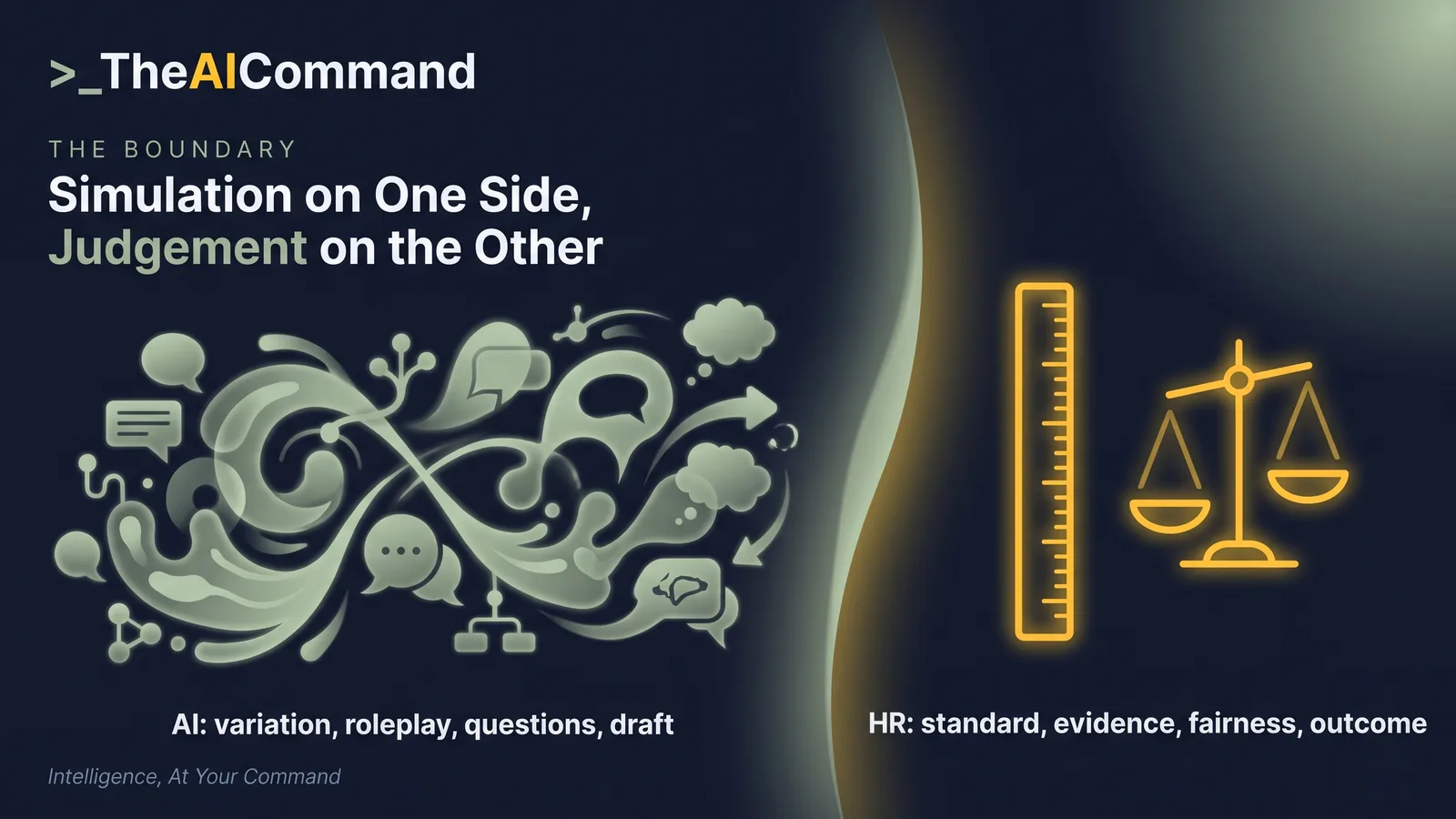
What should you never let AI automate?
Do not let the model:
- award a pass, competence finding or professional sign-off
- create a performance rating, promotion recommendation or disciplinary conclusion
- infer attitude, honesty, disability, health, caring status or cultural fit
- compare employees using conversational style or prompt skill
- turn a voluntary practice transcript into an employment record without notice and authority
- invent realism from real employee, candidate, claimant, customer or student data
- decide whether a reasonable adjustment preserves the required standard
The same boundary applies when using AI note-takers in HR meetings or structuring an AI-assisted workplace investigation. AI may organise evidence. People own the relationship, the judgement and the consequence.
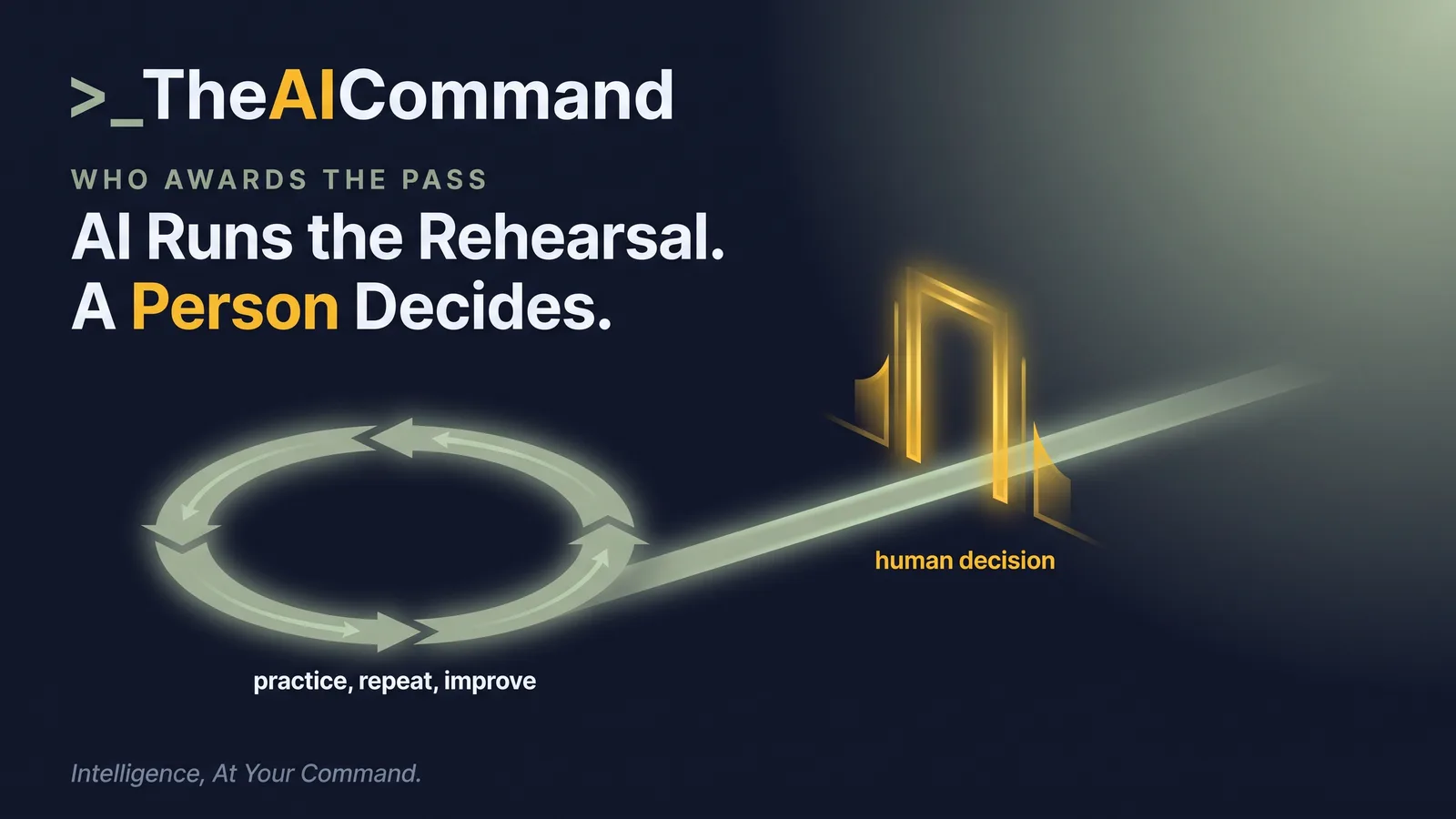
A good simulation programme is judged the same way as any other HR control. The standard was written first, the facts were synthetic, the participants knew the rules, and a person signed every outcome. Build that spine once and AI becomes exactly what it is good at here: a tireless sparring partner inside a boundary that people own.
Bottom line
AI is a tireless sparring partner for workplace practice, but it is not an assessor. Write the observable standard first, keep every scenario synthetic, tell participants the rules and make sure an authorised person signs every outcome. The judgement, the context and the consequence stay with people.
Do this Monday:
- Name one practice purpose in observable terms before opening any AI tool.
- Write three to six observable criteria and one or two critical errors as the human standard.
- Build the scenario from synthetic placeholders such as [EMPLOYEE_NAME] and [WORKPLACE_ISSUE], never a real file.
- Keep practice mode and assessment mode separate, and tell participants what is recorded and who can see it.
- Leave every rating blank for an authorised human reviewer to decide.
TheAICommand. Intelligence, At Your Command.