
The clock you are watching is the wrong one.
On 12 August 2026 the Fair Work Commission decided its first arbitrated dispute about an employee choice notification. Commissioner Crawford noted in Baker v Macquarie University [2026] FWC 3054 that the casual employment conditions in question "commenced operating on 26 August 2024 and do not appear to have been considered in any previous decisions". Two years of a live entitlement before anyone saw how it is applied. Three weeks later the same Commissioner applied it again.
The outcome matters. What it changes about your process is one subsection nobody has been reading.
What the Commission actually decided
The applicant taught in a university school of computing from 2023. On 5 November 2025 he gave written notice under section 66AAB of the Fair Work Act that he believed his employment no longer met the requirements of casual employment. The university did not accept the notification. The dispute was lodged on 23 December 2025, went to a conciliation conference on 27 January 2026 that did not resolve it, and was arbitrated across hearings in March, May and August 2026.
The Commissioner found the applicant did not meet the section 15A definition of a casual employee at the date of the notification, and ordered that he be treated as a 0.1 FTE part-time employee from 28 days after the decision, which fell on 9 September 2026, with the hours averaged across 12 months but paid consistently.
Two details are worth holding onto. First, the applicant was engaged, in the decision's words, "under a reasonably standard casual employment contract which expressly refers to no guarantee of ongoing work", and that did not settle the question. Second, the applicant represented himself, against counsel and an employer association.
The subsection that changes your process
Section 66MA(5)(b) requires the Commission to "disregard conduct of the employer and employee that occurred after the employee gave the notification under section 66AAB ... to the employer."
It was not academic here. It emerged in closing submissions that the applicant's teaching arrangements had changed in Semester 2 of 2026, well after the notification. The Commissioner held he was required to disregard evidence about it, and put the principle plainly: "the Commission cannot take account of any conduct engaged in after the notification is made. The dispute must be resolved based on an assessment of the facts that existed when the employee made the notification to the employer."
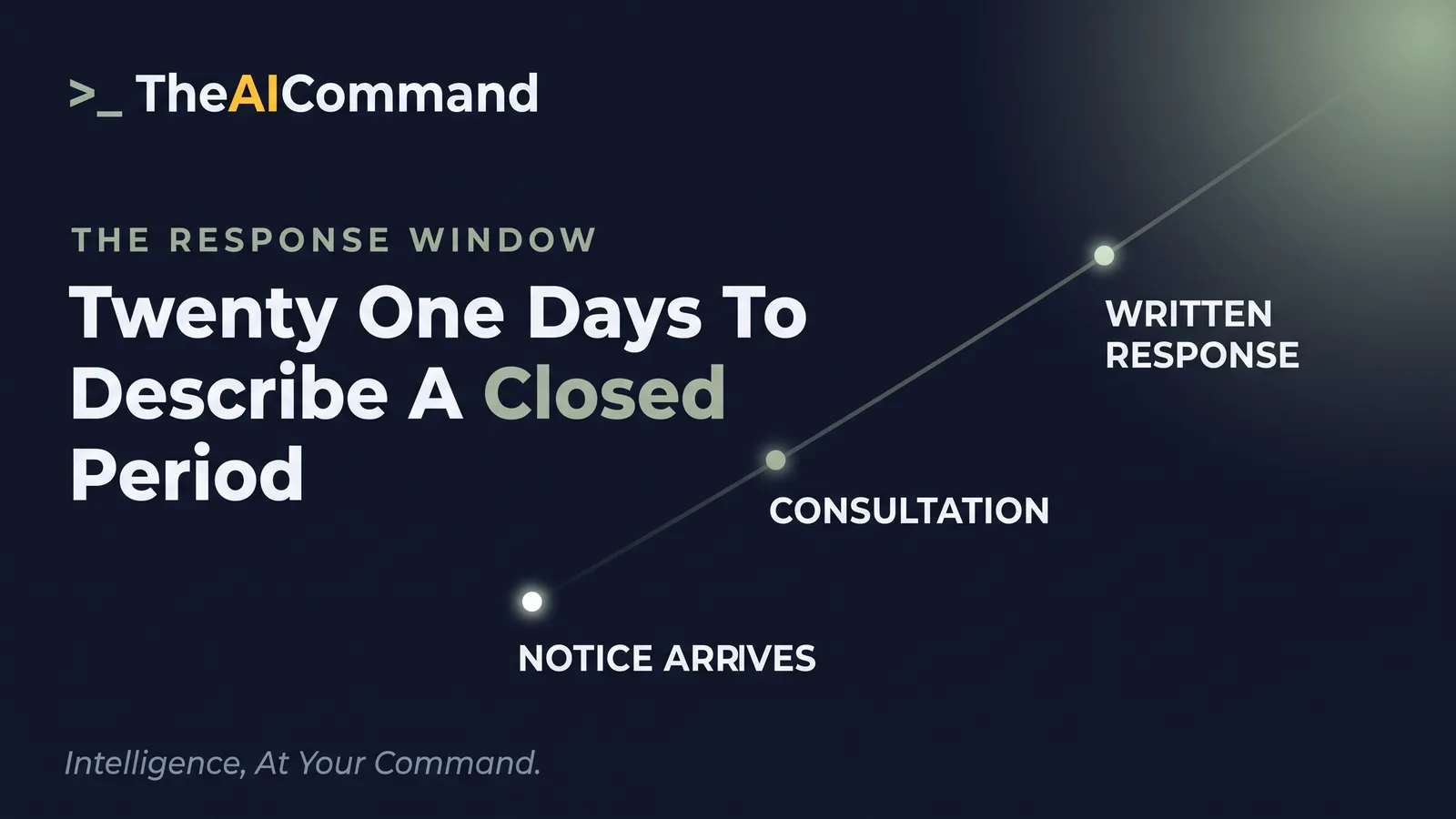
Read that as an operational instruction rather than a legal nicety. The moment a notification arrives, the assessable period closes. Everything after it belongs to a different conversation.
Three weeks later the same Commissioner applied the same rule again, and harder. In Fedele v Technical and Further Education Commission [2026] FWC 3338, decided 2 September 2026, both sides had filed substantial evidence about conduct after the notification date and all of it was disregarded. The applicant was "particularly aggrieved about his hours being dramatically reduced in 2026 and allegedly allocated to another casual employee". The employer had filed its own evidence about how it allocated that same workload. Neither reached the decision. The rule cut both ways in a single case, which is the clearest demonstration yet of what it does. The orders in Fedele are not settled: the Commissioner expressed a provisional view on hours and directed the parties to confer, with a report due to chambers on 16 September 2026.
Which means the two instincts most employers have are both wrong. Reducing someone's hours after a notice arrives will not change the pattern the Commission assesses, and it exposes you elsewhere in the Act. Offering a slightly better arrangement in the hope the question goes away will not change it either. Neither is visible to the decision-maker.
So what are the 21 days for?
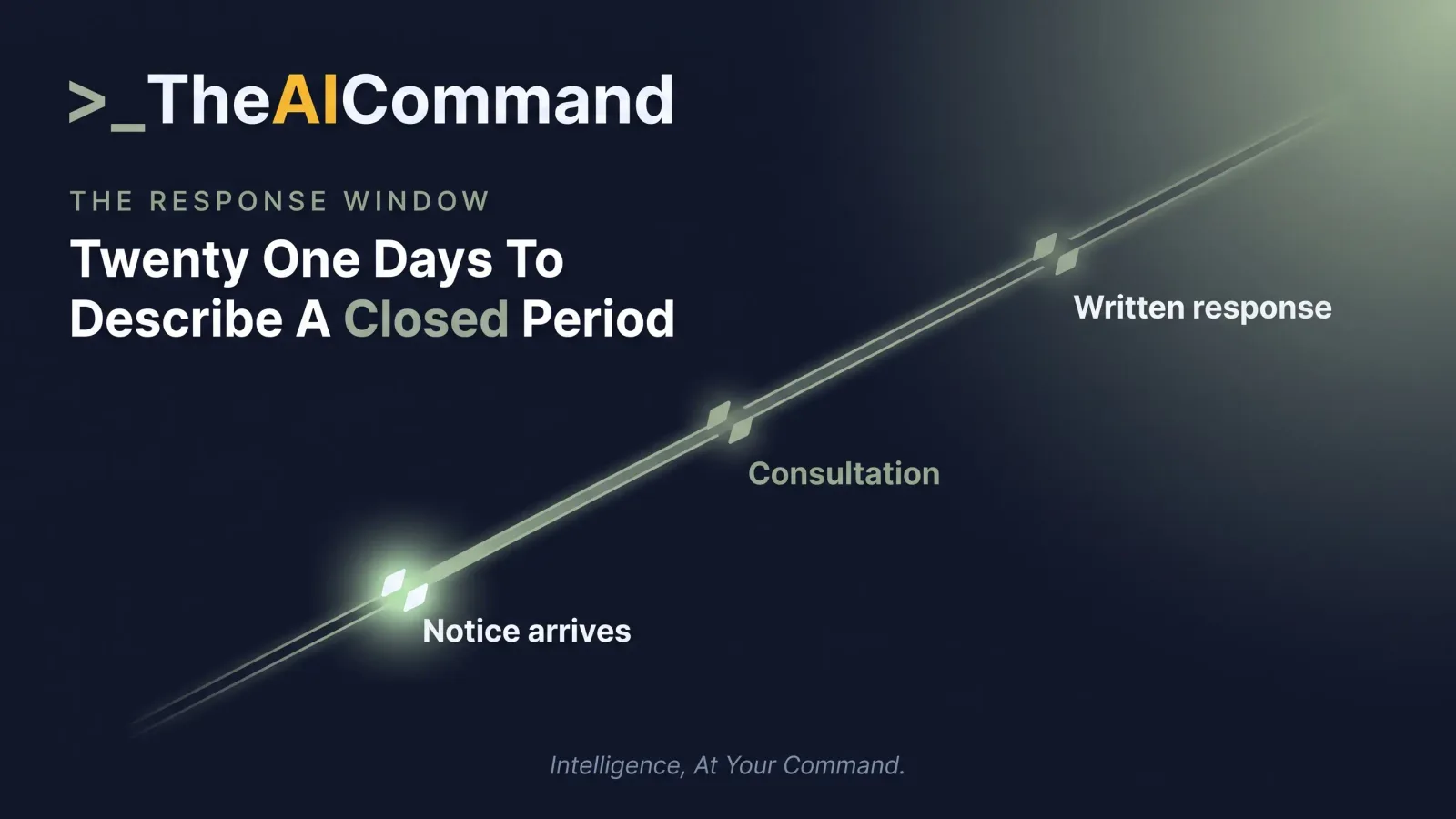
Section 66AAC(1) requires a written response within 21 days, and section 66AAC(3) requires you to consult with the employee before providing it. If you accept, section 66AAC(2)(b) requires details of the proposed arrangements, and section 66AAC(3) requires you to discuss them. If you do not accept, section 66AAC(2)(c) requires the reasons to be set out in the written response.
Those 21 days are not a negotiation window. They are an evidence window about a period that has already ended, and the response you write in them is the document that gets tested.
The grounds are constrained too. Section 66AAC(4) is a closed list of three. You may decline the notification on the ground that, having regard to section 15A(1) to (4) and the current relationship, the employee still meets the casual definition. You may decline on fair and reasonable operational grounds, which the Baker decision summarises as including substantial changes to the way work in the enterprise is organised, significant operational impacts on the enterprise, and substantial changes to the employee's terms and conditions reasonably necessary to ensure you do not contravene a fair work instrument. Or you may decline because accepting would put you outside a recruitment or selection process required by a Commonwealth, State or Territory law. Nothing else counts.
The first of those is the ground both decided cases turned on, and it is worth seeing it for what it is. It is not an opinion about how the arrangement is labelled. It is a factual claim about the real substance of the relationship on the day the notice arrived.
An operational-grounds refusal is a factual claim about your own enterprise. It has to be true, and it has to be evidenced, in a document you write inside three weeks.
What the assessment is actually asking for
The Baker decision summarises the considerations the Act requires to be assessed, none of them determinative, and then works through each of them on the facts. That worked example is the most useful part of the decision for anyone preparing a response, because it shows how weight moves.
The overall conclusion at the end of that exercise was that the work looked "potentially more akin to recurring fixed-term periods of part-time employment, rather than genuine casual employment".
Notice what the assessment runs on. Rosters, allocations, timetables, the shape of the work over years, and what other people in the same team are engaged to do. That is all in your systems already, and almost none of it is in the form anyone can read inside 21 days.
The AI play, and where it stops
This is a reconstruction problem with a deadline, which is exactly the work a model does well and exactly the decision it must not make.
A workable sequence, run on de-identified extracts with placeholders such as [EMPLOYEE_NAME], [TEAM] and [MANAGER_NAME]:
- Fix the cut-off first. Set the notification date as a hard parameter and extract only records up to it. If the extract runs past that date, the analysis is answering a question the Commission is not allowed to ask.
- Rebuild the pattern from source systems. Rostering, payroll, allocation and timetable data across the whole engagement, not the last few months. Every figure carries the system and field it came from.
- Assemble against the considerations, one at a time. For each of the four, the records that bear on it and the records that do not exist. Keep them separate.
- Produce the comparator picture. What full-time and part-time employees in the same team are engaged to do, and how their workloads are composed. The decision shows that composition, not job title, is what moved the weight.
- List the gaps in plain words. Where hours cannot be reconstructed, say so. The applicant here gave an estimate of hours because the data was hard to access, and an employer that cannot produce its own figures is in a poor position to contest one.
- Stop. Hand the bundle to the person who will sign the response.
TheAICommand works to the Verified Draft Method: de-identify the inputs, ground the model in your own source material, keep a person at the decision point, verify against the primary source, and log what happened. Here the primary source is your own rostering and payroll record, not a summary of it, and the person at the decision point is whoever puts their name on the section 66AAC response.
What never gets automated
Four things, and each of them is a judgement or a legal position rather than a retrieval.
The status conclusion. Whether the relationship was characterised by an absence of a firm advance commitment is the statutory question, and a model asserting it has simply restated the test in a confident voice.
The refusal reasons. If you are relying on operational grounds, every factual claim in that paragraph has to be one a named person has checked against the records. This is the same discipline that keeps AI-drafted performance documents procedurally fair: the document is the evidence, and an unverified sentence in it is a liability rather than a defence.
The consultation. Section 66AAC(3) requires consultation before the response, and consultation is a conversation with a person. The same boundary applies when an AI rollout triggers your own consultation clause.
The prediction. Do not ask a model how the Commission would decide it. It will answer, fluently, from general material rather than from your records, and the answer will feel like advice.
The other side of the table
One more thing is worth naming, carefully.
The Baker decision does not mention artificial intelligence anywhere. It is not an AI case. But reporting on it does. Writing in The Conversation on 19 August 2026, Genevieve Grant described the self-represented applicant using multiple paid AI agents, including ChatGPT Pro, to assemble his case, follow up references and anticipate the employer's counterarguments, and reported that an AI tool first alerted him to the conversion pathway at all.
Grant is careful about the limits, and so should we be. She notes that the applicant's IT background, his expertise managing AI agents and his ability to optimise their use for his case represent a rare level of expertise in using AI in a legal context. This is not a story about anyone with a chatbot beating counsel.
It is a story about variance. The floor for a well-prepared self-represented applicant has moved, even if the ceiling has not, and the same disclosure and verification expectations now attach to that preparation as to anyone else's, as the Commission's own rules on AI use in cases set out.
The second decision belongs beside the first, because it cuts the other way. The applicant in Fedele also represented himself and also relied on AI. This time the Commissioner said so on the record, and was unimpressed. The material "bore similarities to material filed by self-represented litigants using AI in other cases I have encountered recently", and there is "a growing trend for parties to file extensive AI-fuelled submissions but not to file evidence about the critical factual issues". His reason is the one that matters here: "The evidence needs to come from the relevant witnesses, and the witnesses need to be able to attend a hearing and answer questions about their evidence if required."
That applicant still succeeded on status. What carried him was not his submissions. It was the employer's own witness statement setting out the days and times he taught, which the Commissioner read as evidence of a regular pattern locked in for the semester.
Put the two decisions together and the lesson is the same on both sides of the table. A model can assemble the argument. The case turns on records and witnesses, and the party who cannot produce its own figures is arguing with nothing. The practical implication for an employer is unglamorous: the response you write in 21 days may be read more closely than responses used to be.
Do this Monday
- Find out who owns the 21 days. If a section 66AAB notice arrived today, name the person who writes the response and the person who signs it. If that takes more than a phone call, that is the finding.
- Write the extract rule now. A standing query that pulls rostering, payroll and allocation history for one person up to a supplied cut-off date, and stops there.
- Test it on a volunteer file. Pick a long-serving casual, run the extract, and see whether you can describe the pattern of work over three years without a manager's recollection.
- Check your comparator data. Can you show what permanent staff in the same team are engaged to do, including how their workloads are composed? That moved the weight in Baker.
- Delete the reflex. Put it in writing internally that hours are not to be adjusted in response to a notification, because it cannot help and can hurt.
- Reread your standard casual contract, then set it aside. A clause disclaiming any guarantee of ongoing work did not settle the question here. The practical reality of the engagement did.
Bottom line
The first arbitrated employee choice decision turned on a subsection about evidence, not about casual employment, and the second one turned on it harder. Section 66MA(5)(b) closes the assessable period on the day the notification arrives, so the only thing your 21-day response can do is describe a period that has already ended, accurately, from records you may never have assembled in that form. That is a reconstruction job with a deadline. Use AI for the reconstruction, keep the status call and the reasons with a person, and stop changing facts that the decision-maker is not permitted to look at.
References
- Baker v Macquarie University [2026] FWC 3054 (Commissioner Crawford, 12 August 2026), C2025/13184, at [4], [6], [8] to [14], [22], [30], [32], [33], [42] and [50]. https://www.fwc.gov.au/document-view/decisions/application-by-gregory-david-baker-to-deal-with-a-dispute-about-changing
- Fedele v Technical and Further Education Commission [2026] FWC 3338 (Commissioner Crawford, 2 September 2026), C2026/5167, at [3], [4], [6], [7], [12], [13], [26] and [29]. Provisional view only; the parties were directed to confer and report by 16 September 2026. https://www.fwc.gov.au/document-view/decisions/application-by-flavio-fedele-to-deal-with-a-dispute-about-changing-from
- Fair Work Act 2009 (Cth), ss 15A, 56, 66AAB, 66AAC, 66M and 66MA, as in force under Compilation No. 73 (C2026C00355). https://www.legislation.gov.au/C2009A00028/latest/text
- Genevieve Grant, An 'AI legal team' has won its first case. It's a rare win for access to justice, The Conversation, 19 August 2026. https://theconversation.com/an-ai-legal-team-has-won-its-first-case-its-a-rare-win-for-access-to-justice-289891
TheAICommand. Intelligence, At Your Command.