Most attention on AI in Fair Work matters has gone to parties using it badly in their own submissions. A decision published on 10 August 2026 points somewhere more consequential for HR: at the employer's own process, and at a document type almost every organisation now produces.
In Dr Stephen Linquist v TasTAFE, Commissioner Redford records at paragraph 17 that a manager said his summary of the applicant's alternative proposal, provided to a group he described as the decision-makers, was produced with the assistance of AI.
The Commission found the consultation obligations were fulfilled, that the role was genuinely redundant, and dismissed the application. The AI assistance drew no criticism at all. That is precisely why the document repays attention: it is a clean look at ordinary practice, not a cautionary tale.
What the summary actually did
The applicant led a digital learning team whose work included the development and implementation of artificial intelligence solutions. During consultation he put forward an alternative to the restructure. His full submission and its attachments were emailed to the decision-makers, and a summary went with them.
The decision reproduces that summary, and it is worth being precise about its contents, because "summary" undersells it. The document set out two broad approaches. Option A, Structure-Led Consolidation, was the employer's change proposal: simplified reporting lines, the digital learning team removed as a distinct integrative function, immediate salary savings. Option B, Integrated Work-System Redesign, was the applicant's proposal: learning design accountability embedded, cross-functional lifecycle engagement formalised, operating within the same full-time-equivalent envelope but requiring transitional redesign effort.
It then went further. Under a heading of analysis and recommendations, the document recommended Option B where the priority was long-term system maturity and longer-term cost control, subject to two conditions, one of which was that governance uplift covering AI, lifecycle and decision rights be formalised immediately. Where the priority was budget stability, it recommended the employer's Option A, noting that further restructure would likely be required.
So the artefact that carried an employee's consultation response to the people deciding his role also characterised that response, set it against the employer's preferred option, and made a conditional recommendation between the two. That is three jobs in one document, and only the first of them is summarising.
Why the framing step matters more than the compression
A consultation obligation of this kind is sourced in an enterprise agreement or a modern award, and it requires an employer to give the affected employee a genuine opportunity to respond and to consider that response before the decision is settled. The source matters more than it looks. Under section 389(1)(b) of the Fair Work Act, a dismissal is only a genuine redundancy if the employer has complied with a consultation obligation in a modern award or enterprise agreement. A consultation step that lives only in company policy does not carry that statutory weight, though it can still be relevant to whether a dismissal was harsh, unjust or unreasonable under section 387. In TasTAFE the obligation came from the enterprise agreement, and the term the Commission applied required prompt consideration of matters raised.
The first half of that obligation, the opportunity to respond, is well drilled. The second half, genuine consideration, is where this decision lands, because consideration happens in a person's head and can only ever be proved from the outside. TasTAFE shows the three things that prove it: what the decision-makers were given, evidence that the response was actually discussed at the meeting that followed, and a change in the outcome traceable to the feedback, which here produced a new Senior Applications Specialist role that had not been in the original plan.
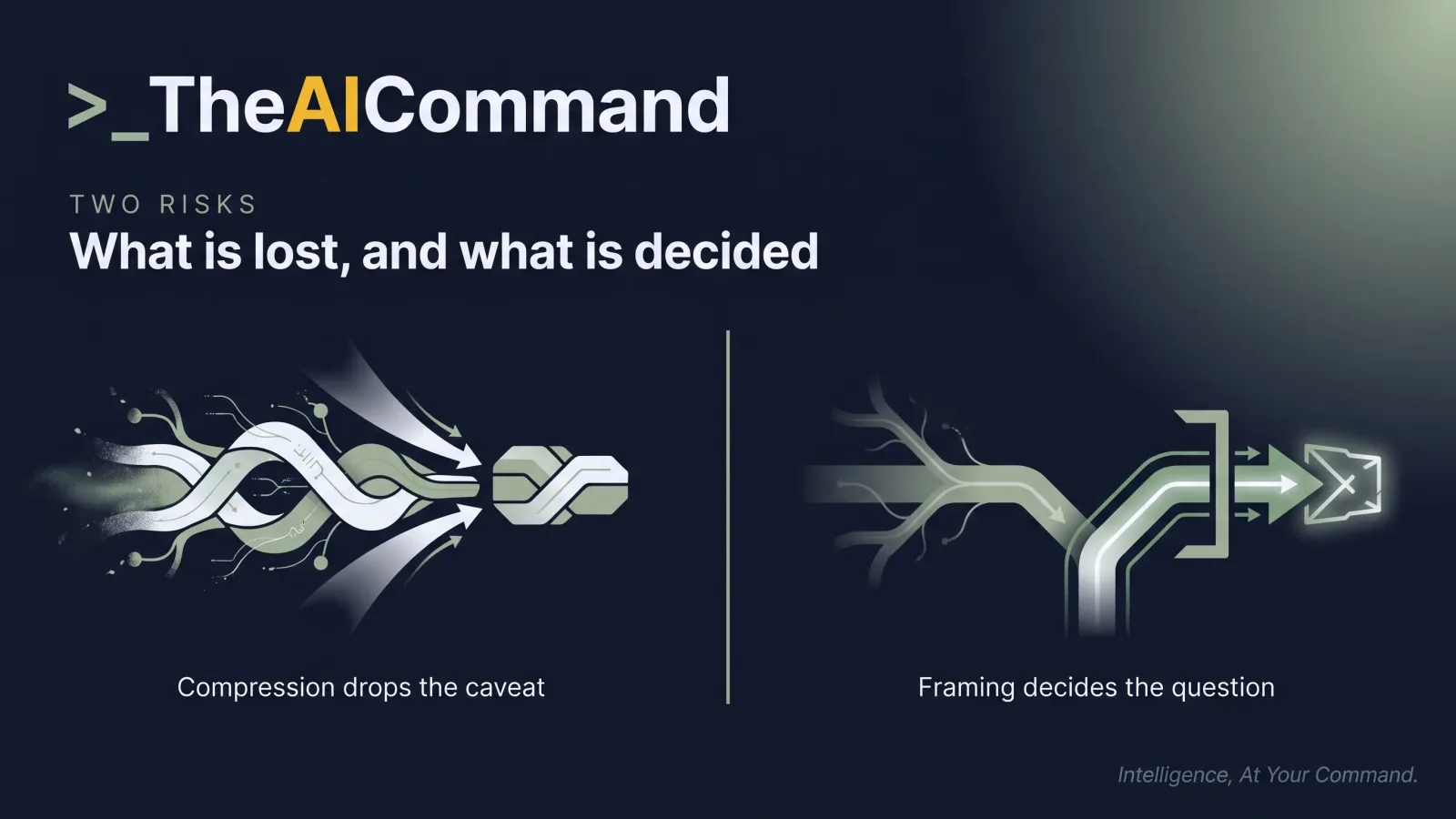
Two distinct risks sit in a document like this, and they need separating.
The first is compression. AI summarisation rarely invents; it omits, and it preferentially omits what carries the least statistical weight and the most argumentative weight, which is usually the condition, the caveat, or the single sentence where an employee accepts most of a change but disputes one assumption. This is the same failure mode covered from the leadership side in what a summary keeps and what it loses. The difference here is the consequence: in a board paper a lost caveat produces a worse decision, while in a consultation it can produce a decision the employer later has to defend as genuine.
The second risk is framing, and it is the larger one. Turning an employee's proposal into "Option B" and setting it against "Option A" is an analytical act with a built-in conclusion, because the choice architecture is doing work before anyone weighs anything. Reduced to two options with a conditional recommendation attached, an employee's argument has already been pre-decided in structure, whatever its merits.
The person best placed to notice either problem is the employee, and the employee never sees the summary, at least not until a hearing.
None of this makes the TasTAFE document improper, and the Commission said so directly. The applicant put exactly this case, arguing the summary and its analysis were unfair and tainted the decision-makers' consideration of his feedback. Commissioner Redford rejected it, finding the manager presented the feedback to the executive fairly, citing "pro's and con's", and that the committee could have continued with the employer's model or adopted the applicant's. The point is narrower and more useful: this is what the layer between an employee's words and a decision-maker's attention now looks like, and most organisations have never described it, let alone controlled it.
What is now on the record
Visibility is the practical change. Once a tribunal reproduces an AI-assisted summary of an employee's consultation response, the practice is established as a thing that happens, a thing worth asking about, and a thing a representative will ask about.
Two other August decisions show the Commission recording AI use as ordinary fact. In a general protections matter published on 6 August 2026, Deputy President Dobson recorded that AI was used to prepare the applicant's case, that case law was incorrectly applied and gave false hope as to the merits, and that the applicant had certified checking the AI work but had in fact read only the excerpts the AI presented. In a stop-bullying matter published on 7 August 2026, Commissioner McKinnon resolved a date conflict by preferring interview notes taken closer to the time, because the submissions and evidence to the contrary appeared to have been prepared with the assistance of artificial intelligence and to be wrong.
Those concern parties in proceedings, which is the territory of the rules the Commission has set out for AI in a case. That guidance is no longer a draft. The Commission published the final Guidance note: Use of generative artificial intelligence in Commission cases on 24 August 2026, and it commences on 20 October 2026, with application and response forms updated by the same date. It sets three requirements: state in the document that GenAI was used and how you used it, check the document so that everything in it is correct and relevant to the case and state that you have done so, and for a witness statement or declaration confirm it is based on your own knowledge, reflects your own words and is true to the best of your knowledge. Every one of those attaches to a document lodged in a Commission case. None of them reaches an employer using AI inside its own consultation process, so the guidance does not touch the TasTAFE summary at all.
The gap is the point. No rule requires an employer to disclose that a consultation summary was AI-assisted. There is only an evidentiary reality: a document created in a consultation process is a document that can be produced, and this one was.
It is also a reminder that these documents surface through the witness box rather than through any disclosure obligation. No rule required the manager to say how the summary was made. It came out because the applicant made the summary the centre of his consultation complaint, the manager described his own process in evidence, and he was questioned on it at hearing. That is the realistic path: the person best placed to challenge a summary is the person it summarises, and here he did. An organisation that would not want a step described in that setting should change the step, not hope it stays unexamined.
What HR should do about the framing layer
The answer is not a prohibition. It is three controls, and none of them is expensive.
Attach the original, always. Wherever a summary of an employee's response goes to a decision-maker, the employee's own words travel with it in full. In TasTAFE the full submission and attachments did go to the group, which is the right practice and worth naming as the standard rather than leaving to chance.
Separate summarising from recommending. A document that condenses an employee's proposal should not also be the document that recommends between options. Splitting them costs one extra file and preserves the thing that matters, which is that the decision-maker weighs the employee's case rather than reading a verdict on it. If a recommendation is needed, it should be authored by a named person who owns it.
Record who prepared it and how. A one-line provenance note is cheap now and valuable later. It is the same discipline already applied to AI-assisted performance documents, extended to the consultation file.
The accountability point underneath the third control is the one worth taking to managers. In this matter the summary came with a named witness who could speak to it, explain how it was produced and be questioned on it. That is the standard to hold. A recommendation that reaches decision-makers without a person willing to say "I formed that view, and here is why" is a recommendation nobody owns, and an organisation only discovers the gap when someone has to give evidence about how the decision was actually made. Naming the author costs a line and settles the question in advance.
Two smaller moves make those stick. Change the instruction: ask for every distinct point the employee made, including the ones that disagree, with conditions flagged separately, rather than a short narrative or a set of options. What HR wants from the tool is an index of the response, not a replacement for it or a verdict on it. Then check what the consultation file would actually produce if requested: the response received, the version the decision-makers read, and the dates of each. That is the same records discipline a restructure already demands under the consultation and selection obligations that bite when roles change, and it is far easier to build before a matter than during one.
There is a quiet detail in these facts worth sitting with. The team whose disestablishment was proposed did AI implementation work. The consultation feedback supported retaining AI integration capability. The summary of the incumbent's counter-proposal was itself AI-assisted, and it recommended that governance over AI and decision rights be formalised immediately. Organisations are already running these tools on the processes that decide people's jobs, including the jobs about the tools. That is not a scandal. It is simply further along than most HR policies assume.
Bottom line
A tribunal has reproduced, without criticism, an AI-assisted document that summarised an employee's consultation response, compared it against the employer's own option and recommended between them, on its way to the people making the decision. The employee challenged that document and lost, which is what makes it useful. Keep the employee's original words travelling with any summary, stop letting one document both compress and recommend, and record who made it and how.
Do this Monday
- Find every point in a consultation, restructure, grievance or investigation process where an employee's written response is summarised before it reaches a decision-maker
- Make attaching the employee's original response mandatory wherever a summary goes to a decision-maker, so both documents always travel together
- Split the summary from the recommendation, so no single document both characterises an employee's position and advises which option to take
- Add a one-line provenance note to summary templates recording who prepared it and whether AI assistance was used
- Rewrite the summarising instruction to ask for every distinct point including disagreements, with conditions flagged separately, rather than a set of options with a preference attached
- Check what your consultation file would produce if requested: the response received, the version the decision-makers read, and the dates of each
- Review whether your AI policy addresses summarising material an employee authored, since most policies cover drafting and are silent on compression and framing
Primary sources
- Fair Work Commission, Dr Stephen Linquist v TasTAFE, [2026] FWC 2258, Commissioner Redford, 10 August 2026, at [17], [19], [55] to [57]. https://www.fwc.gov.au/documents/decisionssigned/pdf/2026fwc2258.pdf
- Fair Work Commission, Ms Wayan Buschman v Good To Great Schools Australia, [2026] FWC 2975, Deputy President Dobson, 6 August 2026, at [2]. https://www.fwc.gov.au/documents/decisionssigned/pdf/2026fwc2975.pdf
- Fair Work Commission, Application by Ms Katrina Harper, [2026] FWC 2996, Commissioner McKinnon, 7 August 2026, at [7]. https://www.fwc.gov.au/documents/decisionssigned/pdf/2026fwc2996.pdf
- Fair Work Commission, Guidance note: Use of generative artificial intelligence in Commission cases, published 24 August 2026, commencing 20 October 2026. https://www.fwc.gov.au/documents/resources/guidance-note-use-of-generative-ai-in-commission-cases.pdf
- Fair Work Commission, Use of AI in Commission cases, news item, 24 August 2026. https://www.fwc.gov.au/about-us/news-and-media/news/use-ai-commission-cases
- Fair Work Commission, Guidance Note: Use of Generative Artificial Intelligence in Commission cases, exposure draft, 25 March 2026, consultation closed 10 April 2026. https://www.fwc.gov.au/documents/consultation/guidance-note-on-the-use-of-gen-ai-exposure-draft-2026-03-24.pdf
- Fair Work Act 2009 (Cth), Compilation No. 73, in force 7 July 2026, sections 387 and 389. https://www.legislation.gov.au/C2009A00028/latest/latest/text/original/epub
TheAICommand. Intelligence, At Your Command.