A disclosure is not ordinary case data. Keep the raw account inside the protected whistleblower environment, then let AI assist only with a deliberately reduced control record that an authorised human has cleared for use.
The answer is no: do not paste a whistleblower disclosure, interview note or attachment into a general AI tool. Removing the person's name is not enough. Their role, location, reporting line, dates and knowledge of an event may still identify them.
That is a control position, not a claim that Australian law bans every use of AI in a whistleblower program. The law is technology neutral. The problem is that a general assistant usually sits outside the restricted disclosure workflow, and its data flows, access rights and retention settings may not have been approved for this purpose.
AI can still help. Give it policy text, empty templates and minimum-necessary, screened control metadata. Keep qualification, consent, investigation scope, credibility, findings, detriment risk and communications with the discloser with authorised people.
What changes when a disclosure enters a general AI tool?
The starting point is Part 9.4AAA of the Corporations Act 2001, current compilation C2026C00339 dated 1 July 2026. A disclosure may qualify for protection when the statutory conditions are met, including conditions concerning the discloser, recipient and subject matter. ASIC Information Sheet 238 confirms that a person may report anonymously and still access the protections when the criteria are met. Human legal or compliance judgement must determine how those provisions apply to a particular report.
Section 1317AAE protects more than a name. It addresses the discloser's identity and information likely to lead to identification. Disclosure is permitted in specified circumstances, including to ASIC, APRA, a member of the Australian Federal Police, a legal practitioner for advice about the whistleblower provisions, a prescribed person or body, or with the discloser's consent.
Receipt and onward disclosure are separate controls. A person or provider may be authorised as an eligible recipient for the initial report under section 1317AAC. That status does not create an unrestricted right to forward identity or likely-identifying information. ASIC Information Sheet 247 warns that even forwarding to another eligible recipient can breach confidentiality without a lawful basis.
There is a separate pathway in section 1317AAE(4) for information used in an investigation without consent. The information must not include the discloser's identity, it must be reasonably necessary for investigating the matter, and all reasonable steps must be taken to reduce the risk of identification. That is a much higher bar than clicking a software option labelled private.
ASIC's Regulatory Guide 270 Whistleblower policies, issued 13 November 2019 explains ASIC's view of the law and includes non-mandatory good-practice guidance. RG 270 says access to disclosure information should be limited to people directly involved in managing and investigating the matter. It also points to redaction, secure storage, restricted awareness of identity and controls over where investigation communications are sent.
The policy duty in section 1317AI does not apply to every company covered by Part 9.4AAA. INFO 247 identifies public companies, large proprietary companies and corporate trustees of registrable superannuation entities as the entities that must have a whistleblower policy. Other companies remain subject to the whistleblower protection provisions even when that policy duty does not apply.
The practical question is therefore not, "Is this an enterprise AI account?" It is, "Who can access every input and output, for what purpose, under which terms, in which locations, and for how long?" The OAIC's guidance on commercially available AI products, published 21 October 2024 and updated 17 January 2025 tells organisations to examine those data flows and recommends that personal information, particularly sensitive information, not be entered into publicly available generative AI tools. The privacy exposure now also runs wider than regulator-facing obligations, because the statutory privacy tort gives individuals their own cause of action.
An enterprise licence may improve the answer. It does not answer it automatically. Until every recipient and transfer has a documented legal basis, and the exact workflow has passed internal privacy, security and program approval, treat the tool as outside the confidentiality perimeter.
What may AI assist with safely?
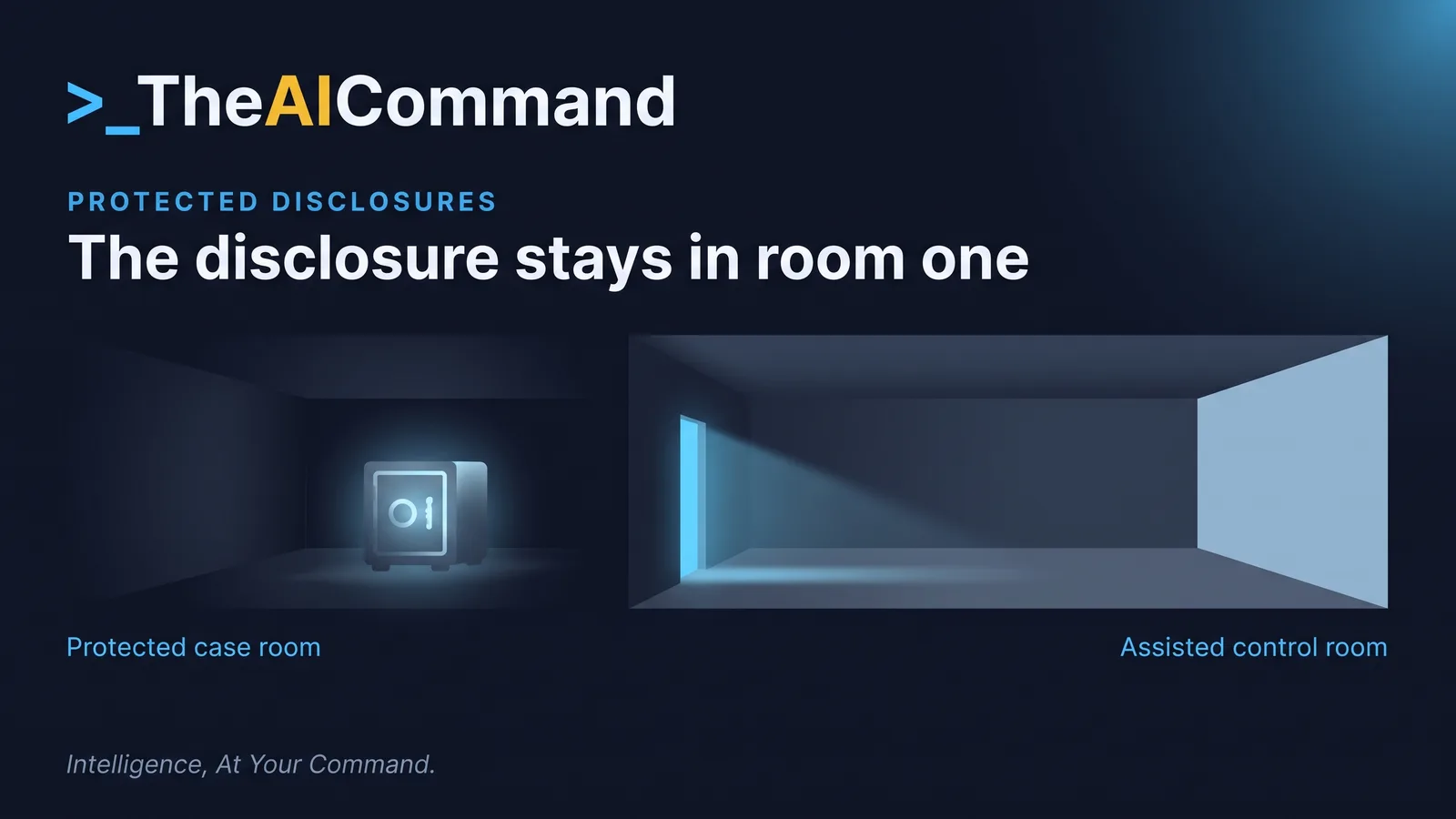
Use a two-room design.
Room one is the protected disclosure room. It contains the original report, identity, contact channel, attachments, interview records, consent instructions, legal assessment, evidence and investigation material. Access is role based and logged. Only recipients covered by a documented statutory basis and the organisation's internal approval may receive case material. Provider approval alone is insufficient.
Room two is the assisted control room. It contains public rules, approved procedures, blank templates and a screened case abstraction. It does not contain the disclosure narrative or details that could reveal who supplied it. AI can compare, structure and draft here. A human confirms the legal basis and controls every transfer from room one.
ASIC's Report 758, released 2 March 2023 drew good practices from a targeted review of seven firms. ASIC observed secure case-management systems, defined responsibility for electronic case folders and disclosure registers, and auditing and testing of user access. It also saw firms use de-identified program data for risk insights while preserving confidentiality.
AI can assist with four useful classes of work:
- checking the public policy against section 1317AI, where it applies, and RG 270
- generating empty intake, consent, protection-risk and investigation-plan templates
- testing whether a proposed management report contains indirect identifiers
- organising approved, high-level program metrics for human analysis and board reporting.
It should not classify the person as protected, decide that consent is valid, determine whether allegations are substantiated, select disciplinary action or judge whether a workplace change creates detriment. Those are legal, evidentiary and human consequences, not text-processing tasks.
Use this prompt to test the policy without supplying any case material. A whistleblower-program owner and legal adviser must review the result against the current Act and the organisation's arrangements.
Use this prompt to build an investigation-plan shell from screened metadata. The authorised case owner must confirm that every input is necessary, non-identifying and approved before use, then decide the scope and investigator.
How do you prove the material is safe to use?
Run a mosaic test before anything leaves room one. The test asks whether a colleague who knows the business could combine the remaining details and infer the discloser. This follows section 1317AAE's focus on information likely to identify, not merely obvious personal identifiers. It is the same discipline that careful de-identification practice applies elsewhere, including the approach in our de-identification toolkit for case managers.
Use this release checklist:
- Purpose: Is AI necessary for this task, or is the approved case system sufficient?
- Legal basis: What statutory basis permits every recipient to receive the exact information? Eligible-recipient status at intake is not free onward sharing.
- Internal approval: Has the whistleblower-program owner approved this use and the exact tool configuration?
- Minimum content: Has every detail that does not change the task been removed?
- Mosaic risk: Could role, team size, chronology, transaction value, writing style or document metadata identify the source when combined?
- Data flow: Are provider access, subcontractors, storage location, retention, training use, logs, integrations and deletion understood?
- Output control: Will the response return only to authorised people, inside the approved recordkeeping process?
- Human decision: Is a named person accountable for checking accuracy, confidentiality, fairness and legal characterisation before use?
Fictional example: a report says [EMPLOYEE_NAME], the only overnight settlements analyst in [BUSINESS_UNIT], saw [EXECUTIVE_ROLE] alter a control result on [EXACT_DATE]. Replacing the name with "an employee" does not solve the problem. The function, shift, senior role and date may identify the reporter.
A safer control abstraction might be: [DISCLOSURE_ID], allegation category [CONTROL_OVERRIDE], date band [QUARTER_AND_YEAR], business area band [OPERATIONS], current detriment-risk status [HUMAN_ASSESSED_LEVEL], and next approval [CASE_OWNER]. Even that abstraction requires the mosaic test. In a very small team, the business-area band may still be too revealing.
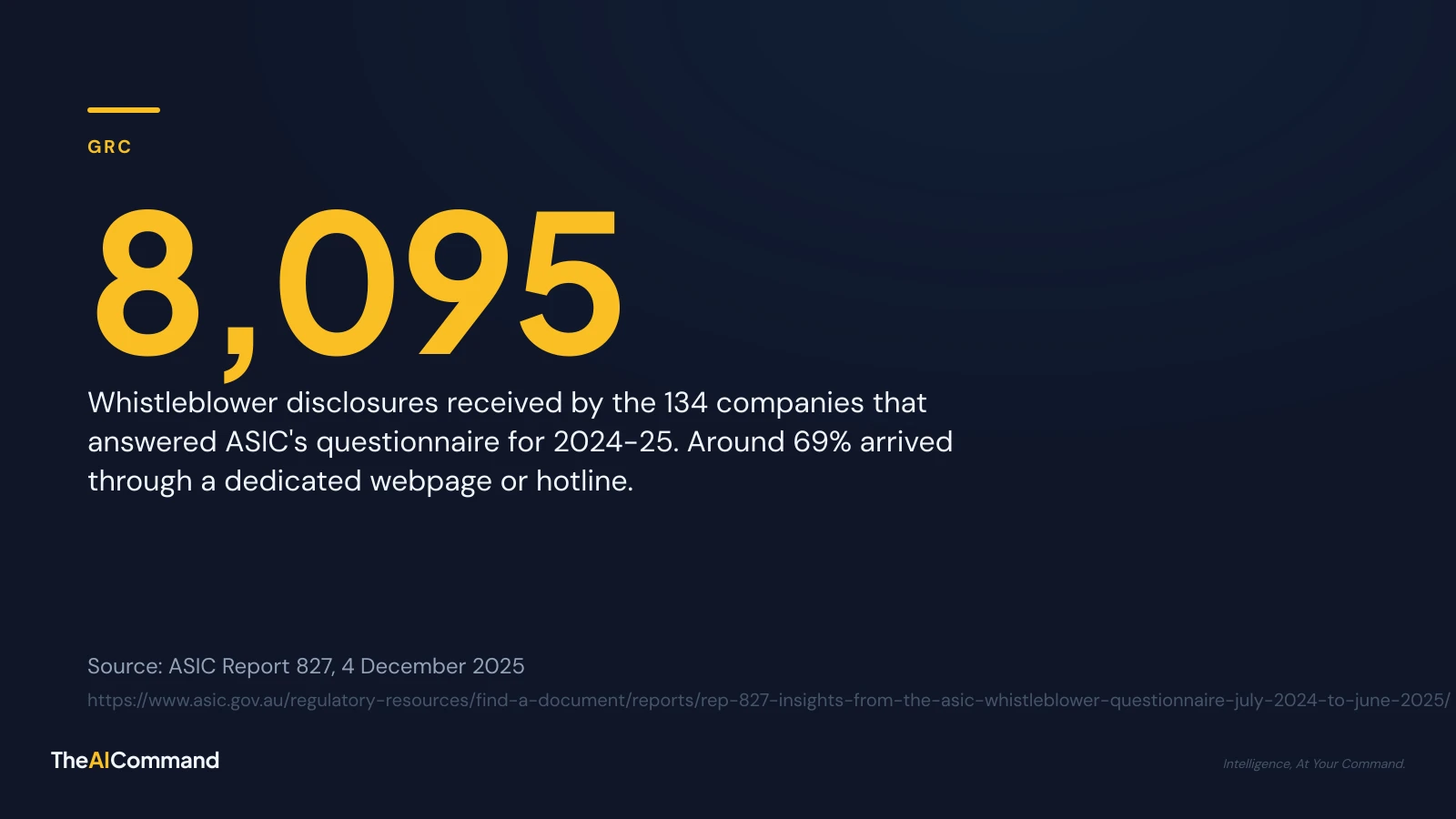
REP 827, released 4 December 2025 reinforces why this is an operating-model issue. The 134 responding companies reported 8,095 disclosures for 1 July 2024 to 30 June 2025. Around 69 per cent came through a dedicated whistleblower webpage or hotline, and companies reported that, on average, more than half of in-scope disclosures were anonymous. These were self-reported responses from the participating companies, not a population estimate or legal benchmark. Protected channels and continuing anonymous communication are normal program infrastructure, not exceptional handling.
Do this Monday
- Issue a temporary boundary. Tell staff not to enter disclosure narratives, attachments, interview notes or identifying details into general AI tools. Point them to the approved channel and escalation contact.
- Map the real workflow. Trace intake, triage, legal assessment, protection-risk assessment, investigation, reporting and closure. Record every system, integration, export and person that can see the data.
- Separate the rooms. Mark the protected case system as the system of record. Create an approved workspace containing only public sources, blank templates and human-screened abstractions.
- Set the release gate. Require the purpose, legal-basis, internal-approval, minimum-content, mosaic, data-flow, output and human-decision checks before any AI-assisted task.
- Test with fictional cases. Use synthetic disclosures with placeholders to see whether prompts, logs, exports, monitoring and access controls behave as expected. Do not test with a closed real case.
- Update governance. Add permitted AI uses, prohibited data, approval roles, incident escalation and periodic access review to the operational procedure. Have legal, privacy, security and the whistleblower-program owner approve it.
Bottom line
A whistleblower disclosure belongs inside a protected handling process, not in a general drafting assistant. AI can help improve policy, templates, issue structure and de-identified program insights, but only after the exact transfer has a documented legal basis and an authorised person has cleared the minimum record needed for the task. Treat indirect identification as seriously as a visible name. If the transfer lacks a statutory basis or the tool has not been approved for this exact purpose, keep the disclosure out.
This article is general information and education only. It is not legal, compliance, financial or professional advice. Obligations vary by organisation and circumstance. Verify current requirements against the primary sources cited and seek advice specific to your situation.
References
- Corporations Act 2001, compilation C2026C00339, Compilation No. 147 dated 1 July 2026, Part 9.4AAA: https://www.legislation.gov.au/C2004A00818/latest
- ASIC, Regulatory Guide 270 Whistleblower policies, issued 13 November 2019: https://www.asic.gov.au/regulatory-resources/find-a-document/regulatory-guides/rg-270-whistleblower-policies/
- ASIC, Report 758 Good practices for handling whistleblower disclosures, released 2 March 2023: https://www.asic.gov.au/regulatory-resources/find-a-document/reports/rep-758-good-practices-for-handling-whistleblower-disclosures/
- ASIC, Report 827 Insights from the ASIC Whistleblower Questionnaire: July 2024 to June 2025, released 4 December 2025: https://www.asic.gov.au/regulatory-resources/find-a-document/reports/rep-827-insights-from-the-asic-whistleblower-questionnaire-july-2024-to-june-2025/
- ASIC, Information Sheet 238 Whistleblower rights and protections, reissued June 2026: https://www.asic.gov.au/about-asic/asic-investigations-and-enforcement/whistleblowing/whistleblower-rights-and-protections
- OAIC, Guidance on privacy and the use of commercially available AI products, published 21 October 2024 and updated 17 January 2025: https://www.oaic.gov.au/privacy/privacy-guidance-for-organisations-and-government-agencies/guidance-on-privacy-and-the-use-of-commercially-available-ai-products
- ASIC, Information Sheet 247 Company officer obligations under the whistleblower protection provisions, issued 30 June 2020: https://www.asic.gov.au/regulatory-resources/find-a-document/information-sheets/company-officer-obligations-under-the-whistleblower-protection-provisions/
TheAICommand. Intelligence, At Your Command.