
The model recommended it. The duty did not move.
Section 180 of the Corporations Act 2001 attaches to a person, not to a governance framework. When a director approves a pricing change, an acquisition or a strategic pivot that a model helped produce, the question the section asks is not whether the organisation had mature AI governance. It is whether that individual exercised care and diligence, and whether the statutory safe harbour in section 180(2) covers what they actually did.
This is deliberately not a board process article. Several pieces on this site already cover the collective machinery, including board AI literacy as a control expectation and the evidence chain behind a risk declaration. Those are about what a board does together. This is the one person at the table and the four cumulative conditions they personally have to satisfy.
The duty travels with your office, not with the tool
Section 180(1) requires a director or other officer of a corporation to exercise their powers and discharge their duties with the degree of care and diligence that a reasonable person would exercise if they, in the words of the subsection, "were a director or officer of a corporation in the corporation's circumstances" and "occupied the office held by, and had the same responsibilities within the corporation as, the director or officer". It is a civil penalty provision.
Read those two limbs together and the standard is not generic. It is calibrated twice: to the circumstances of this corporation, and to the office and responsibilities of this director. A director who chairs the technology committee, or who was appointed for model expertise, is measured against a reasonable person holding that office, not against a notional average director.
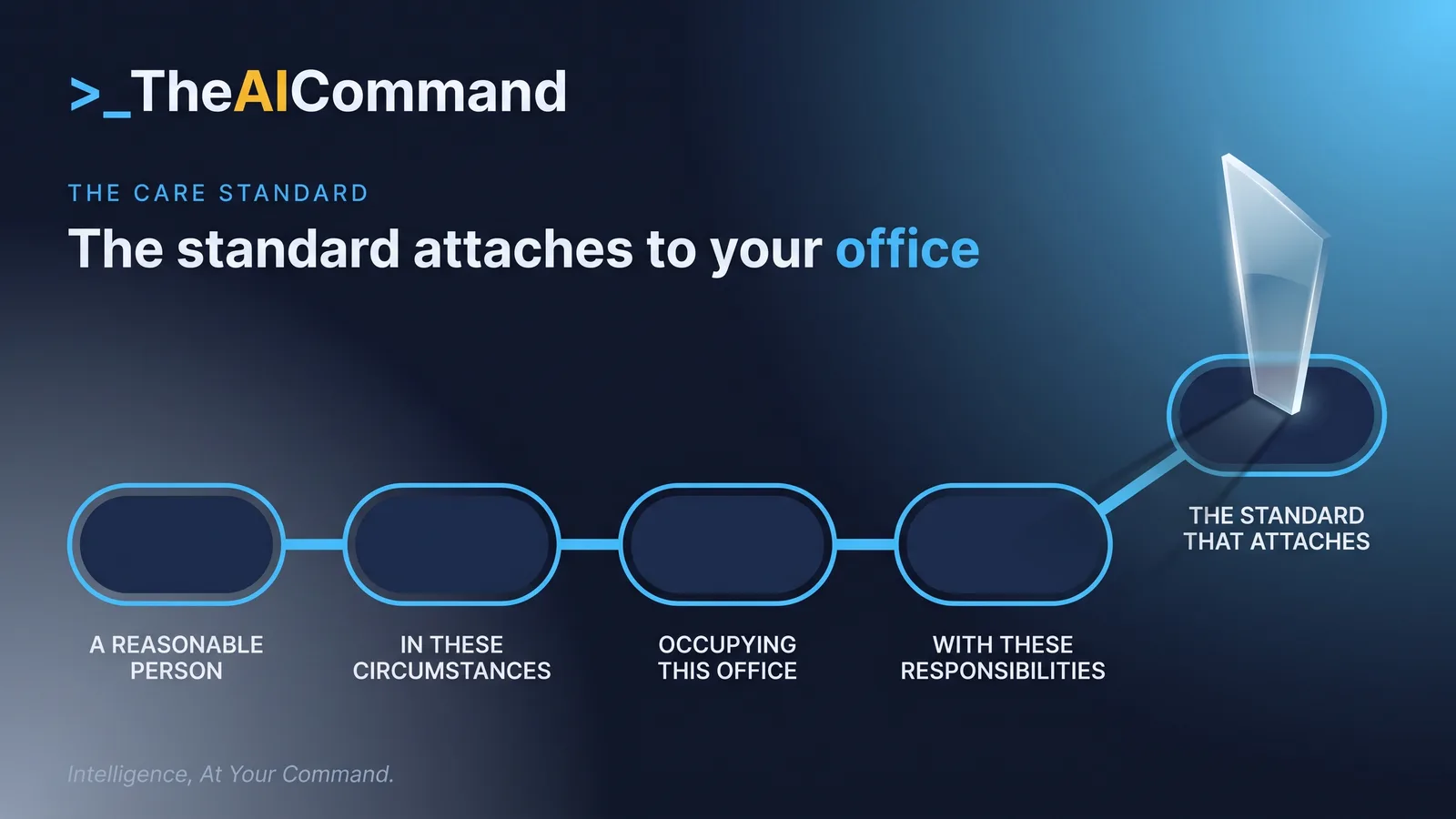
Adopting AI does not lower that standard, and it can raise it, because the responsibilities attaching to an office change as the work changes. A director whose papers are assembled with model assistance has, as part of those responsibilities, some grasp of how the assembly works.
Division 1 of Part 2D.1, sections 180 to 190C, does not use the words artificial intelligence, machine learning or algorithm, verified against Compilation No. 148 dated 27 August 2026, checked 21 September 2026. There is no AI carve-out and no AI overlay. The existing text does the work.
Does the business judgment rule reach what you actually decided?
Two gates sit in front of the four limbs. Both are easy to walk past.
The first gate is whether a business judgment was made at all. Section 180(2) protects a director "who makes a business judgment", and section 180(3) defines that term as "any decision to take or not take action in respect of a matter relevant to the business operations of the corporation". A decision not to act counts, which is broad. But a judgment implies that the director turned their mind to a matter and chose. Signing off a recommendation because it arrived well argued and on time is not obviously the same act as deciding.
The second gate is scope. The note to section 180(2) states that the subsection "only operates in relation to duties under this section and their equivalent duties at common law or in equity (including the duty of care that arises under the common law principles governing liability for negligence)". The note adds that it does not operate in relation to duties under any other provision of the Act or under any other laws.
That second half is the limit. The safe harbour is not a general shield for a decision made with AI assistance. It says nothing about the good faith duty in section 181, about continuous disclosure, about financial reporting, or about misleading conduct. A plausible AI-driven failure in a listed entity, a wrong figure that survives review and reaches the market, generates contraventions the safe harbour cannot reach.
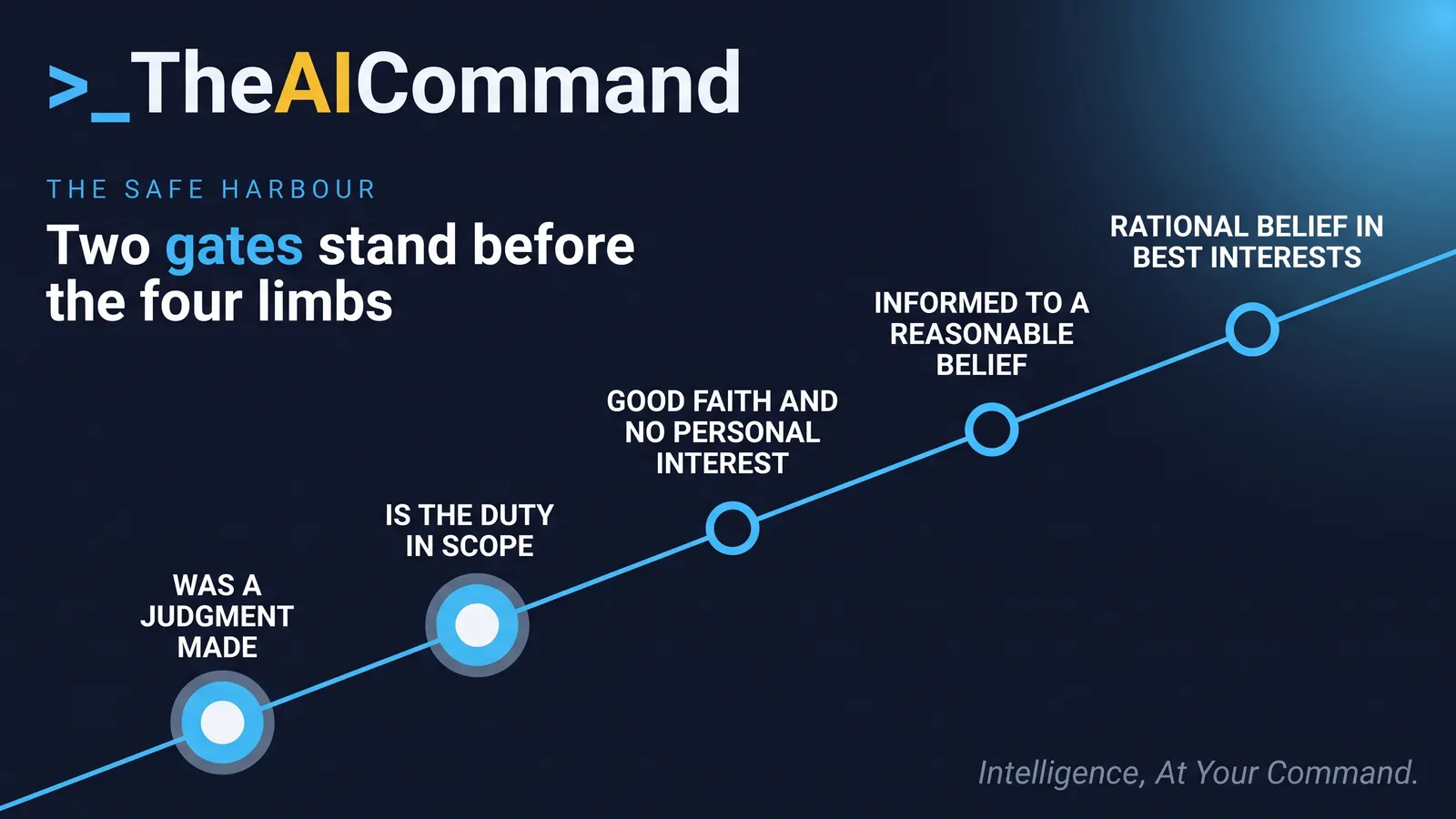
Past the gates, the four limbs are cumulative. Two are usually straightforward: good faith for a proper purpose, and no material personal interest in the subject matter. The fourth, that the director rationally believe the judgment is in the best interests of the corporation, carries an express statutory gloss. The subsection says that belief is a rational one unless it is "one that no reasonable person in their position would hold".
Notice what Parliament did there. It wrote a low threshold into limb (d) and no equivalent gloss into limb (c). That asymmetry is the whole argument in a model-assisted decision.
What does informed mean when the information was model-generated?
Limb (c) requires the director to "inform themselves about the subject matter of the judgment to the extent they reasonably believe to be appropriate". The qualifier attaches to the belief. A belief that is merely held is not enough; it has to be reasonably formed.
Two consequences follow when the material was produced by a model.
The first is that the subject matter of the judgment now includes the provenance of the material. A director informing themselves about a pricing decision built on a model output is informing themselves about the decision and about the reliability of the thing that produced it. Those are not separable, because the second determines how much weight the first can bear.
The second is that fluency is not information. A model output reads like a considered position whether or not one sits underneath it. The risk is not that the recommendation is wrong. It is that its polish supplies the feeling of being informed, so the belief forms from the prose rather than from the material beneath it.
Three questions convert an assumption into a belief that can be defended:
- What source material grounded this, and which version of it
- What was excluded, and by what filter or cut-off
- Which figures are load-bearing, and who checked them against the primary source
APRA's April 2026 letter to industry recorded "an overreliance on vendor presentations and summaries without sufficient examination of key AI risks such as unpredictable model behaviour and the impact on critical operations". That is a supervisory observation about regulated entities, not a ruling on section 180. But it describes the limb (c) failure precisely: a belief about sufficiency formed from a summary rather than from what the summary compressed.
The Federal Court has already said something about it. In Australian Securities and Investments Commission v Bekier (Liability Judgment) [2026] FCA 196, Lee J observed at [393] that directors must be furnished with information "in a form that is both comprehensive and capable of proper digestion", and that the use of AI-generated summaries "as a substitute for the careful reading and interrogation of board materials would warrant caution, not least because inadequately deployed or misdirected AI may increase risk and legal exposure rather than mitigate it". At [394] his Honour added that "any use of AI should be controlled and transparent", and that boards would be prudent to govern AI use deliberately by formally adopting policies rather than tolerating informal shadow use. Those observations sit in the Court's treatment of how boards control the information they receive, not in its analysis of section 180(2), and the liability findings are not final: the two officers held to have contravened section 180(1) were penalised and disqualified in June 2026 and filed Notices of Appeal on 14 July 2026. No hearing date had been listed as at 21 September 2026.
The record matters as much as the reasoning. A minute recording that the board considered the analysis proves a paper existed. What supports limb (c) is narrower: the questions a director asked, the answers given, and what changed as a result. If the output cannot be traced back to its inputs, the answer to the first question is that nobody knows, which is itself a finding. That traceability problem has its own treatment in defensible lineage before the prompt.
ASIC's Chair, Sarah Court, put the regulator's position in one line in the 26 August 2026 corporate plan release: "AI can improve services, productivity and decision making, but its use must not weaken accountability or consumer and investor protections."
Section 189 presumes reliance on a person, not on a system
Directors do not verify everything themselves, and the Act says so. Section 189 makes reliance on information or advice presumptively reasonable, unless the contrary is proved, on cumulative conditions. The first is that the source falls into one of four categories: an employee of the corporation whom the director believes on reasonable grounds to be reliable and competent in relation to the matters concerned, a professional adviser or expert in relation to matters the director believes on reasonable grounds to be within that person's professional or expert competence, another director or officer in relation to matters within that director's or officer's authority, or a committee of directors on which the director did not serve, in relation to matters within the committee's authority.
All four are people, or a committee of people. On the face of the section, the output of a system is none of them, and the section lists no fifth category. The practical consequence is specific: the section 189 presumption does not attach to the model output itself. The question routes back to section 180(2)(c), with no presumption.
The output usually reaches the director through a person, though, and the presumption can attach to that person. Then the other conditions bite. Section 189(b)(ii) requires the reliance to have been made "after making an independent assessment of the information or advice, having regard to the director's knowledge of the corporation and the complexity of the structure and operations of the corporation". An independent assessment of a conclusion whose inputs cannot be inspected is thin to describe in a witness statement.

Delegation runs the same way. Section 190(1) makes a director responsible for a delegate's exercise of a power delegated under section 198D as if the directors had exercised it themselves, and section 198D(1) lists the delegates as a committee of directors, a director, an employee of the company, or any other person. The escape in section 190(2) has two cumulative conditions, the second of which requires the director to have believed on reasonable grounds, in good faith, and "after making proper inquiry if the circumstances indicated the need for inquiry", that "the delegate was reliable and competent in relation to the power delegated".
Reliable and competent are attributes a director forms a belief about in a named individual, after inquiry. Whether that vocabulary transfers to a probabilistic system is a question the section does not answer on its face, and the Court in Bekier spoke to how boards should govern AI use rather than to that question. Until it is answered, the accountable person is the human who ran the tool, and the inquiry is directed at them. Accountability under a separate regime is treated in how the Financial Accountability Regime maps to tooling decisions.
What is left when the four limbs do not hold?
Failing section 180(2) is not itself a contravention. The safe harbour is one route, and losing it means the section 180(1) standard is argued on its merits, which a well-run process can still meet.
Beyond that sit two discretionary relief provisions. Section 1317S(2) lets a court relieve a person wholly or partly from liability in eligible proceedings where the person "has acted honestly" and, having regard to all the circumstances, "ought fairly to be excused for the contravention". Section 1318(1) does the same in civil proceedings for negligence, default, breach of trust or breach of duty.
Neither is a control. Each is a court discretion turning on the whole of the circumstances, and although sections 1317S(4) and 1318(2) let a person apply once a claim is apprehended, that is a response to exposure, not something a board paper can assume. What they reward is what limb (c) rewards: a contemporaneous record showing the director asked, was answered, and acted on what they learned.
Bottom line
The business judgment rule is narrower than its reputation and its third limb is where AI-assisted decisions will be tested. It protects a judgment, not an adoption; it covers section 180 and its general law equivalents and nothing else; and its informed limb carries no rationality gloss of the kind Parliament wrote into the best-interests limb. Section 189 presumes reliance on a competent person and says nothing about a system, which pushes the output back into limb (c) without a presumption. None of that argues against using AI in board material. It argues for one discipline: know what produced the paper in front of you, and be able to say what you asked before you decided.
Do this Monday
- Pick the last decision you approved with model-assisted analysis behind it, and write in three sentences what you were told about how that analysis was produced.
- Ask the paper's author which figures in it are load-bearing, and who checked each of those against the primary source rather than against another summary.
- Establish whether the analysis can be traced back to its inputs, and treat an inability to answer as a finding to record rather than a gap to move past.
- Read the note to section 180(2) with your general counsel and list the duties in your own portfolio that the safe harbour does not touch.
- Change your minute-taking so the record captures the questions asked and the answers given, not only that the board considered the material.
Content disclaimer: This article is for general educational and informational purposes only. It does not constitute legal advice, regulatory guidance, or a substitute for professional compliance judgement. Regulatory obligations vary by entity type, licence, and circumstance. Always refer to primary source guidance from APRA, ASIC, or the relevant regulatory authority.
Primary sources
- Corporations Act 2001, Compilation No. 148, register id C2026C00382, compilation date 27 August 2026, sections 180, 189, 190 and 198D in Volume 1. https://www.legislation.gov.au/C2004A00818/2026-08-27/2026-08-27/text
- Corporations Act 2001, Compilation No. 148, sections 1317S and 1318 in Volume 6. https://www.legislation.gov.au/C2004A00818/2026-08-27/2026-08-27/text
- APRA, Letter to Industry on Artificial Intelligence (AI), 30 April 2026. https://www.apra.gov.au/news-and-publications/apra-letter-industry-artificial-intelligence-ai
- ASIC, media release 26-200MR, ASIC sets plan to be easier to deal with, harder to avoid, 26 August 2026. https://www.asic.gov.au/about-asic/news-centre/find-a-media-release/2026-releases/26-200mr-asic-sets-plan-to-be-easier-to-deal-with-harder-to-avoid
- ASIC, Corporate Plan 2026-27, published 26 August 2026. https://download.asic.gov.au/media/hotigt5a/asic-corporate-plan-2026-27-published-26-august-2026.pdf
- Australian Securities and Investments Commission v Bekier (Liability Judgment) [2026] FCA 196, Lee J, 5 March 2026. https://www.austlii.edu.au/cgi-bin/viewdoc/au/cases/cth/FCA/2026/196.html
- ASIC, media release 26-123MR, Former Star Entertainment executives Mathias Bekier and Paula Martin disqualified and ordered to pay penalties, 17 June 2026. https://www.asic.gov.au/about-asic/news-centre/find-a-media-release/2026-releases/26-123mr-former-star-entertainment-executives-mathias-bekier-and-paula-martin-disqualified-and-ordered-to-pay-penalties
TheAICommand. Intelligence, At Your Command.