
APRA's 30 April 2026 letter to industry should change how governance, risk and compliance teams think about AI education for boards. The practical message is not that directors must become machine learning engineers. The message is that AI literacy is now connected to risk appetite, control assurance, third-party oversight, resilience and accountability. APRA states that AI adoption is accelerating across regulated entities, while maturity in governance, risk management, assurance and operational resilience remains uneven.
For GRC teams, this moves AI literacy out of the optional learning calendar and into the control environment. If a board approves strategy, sets risk appetite and oversees material risk, then the board needs enough AI literacy to ask whether AI systems are being governed with the same discipline as other material technology, data, outsourcing and operational risks. That is a different standard from watching a demonstration of a chatbot or attending a one-hour awareness session.
Why is the bar for board AI literacy rising?
APRA's letter is careful, but it is not ambiguous. It expects regulated entities to maintain risk management that is commensurate with the scale, complexity and materiality of AI use. It also expects boards to have sufficient literacy to understand AI opportunities, limitations and risks, including risks arising through third-party services and the cyber pathways boards are now expected to oversee.
That expectation aligns with the wider Australian direction of travel, and it has continued to sharpen since this article first published: see how APRA's 2026-27 Corporate Plan splits AI into two separate supervisory questions that a board's AI register needs to answer. The Australian Government's Voluntary AI Safety Standard still sets out 10 guardrails for safe and responsible AI, including accountability, risk management, transparency, human oversight and contestability, as at 20 September 2026, though the standard's own page now says it has been evolved by the National AI Centre's Guidance for AI adoption, a simplified six-practice structure published 21 October 2025 for organisations governing more complex or higher-risk AI use. The Digital Transformation Agency's Policy for the responsible use of AI in government is now version 2.0, effective 15 December 2025, and still expects agencies to assign accountability, classify AI use by risk through use case impact assessments, publish transparency statements and manage AI safely, as at 20 September 2026. These are not identical regimes, but they point in the same direction: governance must be visible, accountable and evidence-based.
This distinction matters because AI risk often hides in familiar business processes. A model summarising customer interactions may create privacy and accuracy risks. A retrieval system connected to policy documents may create information security and prompt injection risks. A workflow agent that drafts decisions may create accountability and recordkeeping risks. None of these risks is solved by teaching directors model terminology alone. The literacy requirement is practical: directors need enough understanding to interrogate the control story.
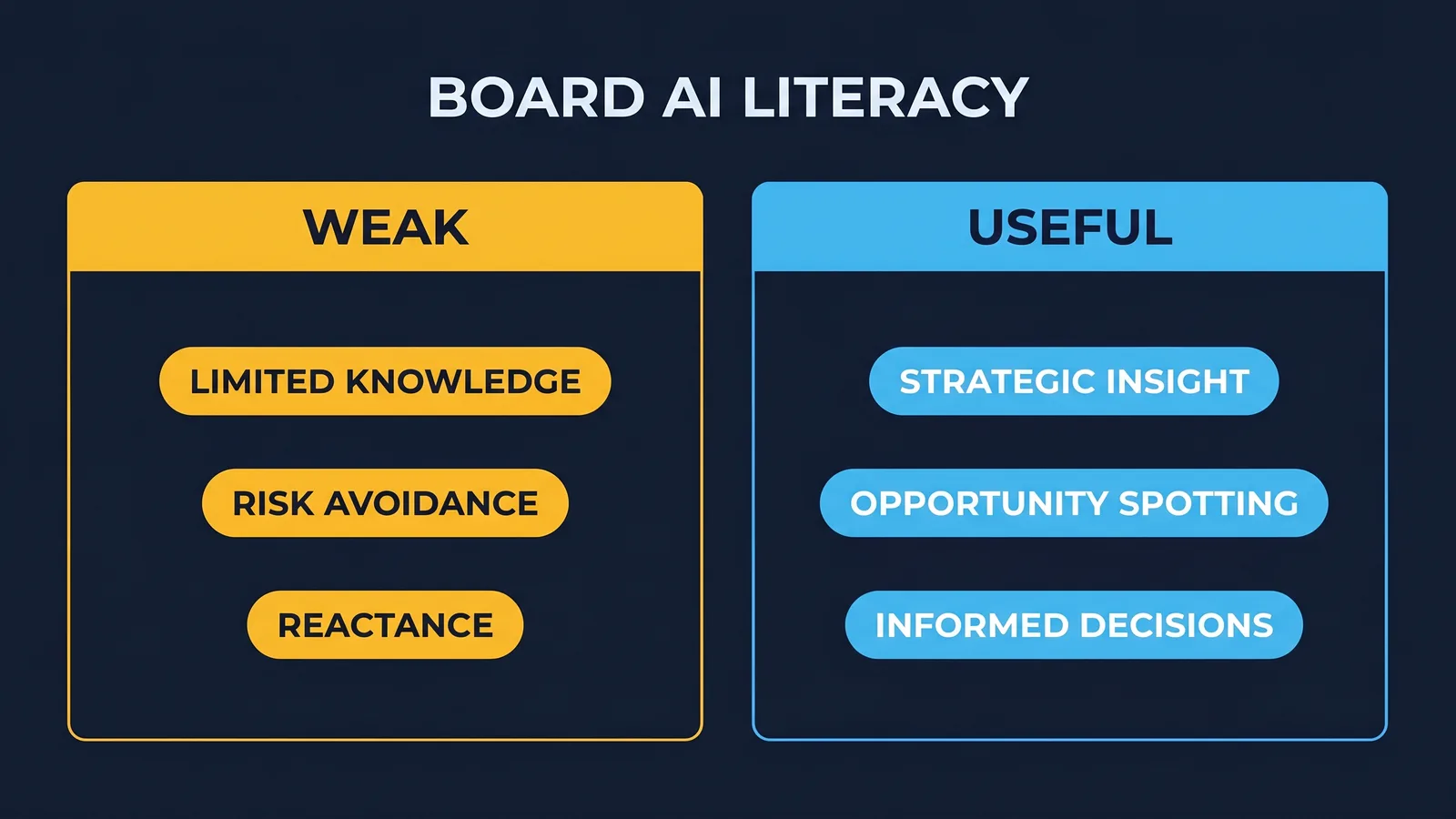
AI literacy should be role-specific
Many organisations will respond with generic AI training. That is a start, but it is not enough for boards and senior executives. A board literacy programme should be built around decisions the board actually makes. It should cover AI strategy, materiality thresholds, high-risk use cases, assurance expectations, regulatory reporting, third-party concentration, cyber exposures and incident escalation.
The NIST AI Risk Management Framework is useful here because it frames AI risk around governance, mapping, measurement and management. The value of that structure is not that Australian firms should simply import a United States framework. The value is that it gives boards a practical language for asking whether the organisation has understood context, measured risk, implemented controls and monitored outcomes. Those questions translate well into Australian GRC work.
Why is third-party AI where board literacy is most tested?
Third-party AI is likely to be the place where board literacy is most tested. Many organisations will not build frontier models. They will buy software, embed vendor copilots, connect enterprise data to external platforms and rely on cloud providers, model providers and specialist workflow tools. APRA's AI letter specifically points to third-party dependencies as a matter for board and senior management attention.
This creates a practical challenge. Traditional vendor due diligence often focuses on security questionnaires, service levels, financial viability and contractual terms. A due diligence framework built for AI vendors needs those controls, but it also needs questions about model behaviour, data retention, training use, explainability, evaluation, subcontractors, monitoring, incident notification and exit. Where an AI service supports critical operations, the control expectation should connect to operational resilience obligations, including CPS 230 arrangements for material service providers. That obligation is no longer prospective: CPS 230's 1 July 2026 deadline for pre-existing material service provider contracts has passed, and boards should also test whether several contracted AI vendors are quietly concentrated on one shared foundation model, which can turn three vendors into a single point of failure.
For boards, the point is not to review every model card. The point is to insist that management has a defensible process for classifying vendor AI risk. A vendor tool that drafts internal meeting summaries is not the same as a vendor tool that recommends fraud flags, employment actions, claims triage outcomes or customer hardship responses. Board literacy should help directors detect when management has treated materially different use cases as if they were the same.
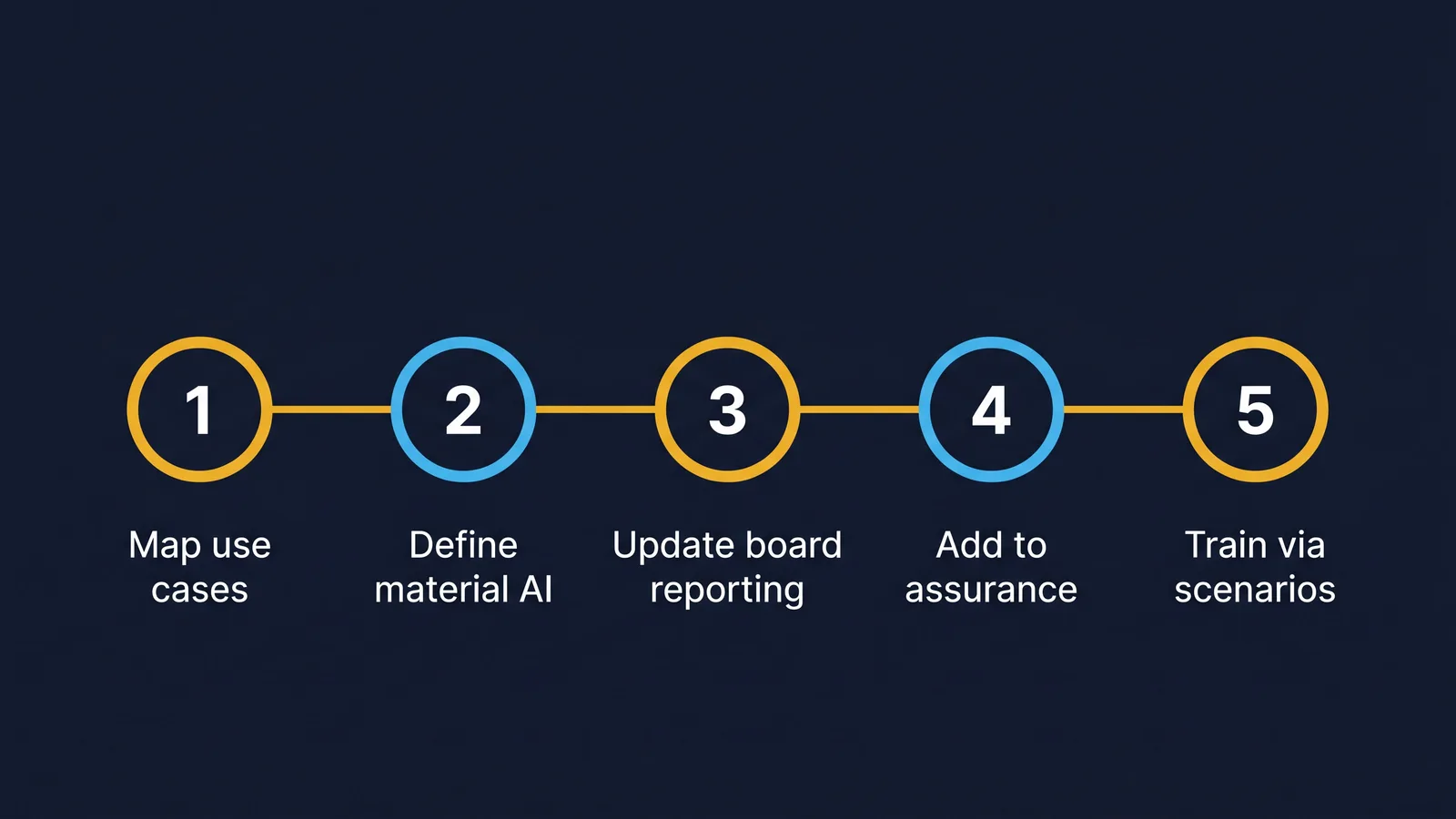
What should GRC teams build now?
GRC teams can turn AI literacy into a control by creating artefacts that boards can use. The first artefact is an AI use-case register that boards can actually use, identifying owner, business purpose, users, affected stakeholders, data categories, vendor dependencies, risk rating and assurance status. The second is a board reporting pack that summarises new material uses, exceptions, incidents, overdue controls and assurance outcomes. The third is a literacy and attestation process for executives accountable for material AI systems. For teams that have already adopted the Voluntary AI Safety Standard's guardrails, the next step is turning those guardrails into audit evidence rather than leaving them as a policy statement.
These artefacts should be tested through internal audit, where AI changes what still counts as evidence, or wider assurance. The question is not merely whether the register exists. The question is whether the register is complete, current and connected to actual procurement, technology, privacy, cyber and change-management processes. A stale spreadsheet is not a control. A living register that triggers review when a business unit connects sensitive data to a new AI tool is much closer to the standard regulators are signalling, and it is what lets a board trace the evidence behind a signed risk declaration rather than take management's word for it.
The best board AI literacy programmes will use scenarios. Scenario-based training reveals whether directors understand materiality, affected stakeholders, failure modes and assurance needs. A useful scenario might walk the board through a vendor copilot that quietly begins drafting customer hardship responses after a routine product update. Directors who can ask where that change was approved, what data the tool now touches, who tested it, and who accepted the residual risk are demonstrating exactly the literacy APRA is describing. Directors who accept the new capability without those questions are not.
The bottom line
AI literacy is becoming part of governance evidence. A board can delegate technical execution, but it cannot delegate the need to understand material risks well enough to oversee them. In 2026, the defensible position is not "our board received AI training". The defensible position is "our board understands how AI is used, how material uses are escalated, what risks sit outside appetite, and what assurance evidence supports management's position".
That is a higher standard, but it is also a more useful one. It turns AI education from a learning event into a governance capability.
Do this Monday
- Open the AI use-case register and test it for completeness. Every material use should carry an owner, business purpose, users, affected stakeholders, data categories, vendor dependencies, risk rating and assurance status. The blank cells are where a board question will land first.
- List the AI capabilities that arrived through vendor product updates. Copilots and features switched on inside software the organisation already licences rarely pass through procurement. Find them, then record who approved each one and on what basis.
- Write the materiality test for AI. Fix the threshold that decides which uses reach the board, so escalation stops depending on who happens to raise it in which forum.
- Name the accountable executive for each material use case, in writing. "Who owns AI" is the weak version of the question. Which executive is accountable for this use case, and where that is recorded, is the version a board can act on.
- Put AI into the next assurance plan. Independent testing, red-team outcomes, privacy checks and audit findings are what convert literacy into evidence rather than assertion.
- Rewrite the AI section of one board paper around the useful questions. Replace "has compliance reviewed it" with what independent testing was performed and what residual risk remains after it.
- Book a scenario session for directors. Run the vendor copilot that quietly begins drafting customer hardship responses after a routine product update, because it tests whether directors reach for approval, data, testing and residual risk without being prompted.
References
- APRA letter to industry on artificial intelligence
- Australian Government Voluntary AI Safety Standard
- Policy for the responsible use of AI in government
- NIST AI Risk Management Framework
- Guidance for AI adoption (National AI Centre)
Content disclaimer: This article is for general educational and informational purposes only. It does not constitute legal advice, regulatory guidance, or a substitute for professional compliance judgement. Regulatory obligations vary by entity type, licence, and circumstance. Always refer to primary source guidance from APRA, ASIC, or the relevant regulatory authority.
TheAICommand. Intelligence, At Your Command.