
There is a date in the next quarter that quietly converts a lot of AI experimentation into a hard compliance obligation. From 1 July 2026, every pre-existing contract with a material service provider has to meet the requirements of APRA's Prudential Standard CPS 230 Operational Risk Management, or it has to have met them at its last renewal, whichever came first. For most banks, insurers and superannuation trustees the legacy contracts have been the slow lane. That lane closes. And a growing share of those material arrangements are now AI arrangements, whether the contract calls them that or not.
This piece is the practitioner version of that deadline. Not a restatement of the standard, but the specific work to do before 1 July when the material service provider on the other side of the contract is an AI provider, and why APRA's most recent supervisory findings make this the part of CPS 230 that is most likely to be tested first.
What does the CPS 230 deadline actually require?
CPS 230 draws a line around an entity's critical operations and around the service providers it relies on to run them. A critical operation, in APRA's words, is a process "which, if disrupted beyond tolerance levels, would have a material adverse impact on its depositors, policyholders, beneficiaries or other customers, or its role in the financial system" (APRA, Prudential Standard CPS 230). A material service provider is one the entity relies on to perform a critical operation, or one that exposes it to material operational risk. That provider can be a third party, a related party or a connected entity.
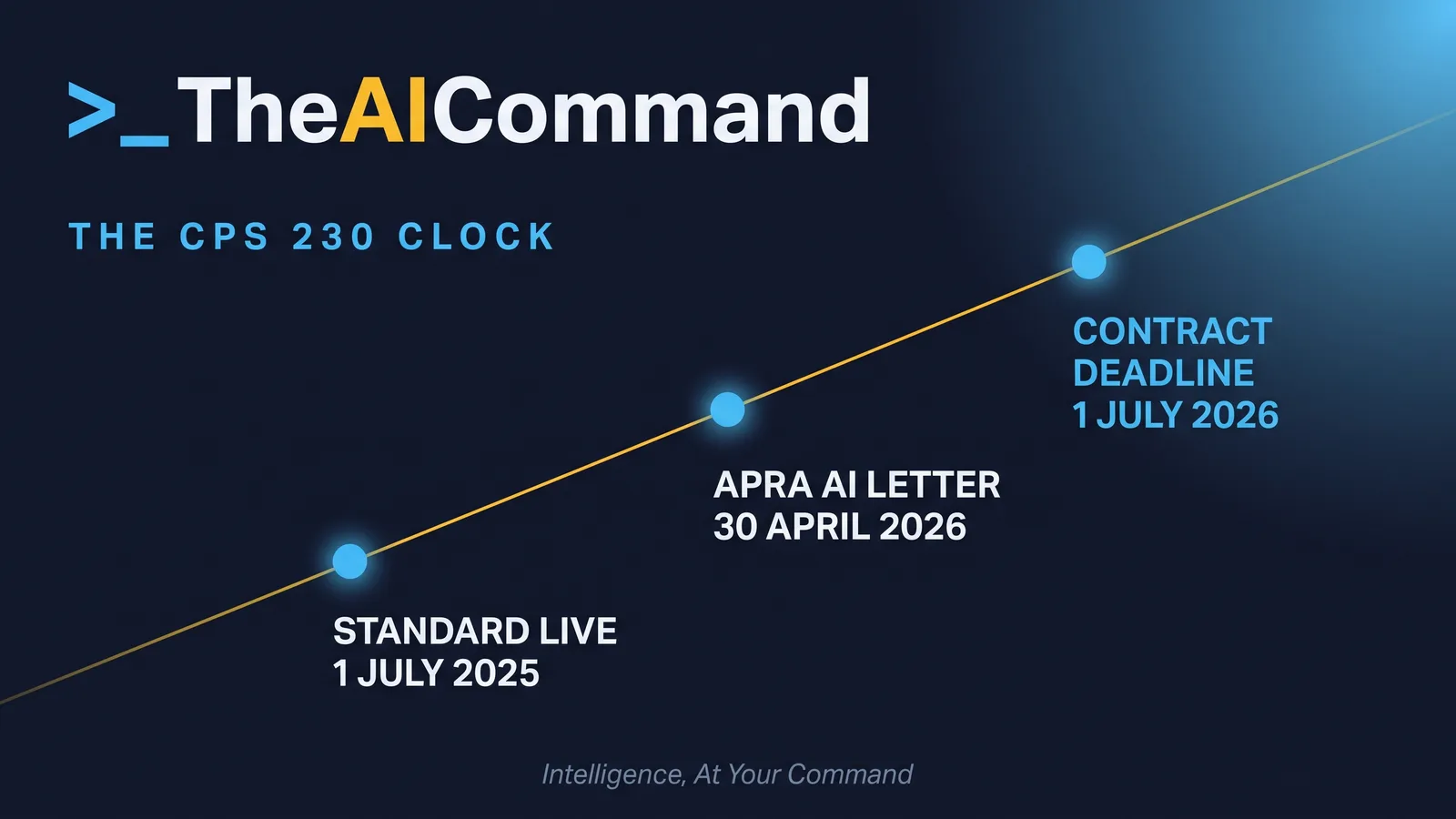
Where a service provider is material, CPS 230 requires a formal written agreement with specified minimum content. The standard's service-provider requirements cover the substance you would expect of an operational resilience contract: service levels and the rights and responsibilities of each party, force majeure, termination, the handling of sub-contracting and fourth-party arrangements, rights for APRA to access and inspect, the entity's ability to make an orderly exit, and ongoing monitoring of performance and compliance. APRA's own response paper is blunt about the timing: entities "will have until the earlier of 1 July 2026 or the next renewal date of an existing agreement to ensure the agreement complies with CPS 230", and "contracts with material service providers should be updated as soon as possible given their importance to critical operations and operational risk" (APRA, Response paper, Operational Risk Management).
The 30 April 2026 amendments did not move that date. They narrowed it slightly at the edges: APRA introduced "limited exemptions from specific contractual requirements in CPS 230 for material arrangements with certain categories of non-traditional service providers", such as central banks and clearing facilities, where the standard contractual terms are not feasible (APRA, "APRA finalises targeted amendments to CPS 230", 30 April 2026). Those amendments come into effect on 1 July 2026, the same day the transitional window closes. For the overwhelming majority of AI providers, none of that exemption applies. A commercial model vendor or an AI feature embedded in a software platform is exactly the kind of arrangement the standard was written for.
Why is AI the part of CPS 230 most likely to be tested?
On the same day it amended CPS 230, APRA published its letter to industry on AI, and the findings read like a map of where AI contracts go wrong. APRA's headline was that "AI use is accelerating across all APRA-regulated industries", but "governance arrangements have not matured at the same pace" (APRA, "APRA calls for a step-change in AI-related risk management and governance", 30 April 2026). It assessed four areas: governance, risk management, assurance, and operational resilience. The operational resilience findings are the ones that collide with the CPS 230 deadline.
APRA observed "some entities heavily dependent on a single provider for multiple AI use cases", and noted that "few entities had demonstrated robust contingency planning or tested exit and substitution strategies for critical AI providers" (APRA, Letter to industry on AI, 30 April 2026). That is concentration risk stated plainly. It also flagged the opacity problem that makes AI contracts harder than ordinary technology contracts: "AI capabilities are increasingly embedded within software, platforms or developer tools", which means "upstream dependencies such as foundation models, training data sources and fourth party service providers are opaque", limiting an entity's ability to independently assess "model performance, bias, resilience and security".
Put those two documents next to each other. CPS 230 says the contract for a material AI provider must give you orderly exit, fourth-party visibility, APRA access and a tested fallback. APRA's letter says it has just looked and found exactly those things missing for AI. The deadline and the supervisory focus have converged on the same clauses. That is why, of all the CPS 230 remediation an entity might still owe, the AI contracts are the ones a supervisor is most primed to ask about.
What is the work to do before 1 July?
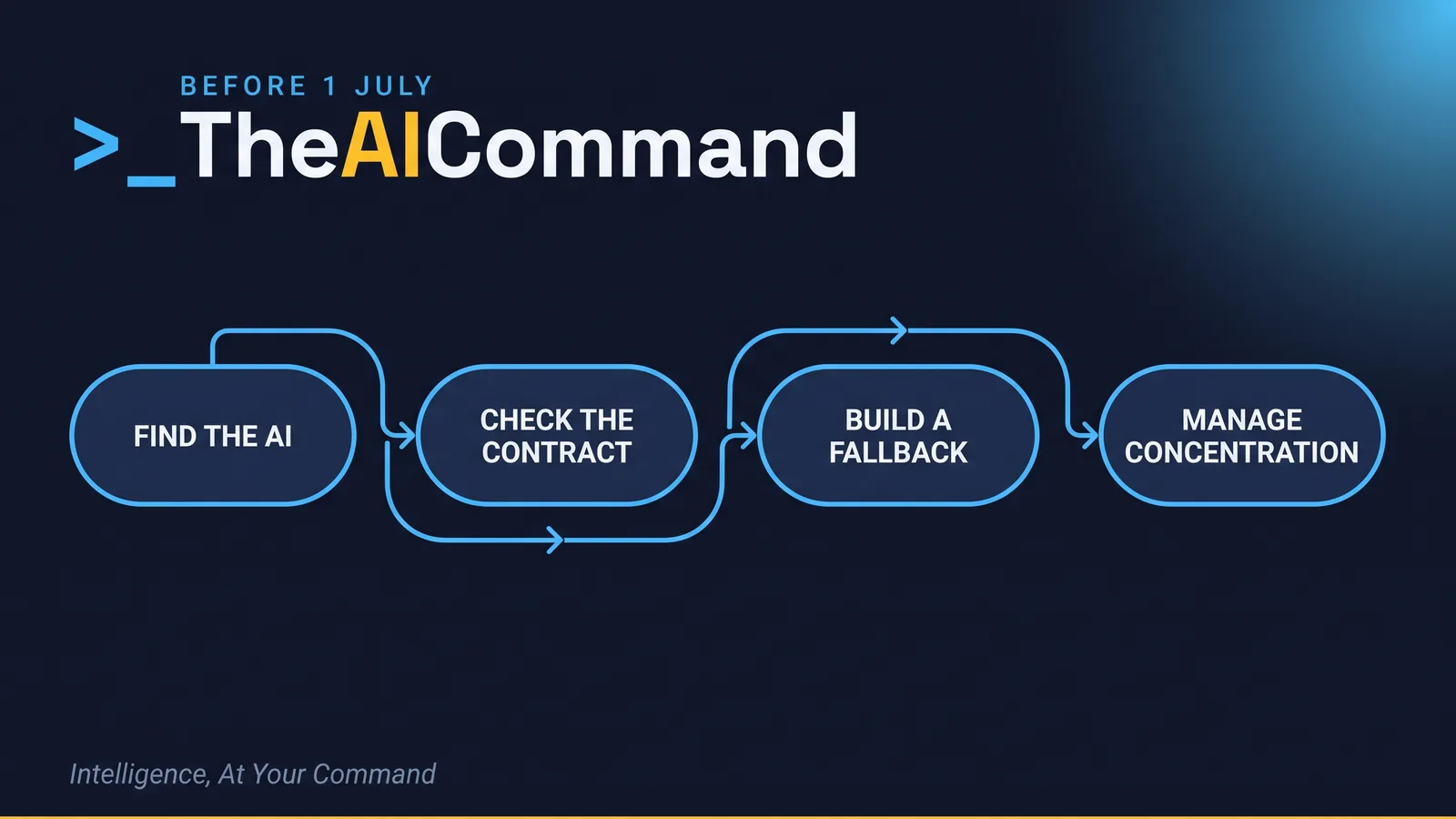
The job in the final quarter is not to read the standard again. It is four concrete passes over your AI estate.
- Find the AI inside your material arrangements. Most AI does not arrive labelled "AI vendor". It arrives as a feature switched on inside a platform you already buy, a model wired into a fraud engine, a copilot embedded in a core banking or policy-administration system. Start from your existing material service provider register and ask, for each entry, whether AI now performs or materially supports the work. Add any standalone AI tools that touch a critical operation. The output is a shortlist of material AI arrangements, each tied to the critical operation it supports.
- Test each one against the contract checklist. For every material AI arrangement, walk the agreement against the CPS 230 service-provider requirements. Does it give you a right of orderly exit, and is that exit actually feasible given how the data and the integration are locked in? Does it require notification of material changes, including changes to the underlying model, not just to the product? Does it give visibility and rights over fourth parties, the foundation-model provider and data sources sitting upstream that APRA specifically called opaque? Does it preserve APRA's access and inspection rights? Where a clause is missing or the right exists on paper but cannot be exercised, that is your remediation list.
- Build and test a fallback where the AI supports a critical operation. APRA's standard is not "have an exit clause", it is that "where AI supports critical operations, credible fallback processes are required". A fallback you have never run is not credible. For each critical-operation AI, define what the business does if the model is unavailable, materially degraded, or has to be switched off because of a defect or a regulatory event. Then actually exercise it, even at small scale, and keep the evidence. This is where concentration risk gets resolved or exposed: if the honest answer is that there is no workable manual or alternative path, that is the finding, and it belongs in front of the accountable executive now, not after an incident.
- Manage the concentration. APRA asked for "active management of concentration risk", including "plausible and systemic failure scenarios" and "the credibility and feasibility of substitution, portability or exit arrangements for critical AI providers". If one provider sits behind several of your critical AI use cases, the remediation is not only contractual. It is a deliberate decision, owned at the right level, about whether that concentration is acceptable and what would make a second source or an exit realistic. Document the decision either way.
The governance line
The reason this work cannot be delegated wholesale to a vendor-management team is that CPS 230 is an accountability standard, not a paperwork standard. Someone has to own each material AI arrangement, understand what it does inside a critical operation, and be able to answer for the fallback. The Australian framing reinforces this. The National AI Centre's Guidance for AI Adoption, the AI6 essential practices that replaced the Voluntary AI Safety Standard in October 2025, opens with "decide who is accountable" and closes with "maintain human control" (National AI Centre, Guidance for AI Adoption, October 2025). Voluntary guidance and a prudential standard are saying the same thing from two directions: a named human owns the AI, and the human stays in control of the operation it sits inside.
A worked sketch, fully de-identified. Suppose [BUSINESS_UNIT] runs a claims triage model from [AI_VENDOR] that helps prioritise [CLAIM_TYPE] claims, and claims processing is a critical operation for the entity. The model is embedded in a wider administration platform, so the contract is with the platform, not the model maker. The remediation is to confirm whether claims triage is material, trace the upstream model dependency the platform relies on, check whether the platform contract gives exit, change-notification and fourth-party rights over that model, and define what happens to triage if the model is pulled. None of those steps needs real claim data, a real claimant, or a real vendor name to plan. They need the register, the contract, and a tested fallback.
What stays human, and what never gets automated away
You can and should use AI to accelerate this work. Drafting a contract-gap checklist, summarising a long master services agreement against the CPS 230 requirements, producing a first-pass register of where AI sits in your platforms: all of that is fair game, and the prompt below does exactly that. What does not get automated is the judgement. An AI can tell you a clause appears to be missing; it cannot decide whether your exit is genuinely feasible, whether a concentration is acceptable, or whether a fallback is credible. Those are accountable-person decisions, and CPS 230 is built so that a named human answers for them.
The deadline is a forcing function, not the point. The point is that AI has moved into critical operations faster than the contracts around it were rewritten, and APRA has now said, in the same week it set the clock, that this is where it is looking. The entities that come out of 1 July well will be the ones that treated their AI providers as what the standard already says they are: material service providers, with everything that follows.
The contract-review prompt
Paste the block below into ChatGPT or Claude. It reviews one AI service-provider contract against the CPS 230 service-provider requirements and returns a prioritised remediation list. It is a drafting aid; a named accountable person, with legal advice, decides compliance.
How to run it. Create a ChatGPT Project (or a Claude Project) called "CPS 230 AI contract review", paste the prompt into the project's custom instructions, and drop in two files the model can reuse across every chat: a one-page note listing your critical operations and tolerance levels, and the CPS 230 service-provider requirement list, with no real claimant, customer or pricing data. Run your shortlist one arrangement at a time, and for every "Partial" or "Cannot tell" ask the model to quote the exact words it relied on and say what wording would move the item to Present. Then take the top three remediation priorities into your tracker tagged to the critical operation and the owner, and have the model critique its own review as if it were the APRA supervisor who wrote the 30 April 2026 AI letter before you finalise the list.
Bottom line
From 1 July 2026 every pre-existing material service provider contract has to meet CPS 230, and where AI performs or materially supports a critical operation the AI provider is a material service provider. APRA's 30 April 2026 AI letter found the exact gaps the standard requires those contracts to close: single-provider dependence, few tested exit strategies and opaque upstream dependencies. That is why AI contracts are the part of CPS 230 a supervisor is most primed to test, and the accountable-person judgements sit with a named human, not the tool.
Do this Monday:
- Start from your material service provider register and flag every arrangement where AI now performs or materially supports a critical operation.
- Walk each of those contracts against the CPS 230 service-provider tests: orderly exit, notification of material changes, fourth-party visibility, and APRA access.
- Build and actually exercise a fallback for any AI that supports a critical operation, and keep the evidence.
- Document the concentration decision where one provider sits behind several critical AI use cases.
- Use the contract-review prompt as a drafting aid only, and leave the compliance and feasibility calls to a named accountable person with legal advice.
References
- APRA, "APRA calls for a step-change in AI-related risk management and governance" (media release), 30 April 2026. https://www.apra.gov.au/news-and-publications/apra-calls-for-a-step-change-ai-related-risk-management-and-governance
- APRA, "Letter to industry on Artificial Intelligence (AI)", 30 April 2026. https://www.apra.gov.au/apra-letter-to-industry-on-artificial-intelligence-ai
- APRA, "APRA finalises targeted amendments to CPS 230 Operational Risk Management", 30 April 2026. https://www.apra.gov.au/news-and-publications/apra-finalises-targeted-amendments-to-cps-230-operational-risk-management
- APRA, Prudential Standard CPS 230 Operational Risk Management, and the Operational Risk Management response paper (commencement 1 July 2025; service-provider transitional arrangement to the earlier of next renewal or 1 July 2026). https://www.apra.gov.au/operational-risk-management
- National AI Centre (Department of Industry, Science and Resources), Guidance for AI Adoption (the six essential practices, AI6), October 2025. https://www.industry.gov.au/publications/guidance-for-ai-adoption
General information and education only. This is not legal, compliance, risk, or financial advice, and it does not establish an adviser relationship. CPS 230 obligations turn on your specific arrangements; confirm your position against the current prudential standard and your own legal and risk advice.
TheAICommand. Intelligence, At Your Command.