
The Scams Prevention Framework imposes a technology-neutral reasonable-steps duty on banks, telcos and digital platforms, and because the scams it targets are now AI-generated, manual-only controls will be hard to defend as reasonable and any AI detection you deploy becomes a second system you must govern. On 28 May 2026, Treasury released the exposure draft of the codes and rules that put operational detail on the Scams Prevention Framework, the Commonwealth regime that makes banks, telecommunications providers and digital platforms legally responsible for preventing, detecting and disrupting scams. Consultation closed on 25 June 2026, and the draft proposes substantive sector obligations from 31 March 2027. The duty it imposes is technology-neutral and built on 'reasonable steps', but the scams it targets are increasingly generated by artificial intelligence. For governance, risk and compliance teams, that gap between a neutral legal standard and an AI-accelerated threat is the whole problem.
A new statute, and a deadline closer than it looks
The Scams Prevention Framework Act 2025 received Royal Assent on 20 February 2025 and amended the Competition and Consumer Act 2010 to create the Scams Prevention Framework, or SPF (Federal Register of Legislation, C2025A00015). For more than a year the framework existed mostly as principle. That changed on 28 May 2026, when Treasury released the exposure draft of the SPF codes and rules: a Common Code of obligations for all regulated entities, separate sector codes for banks, telcos and digital platforms, the SPF Rules that carry the operational detail, and an internal dispute resolution position paper. Consultation closed on 25 June 2026 (Treasury consultation hub, c2026-765133).
The draft proposes that the SPF Rules commence around September 2026, with substantive sector obligations applying from 31 March 2027. Those dates are not yet law, but they set the planning horizon. A compliance program that has to evidence reasonable steps across six principles, three sector codes and a multi-regulator enforcement regime is not built in a quarter. The work starts now.
Why the framework exists is not in dispute. The National Anti-Scam Centre reported that Australians lost 2.03 billion dollars to scams in 2024, even after a 25.9 per cent fall on the previous year, across 494,732 reports (National Anti-Scam Centre, Targeting scams report, 11 March 2025). ASIC put 2025 losses at 2.18 billion dollars, with investment scams alone costing 837.7 million dollars (ASIC, 26-063MR, 8 April 2026). The totals are falling, but the harm is still measured in billions, and the methods are getting better.
The framework in one page
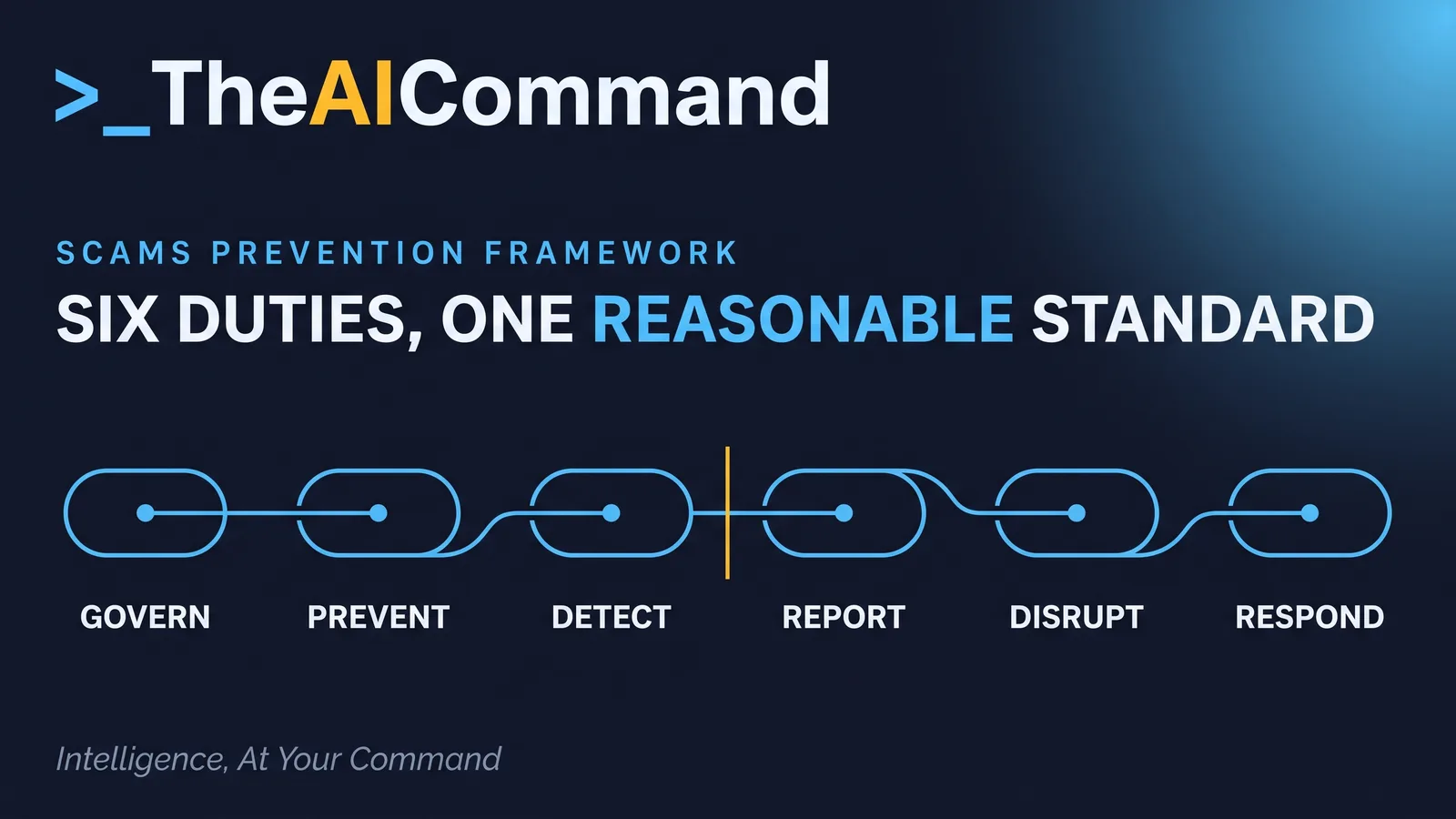
The SPF is built on six overarching principles that every regulated entity must satisfy: govern, prevent, detect, report, disrupt and respond. In plain terms, an entity must have accountable governance for scam risk, take reasonable steps to prevent scams reaching its customers, detect scam activity on its services, report it to the right bodies, disrupt scams in progress, and respond to affected consumers. The principles are deliberately outcome-based rather than prescriptive, which is what makes them durable and what makes them demanding.
The obligations also come in layers. The exposure draft sets a Common Code that binds every regulated entity, separate sector codes that add bank, telco and digital-platform specifics, and the SPF Rules that carry the operational detail, with an internal dispute resolution standard sitting underneath. An entity has to satisfy the Common Code and its sector code, not one or the other, and the codes were still in exposure draft when this was written, so the detail can move before the obligations are final.
Three regulators share the work. The ACCC is the SPF general regulator, responsible for the framework as a whole and for the digital platforms sector. ASIC regulates the banking sector code. ACMA regulates the telecommunications sector code. The Australian Financial Complaints Authority is the authorised external dispute resolution scheme, so a consumer who is dissatisfied with how an entity handled a scam has a path to an independent decision, and the entity has a standing dispute pipeline to resource.
The enforcement teeth are real. The SPF carries a two-tier civil penalty regime. The most serious breaches, tied to the prevent, detect, disrupt and respond principles, attract penalties up to around 50 million dollars per contravention for a body corporate (the greater of 159,745 penalty units, three times the benefit obtained, or 30 per cent of adjusted turnover). A pathway to consumer compensation sits alongside the regulator action. This is consumer-protection regulation with the penalty profile of competition law.
The part the codes do not name: AI
The codes are technology-neutral. They do not mention deepfakes, voice cloning or large language models, and they should not, because naming a technology dates a law. But the threat the framework is responding to has changed shape, and the change is driven by AI.
ASIC has been blunt about it. In April 2026 the regulator reported coordinating the removal of 11,964 phishing and investment scam websites during 2025, a 90 per cent increase on the prior year and about 32 sites a day, taking the total past 25,000 since its takedown service began in 2023 (ASIC, 26-063MR). It also removed more than 1,100 scam advertisements from social media. ASIC's explanation for the surge was direct: scammers are using artificial intelligence to make fake investment ads look more polished, more convincing and harder to spot, with AI used to generate professional videos, fake endorsements and targeted ads.
Those takedowns are only the visible tip. For every site ASIC removes, more are generated to replace it, because the marginal cost of producing one more convincing fake is now close to zero. That is the structural shift the framework has to contend with: not a fixed set of bad actors, but an automated production line.
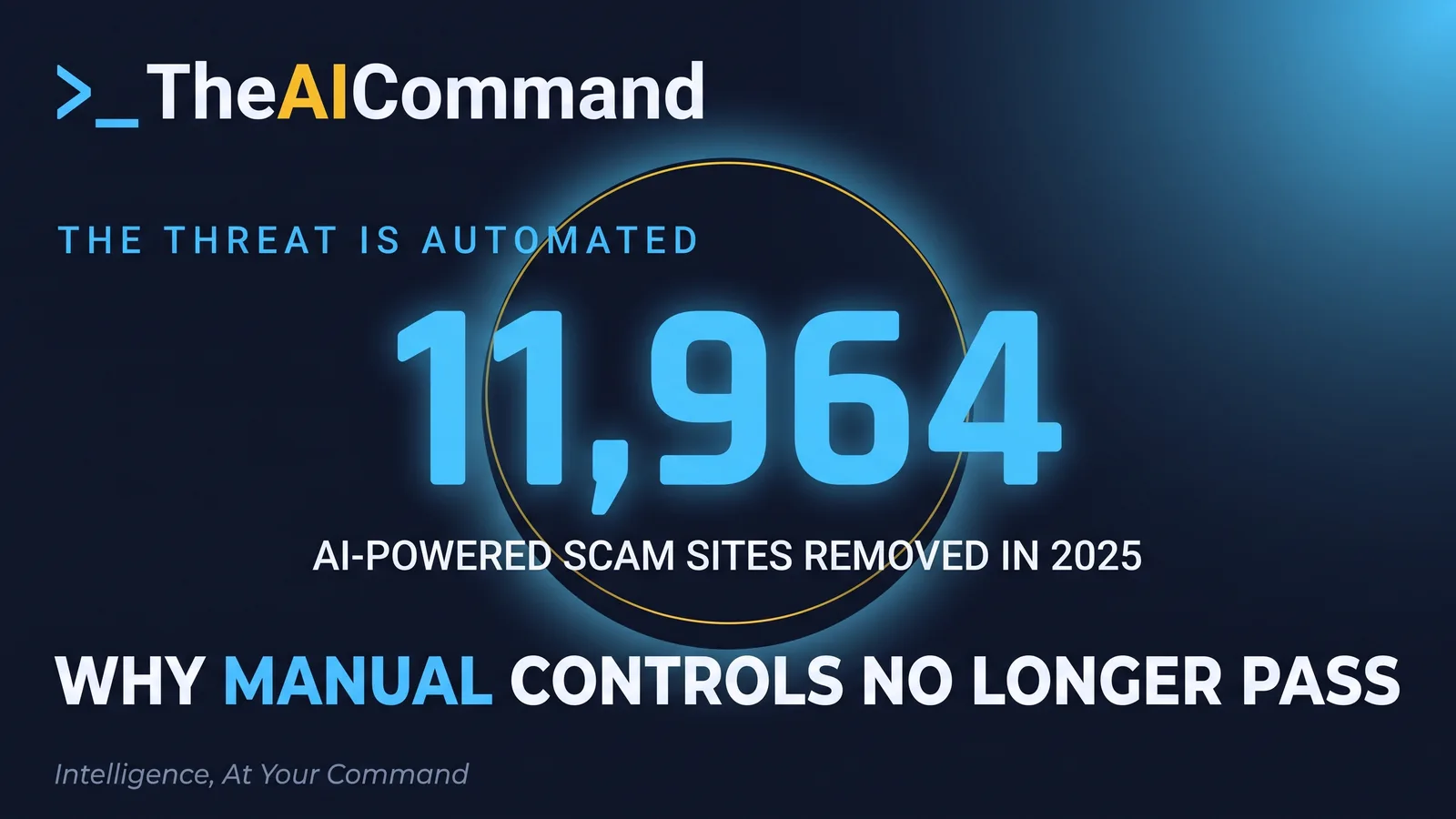
That is the asymmetry the SPF now sits inside. A scammer can spin up a convincing deepfake endorsement, a cloned brand site and thousands of personalised messages for almost nothing. The signals that compliance teams relied on to spot fraud, such as clumsy grammar, generic greetings and low production values, have largely disappeared. The volume is machine-scale and the quality is near-indistinguishable. A reasonable-steps duty to prevent and detect scams, measured against that threat, cannot be met with the controls that worked in 2022.
What does 'reasonable steps' now demand?
Reasonable steps is a moving standard. It is judged against what a diligent entity could and should have done given the risk, the available technology and the cost. As AI-enabled detection becomes standard and affordable, the floor of what counts as reasonable rises with it. Regulators do not ask whether an entity used a particular product; they ask whether its response was proportionate to a known and rising risk. When the regulator has publicly framed the risk as AI-driven, an entity that has not even assessed AI-assisted controls has a harder story to tell. Three of the six principles carry most of the AI weight.
Prevent and detect
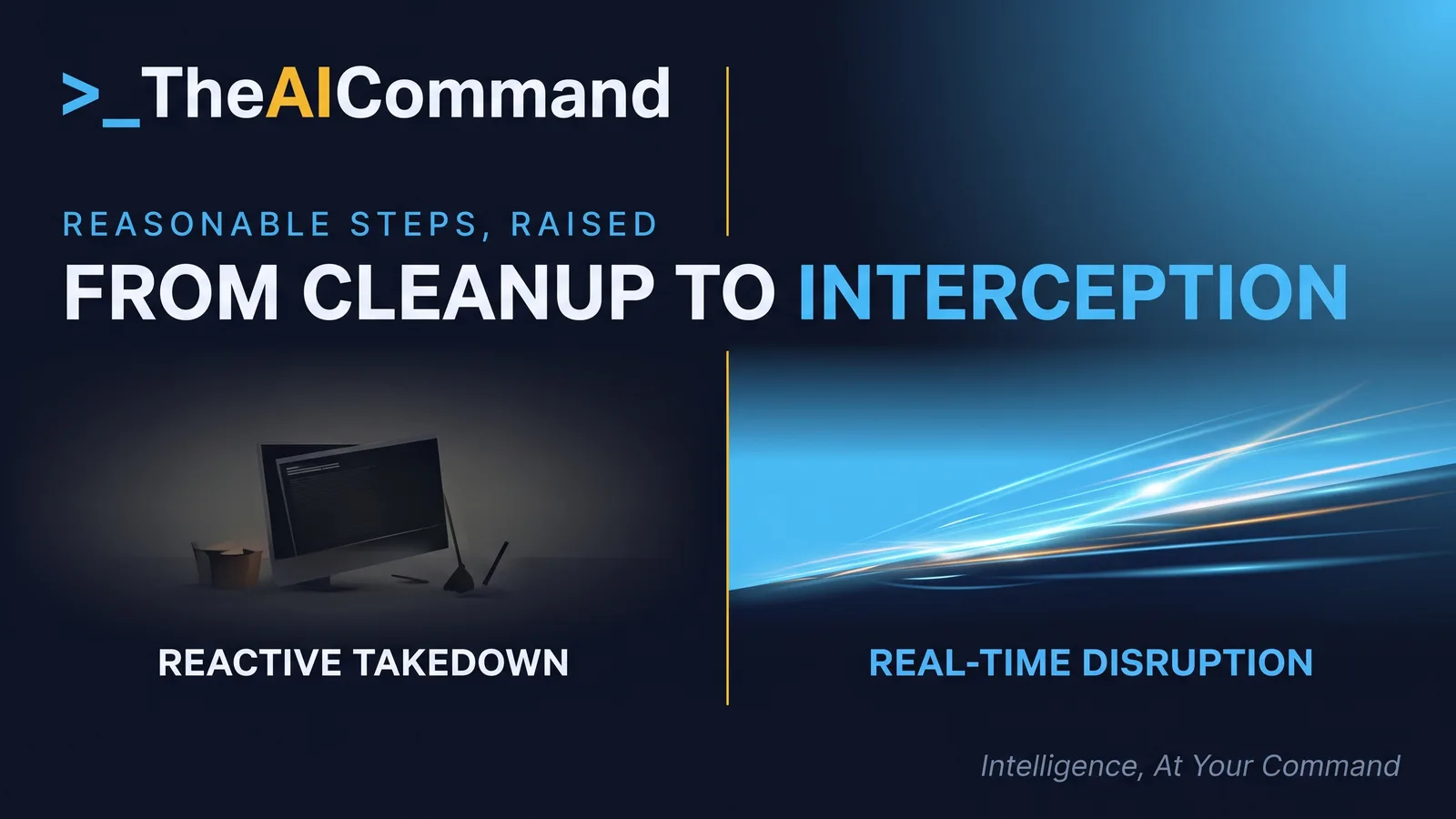
Reactive moderation, taking a scam down after a customer reports it, will increasingly read as below the standard. Meeting the prevent and detect principles against AI-generated scams points towards AI-assisted controls: models that flag synthetic or manipulated media in advertising, anomaly detection on payment and messaging patterns, brand-impersonation monitoring across platforms, and content-provenance signals where they exist. The point is not that AI is mandatory. It is that a manual-only control set will be hard to defend as reasonable when the threat is automated and the tooling to counter it is available.
Disrupt
Disruption is about speed. The SPF expects entities to interrupt scams in progress by holding a suspicious payment, requiring step-up authentication, or suspending a fraudulent channel. AI-driven detection is what makes real-time disruption feasible at scale. But disruption also creates friction and false positives, which is a governance problem in its own right, covered below.
Govern, report and respond
These are the principles where evidence lives. Governance means a named accountable owner for scam risk, board-level visibility, and a control framework that is documented and tested. Reporting means structured, timely notification to the ACCC, ASIC, ACMA or the Telecommunications Industry Ombudsman as the codes require. Respond means a resourced consumer-handling and dispute process feeding AFCA. None of these are AI problems, but all of them are where a regulator will look first when something goes wrong.
The GRC task, then, is a mapping exercise. Take each of the six SPF principles, name the specific controls that satisfy it, identify which of those controls now depend on AI-assisted detection, and define the evidence that proves the control operated. That mapping is the spine of an SPF compliance program, and it is the artefact a regulator or an internal auditor will ask to see.
Does fighting AI scams with AI create a second risk?
Here is the second-order risk that the just-deploy-AI-detection answer skips. The moment an entity uses AI to meet the prevent, detect and disrupt principles, it has introduced a new AI system into a consumer-facing, high-consequence decision, and that system needs governing as carefully as the scams it hunts.
The failure modes are familiar to anyone who has run a model-risk process. A scam-detection model that is too aggressive freezes legitimate payments and locks real customers out of their own money, which is its own consumer harm and its own complaint volume into AFCA. A model that is too permissive misses the scam the framework required the entity to catch. Both are governance failures, not technical ones. The detection model makes decisions about real people, so it carries privacy obligations under the Privacy Act and the OAIC's guidance on AI, fairness and bias exposure, and an explainability burden when a customer or a regulator asks why a payment was held or an account suspended.
So the SPF quietly creates two AI governance obligations, not one. The first is to detect AI-generated scams. The second is to govern the AI you deploy to detect them: model validation, monitoring for drift, a documented false-positive and override process, human review of consequential actions, and clear records of why the system did what it did. An SPF program that buys an AI scam-detection product and treats it as a black box has not closed its risk. It has moved it.
What should a GRC team do before the framework applies?
For GRC teams in or adjacent to a designated sector, the pre-2027 work is concrete. Treat the following as the first pass of a program plan, refined once the codes and rules are made:
- Confirm whether you are in scope. The first sectors are banks, telecommunications providers and digital platforms (social media, search and instant messaging). If you sit in a supply chain to one of these, expect contractual flow-down of SPF expectations.
- Build the principle-to-control map. Six principles, named controls, named owners, named evidence. Start it now in draft against the exposure draft, refine it when the codes are made.
- Inventory the AI in your detection stack. Every model that touches scam prevention, detection or disruption goes on the AI register, with an owner, a validation status and a monitoring plan.
- Stand up the dispute and reporting pipelines. AFCA membership, internal dispute resolution to the proposed standard, and structured reporting channels to the relevant regulator.
- Govern the detection AI as a high-consequence system. False-positive handling, override and human review for consequential actions, and privacy and explainability sign-off.
- Keep the board in the loop. The govern principle is its own obligation; delegating it to the fraud team is not a governance position a board can defend.
The Scams Prevention Framework is not an AI law, and it is right not to be. But it lands at exactly the moment AI has made scams cheaper, faster and more convincing, and it sets a reasonable-steps bar that will be read against that reality. The organisations that treat the exposure draft as a planning trigger, and that govern their own detection AI as carefully as they hunt the scammers', will be the ones that can show their steps were reasonable when it counts.
A prompt to map the six principles to controls
Paste this into ChatGPT or Claude to build the principle-to-control map the section above describes. It is a drafting aid, not a compliance sign-off.
How to run it: create a ChatGPT Project (or a dedicated chat) and paste the prompt into the project instructions so the SPF context block is inherited by every message, then keep your control inventory in a single pinned note you can re-paste. Run it in two passes: first let the model produce the full six-row map, then ask it to re-read its own output as a sceptical ASIC reviewer testing whether the steps are reasonable, name the three weakest controls and tighten them. Repeat the second pass until the weakest rows stop changing.
Bottom line
The Scams Prevention Framework sets a technology-neutral reasonable-steps duty across six principles, backed by civil penalties up to around 50 million dollars per contravention, with substantive sector obligations proposed from 31 March 2027. Because the scams it targets are now AI-generated, manual-only controls will be hard to defend, and any AI you deploy to detect them becomes a second high-consequence system you must govern. Treat the exposure draft as a planning trigger, not a future problem.
Do this Monday:
- Confirm whether you are in scope as a bank, telco or digital platform, or a supplier to one.
- Start the principle-to-control map: six principles, named controls, named owners, named evidence.
- Inventory every AI model in your scam detection stack on the AI register.
- Stand up the dispute and reporting pipelines to the ACCC, ASIC, ACMA and AFCA.
- Govern the detection AI as a high-consequence system, with false-positive handling and human review.
References
- Scams Prevention Framework Act 2025 (Cth), Act No. 15 of 2025; Royal Assent 20 February 2025. Federal Register of Legislation, C2025A00015. https://www.legislation.gov.au/C2025A00015/latest/text
- The Treasury, Scams Prevention Framework codes and rules exposure draft; released 28 May 2026, consultation closed 25 June 2026. Treasury consultation hub c2026-765133. https://consult.treasury.gov.au/c2026-765133
- ASIC, Media Release 26-063MR, 'ASIC ramps-up action to protect consumers from AI-powered online investment scams', 8 April 2026. https://www.asic.gov.au/about-asic/news-centre/find-a-media-release/2026-releases/26-063mr-asic-ramps-up-action-to-protect-consumers-from-ai-powered-online-investment-scams/
- National Anti-Scam Centre, 'Targeting scams: report on scams data and activity 2024', 11 March 2025. https://www.nasc.gov.au/news/australians-better-protected-as-reported-scam-losses-fell-by-almost-26-per-cent
- The Hon Dr Daniel Mulino MP, 'Consulting on industry codes and rules to protect consumers from scams', Treasury Ministers media release, 29 November 2025. https://ministers.treasury.gov.au/ministers/daniel-mulino-2025/media-releases/consulting-industry-codes-and-rules-protect-consumers
- Australian Financial Complaints Authority, 'Scams Prevention Framework'. https://www.afca.org.au/about-afca/scams-prevention-framework
This is general information for governance, risk and compliance professionals, not legal or compliance advice. The Scams Prevention Framework codes and rules were in exposure draft at the time of writing and may change before they are made. Confirm your obligations against the final instruments and with the relevant regulators (the ACCC, ASIC and ACMA) before acting.
TheAICommand. Intelligence, At Your Command.