
A contract generator does not write one contract. It writes the same contract, over and over, at whatever volume the pipeline demands.
That is the point of it, and it is the fact pattern the unfair contract terms regime was built around. The law does not ask who drafted the clause. It asks how many times the same clause went out, whether the other side could change it, and whether the term is unfair. A model answers the first two against you.
What makes a contract standard form?
Section 27(1) of the Australian Consumer Law puts the onus where compliance teams do not expect it. If a party to a proceeding alleges a contract is a standard form contract, it is presumed to be one unless another party proves otherwise. The supplier that prepared the template carries that burden.
Section 27(2) sets out what a court must take into account, and one factor reads as though drafted for automated production. Paragraph (ba) requires the court to consider whether one of the parties has made another contract, in the same or substantially similar terms, prepared by that party, and if so how many. Paragraph (a) asks about bargaining power, and paragraph (c) whether the other side had to accept or reject the terms as presented.
Section 27(3) closes the obvious escape routes. A contract may still be standard form despite an opportunity to negotiate changes that are minor or insubstantial in effect, and despite an opportunity to select a term from a range of options determined by another party. A generator offering three approved variants of a termination clause is doing what paragraph (3)(b) describes.
The practical consequence is blunt. If you automate contract production, arguing the output is not standard form is hard, and you are the one who has to argue it.
What makes a term unfair, and who carries the onus?
Section 24(1) sets three cumulative limbs. The term must cause a significant imbalance in the parties' rights and obligations under the contract, must not be reasonably necessary to protect the legitimate interests of the party advantaged by it, and must cause detriment, financial or otherwise, if applied or relied on.
The second limb carries its own reverse onus. Section 24(4) presumes a term is not reasonably necessary to protect those interests unless the advantaged party proves otherwise. The supplier proves the contract is not standard form, then proves the term was reasonably necessary. Two presumptions, both pointing the same way.
Section 24(2) requires a court to consider the extent to which the term is transparent and the contract as a whole. Transparent, under section 24(3), means expressed in reasonably plain language, legible, presented clearly, and readily available to any party affected. A model that pads a template with boilerplate can make a term less transparent without changing its effect.
Section 25 lists the examples, and the unilateral variation limbs bite hardest for subscription businesses. Paragraph (d) covers a term permitting one party but not another to vary the terms, and paragraph (g) unilateral variation of the characteristics of the goods or services supplied. Section 26 carves out terms defining the main subject matter, setting the upfront price, or required or expressly permitted by law, but only to that extent.
The penalty counts terms, not contracts
Section 23(1) voids an unfair term in a standard form consumer or small business contract, and section 23(2) keeps the rest on foot if it can operate without it. Voidness is the old remedy. The subsections that matter now are 23(2A) and 23(2C), which make it a contravention to propose an unfair term, and to apply or rely on one.
Then the multiplier. Section 23(2B) makes a person who contravenes subsection 23(2A) liable for a separate contravention for each unfair term that person proposed. Five unfair terms in one template is five contraventions, before anyone counts how many contracts carried them.
Section 224 prices each act or omission. For a body corporate, item 2A of the table in section 224(3) points to section 224(3A): the greater of $100,000,000, three times the benefit where a court can value it, or 30% of adjusted turnover during the breach turnover period where it cannot. For an individual the maximum is $2,500,000, and both are current as at 21 September 2026.

The fixed figure is new. The Treasury Laws Amendment (Doubling Penalties for ACCC Enforcement) Act 2026 substituted $100,000,000 for $50,000,000 in section 224(3A)(a), commencing 28 March 2026, and applies only to acts or omissions on or after that date. The three times benefit and 30% turnover limbs are unchanged.
The turnover limb rewards a second look, because duration inflates it. The breach turnover period is the longer of two windows: twelve months back from the end of the month the conduct ceased or proceedings began, and the period from the beginning of the month it started. A term that sat in a template for three years produces a three year turnover base.
The remedy scales the same way, once a court has declared a term unfair under section 250. Section 243B then lets a court, on the regulator's application, restrain a respondent from including a substantially similar term in any future standard form contract, whether or not that contract is identifiable when the order is made.
One honest counterweight. Section 224(4) provides that where conduct contravenes two or more of the listed provisions, a person is not liable to more than one pecuniary penalty for the same conduct. That constrains stacking across provisions. It does not touch section 23(2B), which counts terms inside one subsection.
Financial services sit under a different Act
If the contract is a financial product, or a contract for the supply of financial services, the operative provisions are not in the Australian Consumer Law. They sit in Subdivision BA of the ASIC Act 2001, which ASIC administers. Section 12BF mirrors section 23, including the per term rule at 12BF(2B), and sections 12BG, 12BH and 12BK mirror the test, the examples and the standard form factors.
Two differences matter for a mixed business running one template library. Section 23(4) of the Australian Consumer Law catches a counterparty employing fewer than 100 persons or turning over less than $10,000,000, with no cap on contract value, while section 12BF(4)(a) of the ASIC Act adds an upfront price condition of $5,000,000. A large financial services contract with a small counterparty can fall outside that regime while an equivalent non-financial contract stays inside.
The penalty is also expressed in penalty units. Section 12GBA(6)(aa) makes a provision of Subdivision BA a civil penalty provision, and section 12GBCA sets the maxima for a body corporate: the greatest of 50,000 penalty units, three times the benefit derived and detriment avoided, or 10% of annual turnover capped at 2.5 million penalty units. A penalty unit is $364 from 1 July 2026, so as at 21 September 2026 that is $18,200,000, with a ceiling of $910,000,000. That value is set by the Crimes (Amount of a Penalty Unit) Instrument 2026 under subsection 4AA(1A) of the Crimes Act 1914, and the instrument records that the amount is the result of indexation and applies to offences committed on or after 1 July 2026.
Why a generator is the exact multiplier the regime assumes
Consider the ACCC's own enforcement. On 30 June 2026 it announced Federal Court proceedings against Amazon Commercial Services, alleging that between November 2023 and August 2025 Prime contracts with more than one million annual subscribers carried five unfair terms permitting unilateral negative changes without a remedy, and that Amazon later relied on one or more of them to bring ads to Prime Video. The ACCC calls it one of the first contested matters under the penalty regime that applies to contracts made or renewed from 9 November 2023, and the allegations were untested as at 21 September 2026. Note the vintage. The alleged conduct ended in August 2025, and section 310 of the Australian Consumer Law applies the doubling only to acts or omissions on or after 28 March 2026, so the fixed limb for that conduct is $50,000,000, not the $100,000,000 above. The ACCC states the same rule for the maxima it publishes.
The structure is what to notice. One standardised sign-up process. Five terms. More than a million contracts. The ACCC also alleges a related overseas entity was involved in drafting the Australian contracts and was knowingly concerned in the conduct, and section 224 reaches a person knowingly concerned in a contravention, not only the entity named on the contract. The ACCC does not allege the terms were machine-drafted. Distribution at scale is what makes the arithmetic bite, whoever wrote the clause.
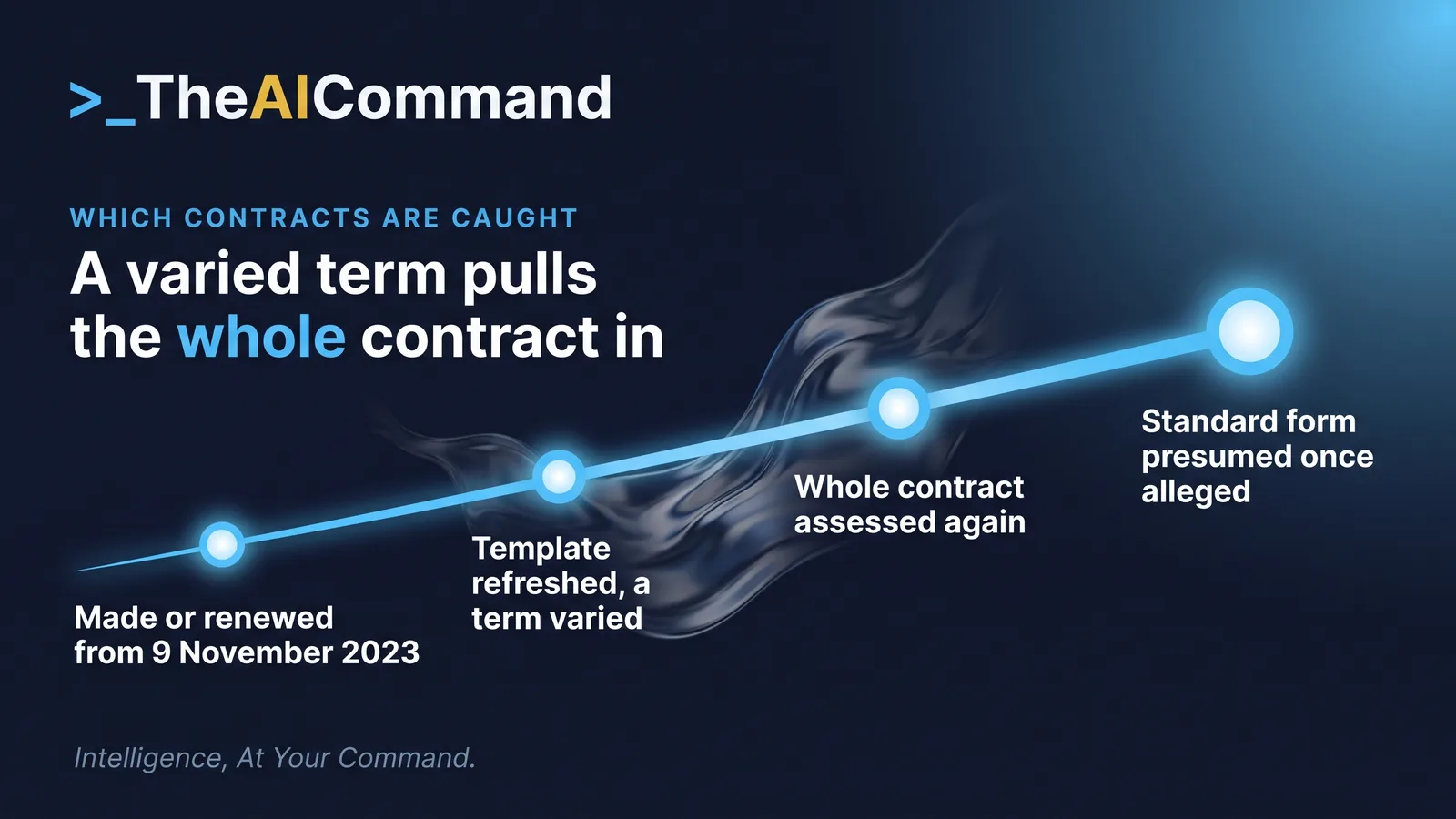
There is a second, quieter exposure. The ACCC states that the 9 November 2023 changes apply to contracts made or renewed on or after that date, and to a term varied or added from it, and that where a term is varied or added, the standard form changes apply to the whole contract. A generator that refreshes a template on a schedule varies terms continuously, and each refresh can pull an older contract into the regime.
None of this makes AI drafting prohibited. Treasury's Review of AI and the Australian Consumer Law reported in October 2025 that the principles-based protections under that law are generally well adapted to the potential consumer law risks of AI enabled goods and services. That finding is not law, and it sits beside Australia's decision not to pass a separate AI Act. The same statute reaches an AI-written advertisement and an AI pricing agent.
What do you check in a generated contract?
Start with the clause families section 25 names, because that is where a court will start and where the ACCC has aimed. Its 2026-27 enforcement priorities, current as at 21 September 2026, single out unfair terms with a focus on harmful cancellation terms, including automatic renewals, early termination fees and non-cancellation clauses. Add one-sided limitation of liability, one-sided assignment, and any term letting one party decide whether the contract was breached.
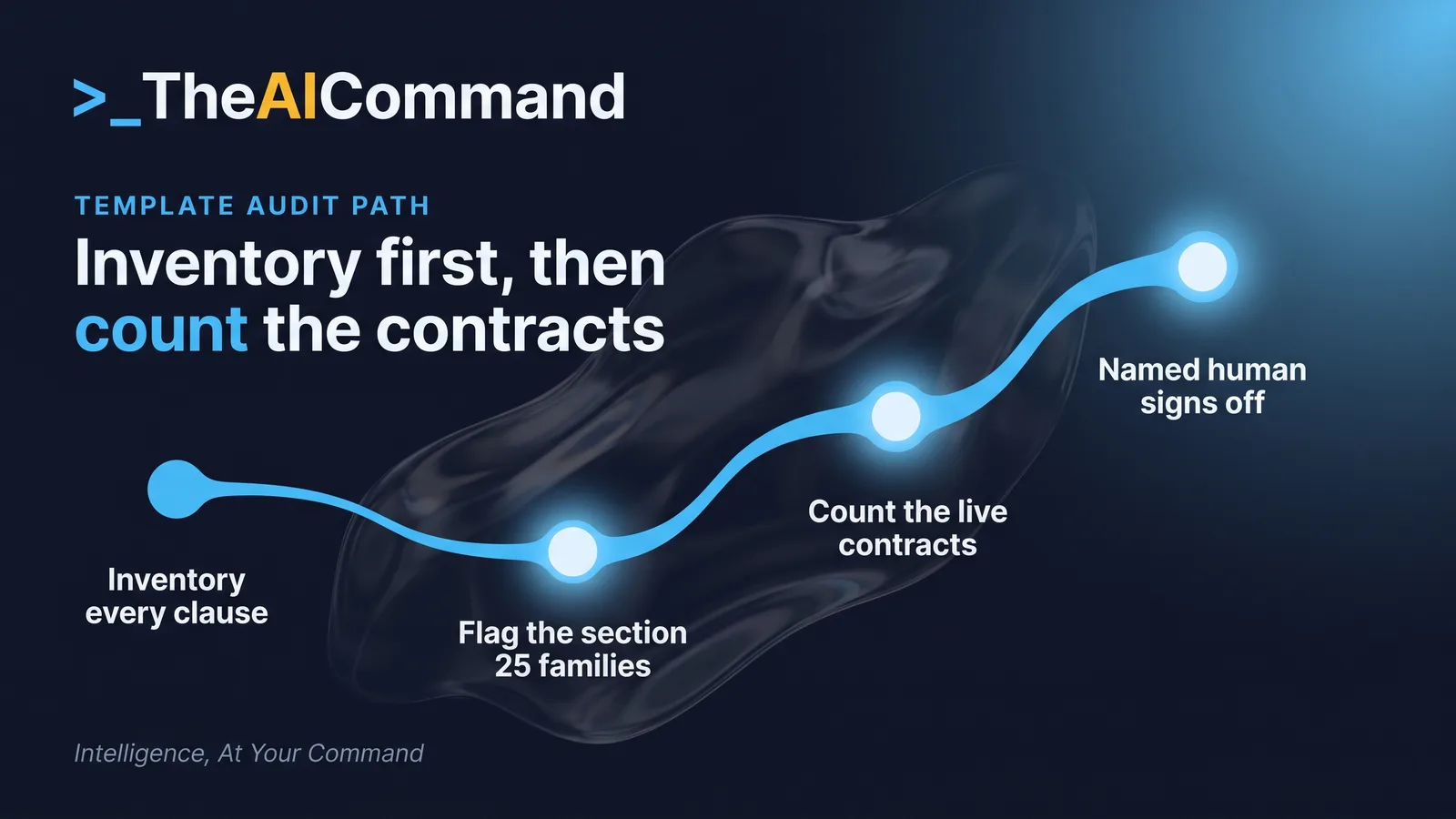
Then answer the question the drafting review will not: how many live contracts carry each term. The register of which template version went to which counterparty on which date converts one clause into a contravention count, and it usually sits in the sales system, not with legal. Treat the template as a controlled document with a version, an owner and an approval, like any other instruction artefact that shapes output at scale, and route changes through the same human change control as an obligations register.
A model is useful for the inventory half of that work. Use it to find and group candidate clauses, never to reach the conclusion.
Bottom line
Automated drafting makes the standard form question easy for the regulator and hard for you, because the evidence section 27(2)(ba) asks for is the volume your generator produces, and two presumptions leave you carrying the onus. The penalty then counts terms, not documents: section 23(2B) makes each unfair term proposed a separate contravention, priced against a maximum that starts at $100,000,000 for a body corporate as at 21 September 2026. The clause is written once. The exposure is counted every time it ships. Audit the template, not the contract.
Do this Monday
- List every template a generator produces, with its name, version, effective date and named owner.
- Screen each template against the section 25 clause families, starting with automatic renewal, early termination fees, non-cancellation clauses and unilateral variation.
- Reconcile templates to live contracts, so you can state how many counterparties hold each flagged clause and when each was made.
- Split the register by regime, marking financial products and services as ASIC Act matters and applying the $5,000,000 upfront price condition only to those.
- Gate template change on a named human approval before anything reaches production.
Content disclaimer: This article is for general educational and informational purposes only. It does not constitute legal advice, regulatory guidance, or a substitute for professional compliance judgement. Regulatory obligations vary by entity type, licence, and circumstance. Always refer to primary source guidance from the ACCC, ASIC, or the relevant regulatory authority.
Primary sources
- Competition and Consumer Act 2010, Schedule 2, sections 23 to 28A, 224, 243B and 250. Compilation No. 166, C2026C00389, the latest registered compilation as at 21 September 2026. A later point-in-time version commenced 16 September 2026 under Schedules 4 and 5 of the Treasury Laws Amendment (Strengthening Accountability for Tax Adviser Misconduct and Other Measures) Act 2026, which amends the merger and competitive neutrality provisions and does not touch sections 23 to 28A, 224, 243B or 250. https://www.legislation.gov.au/C2004A00109/2026-08-27/2026-08-27/text
- Treasury Laws Amendment (Doubling Penalties for ACCC Enforcement) Act 2026, No. 19 of 2026, commenced 28 March 2026. https://www.legislation.gov.au/C2026A00019/asmade/text
- Competition and Consumer Amendment (Unfair Trading Practices) Act 2026, No. 64 of 2026, assented 6 July 2026, commencing 1 July 2027, Schedule 1 items 9 and 19. https://www.legislation.gov.au/C2026A00064/asmade/text
- Australian Securities and Investments Commission Act 2001, Subdivision BA and sections 12GBA to 12GBCA. Compilation No. 108, C2026C00358, in force 7 July 2026. https://www.legislation.gov.au/C2004A00819/latest
- Crimes (Amount of a Penalty Unit) Instrument 2026, F2026N00424, penalty unit $364 from 1 July 2026. https://www.legislation.gov.au/F2026N00424/asmade/text
- ACCC, Amazon in court for introducing ads to Prime Video using allegedly unfair contract terms, media release, 30 June 2026. https://www.accc.gov.au/media-release/amazon-in-court-for-introducing-ads-to-prime-video-using-allegedly-unfair-contract-terms
- ACCC, Fines and penalties, 13 July 2026. https://www.accc.gov.au/business/compliance-and-enforcement/fines-and-penalties
- ACCC, Contracts, 21 July 2026. https://www.accc.gov.au/business/selling-products-and-services/contracts
- ACCC, Compliance and enforcement priorities, 11 June 2026. https://www.accc.gov.au/about-us/accc-strategy-and-priorities/compliance-and-enforcement-priorities
- Treasury, Review of AI and the Australian Consumer Law, Final report, October 2025. https://treasury.gov.au/sites/default/files/2025-10/p2025-702329-fr.pdf
TheAICommand. Intelligence, At Your Command.