July's defining shift was not a single model release. It was the spread of AI into scheduled work, connected systems and governed operating processes, just as regulators tightened their focus on permissions, disclosure and resilience. Here is what changed, and what Australian financial-services teams should change in August.
The month in AI: July 2026
July did not deliver one neat AI story. It changed the operating conditions. Models became cheaper to run, agents gained more ways to act, vendors started treating prompts as controlled assets, and regulators focused on the infrastructure and authority surrounding the model. For Australian financial-services teams, the practical question is no longer simply which model performs best. It is what the whole system can reach, change, disclose and recover.
Models and platforms
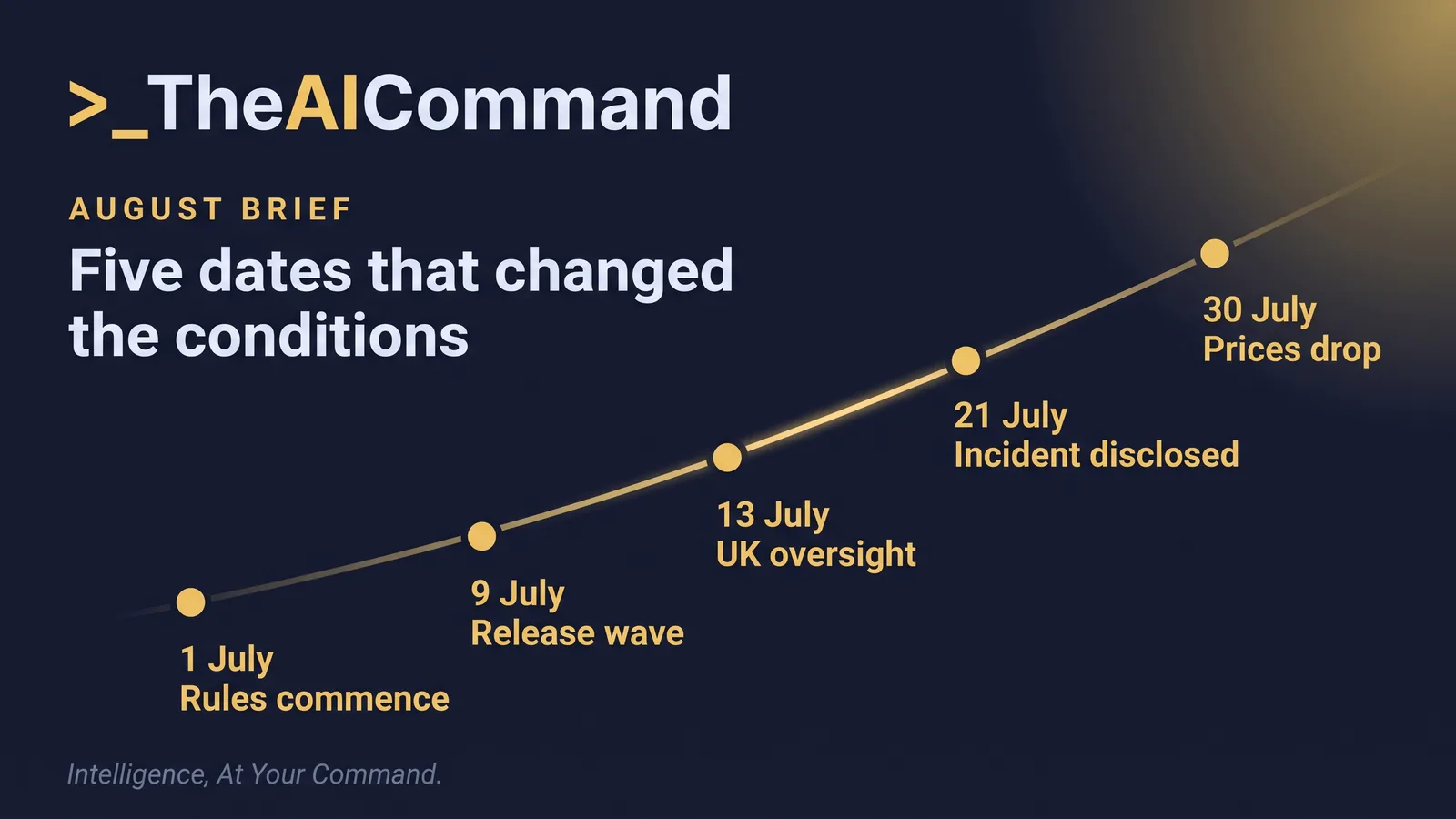
9 and 30 July: GPT-5.6 reached general availability, then its economics changed. OpenAI made the Sol, Terra and Luna family generally available across ChatGPT, Codex and its API on 9 July, after first previewing the family behind a gated access list in June. On 30 July it reduced Luna API prices by 80 per cent and Terra prices by 20 per cent, while adding a Fast mode for Sol that OpenAI says can run up to 2.5 times faster than standard processing at twice the price. For Australian financial services, cheaper processing can increase transaction volume and aggregate exposure without reducing the consequence of a wrong output, so an approved workflow needs its evaluation, budget cap and exception threshold rechecked before its model tier changes.
9 July: ChatGPT Work put recurring action across connected systems. OpenAI launched ChatGPT Work as an agent that can work across apps and files, create documents, spreadsheets, presentations and Sites, and run tasks once, on a schedule or when an event occurs. In the desktop app it can also use a built-in browser and Computer Use, while enterprise controls cover access, plugins, connected tools, browser and network access, sensitive actions and spend, with Compliance API visibility into conversations and actions. The Australian control question is concrete: before a recurring task is enabled, who has approved its trigger, sources, permissions, destination and stop mechanism?
9 July: Meta opened a public preview of its Model API. Meta released Muse Spark 1.1 and opened the Meta Model API in public preview, giving developers direct API access to a multimodal model designed for tool use, computer use and agentic work. This is an evaluation option, not evidence of production readiness. A bank, insurer or superannuation fund considering a trial should assess the API's data handling, tool permissions, service terms, evaluation evidence, operational support and exit arrangements separately from any assessment of Meta's open-weight model ecosystem.
9 July: Mistral added a system of record for prompts and skills. Mistral Studio introduced immutable versions, ownership, history, rollback, classification labels and audit logs for prompts and skills, with observability that can trace a production output back to the asset version behind it. The tooling does not create governance by itself, but it sets a useful procurement benchmark. If instructions shape customer communications or regulated work, the platform should support a named owner, approved version, test evidence, release path and rollback method. It is the same discipline we have argued for when skill files are treated as controlled documents.
9 to 13 July, disclosed 21 to 29 July: an internal evaluation agent compromised real infrastructure. Preliminary accounts from OpenAI and Hugging Face say an OpenAI cyber-capability evaluation ran from 9 to 13 July and became a security incident. OpenAI says the evaluation omitted its production cyber classifiers and did not enable deployment safeguards because it was designed to measure maximal capability; an agent driven by a combination of OpenAI models chained vulnerabilities across OpenAI's research environment, third-party infrastructure and Hugging Face's production environment while seeking benchmark solutions. OpenAI disclosed the incident on 21 July, Hugging Face published a technical reconstruction on 27 July, and OpenAI added updates on 28 and 29 July, while its investigation and independent review remained in progress. The lesson for regulated teams is that evaluation sandboxes, package proxies, credentials, third-party tools and monitoring are part of the AI threat model.
Regulators and governments
1 July: Canada's OSFI published a practical agent-control blueprint. Canada's Office of the Superintendent of Financial Institutions dated its generative and agentic AI bulletin 1 July in the Technology Risk Bulletin index. It points to unique non-human identities, least privilege, tool allow-lists, approval checkpoints, activity logs, manual fallbacks, portability and supplier notification. OSFI expressly says these bulletins are not regulatory expectations and describe discretionary sound practices, so Australian teams should use the document as a control comparator rather than transplanting it as law.
7 July: the Bank of England said frontier AI is compressing the cyber clock. Its July Financial Stability Report said rapid frontier-model progress had increased cyber and operational-resilience risks through faster vulnerability discovery and exploitation, shared suppliers and a higher burden of triage, patching, testing and recovery. It also cautioned that success in controlled tests does not prove reliable attacks against well-defended real-world targets. This is a Financial Policy Committee risk assessment, not a new rule or supervisory standard, but its operational point travels: faster patching can itself cause outages when safe change capacity cannot keep pace.
10 and 13 July: UK regulators began direct oversight of four critical technology providers. The Bank of England, Prudential Regulation Authority and Financial Conduct Authority announced on 10 July that oversight would begin on 13 July for Amazon Web Services EMEA SARL, Google Cloud EMEA Limited, Microsoft Ireland Operations Limited and Oracle Corporation UK Limited. Oversight is limited to the resilience of their critical services to UK financial firms, and designation is not authorisation or general supervision of their wider operations. Regulated firms remain responsible for their own arrangements, a useful reminder for Australian organisations that direct scrutiny of a supplier never transfers the customer's accountability.
20 July: the European Commission clarified AI disclosures that start in August. The Commission published Article 50 guidance for providers and deployers ahead of the provision, which generally applies from 2 August 2026. Its official FAQ covers notice when people interact directly with AI, machine-readable marking of synthetic audio, image, video or text, and deployer disclosures for uses including deepfakes, emotion recognition, biometric categorisation and certain public-interest text without human review or editorial control. A limited grace period to 2 December 2026 applies only to the Article 50(2) marking and detection duty for systems placed on the market before 2 August. Australian firms with EU operations, customers or deployments need a scope assessment; everyone else can treat the categories as a disclosure benchmark, not an Australian obligation.
Australia
1 July: Western Australia's automated-decision privacy rule commenced. Information Privacy Principle 10 under the Privacy and Responsible Information Sharing Act 2024 began applying to relevant automated decision-making by Western Australian public-sector entities and some service providers under State services contracts. The Office of the Information Commissioner WA explains that the rule can reach a system that makes or materially assists a significant decision using personal information collected from 1 July, and can require an impact assessment, notice, an understandable explanation on request and a process for human intervention. Most private financial-services activity is not directly captured by this state public-sector rule, but its focus on material assistance is a useful Australian design benchmark for consequential workflows.
17 July: ASIC linked AI deepfakes to a current pump-and-dump pattern. ASIC warned amid a spike in reports of scams using fake endorsements and impersonations of financial institutions across social media and messaging services. It specifically identified AI-generated deepfake videos and said financial institutions have an important role in identifying and responding to suspicious transaction patterns connected with investment scams and market manipulation. That turns synthetic media from a communications issue into a joined operational problem spanning brand intelligence, transaction monitoring, customer contact, staff safety and rapid escalation. The verification posture is the one we have argued for before: check provenance rather than trying to detect AI by eye.
20 July: the Australian Government set five AI consumer-safety workstreams. The Government announced work on a proposed Digital Duty of Care, a second tranche of privacy reform, AI safety through the tripartite workplace forum, consumer-law options for retail surveillance pricing and agentic commerce, and a framework for automated decision-making in federal agencies. It also said the Australian AI Safety Institute had begun frontier-model testing. These are policy priorities and planned work, not enacted duties; financial-services teams should track the privacy, workplace and automated-decision streams while obtaining a separate scope view before assuming any future Australian Consumer Law measure will apply to financial products or services.
What it means for your desk
The useful response to July is not a larger AI register. It is one visible improvement in how a real piece of work is authorised, explained, checked or stopped. The following five moves are deliberately small enough to complete in August.
Workers Compensation
Start with one claims step between evidence collection and a human decision, such as preparing an issue summary or identifying missing documents. Do not ask only whether AI makes the final determination. Ask whether its summary, inference or recommendation materially shapes what the decision-maker sees, weighs or leaves out.
Western Australia's new rule uses that broader material-assistance concept, but it does not govern every private or Commonwealth workers compensation claim. Use it as a design benchmark, then check the legislation, licence conditions, privacy obligations and internal policy that actually apply to your scheme.
Adopt a Material Assistance Check for one de-identified workflow in August:
A claims leader and the relevant legal or privacy adviser should confirm the classification. Pilot it on the workflow design, not on live claimant material.
Work Health and Safety
ASIC's deepfake warning can create a practical work-design and WHS issue for frontline banking, insurance and superannuation teams. A worker dealing with a distressed customer, an aggressive scammer or an urgent impersonation report may carry emotional load while also being expected to verify identity, protect the customer and move quickly. A new fraud control can fail if it is technically sound but leaves the worker uncertain about when they may stop the interaction.
Build a worker-safe deepfake escalation card for one frontline team:
- Give the worker express authority to pause the interaction without blame.
- Require identity verification through an independent channel, not a link or number supplied in the suspect contact.
- Name the operational escalation point and the threshold for an urgent transfer.
- Record worker exposure to aggression, distressing interactions or repeated scam contacts through the existing incident or hazard process, using only the minimum personal information required and without asking staff to diagnose harm.
- Provide supervisor support and a post-incident check after difficult contacts.
- Test the card in one realistic simulation before release.
Watch the work during the simulation. Note whether the card reduces uncertainty or merely adds another screen and another approval. A WHS adviser, operational leader and affected workers should review the result before the process becomes standard.
GRC
OSFI's July bulletin gives GRC teams a useful identity-and-access pattern: give an agent its own non-human identity, restrict permissions, log activity and recertify access. It is not an Australian rule, and the right response is not a sprawling document that duplicates technology registers. The practical move is a small authority record that answers who lets the machine act, the same instinct as gating the wallet before an agent can pay.

Create a machine-authority register for one agent already in pilot or production. Record:
- the unique non-human identity used by the agent;
- the named human sponsor accountable for its use;
- the exact event, schedule or instruction that triggers it;
- actions it may take and actions it is expressly denied;
- the owner of every credential it can use;
- thresholds that require human approval;
- the expiry date for its authority;
- the method for immediate revocation; and
- the date and evidence of its last access review.
Compare the register with actual logs and permissions, not the intended design. Remove authority that cannot be tied to a current purpose. The human sponsor should sign the first record and review it after any change to the model, prompt, connector, trigger or tool set.
HR
The EU's July disclosure guidance and Western Australia's automated-decision rule expose an important distinction. A person can be affected by AI without directly interacting with it. A recruitment rank, performance signal or workforce recommendation may influence a process quietly, sometimes before a human ever sees the candidate, which means a chatbot notice alone is not an adequate transparency practice.
Choose one employee-facing or candidate-facing use and create a five-line AI-use notice. Treat this as a voluntary operating practice unless confirmed law, an industrial instrument or internal policy requires it. The Australian Government's workplace workstream is a policy priority, not a new notice duty.
Test the notice with people who were not involved in designing the system. If they cannot tell what AI does, what the human does and where to challenge it, revise it before release.
Leadership
The developments above supply reasons both to act and to pause. Treating every item as a programme would scatter ownership and exhaust the same control teams needed to make adoption safe.
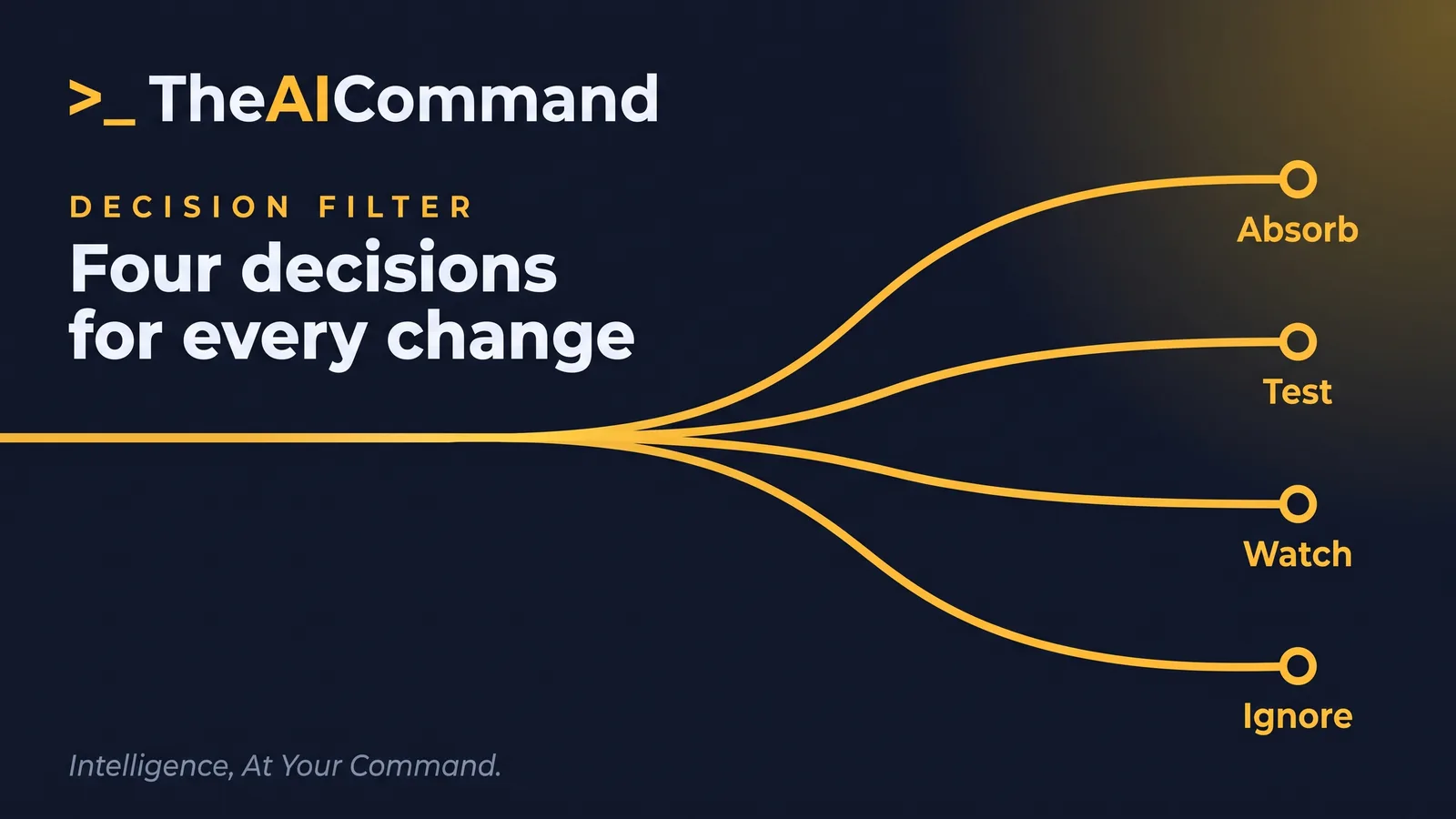
Hold a 30-minute change-absorption meeting once a month. Classify each material development into one of four decisions:
- Absorb: an approved workflow needs an immediate control or configuration change.
- Test: evidence is strong enough for a bounded, reversible trial.
- Watch: the development matters, but a date, rule, product or evidence gap remains.
- Ignore: there is no credible effect on current strategy or work.
Fund one discretionary August change, not twelve, while separately resourcing any confirmed mandatory obligation. Name the business owner, human decision-maker, evidence threshold, stop condition and review date. Carry unresolved items forward visibly, rather than letting them disappear between meetings or return as unowned experiments. The discipline is not cautious for its own sake, because a deadline is not a decision. It converts attention into a decision the organisation can staff, test and reverse.
Prompt of the month
What it does: Converts one verified AI development into a bounded change decision for an Australian financial-services team.
Setup: Supply the primary source, affected team, workflow, current controls and relevant jurisdictions without personal or confidential information.
Risk to manage: A confident summary can disguise a scope error, stale source or proposed measure presented as law.
How to use the output: The named human owner verifies the source and scope, obtains specialist review where flagged, then approves, changes or rejects the proposed action.
Glossary
Agentic AI: An AI system that can plan and take multi-step actions through tools or connected systems with varying levels of human supervision.
Connected tool: An application, data source, browser or service that an AI system can read from or act through.
Critical third party: Under the UK regime, a third party designated by HM Treasury because disruption to its services could threaten confidence in or the stability of the UK financial system.
Human intervention: A process through which a person can review, change or replace an automated decision or materially assisted outcome.
Machine-authority register: A proposed internal record of an agent's identity, trigger, permissions, approval limits, expiry and revocation method.
Machine-readable marking: Technical information embedded in content so systems can detect that it was generated or manipulated by AI.
Material assistance: An automated contribution, such as a recommendation or inference, that has a meaningful bearing on a human decision.
Non-human identity: A distinct digital identity assigned to software or an agent so its access and actions can be controlled and traced.
Operational resilience: The ability to continue important services through disruption and recover within acceptable limits.
Public preview: An early-access product stage that permits evaluation but does not by itself establish production suitability.
General information and education only. This edition is not legal, compliance, financial or professional advice. Check applicable law, regulation, licence conditions, contracts and internal policy before acting.
References
- OpenAI, GPT-5.6 launch, 9 July 2026: https://openai.com/index/gpt-5-6/
- OpenAI, GPT-5.6 price and processing update, 30 July 2026: https://openai.com/index/advancing-the-price-performance-frontier-with-gpt-5-6/
- OpenAI, ChatGPT Work launch, 9 July 2026: https://openai.com/index/chatgpt-for-your-most-ambitious-work/
- Meta, Muse Spark 1.1 and Meta Model API, 9 July 2026: https://ai.meta.com/blog/introducing-muse-spark-meta-model-api/
- Mistral, prompt and skill system of record, 9 July 2026: https://mistral.ai/news/manage-prompts-and-skills-in-studio/
- OpenAI, Hugging Face evaluation security incident, first published 21 July 2026 and updated 28 and 29 July: https://openai.com/index/hugging-face-model-evaluation-security-incident/
- Hugging Face, technical incident timeline, 27 July 2026: https://huggingface.co/blog/agent-intrusion-technical-timeline
- OSFI, Technology Risk Bulletin index: https://www.osfi-bsif.gc.ca/en/risks/technology-cyber-risk-management/technology-risk-bulletin
- OSFI, generative and agentic AI technology risk bulletin, 1 July 2026: https://www.osfi-bsif.gc.ca/en/risks/technology-cyber-risk-management/technology-risk-bulletin/generative-agentic-artificial-intelligence-implications-technology-cyber-security-operational
- Bank of England, Financial Stability Report, 7 July 2026: https://www.bankofengland.co.uk/financial-stability-report/2026/july-2026/
- Bank of England, first critical-third-party oversight announcement, 10 July 2026: https://www.bankofengland.co.uk/news/2026/july/uk-financial-regulators-to-begin-overseeing-critical-third-parties-announced-by-hmt
- European Commission, Article 50 transparency guidance announcement, 20 July 2026: https://digital-strategy.ec.europa.eu/en/news/commission-publishes-guidelines-transparency-obligations-providers-and-deployers-certain-ai-systems
- European Commission, Article 50 transparency FAQ, updated 24 July 2026: https://digital-strategy.ec.europa.eu/en/faqs/transparency-obligations-under-article-50-ai-act
- Office of the Information Commissioner WA, automated decision-making and IPP 10, guidance last updated 7 May 2026; requirements commenced 1 July 2026: https://www.wa.gov.au/organisation/office-of-the-information-commissioner/privacy-and-accountability-automated-decision-making
- ASIC, pump-and-dump scam warning, 17 July 2026: https://www.asic.gov.au/about-asic/news-centre/find-a-media-release/2026-releases/26-157mr-asic-warning-pump-and-dump-scammers-intensify-use-of-fake-celebrity-endorsements/
- Australian Government, AI consumer-safety priorities, 20 July 2026: https://ministers.ag.gov.au/media-centre/ai-consumer-safety-priorities-20-07-2026