
A vendor's deadline is a fact about the vendor, not a reason for you to decide.
Today, 6 July 2026, OpenAI's free access window for ChatGPT's workspace agents closes. From this date, agent runs invoked inside ChatGPT move to credit-based pricing across the Business, Enterprise, Edu and Teachers plans, per OpenAI's published rate card. The date is real, it is today, and it lands in the same week a lot of teams are being pushed to make workspace tooling a standing part of how they work. So the question is live this morning for any leader whose team has been trialling the feature: do you greenlight team-wide adoption now, while it is still framed as free, or do you let the window pass and decide on your own timeline.
This piece argues for the second, and names the criteria that should actually drive the call. The window closing today is a useful worked example precisely because the pressure is real. A promotional deadline is one of the most reliable ways to get a capable, careful leader to make a team-wide decision faster than they otherwise would, and speed is exactly the wrong thing to optimise for when the decision commits other people's data and daily work to a new system.
What actually closes today?
It helps to be precise about what a workspace agent is before deciding whether to standardise on one. According to OpenAI's own announcement, workspace agents are an evolution of custom GPTs. Powered by Codex, they can take on repeatable work tasks, from preparing reports to writing code to responding to messages, and they run in the cloud so they keep working when the person who built them is not watching. Crucially, they are designed to be shared: a team builds an agent once, uses it together in ChatGPT or Slack, and improves it over time. An agent can be connected to apps and data sources including Slack, Google Drive, Microsoft apps, Salesforce, Notion and Atlassian, run on a schedule, or triggered through an API.
That is a materially different thing from a personal custom GPT. A custom GPT was a private, prompt-shaped convenience for one person. A workspace agent is a standing piece of team infrastructure with a connection to real systems and the ability to act without a person at the keyboard. OpenAI has been explicit that it intends to deprecate the organisation custom GPT standard at a future date and require Business, Enterprise, Edu and Teachers users to move their GPTs across to workspace agents, a point worth holding onto when weighing lock-in.
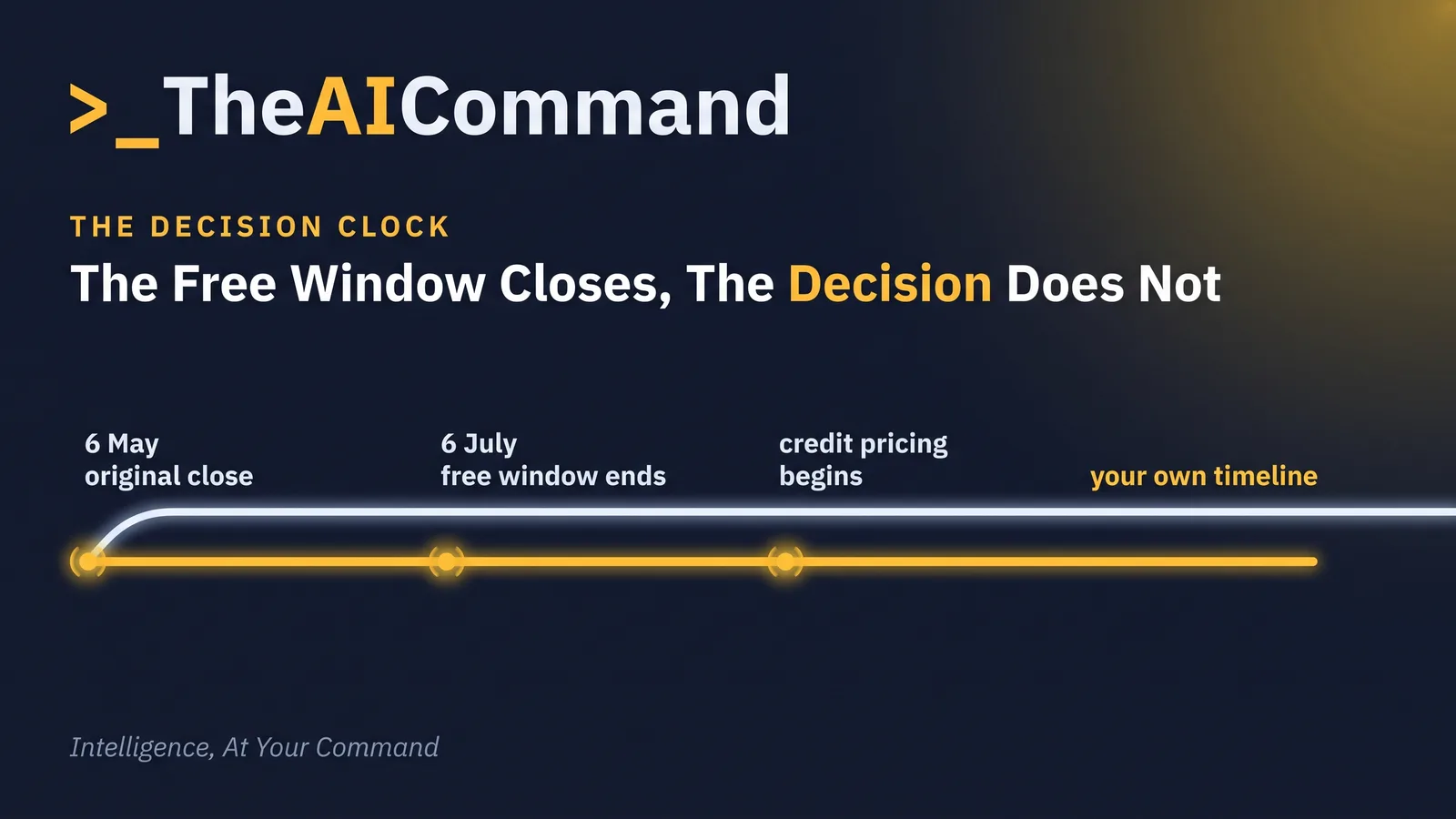
On pricing, the free period was originally due to end on 6 May 2026 and was extended to 6 July when the feature reached general availability. From today, runs invoked inside ChatGPT are billed on credits rather than covered by the flat plan fee. OpenAI's rate card describes credit use as variable, driven by the mix of input, cached input and output tokens, with a typical end-to-end run on its current model consuming somewhere between 5 and 25 credits rather than a fixed per-run price. One nuance matters for the decision: OpenAI has indicated that runs invoked outside ChatGPT, such as an agent responding inside a Slack channel, remain in free preview for now. So "the free window closes" is true, but it closes unevenly. That unevenness is itself a reason not to treat today as a clean buy-or-lose moment.
Why does a deadline distort the decision?
The reason a free window is such an effective prompt is that it converts an open-ended choice into a loss. Left alone, "should we adopt this" is a calm question a leader can sit with. Attached to a deadline, it becomes "are we about to miss out," and loss aversion does the rest. The team starts optimising to avoid the feeling of having left value on the table, rather than to make the decision that is right for the work.
There is an asymmetry hiding in that pressure. If you adopt team-wide today to stay inside the free window and the fit turns out to be wrong, you have already connected the agents to your systems, trained people on them, and shaped a workflow around them. Unwinding that is expensive and visible. If instead you wait, and it turns out the tool was worth standardising on, the cost is simply that you pay for it a little later, on terms you chose. The downside of deciding too fast is structural and hard to reverse. The downside of deciding too slow is a line item. A leader who feels those two costs as equivalent has been successfully anchored by the deadline.
None of this is an argument against the tool. Workspace agents may be exactly right for a given team. It is an argument against letting the vendor's pricing calendar stand in for your own judgement about readiness. The deadline is real. It is just not evidence about your team.
What three criteria should actually drive the decision?
Strip the deadline away and a team-wide adoption decision comes down to three questions. Ask them in this order, because each one can stop the decision before you spend effort on the next.
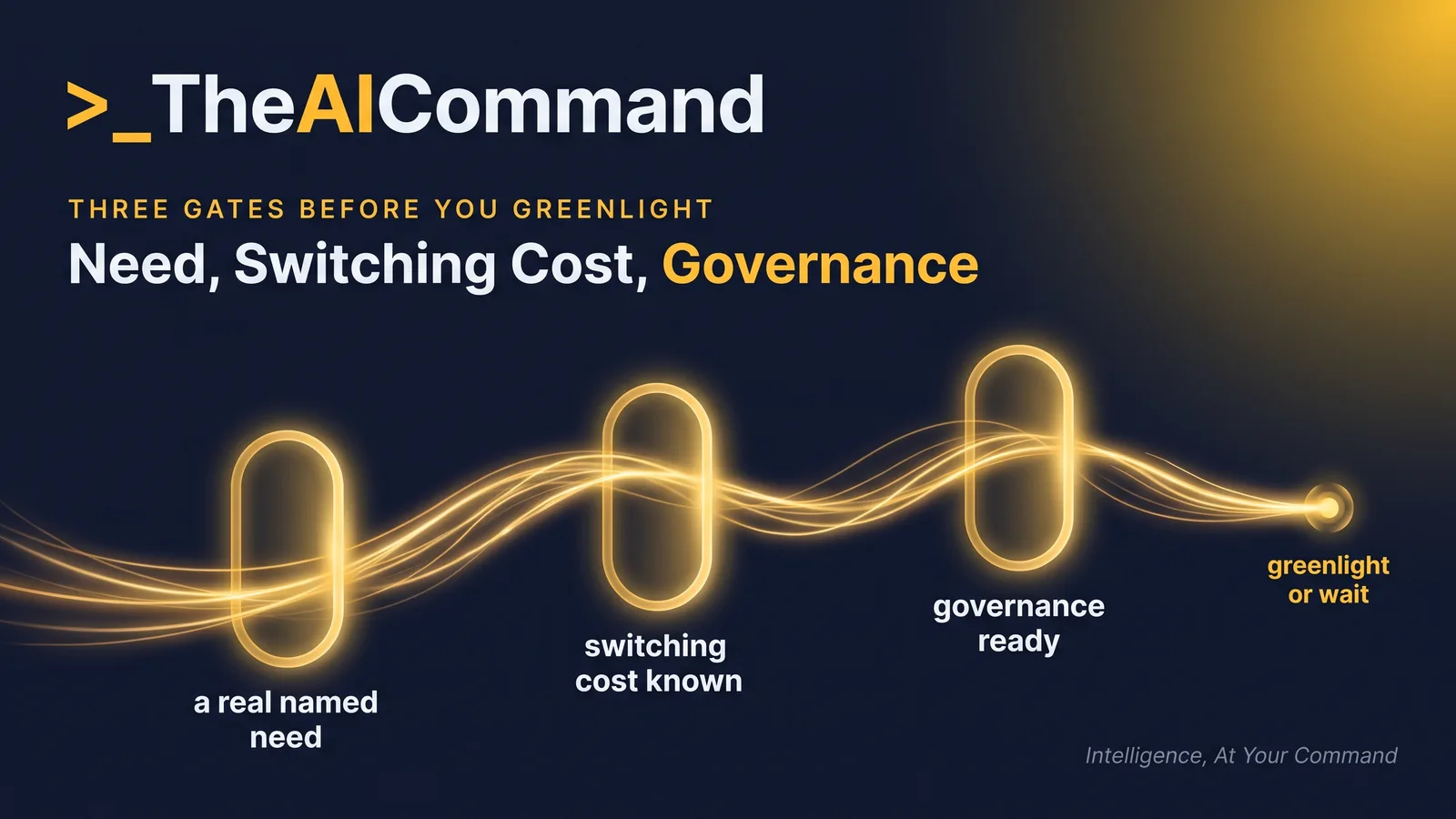
1. Is there a real, named need, or is this fear of missing out. A genuine need looks like a specific, recurring task that a shared agent would measurably improve, named by the people who do it, not a general sense that the team should be "using AI more." If you cannot name the workflow, the frequency and the person who owns it, you do not have a need yet. You have a tool looking for a job, and a deadline making it feel urgent. The Anthropic Economic Index research on how people actually delegate to AI is a useful reality check here: the value shows up where a real task is handed over deliberately, not where a capability is switched on broadly and hopefully.
2. What is the switching cost you are taking on. Standardising on a workspace agent platform is not a light commitment. The connectors to Slack, Salesforce and Drive, the agents your people build, the workflows that grow around them, and the deprecation of the old custom GPT standard all raise the cost of changing your mind later. That is not a reason to avoid it. It is a reason to know the number before you commit, so the decision is made with eyes open rather than discovered at the next renewal.
3. Is your data governance ready. A workspace agent that can reach Google Drive, a CRM or an HR system is a data-handling decision wearing a productivity badge. Before it goes team-wide, someone has to own which connectors are allowed, who may build and run agents, and how agent activity is monitored and stopped if it misbehaves. OpenAI provides the controls for this: admins can set role-based rules for who runs, builds, publishes and connects agents, and a compliance interface gives visibility into every agent's configuration and runs, with the ability to suspend one. Controls existing is not the same as controls being configured. If a connector could touch real customer or employee data before those rules are set, you are not ready, and a deadline does not change that.
Do this Monday
A greenlight decision does not need a committee. It needs one focused sitting with the right people and a bias toward writing the answer down.
- Name the candidate workflow. In one sentence, write the specific recurring task a shared agent would take on, who owns it, and how often it runs. If you cannot write that sentence, stop here and decide not to adopt team-wide yet.
- Size the pilot honestly. Identify the smallest group that could genuinely test the workflow, usually three to five people, not the whole team. A pilot is how you buy evidence without buying the switching cost.
- Run the readiness self-assessment. Use the first prompt below to pressure-test whether the need is real or deadline-driven, and surface the governance gaps before they surface you.
- Map the switching cost. Use the second prompt to list what you would have to unwind if you left the platform in a year, and put a rough time and money figure next to it.
- Confirm the governance owner. Name the person accountable for connectors, build and run permissions, and monitoring. If that person is not identified, the decision is not ready regardless of the date.
- Decide, and write down why. Greenlight the pilot, greenlight team-wide, or decline for now, and record the one reason that drove it. If the reason is "the free window closes today," delete it and find a real one.
- Set the review date. Whatever you decide, put a date on the calendar to revisit it with the pilot's evidence in hand. The point is to move the real decision to a moment when you have information, not pressure.
Two prompts to run first
These are working prompts. Paste them into ChatGPT, Claude or an equivalent, fill the placeholders, and treat the output as a structured draft for a human decision, never the decision itself.
Before you greenlight: a readiness checklist
Run this list before any team-wide switch is flipped. It is deliberately about governance and fit, not features, because the features are the easy part.
- A specific recurring workflow is named, with an owner and a frequency, not a general aspiration to use AI more.
- The decision has been made without the deadline in the room: you can state the reason to adopt without mentioning the free window.
- A named person owns admin control: who may build, run, publish and connect agents.
- The allowed connectors are listed, and any connector reaching customer or employee data is either excluded or explicitly signed off.
- You can monitor agent activity and suspend an agent that misbehaves, and someone knows how.
- The switching cost has a rough figure next to it, so lock-in is a known quantity rather than a future surprise.
- There is a pilot group and a review date, so the team-wide call is made on evidence, not on the calendar.
- If any line above is unchecked, the answer today is pilot or wait, not team-wide adoption.
A worked example
Take [OPS_LEAD], who runs a twenty-person operations team at a mid-sized services firm. Two of their people have been building workspace agents through the free window, one that drafts weekly client status reports from a project system, another that triages a shared inbox. The reports agent is genuinely good. This morning the free window is closing, and there is a quiet expectation that [OPS_LEAD] will roll it out to the whole team today to stay ahead of the cost.
Working the three questions changes the shape of the decision. The need is real for the reports workflow, named and owned, so that one clears the first bar. The inbox triage agent, on inspection, is a solution nobody actually asked for, so it drops out. On switching cost, the reports agent connects to the core project system and a client drive, which [OPS_LEAD] marks as moderate lock-in worth accepting for a workflow this valuable. On governance, the gap appears: the client drive holds material the firm has confidentiality obligations over, and no one has decided who is allowed to connect an agent to it. That is enough to stop the team-wide switch today.
So [OPS_LEAD] greenlights the reports agent as a five-person pilot, names themselves the connector owner, excludes the client drive until the confidentiality question is answered, and books a review in three weeks. The free window closes in the meantime, and the pilot's runs move onto credits, which turns out to cost less in a month than one afternoon of the team's time. What [OPS_LEAD] avoided was not the cost. It was rolling a tool with an unresolved data question across twenty people because a vendor's calendar said today.
That is the leadership move this moment asks for. Not a reflexive yes to stay inside a free window, and not a reflexive no to anything new. A decision made on whether the need is real, the switching cost is known, and the governance is ready, with the vendor's deadline named for what it is: their fact, not your criterion. Let the window close if it has to. The decision was never really about the window.
Bottom line
A vendor's free-window deadline is information about their pricing calendar, not evidence that your team is ready. Greenlight on a real named need, a known switching cost and confirmed governance readiness, and if any of those is unresolved, run a pilot or wait. Let the window close if it has to.
Do this Monday:
- Name the specific recurring workflow, its owner and how often it runs; if you cannot, do not adopt team-wide yet.
- Run the readiness self-assessment prompt to test whether the need is real or deadline-driven.
- Map the switching cost and put a rough time and money figure next to it.
- Name the person accountable for connectors, build and run permissions, and monitoring.
- Decide and write down the reason; if it is "the free window closes today," find a real one.
TheAICommand. Intelligence, At Your Command.