
OpenAI previewed GPT-5.6, its strongest model family yet, but at the US government's request it launched to a small group of vetted partners only, not to the public. OpenAI just shipped its best model. You cannot use it.
On 26 June, OpenAI previewed GPT-5.6, a new family of three models it calls its strongest yet: Sol, the flagship; Terra, a balanced model OpenAI says matches GPT-5.5 at half the cost; and Luna, the fast and cheap option. The capability headlines are doing the rounds. The part that matters for regulated work in Australia is the sentence most coverage buried: at the US government's request, almost nobody can use these models yet.
What is GPT-5.6 Sol and what actually happened?
GPT-5.6 is real and, on OpenAI's own account, a meaningful step up. There is a new naming system, where the number marks the generation and the names mark durable capability tiers that advance on their own cadence. There are new reasoning controls, a max effort setting for the hardest problems and an ultra mode that spins up subagents. The pricing is published: Sol at $5 input and $30 output per million tokens, Terra at $2.50 and $15, Luna at $1 and $6.
Then comes the catch. In OpenAI's words, "we plan to make GPT-5.6 Sol, Terra, and Luna generally available in the coming weeks. As part of our ongoing engagement with the U.S. government, we previewed our plans and the models' capabilities ahead of today's launch. At their request, we are starting with a limited preview for a small group of trusted partners whose participation has been shared with the government." During the preview the models are reachable only through the API and Codex, by that select group. OpenAI is plainly uncomfortable with it, adding that it does not believe "this kind of government access process should become the long-term default" because it "keeps the best tools from users, developers, enterprises, cyber defenders, and global partners who need them."
The reason for the gate is in the GPT-5.6 Preview System Card. Under OpenAI's Preparedness Framework, all three models are rated High capability in both Cybersecurity and Biological and Chemical risk. Sol is OpenAI's most capable cyber model yet, although it "does not cross the Cyber Critical threshold" and is, in OpenAI's framing, better at helping people find and fix vulnerabilities than at running end-to-end attacks. High capability is exactly what a government takes an interest in, and that interest now sits in the release path.
What does the GPT-5.6 gate actually mean?
This is the second time in a month that a US lab's most capable model has been put behind a government gate. Two weeks ago, a US export-control directive forced Anthropic to disable Fable 5 and Mythos 5 for every foreign national, inside or outside the United States, and Anthropic switched them off for all customers to comply. Now OpenAI's flagship launches under a government-shared, partner-only preview. Two different mechanisms, an export control and a staged release, pointing at the same new fact: the US government is now a gate on who gets the frontier.
For two years the constraint on using the best model was money and engineering. You could always buy access if you could justify the cost. That assumption is no longer safe. The most capable model can now be delayed, restricted, or in Anthropic's case switched off entirely, by a policy decision made in another country, between one release and the next.

What does GPT-5.6's gated launch mean in Australia?
Australians are not bystanders to this. When the US directive landed on Anthropic, the people it cut off were foreign nationals, which in Sydney and Melbourne means you. The same logic could apply to any future restriction. So treat frontier-model access the way you treat any other dependency you do not control: assume it can change, and have a plan for when it does.
That has three practical edges. First, do not build a workflow, a business case or a board promise around GPT-5.6 until you can run it on your own work. A limited preview to a vetted few is not a product you can validate, govern, or rely on. Second, name a fallback for anything that matters. If a critical process leans on one lab's best model, decide now what you switch to if access is gated or pulled, and make sure that fallback is something you can reach. This is the same resilience question APRA-regulated firms already have to answer about any material service, applied to the model itself. If guaranteed access weighs more than peak capability for your use case, open-weight models you can download and run yourself are the other lever, and a government cannot switch off a model already sitting on your infrastructure.
Third, mind the capability the gate is about. These models are rated High in cybersecurity, and Australian regulators are already alert to it: ASIC has told the firms it oversees that frontier AI raises the cyber threat level and to lift their defences accordingly. The same capability that helps your security team find and patch vulnerabilities helps an attacker too. That cuts both ways, and it is worth a line in your risk register either way.
The hype check
The benchmarks are doing a lot of work in the coverage, and they are all OpenAI's own, run on a preview, and not independently verified. The claim that Sol is "competitive with Mythos Preview using only ~1/3 of the output tokens" is a vendor figure on a vendor benchmark, and OpenAI itself says it will only "share an expanded suite of evaluation results" once the model is broadly available. "Generally available in the coming weeks" is a plan, not a date. And because the preview is closed, you cannot test any of it against your own tasks yet. Read the launch with that in mind: a strong model, on the maker's evidence, behind a wall.
What to do this week
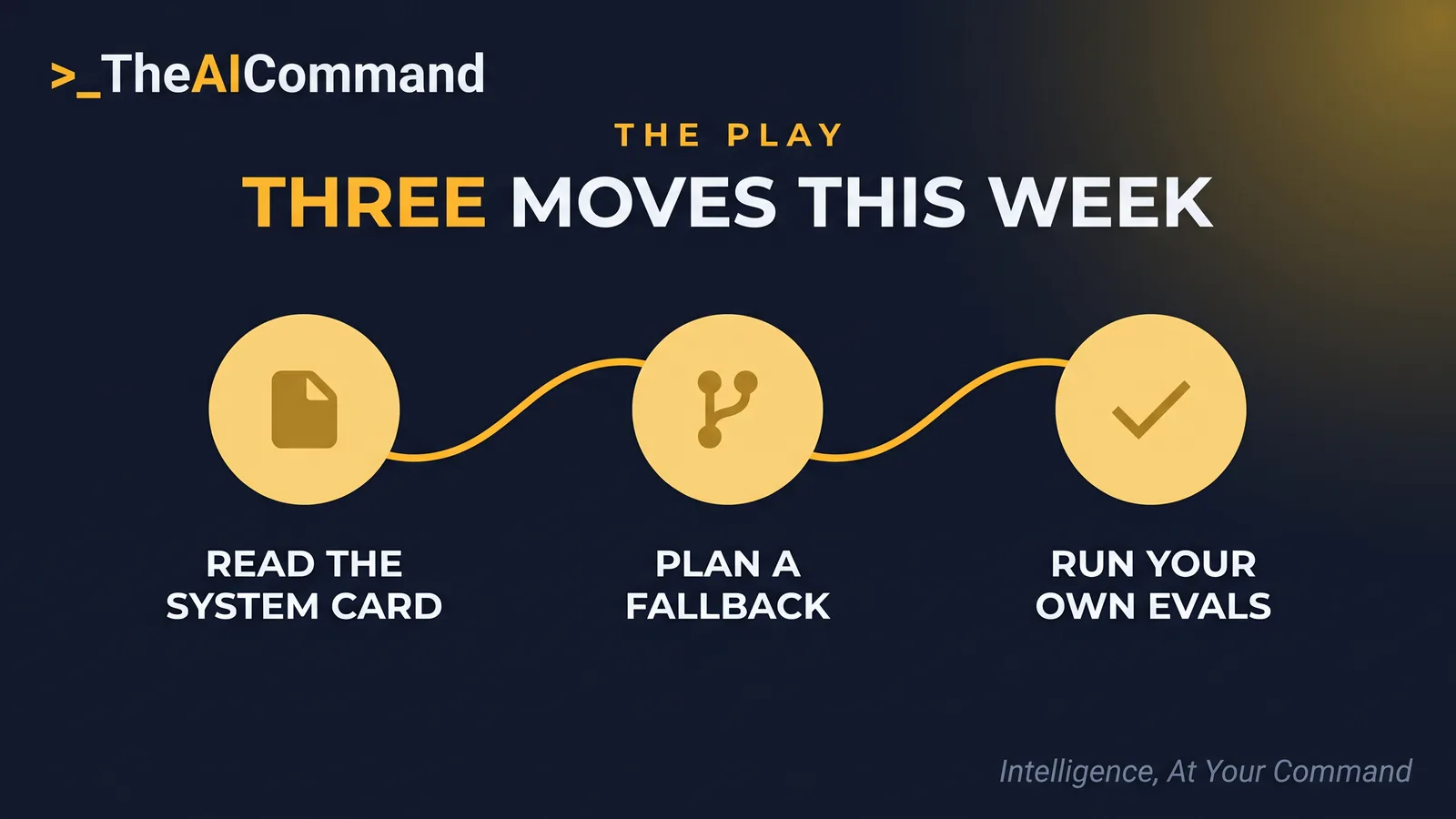
None of this needs a project. It needs three moves.
- Read the system card, not the launch thread. The card tells you the capability ratings, the safeguards and the known limits in OpenAI's own words. That is the document a practitioner uses to separate signal from hype, and it is free to read today even though the model is not.
- Put the assumption in writing. Add one line to your AI plan: frontier access is a policy variable, not a given. Name the fallback model for anything you cannot afford to lose, and make sure you can actually reach it.
- When it opens, treat it as new. A model that becomes generally available in a few weeks does not inherit GPT-5.5's approval. Re-run your own evaluation on your own work, and re-check what data it sees and who owns the decisions it informs, before you let it near anything that matters.
The coverage of GPT-5.6 will be about benchmarks, naming and who has the smartest model this month. The durable lesson is quieter. The frontier is now gated by policy as much as by capability, the gate can move between one model and the next, and the people most exposed to it are exactly the foreign nationals reading this from Australia. Plan for access you might not get, and read the document that tells you what is coming rather than the thread that tells you to be excited.
Bottom line
For the second time in a month a US lab's most capable model launched behind a government gate, and the people most exposed are exactly the foreign nationals reading this from Australia. Frontier access is now a policy variable, so plan for access you might not get rather than architecting a workflow, a business case or a board promise around a model you cannot yet validate or rely on.
Do this Monday:
- Read the GPT-5.6 Preview System Card, not the launch thread, for the capability ratings and known limits.
- Add one line to your AI plan: frontier access is a policy variable, not a given.
- Name a fallback model for anything you cannot afford to lose, and confirm you can actually reach it.
- Note the High cybersecurity rating in your risk register, since the same capability helps defenders and attackers.
- When the model opens broadly, treat it as new and re-run your own evaluation before you rely on it.
References
- OpenAI, Previewing GPT-5.6 Sol: a next-generation model, 26 June 2026. https://openai.com/index/previewing-gpt-5-6-sol/
- OpenAI, GPT-5.6 Preview System Card, 26 June 2026. https://deploymentsafety.openai.com/gpt-5-6-preview
- Anthropic, Statement on the US government directive to suspend access to Fable 5 and Mythos 5, 12 June 2026. https://www.anthropic.com/news/fable-mythos-access
TheAICommand. Intelligence, At Your Command.