
Claude Fable 5 is Anthropic's first publicly available Mythos-class model, released on 9 June 2026, and it ships with three conditions that matter as much as its capability: a silent classifier reroute, mandatory 30-day data retention, and a 23 June billing switch.
The first Mythos-class model is public. Read the conditions.
Anthropic released Claude Fable 5 on 9 June, and the capability story is genuine: frontier-grade performance, on general release, at a price ordinary teams can reach. The more useful story for anyone who owns a third-party AI assessment sits in the terms of access. Three of them. A safety classifier that silently reroutes certain requests to an older model. A mandatory 30-day data retention policy that overrides existing zero-retention agreements. And a 23 June billing change that pulls the model out of subscription plans and onto usage credits. This piece works through what the capability changes, then what the conditions require.
What is Claude Fable 5, and what did Anthropic ship?
On 9 June 2026, Anthropic released Claude Fable 5, the first publicly available model in its Mythos class, alongside Claude Mythos 5, which remains restricted to pre-approved organisations. The Mythos tier was previously limited to Project Glasswing partners, a group Anthropic expanded by roughly 150 organisations on 2 June. TechCrunch observed that the public release landed days after Anthropic's own warnings about how dangerous the technology is becoming, which tells you the company sees the safety architecture, not the model weights, as what makes general release defensible. 9to5Google's framing captured the positioning: Mythos-class capability that is "safe for general use".
Pricing is US$10 per million input tokens and US$50 per million output tokens for both models. That is double Claude Opus 4.8 and, per Anthropic, less than half the price of Claude Mythos Preview. CNBC reports the model scored more than 10 per cent higher than Opus 4.8 on some benchmarks, with what Anthropic describes as exceptional performance across software engineering, knowledge work, vision and scientific research.
The proof points are unusually concrete for a launch day. Anthropic's announcement says Stripe completed a codebase-wide migration in a day that would otherwise have taken a whole team more than two months, that Fable 5 is the first model to break 90 per cent on Hebbia's core analytics benchmark, and that it posted the highest score on Cognition's FrontierCode evaluation even at medium effort. Trading firm IMC says the model aced its trading-analysis evaluations. Availability is immediate on the Claude API, and Amazon announced general availability on Bedrock the same day, with enterprise security controls and regional data residency options.
What does a model that works for days actually change?
The number worth your attention is not the benchmark delta. It is duration. AWS describes Fable 5 as able to work for days at a time, holding focus across millions of tokens, proactively verifying its own outputs and updating its own skills based on what it learns mid-task.
That shifts the unit of delegation. Most knowledge workers currently hand a model a task: draft this, summarise that, reconcile these. A model that holds course for days takes on a project: migrate this codebase, build this analysis from the raw filings, clear this backlog. The Stripe example is the template. Two months of team effort compressed into a day, not because each step ran faster, but because nothing needed re-briefing between steps.
For managers, supervision inverts. Reviewing each output as it lands stops being possible when the output arrives after three days of unattended work. The control moves to the front: define acceptance criteria before the run, audit the result after it, the way you would manage a contractor rather than a junior at the next desk. Very few AI usage policies currently contemplate a system that works overnight with no human in the room. That gap is now live.
What are the three conditions attached to Claude Fable 5?

Condition one: the classifier fallback. Requests touching cybersecurity exploitation, biology, chemistry or model distillation are automatically rerouted to Claude Opus 4.8. Anthropic's early data shows more than 95 per cent of Fable sessions involve no fallback at all, and an external bug bounty produced no universal jailbreaks across more than 1,000 hours of testing. The governance implication: capability is not uniform across your use cases. A penetration testing function, a biosecurity team or a chemicals research group will sometimes be served a different model than the one procurement assessed, silently. A planned trusted-access program, under which vetted biology researchers get the chemistry and biology safeguards lifted while cyber safeguards remain, confirms the point: these controls are adjustable policy, not fixed properties of the model. Your assessment needs to record the routing behaviour, not just the model name.
Condition two: mandatory retention. All Mythos-class traffic now carries a 30-day data retention period, and it applies even to enterprises with prior zero-retention agreements. Anthropic states the retained data is not used for training, exists solely to defend against novel attacks and reduce false positives, and that all human access is logged. Those are reasonable conditions, plainly disclosed. They are also, for some customers, different from what the contract says. Anyone who negotiated zero retention now has a gap between contract and practice, and that gap is the live compliance issue. More on the Australian dimension below.
Condition three: the billing switch. Fable 5 is included on Pro, Max, Team and seat-based Enterprise plans at no extra cost from 9 to 22 June. From 23 June it requires usage credits, with Anthropic saying it plans to restore subscription access as soon as possible. Read that as a two-week trial window with an unknown long-term cost basis. Any business case built on "it is included in our subscription" expires on 22 June.
Who should care
If you own vendor risk or third-party assessments, the Anthropic entry in your register is now out of date in three places: routing behaviour, retention practice and commercial terms. Updating it is this month's work, not next quarter's.
If you manage a team, duration is the planning question. Work that once justified a project team may now justify a supervised model run, and that conversation goes better when managers start it deliberately rather than discovering an analyst quietly ran a three-day job over the weekend. HR teams who own the acceptable-use policy carry the matching action: the policy needs a clause for unattended runs.
If you work in workers compensation or any claims-handling function, the retention change strengthens a rule that already existed: de-identify before anything enters a prompt. A zero-retention agreement was never a substitute for de-identification. Now it cannot even be cited as one, because the data persists for 30 days regardless.
The Australian angle: contract versus practice
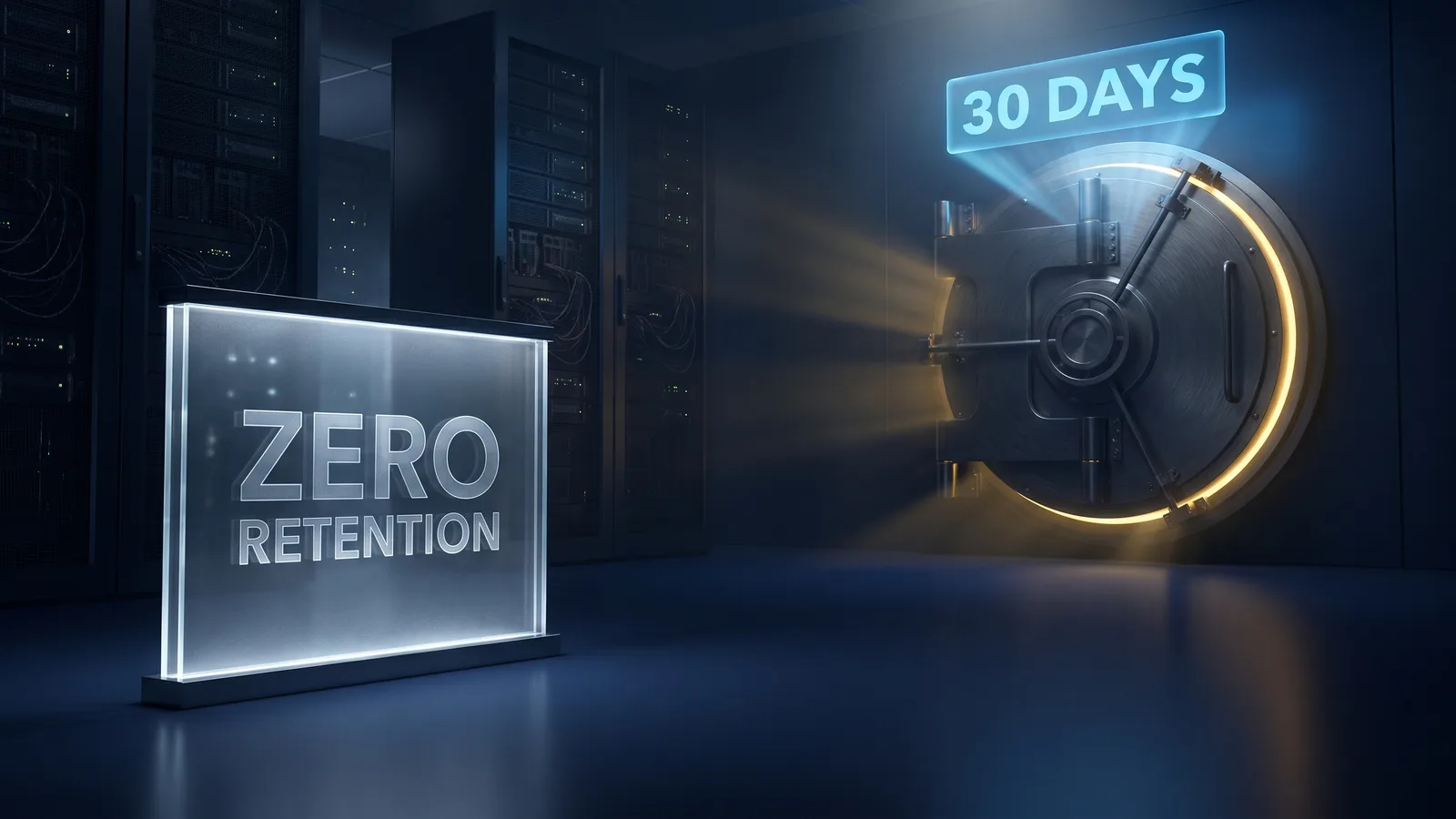
APP 11 of the Privacy Act requires entities to take reasonable steps to secure personal information, and plenty of Australian privacy assessments for Claude deployments record zero data retention as one of those steps. That control description is now inaccurate for Mythos-class traffic. The assessment needs reopening, the data flow needs re-mapping, and the 30-day window needs to appear in your records as the actual practice.
For APRA-regulated entities the obligations stack further. Where Anthropic supports a critical operation, the arrangement sits in CPS 230 material service provider territory, and a unilateral change to data handling is precisely the kind of change the standard expects you to detect and reassess. CPS 234 information security reviews carry the same assumption: your description of where information assets sit, and for how long, is current. A 30-day retention store that did not exist at the last review is a material fact for the next one.
The practical mitigation path for residency is Amazon Bedrock, which offers regional data residency options for Fable 5 workloads, keeping Sydney-region data in region. One caution: residency answers where, not for how long. How the 30-day retention policy operates within a Bedrock arrangement is the specific question to put to AWS before treating Bedrock as the complete answer.
The cost arithmetic, in Australian dollars
At current exchange rates, US$10 and US$50 per million tokens translate to roughly A$15 and A$77. A long-horizon job that runs through 20 million input tokens and 2 million output tokens, a plausible day of autonomous work, costs about US$300, call it A$460. Against the project team it replaces, trivially cheap. Against a subscription that used to include it, a brand-new line item.
The arithmetic that matters is cost per completed task against the human alternative, not the per-token rate card. The timing is awkward either way: 23 June lands in the final week of the Australian financial year, while FY27 budgets are being settled. Team and Enterprise subscribers who adopted Fable 5 inside the included window have days to decide whether the usage-credit version earns a budget line, and finance teams deserve better than discovering the change on the July invoice.
Hype check
The headline capability claims come from Stripe, Hebbia, Cognition and IMC, organisations with mature evaluation harnesses and serious engineering scaffolding. "Works for days" describes what the model does inside that kind of infrastructure. It is not a description of what happens when an unscaffolded team points it at a messy problem with no acceptance criteria. Anthropic also says the model can complete Pokemon FireRed using vision alone, which is a fun demonstration and an irrelevant procurement input.
Note which model the most striking science result belongs to. The drug-design outcome, strong candidates on 9 of 14 protein targets, is Mythos 5, the restricted model, not the one on general release. And the alignment claim, that misaligned behaviour is low and similar to Opus 4.8, is a vendor self-assessment. Treat it the way you treat any vendor self-assessment: a useful input, not independent assurance.
What is undersold is the fallback architecture itself. Silent capability routing may become the industry's standard pattern for shipping frontier models. Third-party assessment templates do not yet have a field for it. They will need one.
What to do this week
- Pull your Anthropic agreement and compare the retention clause against the new policy. If you negotiated zero retention, log the variance, raise it with your vendor manager and reopen the APP 11 assessment. APRA-regulated entities add the CPS 230 and CPS 234 review entries.
- Set your 23 June position now. Nominate which workloads justify usage credits, and tell finance before the included window closes on 22 June, not after the first invoice.
- If Bedrock is your deployment path, put the direct question to AWS: how does the 30-day Mythos-class retention policy operate for Sydney-region Bedrock workloads?
Fable 5 is the most capable model most organisations can now buy. The conditions attached are not hidden, but they are not optional either. Update the assessment first. Then turn it on.
Bottom line
Claude Fable 5 puts frontier capability on general release, but the classifier reroute, mandatory 30-day retention and 23 June billing switch each land in your third-party AI assessment. The retention change is the live compliance item: it overrides prior zero-retention agreements, so any zero-retention control description is now inaccurate. Update the assessment before you turn the model on.
Do this Monday:
- Pull your Anthropic agreement, compare the retention clause against the new policy, and log any zero-retention variance while reopening the APP 11 assessment.
- If you are APRA-regulated, add the CPS 230 material service provider and CPS 234 information security review entries.
- Set your 23 June billing position and tell finance before the included window closes on 22 June.
- If Bedrock is your deployment path, ask AWS how the 30-day retention operates for Sydney-region workloads.
- Record the classifier routing behaviour in the assessment, not just the model name.
General information only. Not legal, compliance, financial, or professional advice.
TheAICommand. Intelligence, At Your Command.