
Google promised its flagship Gemini 3.5 Pro would ship in June 2026. It is now the middle of July, and the model still is not generally available. In a market that treats launch velocity as proof of leadership, a lab publicly missing its own date, more than once, over quality it will not sign off, is the signal worth reading. A model that did not ship this month said something. The trick is hearing what.
For an Australian team weighing whether to move real work onto the newest model, the delay is not gossip about Google. It is information. It tells you how a serious lab behaves when a model is not ready, and it is a live test of whether your own buying process is disciplined enough to wait for its own evidence rather than a vendor's calendar.
What Google promised, and what happened
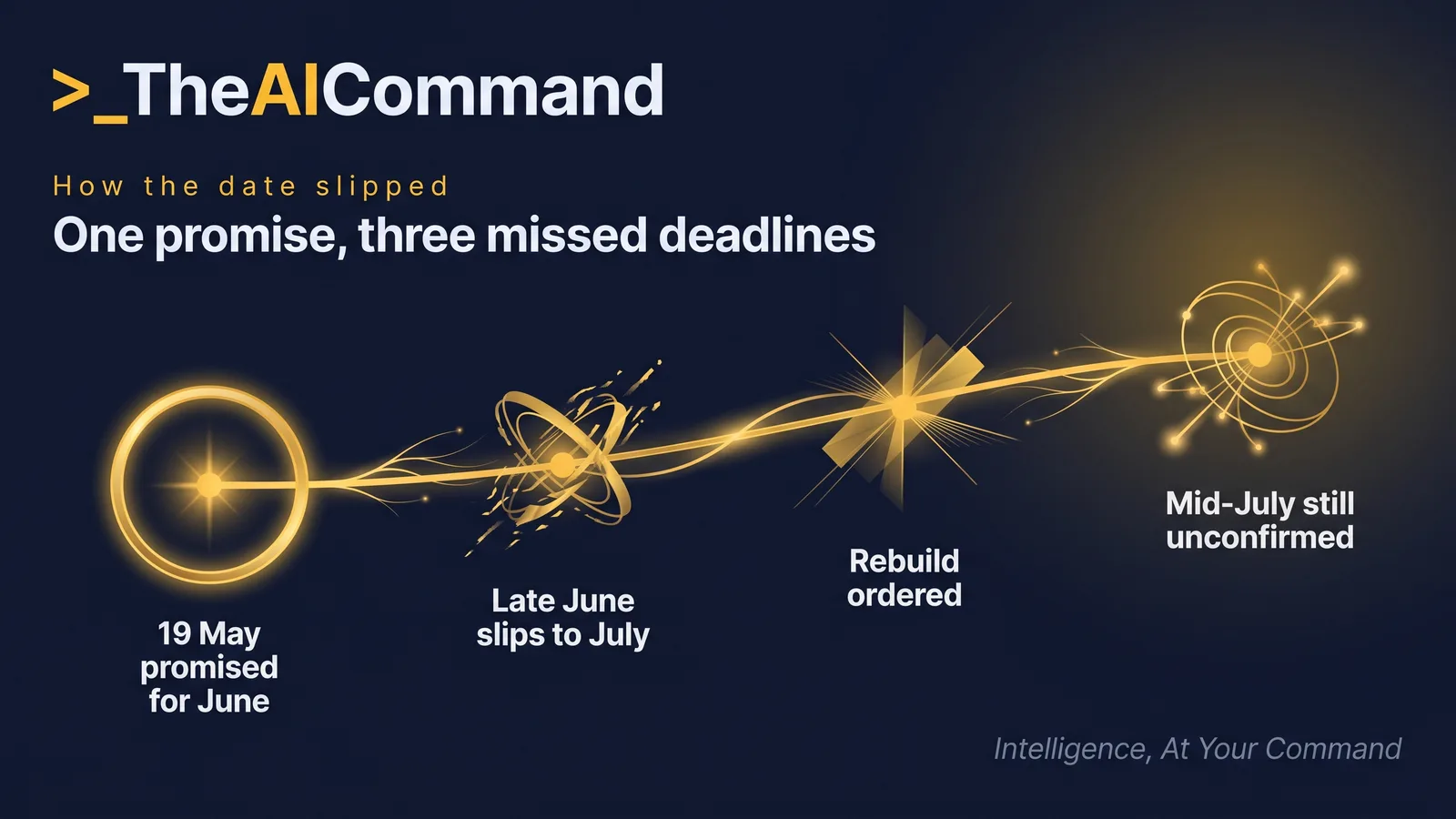
At Google I/O on 19 May 2026, Gemini 3.5 Pro was unveiled with a headline two-million-token context window and a "Deep Think" reasoning mode, and flagged for general availability the following month. This site covered the event at the time, noting the flagship was "coming next month". June was the promise, made from the main stage.
June came and went. By late June the target had slipped to July, with the model held in a limited enterprise preview on Google's Vertex AI platform rather than released to everyone. According to reporting across the tech press, the first slip was attributed to quality refinements after early enterprise testing: token efficiency below where Google wanted it, coding performance short of flagship standard, and long, multi-step reasoning that did not clear the bar set on stage. A second, larger delay reportedly followed a decision to rebuild the model on new foundations, after Google concluded that some failures, in recursive tool use and complex structured output, could not be fixed by fine-tuning alone.
By mid-July the rebuilt model had reportedly missed a third internal deadline, still short of the reliability standard Google set for itself against OpenAI's GPT-5.6. As this piece publishes, general availability remains unconfirmed, and so do the headline specifications. Google has not issued an official post-mortem, so the reasons above come from reporting, not from the company. What is not in dispute is the plain fact anyone can check: the date was promised, and it passed.
The cost has not been only technical. Alphabet's share price fell sharply in late June as investors absorbed the delay alongside reports of senior researcher departures, a reminder that a missed model date now moves real money. That is the drama. The useful part is quieter.
Why the missed date is the signal, not the noise
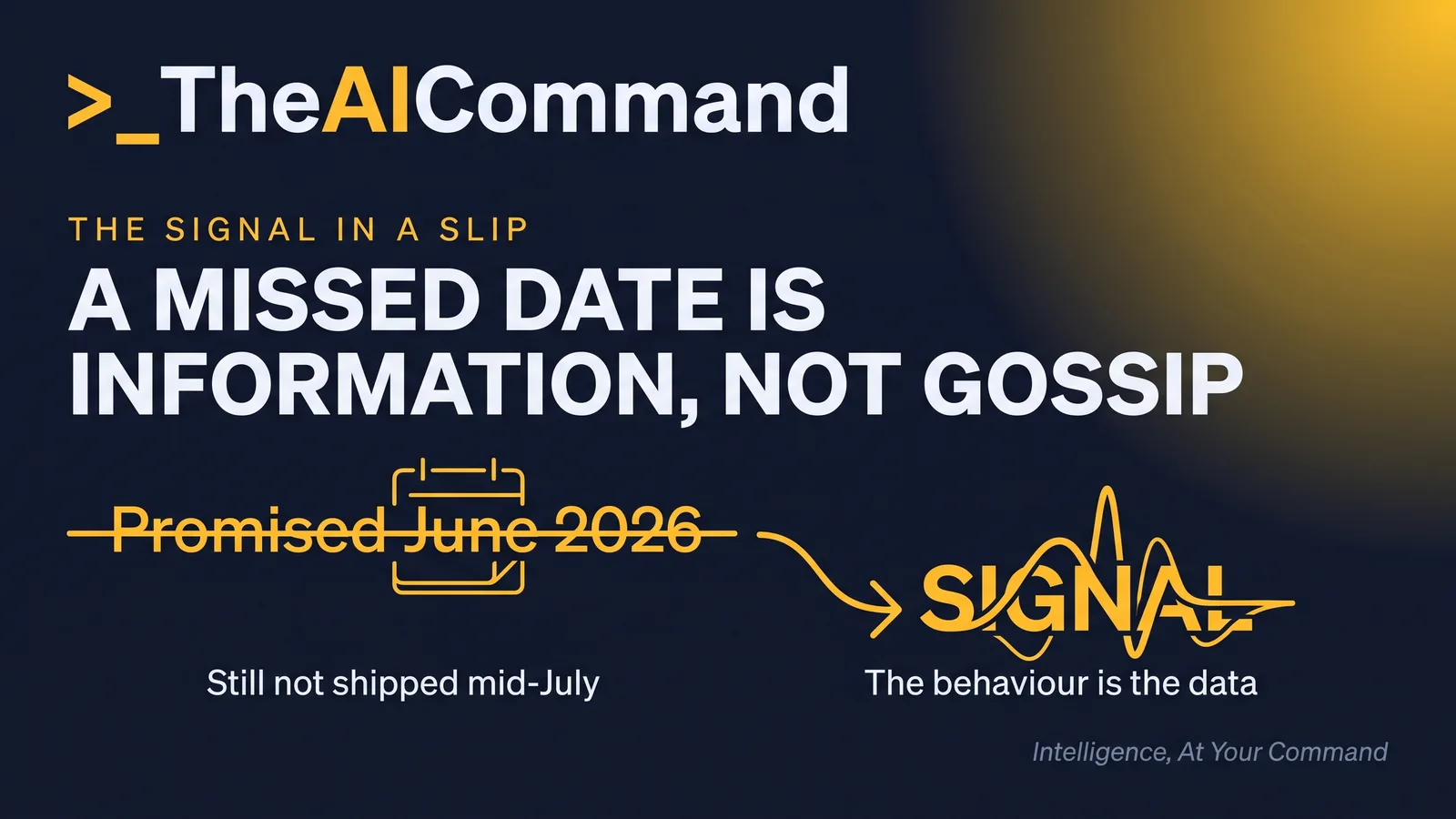
Here is the counter-intuitive read. A lab that ships a flagship it is not happy with, purely to hold a date, is telling you it will let a deadline override quality. A lab that absorbs the delay, the market punishment and the public embarrassment rather than ship something that hallucinates too often is telling you the opposite. Neither is automatically the safer vendor, but the behaviour is data, and it is the kind of data a leaderboard number will never hand you.
This site has argued before that public benchmarks and launch demos are not procurement evidence. The missed date is the same argument from the other side. If a leaderboard score cannot tell you a model is ready for your work, then a launch date cannot tell you either. The release calendar is a marketing artefact. Your evaluation on your own tasks is the only thing that should move your money, whether the vendor is early, on time or four weeks late.
There is a trap at each end. The fear-of-missing-out trap says adopt the new model the moment it lands, because everyone else will. The wait-and-see trap says freeze every decision until the delayed model finally ships, as if your current tool stopped working the day Google slipped. Both hand your timing to the vendor. The discipline is to decouple your decision from the vendor's calendar completely.
What a disciplined buyer does instead
Consider a de-identified example. A mid-sized Australian financial services team runs contract summarisation on a current model and is tempted to switch to Gemini 3.5 Pro the day it ships, on the strength of the two-million-token context window promised at I/O. The disciplined move is to ignore the launch and ask one question: does the new model do this specific job, on our real documents, measurably better than what we run today? That question has the same answer whether the model shipped in June or slips again to August.
To answer it, hold a small, fixed set of your own real tasks, de-identified, and run every candidate model through the identical set. A prompt like this turns a launch into an evaluation rather than an event:
Run that block, unchanged, against your incumbent model and each candidate. Score the outputs against a rubric your team agrees in advance, accuracy, completeness, hallucination rate and format adherence, not against your gut on the day the model trends.
When the pressure to adopt on the release date is coming from inside your own organisation, put the decision in writing before you commit budget:
The memo makes the release date irrelevant on purpose. It forces the decision back onto evidence you generated, and it leaves a record a risk or audit function can read later.

Do this Monday
- Write down the one or two tasks you would actually move to a new model. If you cannot name them, you are not ready to switch, and no launch changes that.
- Build a small evaluation set from those tasks, de-identified, and freeze it so every model faces the same questions.
- Run your current model through the set now and record the scores. That is your baseline, and most teams have never measured it.
- Add each candidate model to the same set as it becomes available, using the evaluation prompt above, unchanged.
- Score against the rubric you agreed in advance, not against the demo or the benchmark.
- Decide with the memo, and name the trigger, a score threshold met or a governance gap closed, that would flip the call.
- Diarise a re-test after any vendor update, because a delayed model that finally ships is still an unproven model on your work.
A buyer's patience checklist
- The decision names a specific task and a measured gap, not a vague upgrade.
- The evaluation ran on your own de-identified work, not the vendor's demo.
- You hold your incumbent model's baseline score, so "better" means a number.
- Governance readiness, data handling, admin ownership and where the model runs, is signed off separately from raw performance.
- The plan survives the model arriving a month early or three months late without changing.
- A named person owns the re-test after the next vendor update.
The honest read
Do not read Google's delay as proof the model is bad, or its rivals as proof theirs are good. A slipped date is not a verdict on the finished product, and the reporting behind the specific reasons is exactly that, reporting, not a company statement. Equally, do not let the launch, whenever it lands, do your thinking for you. The lasting lesson is smaller and more useful than the drama: the release calendar belongs to the vendor, and your decision does not have to. A team that can wait for its own evidence, and move on that evidence rather than a date, is the team that will not be caught out the next time a lab ships late, or the next time one ships too soon.
Bottom line
A missed release date is information, not gossip. Google held its flagship back rather than ship something it would not sign off, and that behaviour tells a buyer more than any leaderboard score will. The release calendar belongs to the vendor, so the only thing that should move your money is evidence from your own de-identified work, scored against a rubric your team agreed in advance. Adopting on launch day hands your timing to a marketing calendar, and freezing every decision until a delayed model finally ships hands it over just as completely. Name the task, hold the baseline, write the memo, and the vendor's dates stop being your problem.
TheAICommand. Intelligence, At Your Command.